Showing posts with label Who said that?. Show all posts

Saturday, February 6, 2016

Money is like muck, not good unless it be spread

This aphorism is attributed to King James I of England / VI of Scotland.  The attribution may be false but it's contained in a collection described as a “Royal Chain of Golden Sentences” published in 1650 (25 years after James’s death). This was during the English civil war, which may be significant.

Francis Bacon (1561 – 1626)
The true originator may be the English philosopher and scientist Francis Bacon who in 1625 wrote a piece discussing statecraft titled “Of Seditions and Troubles”.

Above all things, good Policie is to be used, that the Treasure and Moneyes, in a State, be not gathered into few Hands. For otherwise, a State may have a great Stock, and yet starve. And Money is like Muck, not good except it be spread. This is done, chiefly, by suppressing, or at the least, keeping a strait Hand, upon the Devouring Trades of Usurie, Ingrossing, great Pasturages, and the like.

In the same year Bacon attributed a similar saying to a Mr. Bettenham, including the pleasing image of money stinking when kept in a heap instead of being spread. [1]
 

Mr. Bettenham vsed to say; That Riches were like Mucke: When it lay, vpon an heape, it gaue but a stench, and ill odour; but when it was spread vpon the ground, then it was cause of much fruit.

All this you can find in the Quote Investigator.

It started with someone writing in to ask for the origin of a saying of the British entrepreneur Richard Branson who used the image of money stinking when it's in a pile on his website: “If you let money pile up, it starts to stink. But if you spread it around then it can do a lot of good.”  


Francis Bacon by the bye was the first to make the cogent observation that the modern world was distinguished from the ancient one by the three key inventions of gunpowder, printing, and the magnetic compass. All of which, unbeknownst to him, came from China, a fact unearthed by Joseph Needham in the 20th century, see my essay The day I met a famous man.

My closing thought is to wonder if the Levellers used Bacon's saying that money stinks in a pile in their pamphlets, and if the attribution to James I (by a royalist, clearly) was intended to draw the sting out of it. Pure speculation on my part, I've googled in vain to find any connection. 


A pamphlet by Gerard Winstanley printed in 1649

[1] “Apophthegmes New and Old” (1625) (apophthegme being French for aphorism).

Wednesday, September 25, 2013

Pascal and the writing of short letters


Who said : I didn’t have time to write a short letter, so I wrote a long one instead.

Dr Johnson? Churchill? Cicero? Mark Twain?

Pascal said it, Churchill quoted it, Woodrow Wilson bettered it
Until today I should unhesitatingly have said Winston Churchill, since this is what Mr Dumbreck, my English teacher when I was 12, told us. But it turns out that though Churchill was indeed fond of quoting it, he gave the credit where it is due, namely Blaise Pascal, who in 1657 wrote:

Je n'ai fait celle-ci plus longue que parce que je n'ai pas eu le loisir de la faire plus courte.

I have made this letter long because I don't have the leisure to make it shorter.

Dozens of other writers have expressed similar sentiments over the years, and several have had the saying attributed to them falsely. The Quote Investigator has it all if you want it. The best is Woodrow Wilson who died in 1924. He was asked by a member of his cabinet about the amount of time he spent preparing speeches :

"It depends. If I am to speak ten minutes, I need a week for preparation; if fifteen minutes, three days; if half an hour, two days; if an hour, I am ready now."

I imagine Wilson was familiar with this exchange of telegrams between Mark Twain and his publisher:

NEED 2-PAGE SHORT STORY TWO DAYS, which got the answer: NO CAN DO 2 PAGES TWO DAYS. CAN DO 30 PAGES 2 DAYS. NEED 30 DAYS TO DO 2 PAGES.

As to Blaise Pascal, BBC Radio 4's In Our Time has just kicked off its new season with an episode on him. I've already listened to it twice. And for more on Pascal see Man, the feeblest thing in nature.

References
Pascal: Lettres Provinciales (1657) no 16. Source: Oxford Dictionary of Quotations.
Woodrow Wilson: Respectfully Quoted: A Dictionary of Quotations edited by Suzy Platt, 1989, page 624.
Mark Twain: Guardian


Friday, March 1, 2013

Who compared apples and ideas? Shaw?


If you have an apple and I have an apple and we exchange apples then you and I will still each have one apple. But if you have an idea and I have an idea and we exchange these ideas, then each of us will have two ideas.

This aphorism should have been uttered by George Bernard Shaw and there's no shortage of websites claiming that it was.  But the excellent Quote Investigator has diligently sought compelling evidence that Shaw really made this remark, and has failed to find any. 

George Bernard Shaw: did he talk of swapping apples?
It seems the earliest quotation conforming to this theme was dated 1917, though dollars were mentioned rather than apples. It came in an advertisement for a magazine called System that was printed in the Chicago Tribune. The ad was titled “The Difference Between Dollars and Ideas”.  You'll find a full discussion by following the above link.

It's like this you see, when I find a good quote, I can't rest easy till I've sourced it. And when my dictionary of quotations doesn't help and I distrust what I'm seeing on the world wide web, that’s where the Quote Investigator comes in handy. It's a blog I can't praise too highly.

On a couple of occasions when stumped for the source of a quote, the Quote Investigator has tracked it down for me and put it on his blog. One was Einstein: “Everyone who is seriously interested in the pursuit of science becomes convinced that a spirit is manifest in the laws of the universe – a spirit vastly superior to man, and one in the face of which our modest powers must seem humble.” The other was Winston Churchill:  “Men occasionally stumble over the truth, but most of them pick themselves up and hurry off as if nothing had happened.” In the event this sort of thing excites you (and I realise it very possibly doesn't) the discussions on both these quotes are worth reading. Follow the links.


Monday, February 13, 2012

Beware of Greeks bearing gifts


I'm writing the story of the Trojan Horse, as part of my collection of children’s stories. Which I hope one day will make me rich. If that occurs I'll let you know.

Meanwhile, what of the proverb “Beware of Greeks bearing gifts”? 

The Trojans drag the wooden horse into their
city - as imagined by Wolfgang Petersen in
his 2004 film epic
Troy. Soon Greek soldiers
climb out and open the gates, and the city falls

The scene you are meant to picture is the beach under the walls of Troy. The Trojans are inspecting an enormous wooden horse and debating what it is, what to do with it, and why after 10 long years the besieging Greek army has suddenly disappeared. Some say the horse is a peace offering, some a gift from the gods, and some a trick.

The priest Laocoön declares “Beware of Greeks bearing gifts”. Although of course he doesn’t, he speaks Latin. For it’s the Latin epic poem The Aeneid which is the source for this story.

Laocoön’s actual words are : Equo no credite Teucri!  Quidiquid id est, timeo Danaos et dona ferentes.

The first part of which means “Place no faith in that horse Trojans! Whatever it is …”. As for the phrase timeo Danaos et dona ferentes, Latin can pack lot of meaning into a few words. Translated literally, this phrase could be “I fear the Greeks even (or perhaps especially) when they come with gifts” or “I fear the Greeks and those who bring gifts”.

The 18th century poet John Dryden, has "Trust not their presents, nor admit the horse." Here's Laocoön’s speech in full, as rendered by Dryden in his 1697 translation.

The saying “Beware of Greeks bearing gifts” has become so embedded in the English language that it’s now hard to think of the Latin translated any other way. What I haven't yet found out is, who first came up with this translation?  The Oxford Dictionary of Quotations, 2004, lists it under Proverbs as “Fear the Greeks bearing gifts”. First found in print late 19th century, but no author given.

What of other modern languages? The only ones I've checked are German and Swedish. Neither has an expression equivalent to “Beware of Greeks bearing gifts”, though both use the expression “Trojan Horse” the same way that English does, to indicate a treacherous, invasive, gift.

Saturday, February 11, 2012

A field full of shallow holes


The immature student seeking the water of knowledge, said the Buddha, will dig a three-foot well here, a three-foot well there, until he has a field full of shallow holes, but no water.

I heard this on the radio, and I thought: Oh dear. Sounds like me. Perhaps I should devote myself to digging just one deep well.

Except that although this feels like a saying of the Buddha, I have it on good, I'm tempted to say unassailable, authority, that it isn't. He should have said it, and for all anyone knows he did, but no such statement has ever been attributed to him.  A pity really.

It seems more likely there's an ancient proverb from India about the desert: if you want to strike water, don’t dig ten wells six feet deep, dig one well sixty feet deep.

Thursday, January 19, 2012

The historian


Man proceeds in the fog. But when he looks back to judge people of the past, he sees no fog on their path. From his present, which was their faraway future, their path looks perfectly clear to him, good visibility all the way. Looking back, he sees the path, he sees the people proceeding, he sees their mistakes, but not the fog ...  and one might wonder: who is more blind? Mayakovsky, who as he wrote his poem on Lenin did not know where Leninism would lead? Or we, who judge him decades later and do not see the fog that enveloped him?

Milan Kundera, born 1929 

I'm afraid I can't vouch for the quote's authenticity but I think it's from his book Testaments Betrayed (1995). Joined the Communist Party of Czechoslovakia while in his teens, was expelled, supported the 1968 Prague Spring. Author of The Unbearable Lightness of Being (1984).

I ought to add that I have read none of these books. Came across the quote in The Irish Catholic. Yes, my secret is out. I read this paper every week. I'm not proud of it. But I feel better for having made a clean breast of it. A longer version appears on the website of the Association of Catholic Priests.

Wikipedia links:
Kundera
Mayakovsky

Thursday, January 12, 2012

Shaw: the unreasonable man


The reasonable man adapts himself to the world: the unreasonable one persists in trying to adapt the world to himself. Therefore, all progress depends on the unreasonable man.

George Bernard Shaw, Man and Superman, 1903

Thursday, September 29, 2011

Getting things by their right names, as the Chinese say

The first step to wisdom, as the Chinese say, is getting things by their right names.  (E O Wilson, Consilience, 1998, p 2)

What do you do about alleged Chinese proverbs? Try to source them and discard them if they prove phoney?


“May you live in interesting times”, the supposed Chinese curse, is often asserted to be phoney, although according to this Wikipedia article the argument isn't all on one side. [But see note.] The fact is, that whether or not it’s ever been a Chinese curse, it’s certainly become an English saying, of which the first use known to the Wikipedia contributor was by Robert F. Kennedy in 1966. Actually the more I think about it, the less plausible it is that living in interesting times is an idiom that can be freely exchanged between Chinese and English.

Which brings us back to The first step to wisdom is getting things by their right names. Well, I like it. So let’s just say that the first step to wisdom, as E O Wilson says the Chinese say, is getting things by their right names, and leave it at that. Let's not concern ourselves with whether it really is ancient Chinese wisdom.


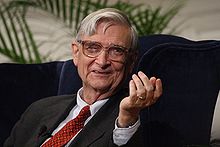
E O Wilson in 2007, age 78
Of course we need to be alive to the possibility that E O Wilson is simply fooling with us. He could have opted for “the start of any philosophical discussion must be correct terminology”, which would have been true but unmemorable. He could have said “The first step to wisdom is getting things by their right names”, which has a zing but might have sounded pretentious. Throwing in “as the Chinese say” may be nothing more than a device for disclaiming wisdom for himself and displacing it to long ago and far away.

I'm told by the way (see this review for example) that were I to read to the end of E O Wilson's book, I may not like it. Be that as it may, to find a pearl on page 2 isn't bad going.

Note added January 2017. The Wikipedia article has recently been amended, and if you follow the link you will find that actually the argument really is all on one side, that is to say, despite being known as "the Chinese curse", the saying is apocryphal, and no actual Chinese source has ever been produced. Moreover it appeared in English in 1936 not 1966.

Thursday, August 11, 2011

Chou En Lai on the French Revolution : Did he say it's too soon to tell?


Nixon with Chou en Lai in February 1972 - taken for all I know in the
walled garden (Encylopedia Britannica)

It is said that Chou En Lai, asked to assess the impact of the French Revolution, replied:

"It's too soon to tell."

Not according to Nixon’s interpreter, the American diplomat Chas Freeman, who has recently spoken about this. But before we see what Freeman had to say, let’s have a look at the story as it’s usually told.

Legend has it that, while preparing Richard Nixon for his historic visit to China in 1972, Henry Kissinger mentioned that Chinese Prime Minister Chou En-Lai was an avid student of French history. During his trip, Nixon met with Chou in the walled garden of the Forbidden City. As they walked slowly around the lily ponds, Nixon remembered Kissinger's comment. To break the ice, he asked Chou what he thought had been the impact of the French revolution on western civilization. Chou En-Lai considered the question for a few moments. Finally, he turned to Nixon and replied, "The impact of the French revolution on western civilization - too early to tell."

It seems this shows up in a few different versions. Sometimes it's said to Kissinger, sometimes, as related above, to Nixon, and sometimes a full twenty years earlier to someone else. So it looks, or looked, like a good guess that Chou En Lai did actually say this, though precisely when, or to whom, isn't clear.

Chou’s answer has become a frequently deployed cliché, used as evidence of Chinese leaders' sage, patient, and far-sighted ways, in contrast to impatient westerners.

But now up pipes Chas Freeman and kills off this cosy anecdote. Here's what he says happened.

Chou and Nixon did indeed converse about events in France. But whilst Nixon’s question referred to the Revolution of 1789, Chou’s reply referred to les évenéments of 1968 – the Paris student riots and sit-ins just three years before.

It seems this all came out at a seminar in Washington (in early June, I surmise) to mark the publication of Kissinger’s book, On China.
Chas Freeman is reported to have said “I distinctly remember the exchange. There was a misunderstanding that was too delicious to invite correction”; also that Chou’s misconstrued comment was “one of those convenient misunderstandings that never gets corrected”. Moreover that this probably occurred over lunch or dinner, during a discussion about revolutions that had succeeded and failed; not in the walled garden.

He said Chou had been confused when asked about the French Revolution and the Paris Commune, since “these were exactly the kinds of terms used by the students to describe what they were up to in 1968 and that is how Chou understood them.”

Just a 300-year interlude

I'm partly sorry this story has been debunked. That the Chinese take a long view of history may be both a cliché and actually true, even if the Nixon/Chou story can no longer be cited as an instance of it.

As an example of short- and long-term historical perspectives, let's note that in the West, China’s emerging economic dominance is surprising and disturbing. To the Chinese on the other hand, it’s wholly unsurprising. Through most of recorded history their country has been the world’s foremost economic power; there’s been a 300-year interlude, that’s all.

As to the effect of the French Revolution, this event brought about the rise of the nation state and was the precursor of the Russian revolution, and the Chinese revolution, and arguably of the First World War (and thereby also the Second World War). Who can say what the long term consequences of all that is? Chou’s answer, the answer we now have to believe he never gave, was quite apposite.

China’s long predominance in world history prompts the question, why did modern science and technology develop in Europe, when China seemed so much better placed to achieve it? It’s known as the Needham Question … but here I'll stop ... more another day.

Source:
Media myth alert - blog by W Joseph Campbell

Subsequent link:
my thoughts on the Needham Question

Thursday, May 26, 2011

Mr. Gandhi what do you think of western civilisation?


I imagine we've all sent or received this postcard at some stage in our lives. But is it true?

Gandhi's famous reply to a reporter's question about western civilisation features in any compendium of Gandhi quotations, but none that I have seen supply the time and place where this encounter is supposed to have occurred.

I think it may be apocryphal. On the other hand, the question would be a perfectly sensible one for a reporter seeking a quote, and the answer is one which I'm sure Gandhi would have been delighted to have thought of, even if he didn’t.  It would have been quite in character, since he is credited with an impish sense of humour.

Western civilisation was a frequent theme in Gandhi’s writing and speeches. He did not hold it in high regard. For example, this from a speech to Young India, 8th September 1920. Speaking of the recently ended First World War he said:

“The last War however has shown, as nothing else has, the Satanic nature of the civilization that dominates Europe today.”

I wonder if the what-do-you-think-of-western-civilisation thing appeared in the 1982 Richard Attenborough film.  I doubt it.  Cliché. 

For language nerds, the joke relies on a sort of pun. It may have a special grammatical name, unknown to me. When the Reporter uses the word civilisation, he uses it as an abstract noun, meaning a society which is city-based. When Mr Gandhi uses the word (and I hope I have this right) he is using it as a gerund, that is a part of the verb "to civilise". So it means an action or process, which instils admirable, or acceptable, norms of behaviour.

Sunday, May 8, 2011

"I will not rejoice in the death of one, not even an enemy"


Martin Luther King:
thought it but didn't say it
Osama bin Laden killed by U.S. special forces. "I mourn the loss of thousands of precious lives, but I will not rejoice in the death of one, not even an enemy. Returning hate for hate multiplies hate, adding deeper darkness to a night already devoid of stars. Darkness cannot drive out darkness: only light can do that. Hate cannot drive out hate: only love can do that."

Last Monday this quote went viral, attributed to Martin Luther King. The attribution is only half right. It seems that “I will not rejoice in the death of one, not even an enemy” are the words of an 24-year old American English teacher currently working in Japan, by the name of Jessica Dovey, who posted these words on Facebook (or somewhere).

Other than the first sentence, the rest of the quote is indeed Martin Luther King, from page 53 of his 1963 collection of sermons entitled Strength to Love.

It’s in a chapter entitled “Loving Your Enemies”, which includes the paragraph:-

“Returning hate for hate multiplies hate, adding deeper darkness to a night already devoid of stars. Darkness cannot drive out darkness; only light can do that. Hate cannot drive out hate; only love can do that. Hate multiplies hate, violence multiplies violence, and toughness multiplies toughness in a descending spiral of destruction. So when Jesus says 'Love your enemies', he is setting forth a profound and ultimately inescapable admonition. Have we not come to such an impasse in the modern world that we must love our enemies – or else? The chain reaction of evil – hate begetting hate, wars producing wars – must be broken, or we shall be plunged into the dark abyss of annihilation.”

As to Jessica’s own words "I mourn the loss of thousands of precious lives, but I will not rejoice in the death of one, not even an enemy”: whereas the words may not be Martin Luther King's, the thought is. In the same book, he wrote this about the drowning of Pharaoh’s soldiers in the crossing of the Red Sea as related in Exodus:-

“The meaning of this story is not found in the drowning of Egyptian soldiers, for no one should rejoice at the death or defeat of a human being.”

A final point.
Jessica Dovey is not to blame for the viral misattribution of the quote in its entirety to MLK. In her original post, the attribution was correct. My guess is that someone else retweeted it and, in the mistaken belief they were correcting an error, moved the position of the quote marks.

Source : a Stanford University blog.


Saturday, March 26, 2011

Did Churchill call democracy a bad form of government?


Much talk of democracy these days plus the occasional mention of Churchill saying it's the worst form of government.  It takes me back to 1967 when I watched a TV serial called Slattery's People. I can be sure of the date because I was 18 and in Trinidad for a year, boarding with a local family, and teaching in a secondary school on VSO.  (Latin and Algebra, since you ask.)  Slattery's People was a weekly American political drama series.  It says here, that the hero was the minority leader in a state legislature, who made it his duty to defend his constituents against the injustices they suffered from government officials, and fought to advance regulations that would end political corruption.

I can’t claim to remember all of that; but what I do remember is the opening voiceover for each episode ...  

"Democracy is a very bad form of government, but I ask you to never to forget it, all the others are far worse".

It seems the original was a Churchill speech in the House of Commons November 11, 1947:-

“Many forms of Government have been tried, and will be tried in this world of sin and woe. No one pretends that democracy is perfect or all-wise. Indeed, it has been said that democracy is the worst form of government except all those other forms that have been tried from time to time.”

That’s not as pithy as “Democracy is a very bad form of government …” which, I've seen it suggested, may have been a Hollywood scriptwriter’s improvement on Churchill’s original. Few people can make such a claim, and hats off if it’s true.

The context was a debate on the Parliament Bill brought forward by the Attlee Labour government.  Churchill was defending the right of the perpetually Tory-controlled House of Lords to enforce a 2-year delay on legislation. The Attlee Bill reduced the period to one year, the purpose being to pre-empt a Lords' delay to nationalising the steel industry. This context takes the shine off the quotation, does it not?   

Tuesday, January 11, 2011

"The first casualty of war is truth"


John Pilger in a justly famous New Statesman article headed “The real first casualty of war” (24 April 2006) wrote “The oldest cliché is that truth is the first casualty of war. I disagree. Journalism is the first casualty. Not only that: it has become a weapon of war, a virulent censorship that goes unrecognised in the United States, Britain and other democracies …”
 

So if it's a cliché, who first said it?

(1) Some say Aeschylus, the Greek tragic dramatist, 525 - 456 BCE. This claim is made by several people on the internet, but none has provided a citation, and I believe the claim to be false. The Wikipedia page of Aeschylus quotes flatly denies it. Moreover a classical scholar informs me that "casualty" is a modern word, which could not be directly translated from ancient Greek.  Also "Aeschylus uses the word for truth very rarely and not that I can find in a context that would translate thus."

(2) Samuel Johnson wrote in the Idler magazine no 30, 1758.  "Among the calamities of war may be justly numbered the diminution of the love of truth, by the falsehoods which interest dictates and credulity encourages."

(3) In 1917 Hiram Johnson (1866-1945) a Progressive Party senator in California reputedly said "The first casualty, when war comes, is truth", referring to the United States entry into World War I.  However I have seen doubt cast on this, and a statement that the saying does not in fact appear in any of Johnson's recorded speeches.  If Hiram Johnson did say these words, had he read Samuel Johnson?  Hiram Johnson died on Aug. 6, 1945, the day the atomic bomb was dropped on Hiroshima. 

(4) Lord Arthur Augustus William Harry Ponsonby (1871 - 1946) was a British politician, writer, and social activist.  In Falsehood in Wartime: Propaganda Lies of the First World War (1928) he wrote "When war is declared, truth is the first casualty.

So, interestingly, we still have not come to who first used the exact phrase "The first casualty of war is truth", or "Truth is the first casualty of war". We can imagine they had read Ponsonby, but we don't know.

Thursday, January 6, 2011

A madman shouting in the marketplace


Dag Hammarskjöld
The madman shouted in the marketplace and no-one stopped to answer him. Thus it was confirmed that his thesis was incontrovertible.

This striking saying was written by Dag Hammarskjöld in 1957. I don't have the original Swedish but I guess it would be "Den galne ropade på torget, men ingen stannade för att svara honom. På det viset syntes att hans tes var oemotsäglig."

I came across the saying in an American blog deploring the Democrat losses in November's mid-term elections.  The blogger writes “The Dems did little to counteract the lies of Fox News, Rush Limbaugh and Glenn Beck and whatever it was they did was ineffective,” and goes on to quote Dag Hammarskjöld and the madman shouting in the marketplace.

The source is Markings, published posthumously in 1963 in Swedish as Vägmärken, which literally means traffic signs.  The book is a sort of personal testament, from which it is clear that Hammarskjöld was motivated by a strong Christian faith.

Dag Hammarskjöld was the second Secretary-General of the United Nations, and his name seemed always on the radio when at the age of 7 or 8 or thereabouts I was becoming dimly aware of world events.

Hammarskjöld was a Swedish diplomat and economist. He served as Secretary-General from April 1953 until his death in a plane crash in September 1961. He is the only person to have been awarded the Nobel Peace Prize posthumously, and the only U.N. Secretary-General to die in office.

There are grounds for suspicion that western intelligence agencies were implicated in the plane crash in which he died.  According to Wikipedia, former US President Harry Truman is reported to have said that "Dag Hammarskjöld was on the point of getting something done when they killed him. Notice that I said, 'when they killed him'."

At issue was the fabulous wealth of the newly independent Congo’s copper reserves, and western fears that Congolese prime minister Patrice Lumumba would nationalise them. Lumumba too was assassinated.

Sunday, November 21, 2010

I dream things that never were and say - Why not?


Serpent : “You see things; and you say Why? But I dream things that never were; and I say Why not?”
  
From Shaw’s play, Back to Methuselah, Act I. The serpent addresses these words to Eve.  John F Kennedy adapted the quote and made it famous in this form:-

Some men see things as they are and say, why?  I dream things that never were and say, why not?

He used it for the first time when he addressed the Dáil on June 28, 1963. His brother Robert used the quote continually during his 1968 campaign for president.  A few weeks ago a reader wrote to the Irish Examiner to say he was with senator Robert Kennedy when he used the quote five days prior to his assassination in Central Valley, California, in May of that year.  Ted Kennedy used it at his brother Robert’s funeral, 8 June 1968. 

I must read Back to Methuselah!  I may get inspiration for my Adam and Eve story.
 

Sunday, November 14, 2010

"Laying it on with a trowel"


Quiz : who originated the expression to lay something on with a trowel? Was it 
A - Shakespeare
B - Dickens
C - Orwell?
 
Answer : Shakespeare. 

In Act 1 scene ii of As You Like It, Celia says “Well said: that was laid on with a trowel.”  But did Shakespeare invent it?  I suppose it may already have been an expression in common use.