Showing posts with label Space exploration. Show all posts

Friday, November 6, 2015

A Dyson sphere, my eye!

The central dot in this image represents a star surrounded by a Dyson ring of solar power collectors, 100 million miles out from a star. Many rings would make a Dyson sphere. Loopy!!
Image via Wikipedia.
When it comes to extraterrestrial life and space colonisation by humans my intuitive response is, this is fantasy stuff, and not worth a second glance.

I'm thinking in particular of the notion that star KIC 8462852 may sport a Dyson sphere. And what, pray, is one of those?  Oh yes, it's a hypothesized artificial structure surrounding a star. A structure the size, say, of Earth’s orbit around the sun, consisting of a shell of solar collectors. The idea being that with this model, all (or at least a significant amount) of a star’s energy would hit a receiving surface where it can be used. The physicist Freeman Dyson speculated that such structures would be necessary for the long-term survival of a technological civilization due to its escalating energy needs.

Madness.
But madness or not serious scientists looking at the data from the recently discovered KIC 8462852 think it's behaving so strangely, that this Dyson sphere conjecture is worth exploring.  Jason Wright, an astronomer from Penn State University, is quoted in The Guardian  “Aliens should always be the very last hypothesis you consider, but this looked like something you would expect an alien civilization to build.”

Even as “the very last hypothesis” this is surely loopy!  … and yet ... as a mere bystander,
who am I to say, no this cannot be?


When I need an image for a space colony I invariably seem to revert to this representation from the Mars One website

Space colonies aren't quite so far out and yet I struggle to take them seriously too. Dr Cameron Smith is someone who’s caught my eye. An archaeologist at Portland State University, he has arresting views on how space-born descendants of explorers would evolve culturally and genetically.  His theme is the biological and cultural dimensions of human space colonisation. 

This will be a process of adaptive evolution, and he thinks evolutionary studies can help plan for its success. He proposes to found a new science that he calls exo-anthropology. He envisages different models of space colonization:-


•    Terrestrially-tethered colonies
•    Independent colonies on other solar system bodies
•    Independent colonies aboard 'closed-system' spacecraft

I recommend listening to an hour-long audio file of a teleconference held last year with scientists from NASA and the University of Texas.  There are slides to accompany his talk, and you can find them on this page. (Look for a pptx file.)

Space colonisation will be a natural continuation of 4 million years of adaptation, he believes.  Against our nature?  No … ever since the human dispersal out of Africa, we’ve always found new places to live. Why would that stop with the atmosphere, he asks?  Plenty of technical reasons maybe, but no reason against space colonisation either philosophically, or evolutionarily. Humans have always perceived new environments and then gone on to colonise them.

All except Antarctica that is. There are some scientific stations,  but where are the colonies, where are the children, huh?  There's the flaw is his scheme surely.  Mars is many times less hospitable than Antarctica.

He says we require a science of extraterrestrial adaptation. It will be an evolutionary transition on a par with our ancestors coming down from the trees.  Humanity has long considered colonising space, and at present we're at the exploration stage, thinking of individuals and how they could survive on Mars. But  as an anthropologist he thinks of groups. Biocultural evolution, co-evolution of genes and culture, that’s what anthropologists study.  Up to now the anthropologists have looked at the present and the past. Cameron Smith wants them to turn their attention to the future.


Dr Cameron Smith, exo-anthropologist
He cites the example of high-altitude societies in the Andes and Tibet. Here genetic mutations allow more efficient blood oxygenation. There's cultural adaptation too, for example in the Andes mothers move down to lower altitude before giving birth. Maybe on Mars there will be a need to give birth in 1g gravity, so, by analogy with practice in the Andes, mothers perhaps will ascend to an orbital station with artificial gravity.

We can expect both beneficial and deleterious mutations to arise off-Earth he says.  Evolution will be driven by selection pressures arising from the different  gas composition, lower atmospheric pressure, and lesser gravity.  All these factors will differ from the Earth conditions that have shaped human embryo development for millions of years.  On Mars we'll see the return of natural selection, big time.   There will be an increase in infant mortality, he sees no way round this.

The Q&A session following his talk is worth listening to as well. A Mars colony would be physically fragile at first, and highly susceptible to sabotage by any of its members who went awry.  A whole new approach to mental illness will be called for.

If a one-hour audio file is too much to digest, Dr Smith also gave a 10-minute talk for SETI Big Picture Science, called “And to space we return”.

Saturday, October 24, 2015

A US national park on the Moon?


Buzz Aldrin salutes the US flag on the Moon, 1969. (Wikipedia)
Should the site be a US national park?
I want to say a few words about archaeology in space; and in particular a Bill in the US Congress mandating that the Apollo 11 landing site on the Moon will be a US national park. The Bill was introduced in July 2013; and though I have no reason to believe that it will ever go anywhere, for I've seen nothing about it since, nonetheless, as I started on this story a few years ago, I feel obliged to bring it up to date.

Back in 2012 my eye was caught by a zany act of the state of California a couple of years earlier, placing preservation orders on the Apollo 11 Moon landing site.  A bizarre act of extraterrestrial heritage imperialism I called it, in a blog post called "To boldly preserve where no man has preserved before". 

But a Bill in the US Congress ratchets the whole enterprise up a notch. So it needs to be said that whilst protecting the Apollo sites is laudable, making them US national parks is not.

Now without a doubt, the US Apollo programme was a premier technological accomplishment of the 20th century. Preserving the six historic landing sites of the manned Apollo missions is important, along with the mementos and equipment still lying around on the Moon.  The same goes for other US missions such as Ranger and Surveyor, and indeed the Soviet Luna missions.

But the US National Park System Act states that the parks are “managed for the benefit and inspiration of all the people of the United States”.  A direct conflict therefore with the 1967 Outer Space Treaty, which clearly emphasizes that the exploration and use of space by nations is to benefit all peoples. Article II of the Treaty provides that “outer space, the moon and other celestial bodies are not subject to national appropriation by claim of sovereignty, by means of use or occupation, or by any other means.” Whichever way you cut it, designating a national park on the Moon would amount to a territorial claim. Nor is submitting the Apollo 11 lunar landing site to UNESCO for designation as a World Heritage Site a way out, as World Heritage Sites are located on the sovereign territory of nations. So this would violate the 1967 Outer Space Treaty too.

Science journal in November 2013 (Vol 342, p 1049) makes these points, and proposes instead an international agreement on lunar artefacts among the United States, Russia, and China.  Other states could join in due course. This would be a far superior and long-lasting solution to a unilateral US proclamation, the article claims.

Private property in space

There are plenty of corporations and their henchmen calling for private property rights on the Moon and elsewhere in space, and the 1967 Outer Space Treaty framework needs supporting.

Should you wish to follow up the private property in space debate, I have a website with plenty of links.  You'll find clear expositions of the case for and against space property rights.  My favourite has to be a piece called “Marx on Mars” by one Virgiliu Pop, a Romanian space lawyer. This is a frontal assault on the Moon Agreement’s embracing of the Common Heritage of Mankind principle.  The principle is based (he says) on Marxism, and Marxism (he says) is a fallacy.  Wonderful stuff.

I'm going to Limerick soon to give a talk to the astronomy club there on the ethics of space exploration, and I just wanted to get this update in beforehand. By the way, if undisturbed, the bootprints in the foreground of the Buzz Aldrin photo might outlive all human artefacts on Earth.


Saturday, March 15, 2014

Is there a Moon Agreement and does it matter?


At the British Library in St Pancras y
esterday to improve my understanding of the status of the 1979 Moon Agreement.   

But I wasn’t able to stay long enough, and I'll need to wait for another visit in a few months.  Ten days ago in Galway I gave my lecture on the ethical limits to space exploration and regrettably, for lack of knowledge, I had to skate around the common heritage of mankind principle. This principle (known to insiders as CHM) is enshrined in the Moon Agreement, which hasn’t been ratified by any country of importance. Accordingly, it seems obvious that it’s a dead letter. Yet I find the Moon Agreement is frequently referred to. So is it a dead letter or isn’t it? In the BL I came across an essay explaining at some length how the Moon Agreement is indeed a dead letter [1]. And yet the very lengthiness of the essay suggested to me that the deadness of the letter is a matter of debate. In October I’ll have the chance to listen to a leading space lawyer on the subject. Perhaps I’ll have to wait till then to get a grip on this.

Staking a claim

And what, you may ask (if you’ve stayed with me thus far) has all this to do with the price of cheese?  Well it has to do with the price of minerals. There are corporations that intend to mine asteroids and the moon. This, despite my perhaps ill-chosen illustration, is a serious proposition. The CHM principle says that all minerals in space are the common heritage of mankind, and have to be shared out equitably. Moreover no-one can own asteroids or planets [2]. But the corporations that propose space mining don’t like this at all: they want private property in space.

Asteroid mining: a serious proposition (Credit: The Tech Journal)
Can any law at all apply in space? Jim Benson has something to say about this. He is now deceased and so is his Space Development Corporation, but he’s a seminal figure in space mining, and in 1997 he said he would send a spacecraft with robotic mining equipment to an asteroid. “After landing, we will ‘stake’ any mining and patent claims we believe to be possible, and then will simply declare ownership of the trillion-dollar asset. This will help draw attention to the need to establish private property rights in space.” [3]

Colonising Mars

Other topics I lump together under the ethical limits to space exploration include

•    The debate on the so-called overprotection of Mars – what are planetary protection rules for, and should they be relaxed with respect to Mars? The ultimate relaxation of planetary protection for Mars would be terraforming - is it desirable?

•    Should Mars be colonised? If so why? Are there good and bad reasons for colonising Mars? Is the Mars One project a suicide mission? Does it infringe human rights? And if so, does it matter?

•    How much invasive science should be done, such as vaporising comets?

•    What is space archaeology and is it important? What steps ought to be taken to preserve it? Is there a role for UNESCO?

The militarisation of space, which arguably dwarfs all of the above issues,  is not included. Another day’s work perhaps.

I’ve set up a dedicated website with links, which I shall add to as time and energy allow.  Also has my presentation slides.

      [1] "The 1979 Moon Agreement - where is its today?" by Carl Christol, 1999, p 273 in Space Law (part of "The Library of Essays in International Law", Francis Lyall & Paul Larsen ed., 2007)
      [2] The non-ownership principle is less contested than CHM. It's in the 1967 Outer Space Treaty, Article II
      [3] Kenneth Silber, A Little Piece of Heaven, 1998


Thursday, January 16, 2014

Mars One is OK, I suppose


The pains of emigration are seared into the Irish soul, and this week I've listened on the radio to Dr Joseph Roche contemplating it in its most extreme form. He's a Trinity College Dublin astrophysicist who’s signed up for Mars One - a privately funded venture to send colonists to Mars in 2023 on a one-way only ticket. 

The first time I wrote about it, I queried whether a no-return crewed mission to Mars was acceptable.  Perhaps those who send these colonists will be colluding in their suicide?  This question of its acceptability was, I have to agree, a woolly one, as I forgot to ask acceptable to whom, and if not, who could stop it. 

Asked by the presenter if it's suicide, Joseph Roche recognises that due to radiation his life expectancy will be “drastically reduced”.  But since there can be very few people who understand the risks better than he does,  I suppose I have to abandon my pretensions to opine on the rightness of the thing. 

You can hear his two interviews here, on RTÉ radio last Thursday and Sunday. They make extraordinary listening. 

Morning Ireland, Thurs 9 January search for “The Irishman who hopes to go to Mars” (5 minutes)

Marian Finucane Show, Sunday 12 January search for “Life on Mars” (18 minutes)

Dr Roche was interviewed after reaching a longlist of 1,058 volunteers, selected from over 200,000.   He says that to be chosen for the mission would be like a dream come true.

 “I definitely wouldn't be coming back, it's not up for debate. As soon as I get there I would have to live out the rest of my days there. Because you would be exposed to conditions that no human has experienced before, and there's not enough atmosphere on Mars to protect you from radiation, even with a space suit, my life expectancy would be drastically reduced. The way I look at it, even with a shorter life on Mars, for every day I live on that planet, I would be taking a leap forward for the scientific endeavour of human kind. For me it would be a dream come true.”

That’s the Morning Ireland clip, the shorter of the two. In the longer interview with Marian Finucane, a fellow hopeful Steve Menaa joins Joe Roche and so does his sister Deirdre. She says the family would be devastated if he was selected and he had to go, but on the other hand Joe was always ambitious and he likes to see through the things he starts, and if this is what he wants we'll support him in it.   Steve says “I like my life on Earth but I like a challenge as well. We humans are explorers.”


Greenhouse for growing plants and insects on Mars. As envisioned by the Mars Society.
Asked what they will do for food, Joe says they will grow plants. And for protein, breed insects. Yummy.

When after 5 years the colony reaches full strength, there will be 20 of them, men and women. Will there be children produced? No. Joe says sterilising all the astronauts should be considered, and it's exciting that there is that ethical discussion. Sacrifice in the cause of science is mentioned, but Joe says it's easy to sign up for this if you're passionate about it, he's not sure sacrifice is the word; it could actually be called selfish, he admits. 

It would be good to work with NASA or ESA and have a return trip, but those agencies’ plans are 30 years in the future. “I'm 30, and if I go, I go now”.

Mental illness?

There will be no Skype. Radio waves will take over 3 minutes to travel in each direction.  (Up to 20 minutes in each direction, I would say, depending on the two planets’ relative positions.)

In neither of these interviews is anything said about the psychology of isolation. According to this Guardian blog, those sent to live and die on the red planet face untold risk of mental illness.


And the 24-hour Big Brother show that’s going to fund the project will heap more pressures on. 

Will it be reality TV, or a horror movie, is my question. And which will bring in the bigger bucks?


Tuesday, January 7, 2014

Space - maybe we can but should we?


Artist's conception of the process of terraforming Mars (Wikipedia).
The question is, should it be done?
Am now working on a lecture I have to give in March to Galway Astronomy Club. It's about the ethics of space exploration.

Is the Mars One project (a no-return mission of Mars colonists) a suicide trip, and if so does it matter? Is colonising Mars a good thing in principle, and if so, does it signify what the motives are? Is preserving the human race a good motive?  In order to hasten exploration of Mars, is it OK to cut corners thereby risking planetary protection .. risking polluting Mars with Earth microbes, which could stymie all future investigation into life on Mars?  Is it OK to terraform Mars … schemes have been devised that, within a few centuries, would turn Mars into a replica of the Earth with an Earthlike atmosphere.  But is it right?

How is the demilitarization of space to be policed? How can we preserve archaeology in space and on the Moon?  Who is allowed to mine asteroids and who should be?

Have a lot of work to do on this in the next 6 weeks, so this blog may be a bit quiet on other matters. Any comments or pointers welcome.  In particular I have to research the international law of space, I was hoping to find someone to help me on that, but I have to do it all by hand. Moreover at the end of February am off to Berlin again with my friend Vincent.

Links:

On this blog
        The Mars One mission
        Preserving the human race on Mars
        Archaeology on the Moon

Elsewhere
        The debate on the so-called over-protection of Mars
        NASA on how to terraform Mars
        Wikipedia on whether to terraform Mars


Saturday, August 4, 2012

One-way trip to Mars planned for 2023


Artist’s impression of the living units that await Mars One colonists.
The inhabitants of these pods will never see Earth again except as a planet in the night sky. (Photo: Mars One)
An announcement I missed in June. A Dutch company called Mars One plans to settle humans on Mars in 2023.  This will be a one-way trip.  No return tickets available.  The participants emigrate, living and working on Mars for the rest of their lives. This is what makes this plan feasible, says the Mars One website. “It goes without saying that we are taking care of the living needs of the settlers.”

Is this a serious operation? It has serious names associated with it. In this promotional video they’ve persuaded the Nobel prize-winning physicist Prof Gerard 't Hooft to endorse the project.


On the Mars One website he says: "The aspect that made all the previous plans so unbelievably expensive and complex, was the uncompromising condition that all Mars travellers must return back to Earth. A return journey would demand launching techniques and manoeuvres that have not been properly investigated, and would double, triple, quadruple the price.”

Eighteen months ago I was surprised to find Paul Davies proposing this one-way trip to Mars thing, and I put together a few thoughts on the ethics of the idea. Would those who sent these colonists be colluding in their suicide?  Read my thoughts here: Can we? Perhaps. Should we? Perhaps not

Mars One mission leader Bas Lansdorp says that by using only previously tested technologies they will avoid expensive research and testing, and keep costs down to about $6 billion for the first settlement of four astronauts.

Mars colonisation meets Big Brother

Now for how they plan to pay for this.  Should we feel queasy when we read on the company's website that media coverage is "a vital component of Mars One's plan"?  With the help of Big Brother creator Paul Römer they will turn the astronaut selection, training, and mission completion into a media spectacle.  "The concept of a 'one-way' mission is both outrageous and exciting," he's quoted as saying. "These aspects are what brought me to the idea of making the mission the biggest media event in the world. Reality meets talent show with no ending and the whole world watching. Now there's a pitch!"

Starting in 2016, supply vessels, solar panels and living infrastructure will be delivered, and in 2018 a rover will comb the landscape for prime locations to place the colony.

Dr. Robert Zubrin, president of the Mars Society and author of The Case For Mars told The Huffington Post: "This is something that has amazing historic value - the transformation of humanity from a single planet species to a multiplanet species  … You only live once. To have the chance to do something like this is profound."

Tuesday, January 10, 2012

To boldly preserve where no man has preserved before


Buzz Aldrin salutes the US flag, 1969. (Wikipedia)
Footprints in foreground: how long will they last?
In a bizarre act of extraterrestrial heritage imperialism, the California state historical commission has placed a preservation order on the Apollo 11 Moon landing site.

Actually they did this two years ago on January 29, 2010. But I've only just found out about it (thanks to Tom) through today's New York Times.

So the state of California has declared that its cultural resource protection law extends to a site outside the state’s territory and, in fact, beyond the surface of planet Earth.  And its historical commission now technically claims to protect the 1969 Apollo 11 landing site. Which contains the discarded landing platform of the lunar module, the American flag planted in the moon dust by astronauts Neil Armstrong and Buzz Aldrin, and various tools and discarded equipment.

Other US states have made similar declarations, all on the grounds that they hosted firms, labs, or government agencies that took part in NASA’s Apollo programme.

The serious point here is that archaeologists and historians are worried lest the next generation of Moon visitors might carelessly obliterate the site of one of humanity’s greatest accomplishments. So these bizarre designations are important first steps toward raising awareness of the need to protect off-world artefacts.

The New York Times cites Beth L. O’Leary as an influential member of the preservation campaign. She’s a professor of anthropology at New Mexico State University and is quoted saying “I think it’s humanity’s heritage … It’s just an incredible realm that archaeologists haven’t begun to look at until now.”

International law

Under international law, the United States government still owns everything it left on the Moon.

On the other hand, 100 nations, including the United States, have signed the Outer Space Treaty, in which they agree not to claim sovereignty over the Moon or any part of it.

It seems federal government officials are wary – and rightly so - that other countries would see granting historic protection to the Apollo sites as a ruse by the United States to put down territorial claims.

New moon missions

NASA was intending to send astronauts back there until the Obama administration changed course a couple of years ago.  But Russia and India plan to send robotic landers.  And crucially, says the New York Times, the Google Lunar X Prize, a competition among 26 teams to become the first private organization to put a spacecraft on the Moon, offered a $1 million bonus for visiting an historic site there.

At least one team announced it was heading for the 1969 Apollo 11 landing site (so-called Tranquillity Base).  But it seems they’ve now backtracked on this and will stay away to avoid obliterating the archaeological record.  The New York Times story suggests that this is due to the publicity attracted by the spurious preservation orders.

Guidelines but no legal force

A couple of months ago, NASA's lunar science institute set guidelines for preserving the Apollo moon landing sites. Robert Kelso, a NASA manager, has catalogued what was left on the moon after the six Apollo landings, and has recommended how to balance historic preservation with the likely desire in the future to investigate how well the materials have lasted.

For Apollo 11, his recommendations ask that any visitor, robotic or human, stay at least 75 meters from the lander. This would protect every footprint and all the flight hardware

For Apollo 17, the suggested protection zone is 225 meters wide because a lunar buggy let the last two men on the moon, Eugene A. Cernan and Harrison H. Schmitt, cover much more ground.

The recommendation for the other landing sites is that visitors can get close but not touch anything.  There are also suggested guidelines for the flight paths of spacecraft overhead, to limit the chance that rocket exhaust will blow around lunar dust and damage the footprints.

None of this has any legal force. “We are hoping that whether it’s an international team or a commercial team, they would honor and recognize the value of these sites and honor these recommendations,” Kelso is quoted as saying.

It would be nice to add the site to the United Nations’ list of world heritage sites. But first the rules would need to be changed. Currently, nations can nominate only sites that are “on their territory.”

How long will the bootprints last?

Will those footprints outlive all human artefacts on Earth? With no atmosphere, perhaps only a direct meteorite strike would obliterate them. I wonder if anyone has estimated how long they will remain intact. Millions of years perhaps? There are moonquakes, but I don’t know if they are strong enough to disturb the dust imprinted by the astronauts’ boots.

By the way, "bizarre act of extraterrestrial heritage imperialism" isn’t my phrase. It comes from a blog I've looked at. I couldn't resist plagiarising it; but I fully support preserving these sites. Though the photo I've included of Buzz Aldrin saluting the US flag is, I admit, ill-suited for harnessing international support for the enterprise.


Tuesday, November 23, 2010

One-way trip to Mars – can we, perhaps – should we, perhaps not


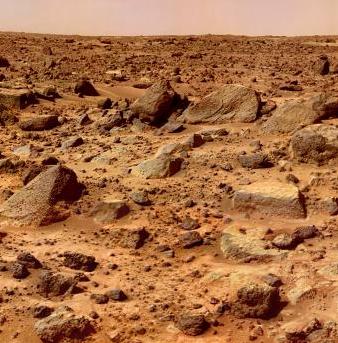
A rock-strewn plain on Mars

Should we allow a one-way crewed mission to Mars? Two scientists, invoking the spirit of Star Trek, contend in a scholarly article entitled To Boldly Go, that human travel to Mars could happen much more quickly and cheaply if the missions are made one-way.  The scientists are Paul Davies of Arizona State University (the main man in my book) and Dirk Schulze-Makuch of Washington State University (previously unknown to me).  Their article has appeared in the Journal of Cosmology (October-November edition).

"The astronauts would go to Mars with the intention of staying for the rest of their lives, as trailblazers of a permanent human Mars colony,"  the article says.  They argue that it would be little different from early settlers to North America, who left Europe with little expectation of return.  "The main point is to get Mars exploration moving," Schulze-Makuch told the Irish Examiner (which is where I first saw the story). 

In addition to offering humanity a "lifeboat" in the event of a mega-catastrophe, a Mars colony is attractive for scientific reasons, the article says. (I don’t like this lifeboat business, see my earlier post against preserving the human species.)

They cite these scientific benefits : That a base on Mars could be a unique opportunity to study an alien life form and a second evolutionary record.  An intensive study of ancient and modern Mars will cast important light on the origin of life on Earth. Mars conceals a wealth of geological and astronomical data that is almost impossible to access from Earth using robotic probes. The base would open the way to comparative planetology on a scale unimagined by any former generation. It would offer a springboard for human/robotic exploration of the outer solar system and the asteroid belt.

Paul Davies - main man
Finally, establishing a permanent multicultural and multinational human presence on another world would have major beneficial political and social implications for Earth, and serve as a strong unifying and uplifting theme for all humanity.  (I like the motivation, even if it’s a bit unrealistic.)

The authors note that Mars is a six-month flight away, possesses surface gravity, an atmosphere (huh? not much of one), abundant water, carbon dioxide and essential minerals. They propose the missions start by sending two 2-person teams, in separate ships. More colonists and regular supply ships would follow.  The technology already exists, or is within easy reach, they write.

The one-way mission idea has been mooted before but I'm pretty sure this is the first time it has been seriously proposed by academics.  It doesn’t find favour in official circles, with NASA or ESA. At least not yet. The Irish Examiner contacted retired Apollo 14 lunar astronaut Ed Mitchell, who was critical of the one-way idea.  "This is premature," Mitchell wrote in an e-mail. "We aren’t ready for this yet."

Davies and Schulze-Makuch deny they’re proposing a "suicide mission".  They recognise the idea is a tough sell for NASA, with its intense focus on safety.  They think the private sector might be a better place to try their plan.  "What we would need is an eccentric billionaire," Schulze-Makuch told the Examiner. "There are people who have the money to put this into reality."

Defining suicide


I've heard it said, and I'm sure it's true, that there would be plenty of volunteers for a one-way mission.  Even so, is it right? 

Would those who sent these colonists be colluding in their suicide? What's the definition of suicide?  If the probability of dying is 1 that’s suicide for sure, but say the probability is 0.9, what then?   And how soon does the death have to occur?  Say that (provided they survived the landing) there's a high probability the colonists will survive 6 months but only a small probability they will survive a year.  Would that be suicide?  And if the colonists know the risks but willingly accept them in a spirit of adventure?

Another scientific ethical dilemma for the lecture I'm working on, “Just because we can does that mean we should”. I hope to give it to Cork Astronomy Club one day. 

Update on this story August 2012.


Thursday, May 6, 2010

Stephen Hawking says don’t phone ET


The Arecibo radio telescope broadcast
a message to ET, causing a level 8 hazard
Around the end of April Stephen Hawking presented a TV programme on the Discovery Channel. I didn’t see it but it was called Stephen Hawking's Universe: Fear The Aliens, and from reports I've seen it seems he argued that it’s dangerous to send signals into space because if aliens pick them up they are likely to come and get us.

This question of should we or shouldn't we send signals into space is controversial within the SETI community (search for extra-terrestrial intelligence). The astronomer and former BBC science correspondent David Whitehouse said: “The civilisation that blurts out its existence might be like some early hominid descending from the trees and calling ‘here kitty’ to a sabre-toothed tiger.”

Back to Stephen Hawking’s programme, I saw a critique of it along the following lines : Stephen Hawking is a physicist not a SETI expert, so his views should be given no special weight.   This statement must bring a smile to the lips.  What special expertise, pray tell, does a SETI expert possess when it comes to figuring out if we are under threat from hostile aliens?

Ha! they reply.  We have the San Marino Scale – bet you didn’t know that, eh?

Well, no I didn’t know that, so lets look it up.  Here it is : http://avsport.org/IAA/smiscale.htm

This scale is used to gauge the risk to humanity of broadcasting messages into space. It was adopted by the International Academy of Astronautics in 2007.  The index runs from 1 for an insignificant potential hazard to 10 for an extraordinary hazard. The number is based on intensity of the signal (on a logarithmic scale no less), its duration and information content.  For example, in 1974 the Arecibo radio telescope broadcast a message which included depictions of a man and woman, and the DNA double helix, all encoded in binary.  On the San Marino Scale this would score an 8, meaning that the potential hazard is far reaching.  9 on the San Marino Scale is an outstanding hazard, and 10 is as bad as it gets : an extraordinary hazard.

Am I wrong to poke fun at this stuff?

I'm working on a lecture to give to Cork Astronomy Club sometime within the next year or so called “Just because we can does that mean we should?” and I'm going to include this question,  as light relief mainly.  The main focus will be on colonising Mars, (on which I have a separate post if you're interested), and on crewed as opposed to robotic space exploration.

Sunday, October 4, 2009

Against preserving the human species


An imagined Mars colony
(Don Dixon Space Art)
There may be good reasons for colonising Mars. But preserving the human species isn't one of them. Nevertheless it’s a motive that’s often cited when colonising Mars is discussed.

J Richard Gott (professor of astrophysical sciences at Princeton University) wrote in New Scientist 12th Sept 2009 (p 35) that a self-supporting Mars colony would make the world a better place, by making the world not the only place for us, thus improving the long-term survival prospects of our species.

I say, firstly, if we spoil this planet, how can we claim to deserve to survive as a species? One of the first lessons we teach a child, is that you clean up one mess before you make another.

Secondly, it's not self-evident that the survival of the human species is a worthwhile goal. The right to survive must be earnt, not assumed. If we can create a just society amongst existing humans, then we shall have earnt that right. Until then, not.

I'm not arguing against space exploration, nor even against colonising Mars. But lets get the reasons right. I say that the scientific enterprise is justified by one criterion only: that it contributes to human happiness. A Mars colony would contribute to science, it would be a human achieving without parallel, it might conceivably bring economic benefits. All those are worthwhile aims.

But the following are not worthwhile aims : providing an escape route for a privileged elite; and ensuring the survival of a species that has proved itself unworthy.

One of the most prominent scientists who think preserving the human race is a reason for colonising space is Stephen Hawking. He says : "Life on Earth is at an ever-increasing risk of being wiped out by a disaster such as sudden global warming, nuclear war, a genetically engineered virus or other dangers". [1]

Now whilst Hawking is right in his premise, he's wrong in his conclusion. The extinction of the human species is not the worst consequence that could flow from the disasters he enumerates.

Firstly, it’s really human civilisation that stands in danger of being wiped out; a number of humans would almost certainly survive any of those catastrophes to perpetuate the species. Even supposing that is what he really means, the key point is that those catastrophes would be the occasion of much suffering, and this would fall disproportionately on the poor and disadvantaged of this world. The very people least responsible for any man-made catastrophes. And the least likely to be emigrating to Mars.

Avoiding that suffering is the only goal which is worthwhile. And it's a goal that preserving human civilisation on Mars contributes nothing to.

[1] New Scientist 5 May 2007 (issue 2602). Another similar link here. And he's still at it in June 2017.