Showing posts with label Philosophy. Show all posts

Monday, August 11, 2014

Of fundamental particles and logs


This is a plug for the Guardian’s Science Weekly podcast. In fact for Guardian podcasts overall. I reckon that were the Guardian a radio station it would be up there with BBC Radio 4 as one of the world’s best. The episode of Monday 28 July featured British physicist Professor Jon Butterworth discussing his work at the Large Hadron Collider.  Just a lot of quite ordinary people getting on with their jobs in a building with shabby corridors, he says, yet they're unlocking the laws of nature and the secrets of the universe.

The whole episode lasts 44 minutes and the Jon Butterworth interview takes up the second half, starting at minute 22:40.  If you have time for just a three minute snippet, try from minute 36:30 to 39:36. Listen to the professor’s thoughts on finding that the Higgs particle is really there, and seeing confirmation of the Z-boson.  By the way don't worry, there's no need to understand exactly what the Higgs or the Z are, other than to know that they are fundamental particles that it takes expensive equipment to detect ... and upon their existence or non-existence rests our whole conception of the laws of nature.

Hear Jon Butterworth say “The fact that we understand nature so well, that when we turn on the Large Hadron Colider for the first time, we see the Z-boson, and it's where it should be, still impresses me, I still get goosebumps even talking about it now.” 


A bicycling engineer leans on a magnet in the 27km-long tunnel of the Large Hadron Collider
(Image: Cern/Maximilien Brice)
The thought he's expressing here isn't new, but when I hear a scientist say it gives them goosebumps, I get goosebumps myself.  I'm put in mind of another physics professor Frank Close, commenting on Dirac’s achievement in predicting the particle known as the positron (a positive electron). Dirac predicted the positron using maths alone, four years before the particle was actually discovered by experiment in 1932. 

“To me it’s remarkable, in a strange way I find it quite uncomfortable, that Dirac is writing things on paper, and the equations say: you can’t just have an electron, you must have a positive version as well.  And it turns out the equations know about nature; for then we go out and do an experiment, and we find that’s how it is.  It’s a very profound, in some way, a disturbing thing.” 

Prof Close was speaking on BBC Radio 4’s In Our Time in 2007. His words made such an impression that I included them in my personal collection of quotes from scientists talking about science.

To conclude about that episode of Science Weekly, Prof Butterworth was invited into the studio to talk about his new book Smashing Physics, his insider's account of the discovery of the Higgs boson. And the first half of the episode is a report from a symposium on the origins of life - did life begin on Earth or elsewhere, and how likely is it that we are alone. Science Weekly is presented by Guardian journalist Ian Sample. The episode of 4th August is another must-listen-to: “How AI could be the end of us”, in which Nick Bostrom believes if we're not careful, the creation of a super-intelligent computer could be our last invention. 

I listen to Science Weekly through my headphones as I go about my morning yard duties, and here's a picture to prove it:-


The log carrier by the way is a little thing of my own invention, loosely based on a traditional Swedish carrier made of birch bark.

Thursday, April 17, 2014

Thankfully, infinity isn't all it's cracked up to be


According to the many worlds hypothesis, there exists an infinite number of universes, and consequently anything that can happen has happened an infinite number of times.  So there's another universe in which I went to bed early tonight and didn't get round to writing this stuff … and yet another in which I omitted the commas from the previous sentence … and so on. Actually an infinite number in which I did each of those things, but lets skip over that absurdity as the proposition is already absurd without it.  It makes my brain explode, and I refuse to accept that this is the way reality is.

So how do we account for this state of affairs? Until recently only two possibilities presented themselves. The first of which was that the many worlds hypothesis is false. There's either only one universe or a finite number of them.  Now, physicists may indeed have got it wrong, but it's hardly my place to say so, as they’ve done the equations and I haven't, nor could I.   So we must consider a second possibility.

Namely that there's something wrong with my intellect. Evolution has simply failed to equip me with a brain capable of grasping the truth about reality. Well, that may be the case; but I refuse to accept it; perhaps indeed, because I've been given the wrong sort of brain; but I refuse to accept it nonetheless.


Mary Midgley: infinity not all it's cracked up to be. And a book that’s just come down from the shelf.
Thankfully the other day in New Scientist I came across a way out of this impasse: a third possibility, that there's something wrong with the idea of infinity.

On the letters page the philosopher Mary Midgley wrote about the meaning of “an infinity” of universes, which she asserts to signify a mere absence of known bounds. Our ignorance of limits is just a negative, she claims. As such, it cannot spawn new facts. In particular it can't spawn the new fact that "everything that can happen will happen, infinitely many times". In this sentence,  infinite is used in a different sense, this time meaning a very large number. This sort of thing is not philosophy, she says, it's just muddled language.

So hurrah. The physicists may be right about an infinite number of universes, but we've misconstrued the consequences of this. There isn't another me that omits commas, and I can accept the possibility of many universes without my head exploding.

There's a book on my shelf about infinity which I've never read.  I see that from the inscription that I bought it at Oxfam in York in 2006. A Brief History of Infinity – the Quest to Think the Unthinkable, by Brian Clegg, 2003.  It's off my shelf now. Time to tackle it.

A short note on many worlds if you want it.

Thursday, January 16, 2014

Mars One is OK, I suppose


The pains of emigration are seared into the Irish soul, and this week I've listened on the radio to Dr Joseph Roche contemplating it in its most extreme form. He's a Trinity College Dublin astrophysicist who’s signed up for Mars One - a privately funded venture to send colonists to Mars in 2023 on a one-way only ticket. 

The first time I wrote about it, I queried whether a no-return crewed mission to Mars was acceptable.  Perhaps those who send these colonists will be colluding in their suicide?  This question of its acceptability was, I have to agree, a woolly one, as I forgot to ask acceptable to whom, and if not, who could stop it. 

Asked by the presenter if it's suicide, Joseph Roche recognises that due to radiation his life expectancy will be “drastically reduced”.  But since there can be very few people who understand the risks better than he does,  I suppose I have to abandon my pretensions to opine on the rightness of the thing. 

You can hear his two interviews here, on RTÉ radio last Thursday and Sunday. They make extraordinary listening. 

Morning Ireland, Thurs 9 January search for “The Irishman who hopes to go to Mars” (5 minutes)

Marian Finucane Show, Sunday 12 January search for “Life on Mars” (18 minutes)

Dr Roche was interviewed after reaching a longlist of 1,058 volunteers, selected from over 200,000.   He says that to be chosen for the mission would be like a dream come true.

 “I definitely wouldn't be coming back, it's not up for debate. As soon as I get there I would have to live out the rest of my days there. Because you would be exposed to conditions that no human has experienced before, and there's not enough atmosphere on Mars to protect you from radiation, even with a space suit, my life expectancy would be drastically reduced. The way I look at it, even with a shorter life on Mars, for every day I live on that planet, I would be taking a leap forward for the scientific endeavour of human kind. For me it would be a dream come true.”

That’s the Morning Ireland clip, the shorter of the two. In the longer interview with Marian Finucane, a fellow hopeful Steve Menaa joins Joe Roche and so does his sister Deirdre. She says the family would be devastated if he was selected and he had to go, but on the other hand Joe was always ambitious and he likes to see through the things he starts, and if this is what he wants we'll support him in it.   Steve says “I like my life on Earth but I like a challenge as well. We humans are explorers.”


Greenhouse for growing plants and insects on Mars. As envisioned by the Mars Society.
Asked what they will do for food, Joe says they will grow plants. And for protein, breed insects. Yummy.

When after 5 years the colony reaches full strength, there will be 20 of them, men and women. Will there be children produced? No. Joe says sterilising all the astronauts should be considered, and it's exciting that there is that ethical discussion. Sacrifice in the cause of science is mentioned, but Joe says it's easy to sign up for this if you're passionate about it, he's not sure sacrifice is the word; it could actually be called selfish, he admits. 

It would be good to work with NASA or ESA and have a return trip, but those agencies’ plans are 30 years in the future. “I'm 30, and if I go, I go now”.

Mental illness?

There will be no Skype. Radio waves will take over 3 minutes to travel in each direction.  (Up to 20 minutes in each direction, I would say, depending on the two planets’ relative positions.)

In neither of these interviews is anything said about the psychology of isolation. According to this Guardian blog, those sent to live and die on the red planet face untold risk of mental illness.


And the 24-hour Big Brother show that’s going to fund the project will heap more pressures on. 

Will it be reality TV, or a horror movie, is my question. And which will bring in the bigger bucks?


Tuesday, January 7, 2014

Space - maybe we can but should we?


Artist's conception of the process of terraforming Mars (Wikipedia).
The question is, should it be done?
Am now working on a lecture I have to give in March to Galway Astronomy Club. It's about the ethics of space exploration.

Is the Mars One project (a no-return mission of Mars colonists) a suicide trip, and if so does it matter? Is colonising Mars a good thing in principle, and if so, does it signify what the motives are? Is preserving the human race a good motive?  In order to hasten exploration of Mars, is it OK to cut corners thereby risking planetary protection .. risking polluting Mars with Earth microbes, which could stymie all future investigation into life on Mars?  Is it OK to terraform Mars … schemes have been devised that, within a few centuries, would turn Mars into a replica of the Earth with an Earthlike atmosphere.  But is it right?

How is the demilitarization of space to be policed? How can we preserve archaeology in space and on the Moon?  Who is allowed to mine asteroids and who should be?

Have a lot of work to do on this in the next 6 weeks, so this blog may be a bit quiet on other matters. Any comments or pointers welcome.  In particular I have to research the international law of space, I was hoping to find someone to help me on that, but I have to do it all by hand. Moreover at the end of February am off to Berlin again with my friend Vincent.

Links:

On this blog
        The Mars One mission
        Preserving the human race on Mars
        Archaeology on the Moon

Elsewhere
        The debate on the so-called over-protection of Mars
        NASA on how to terraform Mars
        Wikipedia on whether to terraform Mars


Sunday, September 29, 2013

"Comments can be bad for science"


"Comments can be bad for science" is a surprising statement from Popular Science, explaining why their website PopularScience.com, has shut comments off.

This magazine devoted to science and technology news was founded in 1872, and is “committed to fostering lively, intellectual debate as we are to spreading the word of science far and wide. ”

But they say the problem is that trolls and spambots have overwhelmed intellectual debate, and diminished their ability to spread the word of science. “It wasn't a decision we made lightly.” They claim research points to the depressing conclusion that ignorant and vituperative comments can skew popular perception of issues such as climate change. Full story here.

PopularScience.com is a site I like to keep an eye on.  For example a recent article on How Do You Dispose Of Chemical Weapons?

Syrian soldier in gas mask from PopularScience.com
(Wikimedia Commons)

Tuesday, October 30, 2012

Planet with 4 suns? Asimov got there first


Nightfall 1990 edition
A couple of weeks ago I pondered how far astronomy could progress on a planet bathed in perpetual daylight, and now Denis has directed me to Isaac Asimov’s 1941 science fiction short story "Nightfall". It features the coming of darkness to the people of a planet ordinarily illuminated at all times on all sides. They have even more suns than the four which grace the recently discovered planet PH1. Asimov’s planet has six.

Total darkness is unknown, and as a result so are stars outside the 6-star system. Their scientists predict that once every 2049 years a brief “night” will occur. Since the current population has never experienced universal darkness, the scientists conclude that the darkness itself would traumatize the people, and that the inhabitants of the planet must prepare accordingly.

But when night falls the scientists themselves get a surprise. Together with the rest of the population they are presented with the spectacle of a black sky filled with hitherto-invisible stars. The short story does not dramatize subsequent events, but in 1990 Asimov (with Robert Silverberg) adapted it into a novel, in which civil disorder breaks out, cities are destroyed in massive fires, competing groups try to seize control, and civilization collapses.

I've taken this from the plot summary in Wikipedia. I must get hold of this story.


Saturday, October 20, 2012

Planet with four suns – can they do astronomy there?


A discovery of a planet with four suns. It orbits one of a pair of stars and is in turn circled by a second pair.  Also in the news this week, an Earth-like planet discovered around the nearest star to our own Sun.

But it's the planet with four suns that interests me more. A pair of stars is called a binary star, and here's a graphic. It shows the two stars orbiting around their common center of mass.


In this case we have two binary stars, so four stars in all. Imagine each dot is itself a binary star. The recently discovered planet is a gas giant orbiting one of the stars. It's been called PH1.

So four suns light up its skies. 


Graphic showing planet PH1 in foreground and a binary star (two suns) in the distance. Pity it doesn't show all four suns.  The suns are imagined as rather feeble, permitting the sky to be full of stars. But what if the suns were stronger and blotted out all stars?   
Can they do astronomy?

Suppose beings inhabited this planet PH1. Which they can't as it's a gas giant, but lets suppose.  Would they experience night?  Perhaps never.  Perhaps there would always be at least one sun in the sky. Imagining this to be so, can we speculate what sort of astronomy the inhabitants of PH1 can do?  They would think the universe consisted of their planet and four suns. If there were one or more moons, they would be dimly aware of them perhaps, if on rare occasions they showed up in the perpetual daylight.

But the stars – these they would never see. Though the four suns might have numerous planets besides PH1, they would be unaware of these too.  Unless, like Venus, a planet occasionally showed up in the daylight sky.

Or suppose the PH1 beings experience an occasional brief night when all four suns happen to line up on the other side of their world. What an amazing spectacle for them!  Then they would briefly see the stars as pricks of light in a dark blanket and say to each other “what on PH1 is that?!”

But would the stars stay around long enough to prompt any investigation?  That's the question I'm posing.  Would they have time to notice that some of the stars behaved oddly and were planets?

Astronomy was born, I think, when sky watchers, having studied the heavens night after night, distinguished the wandering planets from the fixed stars, and charted the planets' courses.  And it came of age when Copernicus realised that the Earth is itself a planet.

So astronomy on PH1 would be depressingly limited.

No night sky, no Copernicus

If they had a Ptolemy, he would devise a fearsomely complicated scheme of spheres and epicycles to account for the movements of the four suns. If they had a Copernicus he would propose it would be so much simpler to imagine the suns orbiting each other and their planet orbiting one of the suns.

But wait! … could they have a Copernicus? I don't think so.

First Copernicus (our Copernicus I mean) had to know about planets. Then he was able make the leap that the Earth itself is one. But a Copernicus on PH1 could know nothing of planets. So how could he make that leap.

No. I fear PH1 astronomy would stop with Ptolemy.

No Copernicus, no Galileo, no Newton, no Einstein.

Monday, August 20, 2012

The Philosopher’s Zone


When I related the parable of the farmer and the runaway horse a few days ago, I recommended the BBC In Our Time programme on Taoism but I forgot to mention the excellent Australian radio programme The Philosopher’s Zone, presented by the recently deceased Alan Saunders.  I've corrected the oversight.

I usually make a point of downloading these episodes which last only 25 minutes but pack a lot in. In this one on Taoism he interviewed two Chinese academics.
 
From the link I've given it's easy to download the episode as well as a transcript.

Alan Saunders was awarded the Australasian Association of Philosophy's Special Media Prize.  He died unexpectedly on 15 June.


Thursday, August 16, 2012

Yin and yan - the farmer and the runaway horse

Taoist yin yan symbol

Long ago in China a farmer’s only horse ran away. The neighbours commiserated with him: “What terrible news about your horse. What will you do?” But the all the farmer said was, “Bad news, good news … who knows?”

A few days later, the animal returned together with a wild horse it had befriended. The neighbours exclaimed: “What wonderful news!” The farmer replied, “Good news, bad news … who knows?”

The next day the farmer’s son tried to ride the new horse, which threw him, breaking his leg. The neighbours said: “What a misfortune! Your son won’t be able to work on the farm.” The farmer replied, “Bad news, good news … who knows?”

The following week the emperor’s soldiers arrived in the village, and conscripted all able bodied young men to fight in the army.  But the farmer’s son was no use to them with his broken leg, so they let him go.

“How lucky for you and your son” said the neighbours.  “Good news, bad news … who knows?” said the farmer.

According to Taoists, being useful may be good, but being useless is good too. This Taoist parable shows how easily such opposites may change places.

A Taoist website explains: yan and yin, light and shadow, useful and useless are all different aspects of the whole, and if we choose one side and block out the other, we upset nature's balance. No single concept or value can be considered absolute or superior. If we are to be whole and follow the way of nature, we must take the hard path of embracing opposites.

For more, try this 45-minute radio programme about Taoism: it's an episode of BBC’s In Our Time. Listen to the episode and find the blurb and studio guests here.  Or to download it as an mp3 file, search for Daoism (with a D) on this page.

Or try this Australian programme. The Philosopher’s Zone, presented by the recently deceased Alan Saunders, interviewing two Chinese academics.

We learn that Taoism first appeared more than two thousand years ago, and for centuries was China’s most popular religion. Based on a book whose author is not known and whose title does not easily translate into English. The goal is to follow the Tao, a word which roughly translates as “The Way”, following life in its natural flow. Taoism has exchanged ideas with Buddhism, and is closely related to the religion of the Chinese imperial court, Confucianism, but has also at times conflicted with it.

Saturday, August 4, 2012

One-way trip to Mars planned for 2023


Artist’s impression of the living units that await Mars One colonists.
The inhabitants of these pods will never see Earth again except as a planet in the night sky. (Photo: Mars One)
An announcement I missed in June. A Dutch company called Mars One plans to settle humans on Mars in 2023.  This will be a one-way trip.  No return tickets available.  The participants emigrate, living and working on Mars for the rest of their lives. This is what makes this plan feasible, says the Mars One website. “It goes without saying that we are taking care of the living needs of the settlers.”

Is this a serious operation? It has serious names associated with it. In this promotional video they’ve persuaded the Nobel prize-winning physicist Prof Gerard 't Hooft to endorse the project.


On the Mars One website he says: "The aspect that made all the previous plans so unbelievably expensive and complex, was the uncompromising condition that all Mars travellers must return back to Earth. A return journey would demand launching techniques and manoeuvres that have not been properly investigated, and would double, triple, quadruple the price.”

Eighteen months ago I was surprised to find Paul Davies proposing this one-way trip to Mars thing, and I put together a few thoughts on the ethics of the idea. Would those who sent these colonists be colluding in their suicide?  Read my thoughts here: Can we? Perhaps. Should we? Perhaps not

Mars One mission leader Bas Lansdorp says that by using only previously tested technologies they will avoid expensive research and testing, and keep costs down to about $6 billion for the first settlement of four astronauts.

Mars colonisation meets Big Brother

Now for how they plan to pay for this.  Should we feel queasy when we read on the company's website that media coverage is "a vital component of Mars One's plan"?  With the help of Big Brother creator Paul Römer they will turn the astronaut selection, training, and mission completion into a media spectacle.  "The concept of a 'one-way' mission is both outrageous and exciting," he's quoted as saying. "These aspects are what brought me to the idea of making the mission the biggest media event in the world. Reality meets talent show with no ending and the whole world watching. Now there's a pitch!"

Starting in 2016, supply vessels, solar panels and living infrastructure will be delivered, and in 2018 a rover will comb the landscape for prime locations to place the colony.

Dr. Robert Zubrin, president of the Mars Society and author of The Case For Mars told The Huffington Post: "This is something that has amazing historic value - the transformation of humanity from a single planet species to a multiplanet species  … You only live once. To have the chance to do something like this is profound."

Thursday, May 17, 2012

What scientists say about science


Anthologies of scientific quotations are already countless but here's one more. It was about 8 years ago I became interested in science when I attended an evening class in York on the Big Bang, following which Phil & Lindsay gave me Simon Singh’s book of the same title for Christmas. This was 2004. The book tells the history of astronomy; which turns out to be almost the same thing as the history of science itself. It's peppered with wonderful quotes, and that’s when I discovered that scientists are also philosophers.

In proof of which, I'm now going to treat you to my own collection of quotes by scientists talking about science. First a video clip of Richard Feynman describing the scientific method.  Feynman, who died in 1988, was an American physicist and Nobel laureate, and renowned as a spellbinding lecturer. Before PowerPoint, the lecturer’s skill was to hold their audience’s attention with their back turned writing on a blackboard.  The video was shot at Cornell University in 1964.  


This is what he says:  Now I'm going to discuss how we would look for a new Law.  In general we look for a new Law by the following process.  First we guess it.  No, don't laugh, that is the real truth.  Then we compute the consequences of the guess, to see what, if this law that we guessed is right, what it would imply.  And then we compare those computation results to Nature; or we say compare to experiment or experience.  Compare it directly to observation to see if it works.  If it disagrees with experiment, it's wrong.  In that simple statement is the key to science.  It doesn't make a difference how beautiful your guess is, it doesn't make a difference how smart you are, or what your name is.  If it disagrees with experiment, it's wrong.  That's all there is to it.

I've put together a 16-page compendium of my favourite quotations from scientists, but in case you don’t have time for that right now here are a few choice ones. First, one more on the scientific method, from Henri Poincaré, French mathematician, 1854–1912:

Science is built up of facts, as a house is built of stones; but an accumulation of facts is no more a science than a heap of stones is a house.

The biggest insight I got from Simon Singh’s book was that great scientists are normally very modest about science’s achievements, freely admitting how few of nature’s secrets have been unlocked, and perhaps will ever be unlocked.  Here's Albert Einstein on this theme:

Nature shows us only the tail of the lion.  But I have no doubt that the lion belongs to it even though he cannot reveal himself all at once because of his large size.  We can see him only the way a louse sitting on him would.

and:

Everyone who is seriously interested in the pursuit of science becomes convinced that a spirit is manifest in the laws of the universe - a spirit vastly superior to man, and one in the face of which our modest powers must seem humble.

Next Steven Weinberg, American Nobel laureate in physics, born 1933.

The effort to understand the universe is one of the very few things that lifts human life a little above the level of farce and endows it with some of the grace of tragedy.  On another occasion he said:  The more the universe seems comprehensible, the more it also seems pointless.

Some scientists have expressed surprise that the human mind can in fact understand anything about the universe at all.  Einstein (I'm afraid we can't avoid his name cropping up) expressed it this way, that the most incomprehensible thing about the universe is that it is comprehensible.  Eugene Wigner had a similar thought when he suggested that it is not at all natural that "laws of nature" exist, much less that man is able to discover them. *

Saving the best till last, what is science for?  Robert Wilson when Director of the US National Accelerator Laboratory, was obliged in 1969 to go in front of a congressional committee to seek government funding for the construction of a particle accelerator. 

Robert R. Wilson at the
Fermilab groundbreaking ceremony
(Wikipedia)
It would be 4 miles long and massively expensive, but he knew the only hope of uncovering the fundamental laws of nature, was to persuade governments to stump up costly kit like this.  Facing that committee must have been a critical moment in his career, and cross-examined by Senator John Pastore, Wilson had to answer the question he will have dreaded: would the project give the USA any advantage over the Russians in the Cold War?  

No, said Wilson.  It has no military application.  He continued:

What it has to do with is: Are we good painters, good sculptors, great poets? I mean all the things that we really venerate and honor in our country and are patriotic about.  In that sense, this new knowledge has all to do with honor and country; but it has nothing to do directly with defending our country, except to help make it worth defending.

Wilson got the funding: the accelerator was later known as Fermilab.  More in my compendium, page 10.

Wilson by the way has an interesting history.  A veteran of the Manhattan atomic bomb project, he was one of those scientists for whom the work raised deep questions about science and society.  In 1945, when Nazi Germany surrendered, Wilson attempted to raise the question at the lab of whether they should continue with their work. He deplored the actual use of the bomb at Hiroshima. He sounds to me like a good egg, and some day I'll write more about him, and other physicists who worked on the atomic bomb.  On page 16, I have quotes from a couple of them.

I'm putting this on my blog now as a sort of tribute to my friend Stu who died last week. Several years ago I showed him an early draft of this collection of quotes and we talked far into the small hours about the philosophy of science, politics, religion and probably much besides.   I was looking forward to showing him my final list, but the day never came. 

* In his 1960 paper The Unreasonable Effectiveness of Mathematics in the Natural Sciences, cited in the pdf file though I didn't have room for this particular quote

Sunday, December 4, 2011

I muse on Frankenstein and his monster


€1 in Mitchelstown on 28th Nov

Whiling away a spare half hour before my bus to Cork last week, l bought a battered copy of Mary Shelley’s Frankenstein in a charity shop. I decided to familiarise myself with this iconic work.

Here's what happens. The young Swiss Victor Frankenstein growing up in Geneva develops a passion for natural philosophy and chemistry and enrols as a student at the university. There he becomes consumed by the desire to discover the secret of life and after several years of research, attains the knowledge he seeks.

For months he feverishly and clandestinely fashions a creature out of old body parts and strange chemicals. One climactic night, he brings his creation to life. But the monstrosity he has made horrifies him. He flees the scene.  Sickened by his disgusting deed he falls dangerously ill. 

On recovery he returns to Geneva, to his family, and he hopes, to his old life. But the monster dogs his steps, and over the course of the book commits four murders. The first of these is Victor Frankenstein’s little brother. The second is when the monster cleverly contrives a miscarriage of justice so that the kind, gentle Justine, a sort of adopted cousin, is tried for the murder, condemned, and executed,

Only Victor knows of the monster’s existence, which he dare not divulge.

Overcome by grief and remorse, he flees to the Alps. Here the monster (sometimes called a dæmon, sometimes a fiend) tracks him down, and here we would expect the monster to kill him, end of book. But no, the monster whilst admitting to the murders, begs for understanding.

It emerges that the monster has previously attempted to befriend human kind but has been rebuffed due his hideous appearance, and so travels at night and hides in dark places, seeking revenge on Frankenstein. Lonely, shunned, and forlorn, he says that he struck out at Victor’s little brother in a desperate attempt to injure Victor, his cruel creator. The monster begs Victor to create a mate for him, a female monster equally grotesque, to serve as his sole companion.

Creating another monster

Appalled at the prospect of creating a second monster Victor at first refuses. But the monster is eloquent and persuasive, and eventually Victor is convinced.

After many delays (reminiscent of Hamlet, perhaps) Victor secludes himself on a desolate island in Orkney and reluctantly works at his ghastly task. One night, consumed by doubts about the morality of his actions, Victor perceives the monster glaring in at him through a window with a horrid grin. Alive for the first time to the awful consequences of his work, Victor destroys his new creation.

Whereupon the enraged monster vows revenge, and swears that he will be with Victor on his wedding night.  After more adventures, and another murder (of Victor’s friend Henry) Victor returns home to Geneva, where he marries his cousin and childhood sweetheart Elizabeth. Whom, true to his word, the monster murders on their wedding night.

Like Moby Dick

Vowing to devote the rest of his life to finding the monster and exacting his revenge, Victor tracks him ever northward into the arctic ice. His obsessive pursuit puts one in mind of Captain Ahab pursuing the great white whale, a parallel Melville surely had very much in mind.

In a dogsled chase, Victor almost catches up with the monster, but the sea beneath them swells and the ice breaks, leaving an unbridgeable gap between them. At this critical moment, Victor Frankenstein is saved by the crew of an arctic exploration vessel, but after some days expires of exhaustion. Not however before he has told the ship's captain Walton his entire story.

Later Walton is startled to find the monster weeping over Victor’s body. To Walton the monster confides his immense solitude, suffering, hatred, and remorse. He asserts that now his creator is dead, he too can end his suffering. The monster then departs for the northernmost ice to die.

I've put an edited version of the book’s last four pages in this pdf file.

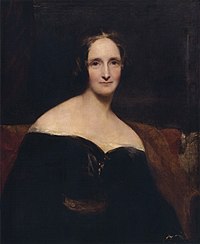
Mary Shelley (née Mary Wollstonecraft Godwin)
1797–1851
Nested narratives

The novel’s structure is the nested narrative, like the Arabian Nights. The arctic explorer Walton’s letters to his sister back in England envelop the entire tale. Victor’s story fits inside Walton’s letters. The monster’s story fits inside Victor’s. And there's more nesting that I won't go into here.

Who is most monstrous?

Eight feet tall and hideously ugly, the monster is rejected by society. His monstrosity resides not only in his grotesque appearance but also from the unnatural manner of his creation.  One commentary I've seen suggests that there are a number of monstrous entities in the novel, of which the monster is only the most literal.

There's the dangerous knowledge that Victor employs to create the monster. And then there's Victor himself - is he a kind of monster. Ordinary on the outside, his ambition, secrecy, and selfishness alienate him from human society, and at last he's consumed by obsessive hatred of his creation.

Finally (it says here), many critics have described the novel itself as monstrous, a stitched-together combination of different voices, texts, and tenses (see nesting above.)

A classic

Mary Shelley was only 18 when she wrote it, and in some places it shows.  But what an achievement. As a metaphor for responsibility in science it’s unrivalled, although doubtless often used carelessly by people who, like me until last week, haven’t read the book. If you are so minded, you can also read a Marxist metaphor into it: Frankenstein the capitalist system, the monster the working class that capitalism summons into existence.  These metaphors are not Mary Shelley's own of course. But they are there to be read, and they are why the book is a classic.

The book’s subtitle is A Modern Prometheus, in reference to the ancient Greek myth that the god Prometheus was assigned the task of creating mankind.

I googled some images to spice this post up a bit but none were satisfactory. I wonder if any of the film versions do it justice. I've not seen any, but I speculate that the answer is no. I suspect it's a book that should remain as a book. This Wikipedia link is to Frankenstein in popular culture.

Sunday, August 14, 2011

Morality is what you do when you think no-one is looking


Even, if this Youtube moment is to be believed, in Bern, Switzerland


Thursday, February 24, 2011

Will robots take over the world?


In London. To a
UCL lunchtime lecture entitled ‘Will robots take over the world?’ 

Kathleen Richardson says no. She’s an anthropologist.  Who’s better placed to answer such a question? An anthropologist or a roboticist?  Surely the answer’s obvious!  Or is it?

Another thought.  Computers habitually do things they shouldn’t.  So even if we programme them with Asimov’s 3 laws of robotics (of which number 1 is harm no humans) might they flout the laws? 

Must see 2001 A Space Odyssey again. Last watched it in the 1970’s I suppose (it came out in 1968 – blimey!).  Did HAL the rougue computer flout the Asimov laws?  Or did HAL conform to the laws in ways the humans failed to foresee?  Here's the offcial trailer to the film, 3:32 mins.  For the famous sequence "open the pod bay doors HAL", jump to 1:45.


On the question of computers doing things they shouldn’t.  You can say that, when you look into it, it’s always a human’s fault. But I don’t think that alters the case. Then of course if artificial intelligence is possible (which is disputed but say it is) then artificial malevolence is possible.  And then there’s this: there are already malevolent robots, designed to be so.  They’re called military robots. Yes they have built in protocols. But this brings us back to computers doing things they shouldn’t …

Lastly a bit of history. ÄŒapek conceived the first robots in 1921, as humans, assembled from parts, like a Ford car. So if you’ve read my post Robot : a Czech Serf, I got that wrong.  The metal man I've illustrated came a few years later.  More of this when I’ve made sense of my notes.

Tuesday, November 23, 2010

One-way trip to Mars – can we, perhaps – should we, perhaps not


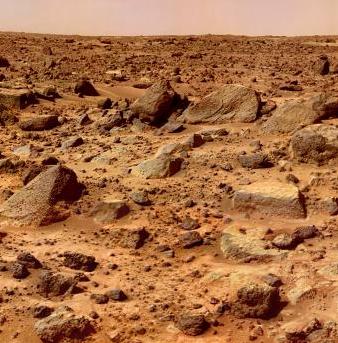
A rock-strewn plain on Mars

Should we allow a one-way crewed mission to Mars? Two scientists, invoking the spirit of Star Trek, contend in a scholarly article entitled To Boldly Go, that human travel to Mars could happen much more quickly and cheaply if the missions are made one-way.  The scientists are Paul Davies of Arizona State University (the main man in my book) and Dirk Schulze-Makuch of Washington State University (previously unknown to me).  Their article has appeared in the Journal of Cosmology (October-November edition).

"The astronauts would go to Mars with the intention of staying for the rest of their lives, as trailblazers of a permanent human Mars colony,"  the article says.  They argue that it would be little different from early settlers to North America, who left Europe with little expectation of return.  "The main point is to get Mars exploration moving," Schulze-Makuch told the Irish Examiner (which is where I first saw the story). 

In addition to offering humanity a "lifeboat" in the event of a mega-catastrophe, a Mars colony is attractive for scientific reasons, the article says. (I don’t like this lifeboat business, see my earlier post against preserving the human species.)

They cite these scientific benefits : That a base on Mars could be a unique opportunity to study an alien life form and a second evolutionary record.  An intensive study of ancient and modern Mars will cast important light on the origin of life on Earth. Mars conceals a wealth of geological and astronomical data that is almost impossible to access from Earth using robotic probes. The base would open the way to comparative planetology on a scale unimagined by any former generation. It would offer a springboard for human/robotic exploration of the outer solar system and the asteroid belt.

Paul Davies - main man
Finally, establishing a permanent multicultural and multinational human presence on another world would have major beneficial political and social implications for Earth, and serve as a strong unifying and uplifting theme for all humanity.  (I like the motivation, even if it’s a bit unrealistic.)

The authors note that Mars is a six-month flight away, possesses surface gravity, an atmosphere (huh? not much of one), abundant water, carbon dioxide and essential minerals. They propose the missions start by sending two 2-person teams, in separate ships. More colonists and regular supply ships would follow.  The technology already exists, or is within easy reach, they write.

The one-way mission idea has been mooted before but I'm pretty sure this is the first time it has been seriously proposed by academics.  It doesn’t find favour in official circles, with NASA or ESA. At least not yet. The Irish Examiner contacted retired Apollo 14 lunar astronaut Ed Mitchell, who was critical of the one-way idea.  "This is premature," Mitchell wrote in an e-mail. "We aren’t ready for this yet."

Davies and Schulze-Makuch deny they’re proposing a "suicide mission".  They recognise the idea is a tough sell for NASA, with its intense focus on safety.  They think the private sector might be a better place to try their plan.  "What we would need is an eccentric billionaire," Schulze-Makuch told the Examiner. "There are people who have the money to put this into reality."

Defining suicide


I've heard it said, and I'm sure it's true, that there would be plenty of volunteers for a one-way mission.  Even so, is it right? 

Would those who sent these colonists be colluding in their suicide? What's the definition of suicide?  If the probability of dying is 1 that’s suicide for sure, but say the probability is 0.9, what then?   And how soon does the death have to occur?  Say that (provided they survived the landing) there's a high probability the colonists will survive 6 months but only a small probability they will survive a year.  Would that be suicide?  And if the colonists know the risks but willingly accept them in a spirit of adventure?

Another scientific ethical dilemma for the lecture I'm working on, “Just because we can does that mean we should”. I hope to give it to Cork Astronomy Club one day. 

Update on this story August 2012.


Friday, November 5, 2010

What’s secularism?


Been giving some thought recently to secularism, and the distinction between secularism, secularisation, atheism, humanism.  Many loose ends to be woven together.  This interest, previously dormant, was aroused by an excellent Canadian radio programme in April. (Sadly this is no longer available for downloading on the CBC website.) Next came the Pope’s speech on 17th September at Westminster Hall against aggressive secularism, which at first I was inclined to dismiss out of hand but now I think needs a more considered response.

Other strands to be gathered up include :
  • A blasphemy law introduced in Ireland in (would you believe) 2009. 
  • An episode from Irish history in the 1950’s known as the Mother and Child scheme. 
  • And my belief that Richard Dawkins’ atheist bus was naff. 
The Dawkins atheist bus - naff
A lot of thinking to be done and I'll blog about these things one at a time as I sort them out in my head.  For now, here are a few links.
 
First, an article in the Irish Examiner 9/1/2010 on the subservience of Irish governments in the first half of the 20th century to the Catholic hierarchy.  “We’ve moved on from the days when Rome ruled our Republic” by Ryle Dwyer.  It’s a representative sample of a recurrent theme in Irish journalism. In this particular article, the finger of blame for a disgracefully subservient demeanour towards the church is pointed at the coalition government that ousted DeValera in 1948, whilst DeValera himself is exonerated from the charge.

For the Pope’s 17th September speech at Westminster Hall, see the Irish Catholic (and the full transcript on the BBC website.)

''Religion is not a problem for legislators to solve, but a vital contributor to the national conversation … I cannot but voice my concern at the increasing marginalisation of religion, particularly of Christianity, that is taking place in some quarters, even in nations which place a great emphasis on tolerance.  There are those who would advocate that the voice of religion be silenced, or at least relegated to the purely private sphere.” 

I'm torn between sympathising with this point of view, and dismissing it as the wheedling of a bully who has finally met his match.  More of this in the future.

On the topic of humanism, try downloading this 20-minute interview with Greg Epstein (an atheist and the Humanist Chaplain at Harvard University) about his book, Good Without God (NPR Fresh Air December 23, 2009)
 

Tuesday, September 28, 2010

The shore of our ignorance


John Archibald Wheeler (1911 – 2008) is someone I must find out about.  He said: "As the island of our knowledge grows, so does the shore of our ignorance."  He was an American theoretical physicist, and one of the later collaborators of Albert Einstein.  He is also known for having coined the term black hole.  But if he never did anything except coin that phrase about the island of our knowledge and the shore of our ignorance, he would have justified his existence.   

Even though he probably borrowed the thought from TH Huxley who said "The known is finite, the unknown is infinite; intellectually we stand on an islet in the midst of an illimitable ocean of inexplicability.  Our business in every generation is to reclaim a little more land." (Huxley was "Darwin's Bulldog" 1825 – 1895)

Saturday, September 25, 2010

Angry reaction feared to new evolution claim


Worker bee - sterile
Photo: Albert Freeman
A revealing insight into the sociology of science.  The 26th August edition of the Nature podcast (the leading scientific journal) carries an interview about a new theory of kin selection.  What causes worker bees to help the queen bee to reproduce, when they themselves are sterile?  Since the 1960’s it’s been widely held that natural selection can't account for this, so a theory of kin selection is required. Harvard’s Martin Novak now says that the kin selection theory is redundant and natural selection can fully account for the worker bees’ behaviour. Mathematics is adduced in support.

I didn’t follow the argument, but it’s not important for the point which I'm coming to.

After an interview with Novak, Nature editor Patrick Goymer comments “Given how core kin selection has been, this is the sort of thing that will ruffle many feathers.”

Presenter Kerry Smith then prompts him: “Yes, to say the least – what do you think will be the implications of Martin Novak and his team’s new work?”

Goymer adds: “There will be some anger from some people. It will take quite a while for people to digest the maths and work out how this fits in with things that have gone before. So I think the debate will move on possibly slowly.” 

Wot!  Faced with a new theory, scientists get huffy?  They ought to say “aha! so that’s how it works!” and be really pleased.

Richard Dawkins tells a story from his undergraduate days of a professor who admitted he had been wrong for 15 years about a pet theory, and publicly thanked and shook the hand of the man of who had proved his error.  He cites this example to show how science works, in contrast to religion where dogma rules. The Nature editor's comments suggest it’s frequently not as tidy as that.

More about podcasts

Wednesday, September 1, 2010

Dawkins warns against brain falling out


Watched Dawkins The Enemies of Reason, on astrology, water dousing and alternative medicine.  “We should be open minded but not so open minded that our brain falls out.” 
Dawkins is alarmed at a widespread turning away from science and evidence to mumbo jumbo.
An earlier episode examined religion, and he quoted Steven Weinberg : “Religion is an insult to human dignity. With or without it, you'd have good people doing good things and evil people doing bad things, but for good people to do bad things, it takes religion.”  Too right! That’s told them!  But hold on.  Religion might be a sufficient motive for good people doing bad things, but is it actually a necessary one? Could not the same thing could be said of politics? Look at the French and Russian Revolutions.  We seem to have a propensity to believe so passionately that something is for the good (and sometimes it really is for the good, for example creating socialism), that any means to achieve it is OK, even the revolution eating its own children. 

Wednesday, July 28, 2010

The crooked timber of humanity


Immanuel Kant (1784):  “From the crooked timber of humanity, no straight thing was ever made.”

The original German is : "Aus so krummen Holze, als woraus der Mensch gemacht ist, kann nichts ganz Gerades gezimmert werden."
A word for word translation goes : “Out of timber so crooked, as that from which human beings are made, nothing entirely straight can be fashioned.”.  I don’t know German but I wish I did as it’s a wonderful language.