Showing posts with label UK politics. Show all posts

Sunday, July 10, 2016

But why did it feel that way?

Soon after the news of the Brexit vote came out, I wrote a piece describing what it felt like. Shock, disbelief, a country I don't recognise, these were some of my thoughts, which seemed to be shared by many of those with whom I am in contact in England, by Guardian columnists, and the like. Since then, I've been puzzling firstly, why these thoughts ... and secondly if they are the right thoughts. 

What were we voting for, we who voted Remain? It's perhaps presumptuous to say “we” because there will be many different we’s but I'm going to make a stab at saying what the we that I belong to voted for.  And the first thing to say is that it was neither the dull economic arguments often put forward by the Remain side; nor was it a vote for the EU that actually exists – the EU that wants to crush the Greek people and hand power to the corporations through TTIP.  Read George Monbiot on this theme: “I’m starting to hate the EU. But I will vote to stay in.”

No, not for what the EU is but what it should be. Equally, for what sort of country Britain should be. A connected and inclusive nation, not an angry island on the edge, in the words of the Guardian editorial two days before the vote. 


This montage encapsulates what I was turning my back on when I voted Remain.

And why was the Leave result so devastating? It appeared to be a vote for the Farage poster that encouraged voters to turn their backs on refugees, for a murky blend of xenophobia, nationalism, humble patriotism, and nostalgia for an imaginary lost age, a rainbow where the malignant merges into the stupid and the stupid merges into the naïve. The racist abuse “go home we voted Leave” that has followed the result, strongly reinforces the point.

Now for the hard bit

Those then were the thoughts that motivated a Remain vote and greeted the result. And up to here was easy enough to write. But what follows has been through several drafts and I'm not sure I've got it right yet. Since the vote there's been another analysis. That the large proportion of working class Leave votes in post-industrial Britain, if you’ll allow me to use that phrase, was a howl of anguish against the status quo. Why vote for what is, when what is is crap. I had a message from England after the vote along the lines of, “Is something good going to come out of all this.  I don't see what it is yet” ... and maybe this is it, that the dispossessed have found a voice. But if so they’ve used it to say the wrong thing. Life is bad! Let’s do what the right wing of the Conservative Party wants and see if that helps!  In the words of Fintan O’Toole writing in the Irish Times, it's a Downton Abbey fantasy rebellion of toffs and servants all mucking in together.

But I'm being dismissive again and I didn't intend that. Lisa McKenzie’s Guardian article “Brexit is the only way the working class can change anything” is worth a read. Writing a week before the vote, she says working-class people are sick of being called ignorant or racist because of their valid concerns. Hmm. What do I say about this ... let’s try: undeniably the Leave campaign was directed to the ignorant and racist. £350m a week for the NHS forsooth! So like it not, the burden of proof is on those who voted Leave.

Stupid to be taken in by this?
But the referendum is a chance for the marginalised working class to have their say, goes the argument. No explanation though of how voting Leave will help, or lessen precarity [1] and fear. Indeed the architects of Brexit hope to undermine workers rights many of which are based on European law. See a TUC report from February, UK employment rights and the EU.

Granted, in precarious employment, it's hard to enforce rights. And in no employment, impossible. But handing over to libertarian free marketers? What kind of answer is that? The drift of McKenzie’s article, and similar ones I've seen, appears to be things are so bad they couldn’t be worse so let’s take a punt on leaving the EU, it might be better, who knows. That may not be stupid or racist, but it is reckless. A recklessness born of desperation, it will be argued. Here I stop. I ought to have said something about the various studies contradicting the the view that immigration is the cause of falling wages. If my essay appears incomplete, I can only apologise.

[1] Apparently I haven't been keeping up, because “precarity” is the new word for the effects on workers of neoliberalism.

Friday, July 1, 2016

The Brexit referendum - what it felt like

The safety pin - a hastily improvised symbol to oppose post-referendum racism

If you live in Britain and especially in England you won't need to read this because you will know it, and have felt it yourself.  But for those elsewhere I just want to chronicle some of the shock and disbelief that greeted the Brexit referendum. It was on Thursday 23 June, the result coming early on Friday morning. Hard to remember this was only 7 days ago, so much has happened since.  Yesterday I heard an elderly Englishwoman on the radio describing her reaction on Friday morning.  She said it was the most shocking news since the declaration of the Second World War.  A New Statesman columnist wrote “I woke up in a country I do not recognise.”  And myself here in Ireland?  Well, I was so angry and upset that day I couldn’t bring myself to contact anybody even though there were various people I ought to have been in touch with on unrelated matters.
 

Here are some comments I had from friends over the following couple of days, directly or through Facebook … “Heartbroken, where has my country gone?” … “Terrible. I'm ashamed and embarrassed to be English, and I'm angry and upset” ….  “Feeling gutted, upset and as if living in another country” …. “Cannot believe that Britain has been so *** stupid. Very depressed” … “We had a party here yesterday for our local old friends and they are all very depressed”.  
 
Two days later in the European soccer championship Iceland faced England and beat them 2:1. I was delighted.  Seeing the England flags and hearing the England supporters singing God Save the Queen turned my stomach. I'm not normally a follower of football; but I know some English people who are, and they had much the same response to the Iceland match as me.  All those I've quoted are English, so far as I know anyway. (I'm stressing English because Scotland voted clearly to remain in the EU, so did Northern Ireland. Wales followed England, why I ask myself.)  

I'm recording all this partly for the benefit of anyone who hasn’t experienced it first-hand, and partly for my own benefit to come back to in years to come.

Something I should like to do and maybe shall in the next few days, is to analyse just why I and so many others feel this way. I've been sucking my pen wondering what to write next. Won't comment on the current political situation in Britain as it's moving too fast.  But one thing does need mentioning, and that’s the reports of racism unleashed by the Brexit vote. 

There's a 6-minute interview worth listening to, from a Canadian radio programme called As it happens.
It's a young British woman named Singh.  She describes racist incidents witnessed in the past few days. The referendum she says, has emboldened people to be racist. They don't feel ashamed to come and hurl this abuse at you like they maybe would have felt before,  they feel they now have a democratic mandate for it. “Go home we voted Leave”.  In a similar vein, here are some reports of racism collected from Twitter over the past few days; all directed against those perceived as being of Muslim heritage - so, absurdly, the racists either don't know or don't care that the referendum was about Europe not Asia or North Africa:-


This evening my daughter left work in Birmingham and saw a group of lads corner a Muslim girl shouting “Get out, we voted leave”. Awful times.

We were accused of bringing sharia law in whilst distributing Remain leaflets yesterday in Southampton

Just arrived at 78% Muslim school. White man stood making victory signs at families walking past. This is the racism we have legitimised.

My 13-year old brother had chants of “bye bye you're going home” at school today. He insisted it was “a joke” but it worries me.


Maybe it's to soon for analysis. Maybe when history comes to be written it will emerge that this spike is post-referendum racism was very localised and short-lived.  I hope so but the signs are not good. There's a Facebook group worth a look called Post Ref Racism.

Linguistic postscript re the word “Brexit”.  Everyone is using it so I've fallen into line, though I resisted it as long as I could.  

Wednesday, June 22, 2016

Fervently hoping for Remain


Well, 24 hours from now the count will be on. I've sent in my postal vote to Remain in the EU, having voted against in the 1975 referendum. 

At that time I viewed the Common Market as it then was as a club for capitalists, and though the argument can still be made, now is neither the time nor the place to rehearse it. I hope that when I come to look over these words in a year’s time,  I shall find my predictions null and void: but if it's a vote for Leave, I fear not just God Save the Queen being sung in the streets - which I shall be mercifully spared - but a resurgence of fascism both in Britain and across Europe.

Staying in the EU was always going to be a hard sell to those of us on the left according to Billy Bragg writing a few days ago on Facebook.

The treatment of Greece and the threat of TTIP suggest that the European Union is little more than a neo-liberal cartel. He quotes Jeremy Corbyn being merely “7.5 out of 10” in favour of remaining within the EU. [1]

A turning point?

And he refers to the Jo Cox murder last Thursday as a turning point.

Is he right to do so? Not widely known before she died, and certainly not to me, this young Labour MP seems to have been murdered in the name of 'Independence for Britain'. She had a passionate belief in the European Union as standing for international cooperation, and had engaged in international humanitarian work in Darfur, Syria and Afghanistan, advocating for the UN-initiated, but dormant, concept of a Responsibility to Protect.
 

Since her death, says Billy Bragg, none of us on the left can be in any doubt who will be emboldened by a victory for Leave.  Viewed from over here in Ireland, my comment is this was never in doubt, with or without that murder, but no matter. The referendum is a battle for the soul of our country, says Bragg. If we win, we will have to work hard to address the genuine problems that mass immigration causes. We will need to build schools, hospitals and union membership. We will need to give a voice to the forgotten and the marginalised so that they can have some control over their lives and communities. And we will need to reform the EU to make it more about people and less about profits.
 

Addressing fellow socialists who are tempted to vote Leave, he says that if we do, none of this will be possible. If the libertarians triumph, what's left of our welfare state will be sold to the highest bidder and our workplaces – already the most deregulated in Europe - will be stripped of their meagre protections. The Tory Party will be reborn as shiny suited free market zealots. At the same time the forces of division will be emboldened and anyone doesn't fit in with their warped idea of who does and who doesn't belong will have a life of misery. But if Remain wins, then we will have momentum and the chance to utilise it while the Tories tear themselves apart over Europe.
 

Everything Bragg says is true, I've no doubt about it. At the end of his article, someone comments that if it was a choice between Weimar and the Third Reich, we would be campaigning for Weimar without hesitation, and I have the feeling there's some parallel to what's happening now.
 

[1] George Monbiot made a similar argument in the Guardian on 10 February 2016: "I’m starting to hate the EU. But I will vote to stay in."

Monday, May 18, 2015

Jo Baker, Jane Austen and a catastrophic election


What makes people vote against their class? is a question I saw on Facebook today, the questioner evidently as downhearted as me about the recent UK general election, which right now I can't muster the energy to go into.  Frances O'Grady, the leader of the trade union movement in Britain, warned last year’s TUC annual congress that Britain risks creating a "Downton Abbey-style" society in which social mobility has gone into reverse, with all official blame for the country's ills heaped on the vulnerable while the powerful and privileged sit pretty, and young people are converted into an army of casualised low-paid workers.  

Frances O'Grady was referring to the television serial drama Downton Abbey depicting the early 20th century English upper class and their servants. The series came up last weekend at a Jane Austen event in Dublin. Eight of us from the Cork Jane Austen group travelled up, to hear Jo Baker speak about her novel Longbourn, the servants’ version of Pride and Prejudice. In questions afterwards, Downton Abbey was mentioned as a possible parallel. This Jo Baker roundly dismissed. The programme annoys her:  everyone is happy in their place:  no they're not, she insisted … and apologising for introducing politics (and drawing applause from the audience) lamented that the UK has now got another five years of it.  By the way, you’ve heard of shy Tories, those who didn't admit when asked that they supported Cameron and skewed (so it seems) the opinion polls in the run-up to the UK election. Well I'm a shy Downton Abbey viewer, and I didn't admit this to Jo Baker
when she signed my copy of Longbourn:-


A truly engaging person. From my own review of her book you'll see that I think it illuminates Pride and Prejudice in useful ways; and in Dublin Jo Baker herself illuminated Longbourn.  A massive Jane Austen fan, she told how whilst re-reading Pride and Prejudice she got stuck on a particular line:-  

“If there had not been a Netherfield ball to prepare for and talk of, the younger Miss Bennets would have been in a pitiable state at this time; for from the day of the invitation to the day of the ball, there was such a succession of rain as prevented their walking to Meryton once. No aunt, no officers, no news could be sought after - the very shoe-roses for Netherfield were got by proxy.”  [1]

Who is Proxy she wondered, and how does Proxy feel about being sent in the rain and mud to get accessories for a ball she can't attend?  Baker noted both presences and absences in Jane Austen’s novel. A meal was served … a carriage was brought round ...
“but I'm not hearing anything about the person who did this thing”. Absent presences such as these reminded Baker of her own great aunts who were in domestic service, and prompted her to put pen to paper. 

White gloves

A nugget from her historical research for Longbourn. It seems that during the Napoleonic wars, where Pride and Prejudice is set, there was a massive premium on male labour, with all young able bodied men either in the fields, in the army or the navy.  The government discouraged the employment of young men in inessential jobs by taxing it; which led to the unintended consequence that it became fashionable amongst the upper class to have young men standing around in white gloves serving soup, just to show they could afford it.

I'll leave you with a couple more thoughts on that election, a sore I can't help picking at.  A business insider website has analysed the votes and concludes "You'll be surprised to learn that the general election was a huge win for the British left". Whilst I can hardly support the adjective "huge", I was marginally less gloomy, perhaps wrongly so, after I came across this. Finally I do hope the Labour party doesn't in it's coming leadership election attempt to shuffle towards the ever rightward drifting so-called centre ground; though I fear it will.  Read this selection of Guardian readers letters for a flavour of the debate.


[1] Pride and Prejudice vol 1, ch 18

Friday, September 19, 2014

On being British


The day of the Scottish referendum is a good time to say a few words about being British. Which is something I'm not.  I sometimes say I'm English, and sometimes half English and half Swedish. But never British.  Half English and half Swedish is an ungainly expression, so I think in future I'll say “both English and Swedish”.  The other day I caught myself calling Luleå my home town.  A surprising thing to say, perhaps, seeing as the longest I have ever spent there is six weeks when I was 17. But though I was brought up in the south of England, there's no one place we lived more than a few years. Consequently no place in England I can think of as my home town.  I spent more than half my life in York. But you can't call a place your home town if you didn't get there till you were 23. Whereas Luleå is the one place that has been in my life ever since I can remember. I still have my mother’s sister Kerstin there and my cousin Tolle, and we visit every other year or so.  By contrast, when I go to either Bristol or Brighton (which I haven't done for a long time, and maybe never again) I don't feel as if I'm going home, and I have no connections there. 

Luleå: my home town in the north of Sweden
But I've drifted from the Scottish referendum. I just need to comment that it was a disappointing result.  A vote for an independent Scotland would have shaken politics up a bit. Whether it would have shaken English politics up in a good way is a question worth pondering. Maybe it would have boosted English nationalism which has always been a right wing phenomenon. Unlike Scottish nationalism which has a wholesome social democratic flavour. Taken all in all, nationalism has been and remains the bane of world politics and if I could abolish it I would. A foolish and unhistorical thing to say, but there I've said it.

But back to Scotland. The question has to be asked, and would have been asked loudly had the vote been for independence: independence from whom and from what? Who would have governed Scotland, the government in Edinburgh or the multinational corporations? Escaping from under the neoliberal Tory yoke suggests a hopeful answer to that question; but the soon to resign Alex Salmond’s support for the Transatlantic Trade and Investment Partnership between the European Union and the United States (TTIP) suggests a bad answer. 

The TTIP deal hands sovereignty to multinationals, but according to Salmond “For Scotland, given that the United States is our largest individual trading partner outside the UK, this agreement will be especially good news”. 


Feeling English


This essay, I am beginning to see, is a ramshackle affair. Because now I am going to tack back to the beginning and say something about feeling English and not British. And I just want to address those who, for fear of being suspected of Ukippery or racism, would be shy of saying they feel English.  Whilst England is a place, Britain and British to me are political expressions and suggest the Empire.  My father was a big believer in the British Empire and its unique civilising mission in world history, and was always intensely proud to call himself British. But that’s not for me. English is Shakespeare, Milton, the Lollards, the Levellers, William Blake’s Jerusalem (which requires a separate essay but I'll spare you it on this occasion), Thomas Paine, the Luddites (another essay), the Tolpuddle Martyrs.  When I say I'm English, that’s what I associate myself with.

Finally, these ramblings have been an exercise in displacement activity, since what's really important, and what's stopped me writing on this blog for the past month, is the Islamic State. I still haven’t yet worked out what to say about it - and until I do, I don't really feel like writing about anything else. But the Scottish referendum handed me an excuse for this riff on Britishness.


Friday, September 13, 2013

We must support The Guardian


This post is embarrassingly late but I suppose it's better than never. It was around 19th August that I learnt of an alarming series of episodes concerning The Guardian: the detention of the partner of Glenn Greenwald, the journalist publishing Edward Snowden's explosive documents on spying by the NSA and GCHQ; government agents sent to the paper's offices to destroy its computers; and prime minister David Cameron ordering a top aide to threaten the paper that it faced "serious consequences" if it continued reporting.


Today I've become tardily aware of the opportunity to sign an open letter of support for The Guardian and its journalists in withstanding all this pressure from the UK government. The letter was put together on 22 Aug by SumOfUs.

So I've belatedly signed the letter and suggest you do too. SumOfUs claims, correctly so far as I can see, that the UK government is trying to intimidate and shut down The Guardian's investigation into the NSA scandal. “For this to be happening in the UK is chilling” they say, and their letter aims “to show The Guardian, its journalists, and editor that they have public support for their vital work in revealing the true extent of mass spying programmes” and to demonstrate to the UK government and its intelligence agencies that “we will not allow our basic rights and freedoms to be curtailed.”

Here's where you can sign the letter.

The Guardian has established itself as a major force in global journalism, having broken stories on the Wikileaks diplomatic files, the UK phone hacking scandal, and now perhaps its most important scoop, revealing that every person’s phone, email and web history is tracked and stored by the NSA and Western intelligence agencies.

This link dated 19 August 2013 is Guardian editor Alan Rusbridger on David Miranda, schedule 7 and the danger that all reporters now face

SumOfUs by the way is something I had never heard of till today, maybe I ought to have.

Saturday, August 24, 2013

Too much news


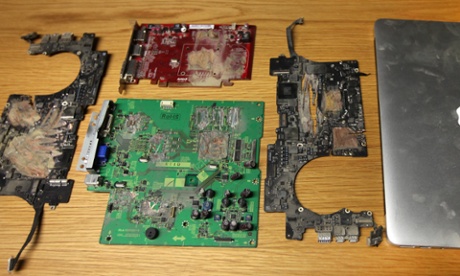
The remains of a computer that held files leaked to the Guardian by Edward Snowden and destroyed while GCHQ officials looked on. Credit: Roger Tooth
Too much news. Hundreds killed in gas attack in Syria. Bradley Manning imprisoned for 35 years. "Sometimes You Have to Pay a Heavy Price to Live in a Free Society"   Egypt!!! Mubarak released from jail. Muslim Brotherhood protest camps really did engage in torture, that wasn’t invented by the military. Guardian smashes its own computer intimidated by Government (but it turns out this happened two months ago so what's going on here??!)  Miranda detained 9 hours under terrorism law and laptop stolen. Can't keep up.  I could perhaps cope with the rest; but the main reason I can't keep up is I'm pre-occupied with my inability to work out what's going on in Egypt.  Can't work out just who supports Tamarod, can't work out the apparent enthusiastic support for the military coup.  By whom? The same people who stood in the square for 3 weeks in February 2011 to oust Mubarak? Those who support the military now will come to regret it that’s definite. Parallels with fascism? By the bye, does the US need the Egyptian military more than the Egyptian military needs the US? Can't work out what I'm meant to think of the Muslim Brotherhood. Before the coup the matter was beyond doubt, now I'm not quite sure. And not being quite sure is a thing I do not like. 

Supporters of Egypt's former Egyptian President Hosni Mubarak (but who are they?) hold his posters and a poster of Army Chief Gen. el-Sissi, left, in front of the Cairo prison where Mubarak has been held, Thursday, Aug 22. (AP Photo/Amr Nabil)

Tuesday, August 6, 2013

Burgers with a bad taste


Two hamburger stories in today's Guardian.

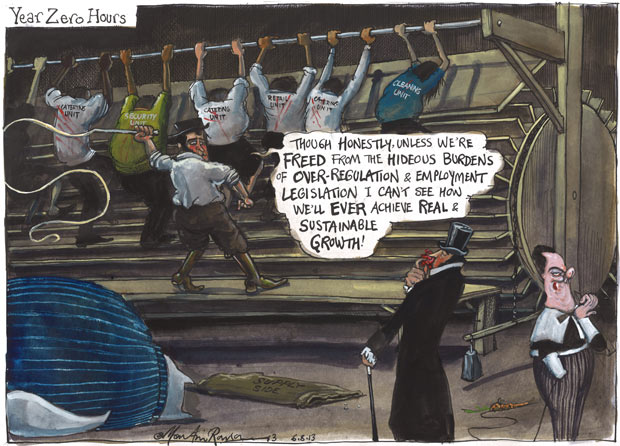
Burger chain McDonald's ties 9 out of 10 workers to zero-hours contracts, we learn. It's Britain's biggest food chain and has 83,000 staff on these exploitative terms. And, no surprise, employers claim the economy needs this sort of flexibility.

I can't really improve on holzy's comment on the Guardian story :

Funny, ain't it ... I mean, the 30+ years of endlessly expanding layers of management and it turns out none of these idiots have a clue how many staff they might need on any given day.

It was prompted by the Institute of Directors attacking calls for a ban on zero-hours contracts, and claiming the UK could be in the same situation as Italy or Spain without a flexible labour market.

Today's Guardian cartoon
A typical clause in these contracts (from another fast food chain) reads: "The company has no duty to provide you with work. Your hours of work are not predetermined and will be notified to you on a weekly basis as soon as is reasonably practicable in advance by your store manager. The company has the right to require you to work varied or extended hours from time to time."

A strike by McDonalds workers in New York points the way forward. But first the workers need to be organised into a union and I know that’s a tough row to hoe.

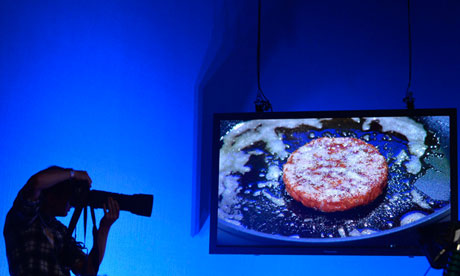
The other story was the frying of the world's first lab-grown beefburger, and the crucial question is: how does it taste? So-so appears to be the answer since at the press conference where it was launched the promoters refused a request for a randomly picked member of the audience to sample it. Though of course that’s not actually the crucial question, is it? The crucial question is should The Guardian have devoted a two-page spread to the event funded by a billionaire American businessman? And will it save the world? A Guardian Poverty Matters Blog lambasts the experiment on the grounds that heavily processed food developed at a phenomenal cost in hi-tech western laboratories is the last thing the world's poorest people need to keep them alive. The true solution is for agriculture to reconnect itself with small farmers.


A cameraman films from a big screen at the press conference as a £250,000 lab burger fries
But maybe this misses the point. If there has to be meat eating, and if there has to be McDonalds – both those if’s need exploring but no space here to do it – maybe lab meat is the answer to the problems this entails: animal welfare, land use, biodiversity, greenhouse gas emissions. It's all in this Guardian background to today’s burger story.

Wednesday, April 17, 2013

Today's funeral arrangements


Night-time dress rehearsal for Thatcher funeral. Credit: www.news.com.au
"We haven't come here to insult anybody, we have come here to tell you there's a different point of view than the one that the media have been pushing and ramming down our throats all the week.

"Our families are markedly insulted of the eulogising of a woman who absolutely destroyed our communities."

The words of miners’ union leader David Douglas, from a passionate address to the crowd in Trafalgar Square at an anti-Thatcher party on Saturday 13th, quoted in Morning Star Online.  “Ex-miners have last word at capital party” was the headline.

Meanwhile Mark Rowe ‏@MarkRowe10 tweeted that when North Korean Kim Jong II died (Dec 2011) UK media ridiculed mourners saying they are all being forced to mourn with no dissent allowed.

Daily Telegraph: What about Clement Attlee?

But let's give the last word to the top Tories’ favourite paper.  On 10th April The Daily Telegraph's columnist Peter Oborne dismissed as flimsy official denials that Thatcher is getting a state funeral. That's what it is, and it’s a mistake, he said. The decision to acknowledge Lady Thatcher, but not Clement Attlee, makes the Queen appear partisan. (Don't forget this is the Daily Telegraph and these things matter to them.)

Here's an extract:-

So the question arises: what’s so special about Maggie Thatcher? Defenders of next week’s funeral arrangements say that she was a “transformational” prime minister. This is true. But so was Clement Attlee, who introduced the welfare system and the National Health Service, thus fundamentally changing the connection between state and individual. Yet the Queen did not attend Mr Attlee’s funeral, a quiet affair in Temple Church near Westminster. According to a 1967 report in Time magazine, “all the trappings of power were absent last week at the funeral of Earl Attlee … there were no honour guards or artillery caissons, no press or television, no crush of spectators. Only 150 friends and relatives gathered for a brief Anglican ceremony in honour of the man who had shaped the political destiny of post-war Britain.”

The decision to acknowledge Lady Thatcher, but not Attlee, makes the Queen appear partisan and is totally out of kilter with the traditional impartiality of the modern British monarchy.


Poster circulated on social media that originally appeared on the front page of The Daily Telegraph (only joking)
No assistance for funerals

By the way, according to the Morning Star, miners' leader David Douglas claimed in his Trafalgar Square speech that during the 1984-85 mining strikes, Thatcher's government had "instructed the social security that no miner's families had to have assistance for funerals."

Uncanny echo of another Daily Telegraph article, this one from 16 July 2012. “Pauper's funerals increase as Government rejects half of welfare applicants” was the headline over a report of a sharp rise in pauper's funerals consequent upon the Government rejecting half of applicants for a state funeral grant. Maybe the Telegraph isn't such a bad paper after all. My Dad (which isn't a surprise) never read anything else. And my friend Mark reads it. For the sport, he says.


Tuesday, April 9, 2013

I reminisce about Thatcher and give OK to parties


Just a couple of reminiscences about Thatcher. And by the way yes it's quite okay to party at her demise. The politicised contest about how to remember her is not about the past it's a battle over Britain's present and future. Read Jonathan Freedland in today’s Guardian. The only reason the expression “state funeral” isn't being used, he says, is to avoid a vote in parliament which would give opportunity for dissent. Palace and government are working hard to make the funeral create the illusion that Thatcher has a cherished place in the nation’s memory.

Michael Foot lost the 1983 election.
A decent cove.
But I promised my reminiscences. One is from the 1983 General Election. Thatcher had been in power for 4 years at this time and it was pretty clear Labour led by Michael Foot were heading for a catastrophic defeat largely due to the SDP split.  Thatcher would increase her majority and five years of misery beckoned. I was the presiding officer at a polling station in Acomb in York. During the evening a working class family came in to vote, and I could tell the middle-aged man had difficulty reading. There was a protocol to follow, which I think involved me going into the voting booth and reading the names on the ballot paper to him. This I offered to do, but soon wished I hadn’t. He drew himself up to his full height and informed me that that whilst he might not be able to read and write, he knew right from wrong. Off he stalked into the polling booth, and when he came back a glimpse at his ballot as he slipped it into the box told me he had voted Labour.
 

The other reminiscence is from the day of Thatcher’s departure in November 1990. Geoffrey Howe’s speech in Parliament had triggered a Conservative leadership election, and though it seemed to be about Europe I think everyone knew it was really about the poll tax.

Poll tax demo in late 1980's
This was a local tax which took huge sums from the poor in order to reduce the tax paid by the rich. Millions refused to pay - 18 million if you believe this anticapitalist website, though I'm not sure I do. The Tories knew they were on to a loser and all three of the contenders to succeed
Thatcher as party leader pledged to abandon the tax.

When it became clear that she wasn’t going to win the leadership election,  Thatcher resigned. Joy all round. The day was Thursday 22nd November 1990.  Eileen and I were due in court within the next the few weeks for poll tax non-payment and we prided ourselves on having contributed in a small way to her downfall.

At that time my Dad was alive and living in Bristol. Every Sunday we used to talk on the phone. He was a big Thatcher supporter, he really loved her, I think that can be said of a lot of her supporters. So on Sunday 25th I didn't ring. I knew he would be sore about her going, and we would have a destructive quarrel. And I'm very glad I didn't, as it would have been our last conversation. A few days later he died suddenly of a heart attack. Those are my Thatcher reminiscences for what they are worth.


Friday, February 15, 2013

Was the big march against Blair’s war in vain?


10 years today. The smudgy pink thing is my ticket to the biggest march in British history. I was bus monitor for bus no 19 from York. Or it might have been bus 17. I know it was a prime number. We sent 21 buses in all. Did we waste our time? Most people, even those who went, will tell you yes, but Peace News is trying to get us to think differently.


Peace News has dubbed 11 March 2003 Wobbly Tuesday, one of the great secrets of the Iraq war, kept secret not by state censorship and repression, but by media and academic self-censorship.  They say it’s time for the British anti-war movement to finally shake off the lie that the astonishing anti-war mobilisation of early 2003 had no effect whatsoever on the British government.

Though we all thought we had marched entirely in vain, the truth is that on Wobbly Tuesday the Blair government panicked. The Sunday Telegraph later reported that "Mr Hoon’s department [the ministry of defence] was frantically preparing contingency plans to 'disconnect' British troops entirely from the military invasion of Iraq, demoting their role to subsequent phases of the campaign and peacekeeping." (Sunday Telegraph, 16 March)

This is taken from wobblytuesday.org a website set up by peace activist Milan Rai.

In the publicity for Ian Sinclair's The march that shook Blair: An oral history of 15 February 2003, to be launched later today, Peace News suggests that “on this evidence, the big march was shock and awe from the bottom up; it came within a hair’s breadth of derailing the warmongers and still shapes our politics today.”

Sadly when it comes to war a hair’s breadth is the difference between life an death.


Tuesday, July 24, 2012

A day I hoped to see but never thought I would


A significant day ... Coulson, Brooks and 6 others charged with phone-hacking. Two years prison is a possibility.  Rebekah Brooks was courted by a Blair, Brown and Cameron. All were desperate for Murdoch’s backing.  It's getting close to Cameron now!  He made Coulson the Tories' director of communications, six months after being News of the World editor, and after one of his reporters was already jailed for phone hacking.

We need to remind ourselves this story is more than just good knockabout fun.  Two years ago, The Guardian reported that MPs had backed down from summoning News of the World editor Rebekah Brooks to testify to a parliamentary committee after being warned their own personal lives would be investigated.  The issue was the same then as now: illegal phone hacking.

So Murdoch was beyond the reach of politicians.

Thank goodness for The Guardian then!

Monday, July 16, 2012

Austerity widens inequality - latest


Income of Ireland's poorest households fell between 2009 and 2010 by over 18% in a single year, while the income of the richest rose by 4%. This is the fruits of the Irish government’s austerity programme according to Social Justice Ireland, a Catholic think tank.

They have issued a policy briefing today; though it doesn't seem to be available yet on their website.  This news was on today’s Morning Ireland programme.  (Link includes an audio clip also a video.)

I think we can be confident that austerity programmes have this effect everywhere.

TUC After Austerity conference

Next. In this 8-miunte video from The Guardian, the American economist Dean Baker and the TUC's Nicola Smith discuss why the UK's economic gains of the past 30 years have gone disproportionately to the wealthiest section of society. They weigh up the arguments for tax credits, capping executive pay, and increasing the minimum wage. Interviewed by Tom Clark at the TUC's After Austerity conference.


Irish inequality deepened spectacularly in 2010

Next, one from the Irish Central Statistics Office (CSO). Probably covering the same ground as the Social Justice Ireland briefing paper, the CSO found that inequality deepened in Ireland spectacularly in 2010. The likelihood is that this worsened in 2011 and will again this year. The Survey in Income and Living Conditions data for 2010, published in late March 2012, showed a devastating disparity in the impact of austerity.  The survey measured impact on people in the lowest income decile (the 10% of households earning least) and the richest decile (the richest 10% of households).

The report states: “Those in the lowest income decile experienced a decrease in equivalised disposable income of more than 26%, while those in the highest income decile experienced an increase in income of more than 8%.” (Equivalised income is derived for weightings, whereby one adult in a household is rated at 1.0, other adults 0.7 each; children 0.5 each.)

Foregoing extract from the CSO report courtesy of Vincent Browne writing in The Irish Times on April 4th, under the heading “Fiscal treaty will increase gap between rich and poor”.  Through the EU, he argues, Ireland has bought into a system of inflicting the costs of austerity on to society's poorer sectors.

Tuesday, July 10, 2012

Lloyd George: 500 men chosen from the unemployed


House of Lords reform in the news. 70 Tory MP’s to rebel and refuse to support the Bill so dear to Nick Clegg and the Lib-Dems; and much speculation that the coalition government will break up.

Lloyd George in 1908 the year before
he made two cracking speeches
During these past few months, whenever the House of Lords is mentioned, you can be sure to find Lloyd George describing it as a body of 500 men chosen at random from amongst the unemployed.

For example, Nick Clegg writing a comment piece in the London Independent on 21st June:

Lloyd George once described the House of Lords as being "a body of 500 men chosen at random from amongst the unemployed". In the years since he made that remark all that has really changed is the number – we are now pushing nearly 1,000 peers who get £300 tax-free a day just for turning up, more than half from the ranks of retired or failed politicians. For those retired MPs in the Lords, this amounts to a £1m top-up to their pensions.

A catchy phrase "chosen at random from amongst the unemployed", so what did Lloyd George actually say and when did he say it?   

It's in a speech he gave in Newcastle on 9 October 1909, in the course of the controversy over that year's People’s Budget.  The House of Lords had vetoed it because of a modest land tax to fund pensions for workers.  Lloyd George argued that the House of Lords had no right to the veto since it was an established constitutional principle that the House of Commons had the final say on budgets.  And he challenged the Lords thus:

Let them realise what they are doing. They are forcing a revolution, and they will get it. The Lords may decree a revolution, but the people will direct it. If they begin, issues will be raised that they little dream of. Questions will be asked which are now whispered in humble voices, and answers will be demanded then with authority. The question will be asked whether five hundred men, ordinary men chosen accidentally from among the unemployed, should override the judgment, the deliberate judgment, of millions of people who are engaged in the industry which makes the wealth of the country.

This is good stuff. There's more. And take note, this a Chancellor of the Exchequer speaking. 

That is one question. Another will be, Who ordained that a few should have the land of Britain as a perquisite? Who made ten thousand people owners of the soil, and the rest of us trespassers in the land of our birth? Who is it who is responsible for the scheme of things whereby one man is engaged through life in grinding labour to win a bare and precarious subsistence for himself, and when, at the end of his days, he claims at the hands of the community he served a poor pension of eightpence a day, he can only get it through a revolution, and another man who does not toil receives every hour of the day, every hour of the night, whilst he slumbers, more than his poor neighbour receives in a whole year of toil? Where did the table of that law come from? Whose finger inscribed it? These are the questions that will be asked.

Read the Newcastle speech in full.

Also worth reading is his Limehouse speech given a couple of months earlier. I remember the name from school history lessons. Write an essay on the reforms of the 1906 Liberal Government. 10 points to include, no 7, the Limehouse speech.  Limehouse, I know now from Wikipedia, but I probably didn't know then, was one of the poorest areas of the East End of London.

Tuesday, June 12, 2012

Libraries without money better than money without libraries


Just seen a rather good libraries slogan, pity it's a bit long for a placard ...

Libraries will get you through times of no money better than money will get you through times of no libraries

Library campaigners with placards outside the high court in December 2011 [1]
Attributed to Anne Herbert, an American writer, born 1952, of whom I know nothing.  It seems she derived it from a quote of Gilbert Shelton (of whom I also know nothing): "Dope will get you through times of no money better than money will get you through times of no dope."

Another of her pronouncements is:  "Practice random kindness and senseless acts of beauty."

UK Library campaigning links:

    Save Our Libraries campaign, one year on (Guardian books blog, Jan 2012)

[1] The high court protesters were from Brent, in an unsuccessful bid to obtain a judicial review of closures. (Photo: Guardian) 

Thursday, December 8, 2011

Bosses pay too high? Then move to Cuba!


A report has suggested that workers representatives should sit on company remuneration committees. But the idea is barking mad and if that’s what you think you should move to Cuba. So said Heather McGregor of executive recruitment firm Taylor Bennett on the BBC.

Deborah Hargreaves
chair of the High Pay Commission
McGregor was on the Today Programme interviewed by John Humphrys on 22nd November, the day the report was released. It’s good knockabout stuff. McGregor says there is no such thing as too much, or too little for that matter, and that the concept of fairness is for 7-year olds. While the High Pay Commission’s Deborah Hargreaves reveals that in the past 30 years we have seen the ratio between company directors and average pay stretch from a multiple of around 13 to over 100.

The background is a year long inquiry into boardroom pay which has found that excessive deals for the UK's top bosses is having a corrosive effect on the economy, for companies as well as society as a whole.

The High Pay Commission was set up by the mildly leftwing think tank Compass. Their report argues that, left unchecked, income inequality will be back at Victorian levels before long. One of the drivers of this is the runaway train of boardroom pay. Despite the financial crisis, executive pay has continued to grow at levels far in excess of inflation.

It's an argument very much in line with The Spirit Level , a must-read book that produces a wealth of evidence that inequality (not merely absolute poverty) causes shorter, unhealthier and unhappier lives, whilst functioning as a driver of consumption and depleting the planet's resources.

Links

Here's a Guardian podcast where Deborah Hargreaves discusses her report with Guardian city editor Jill Treanor.

High Pay Commission

Heather McGregor's company

Wednesday, November 30, 2011

Solidarity with all on strike in the UK today


A picket at a York hospital this morning (York Press)


Public service workers are not asking for more – they just want the pension benefits they signed up for to stand.


The 19th century black anti-slavery campaigner Frederick Douglass said:-


"Find out just what the people will submit to and you have found out the exact amount of injustice and wrong which will be imposed upon them."

Sunday, September 4, 2011

Cameron, the Bullingdon Club and the riots


Hear Cameron on BBC's Today programme on Friday. Presenter Evan Davies asked Cameron whether there was any parallel between the antics of Oxford University’s Bullingdon Club of which Cameron was a member, and last month's riots.


ED : “Did you witness stuff at the Bullingdon Club … did you see people throwing things through windows, smashing up restaurants … ?”

DC : “No I didn’t. We all do stupid things …”

ED : “It’s all written about as a very violent group.”

DC : “… when we’re young. And I think that’s clear. But I think what we saw in terms of the riots was actually very well organised in many cases … ”

ED : “Well, the Bullingdon Club was well organised.”

DC : “ … looting and stealing a thieving. We have to react very clearly to that.”

Friday, August 19, 2011

Riots: More politics than I thought


Have just come across this article in last Saturday's Irish Examiner (13th Aug), by Mohammed Abbas, a Reuters journalist writing from London.


‘This law and order is dishonest. I get stopped and searched. You won’t’

There's more politics in here than I thought. Mohammed Abbas talked to some rioters in Hackney, and here are a few quotes:-

"The looting was done, not just because they can’t afford the stuff, it was done to show they just don’t give a shit... We’re here and not going away."

"It’s like the old days. It’s bringing the community spirit back. Even though it’s a sad way to do it, it’s bringing the community together."

"But if the riots kick off again, I’m going. It’s history, it’s a revolution."

"I loved Hackney during the riot. I loved every minute of it. It was great to see the people coming together to show the authorities that they cannot just come out here bullying."

Thursday, August 18, 2011

Giving rioting a bad name


‘If you’re not careful the newspapers will have you hating the people who are being oppressed and loving the people who are doing the oppressing.’
- Malcolm X


First of all: you can hold disparate opinions about the riots if you want to. I can say that the causes of the riots are rampant consumerism, vast and rapidly increasing inequality, and thousands of lives without hope. And I can say that the looting perpetrated by the rioters was an amateurish affair compared to the industrial scale looting perpetrated year after year by bankers. Yet at the same time I can also say I should take it a deep personal failure if any grandchild of mine was mixed up in most of what I've seen on the screen and read about. I can say that some of the rioters were the scum of the earth. I can also pose the question: how did they come to be this way? All those things I can think simultaneously.

Yes. What happened in London and elsewhere in England has given rioting a bad name. The very word riot implies some sort of political consciousness which was notably absent. Not wholly so though. I did see one looter say to a reporter who challenged him ”these big shops can afford it”. But that doesn’t excuse indiscriminate (indiscriminate is the operative word here) looting, arson and violence.


The Spirit Level

If you haven't read The Spirit Level you should. It produces a wealth of evidence that inequality (not merely absolute poverty) causes shorter, unhealthier and unhappier lives, whilst functioning as a driver of consumption and depleting the planet's resources.

The full title is The Spirit Level - Why equality is better for everyone, 2009, by Richard Wilkinson and Kate Pickett.

Cameron can declare war on gangs but he needs to lose his attitude first. If gangs didn’t serve a purpose they wouldn't exist. He needs to work out what their purpose is. And why that purpose is served by gangs and not by more socially useful organisations such as work, trade unions, political parties, churches, youth clubs and the like.


Who were the rioters?

A few extracts from the newspapers.

From The Guardian Wednesday 10 August. “Who are the rioters? Young men from poor areas; but that's not the full story”. Paul Lewis and James Harkin reported that the crowds involved in violence and looting are drawn from a complex mix of social and racial backgrounds. As Lewis and Harkin followed a group of looters who had just finished ransacking a pawnbroker's, and had started cleaning out a local fashion boutique, they witnessed an angry young black woman berating one of the looters.

" ‘You're taking the piss, man. That woman hand-stitches everything, she's built that shop up from nothing. It's like stealing from your mum.’ A girl holding a looted wedding dress smiled sheepishly, stuck for anything to say. ”

The context suggests the angry young black woman was herself a looter, though the story doesn’t say.

Terry Prone had a piece in the
Irish Examiner 15th August “No easy answers as to why ordinary people were stirred into looting”. She mentions two cases that came to court. The youngest of the looters captured was an 11-year-old who had stolen a trash can. It might have been a wheelie bin. Or it might have been a static garbage container. The details didn’t come out in court. All that came out in evidence was that he had stolen this trash can. Outside the court, his mother turned to him and asked him the lethal simple question, to which she got no answer: “Why?”

The other case Terry Prone mentions was an aspirant social worker. Natasha Reid, aged 24, didn’t wait for the police to identify her from CCTV footage. She had nicked a TV set from one of the shops broken into during the rioting, and turned herself in, having, according to her mother, spent a couple of days in her bedroom, doing nothing but crying. This young graduate knew she was guilty, and was ashamed of what she had done.

Her mother, baffled by the three days which had put her daughter on the front pages of newspapers worldwide and put paid to any chance of getting a job as a social worker, told reporters: ’She didn’t want a TV. She doesn’t even know why she took it. She doesn’t need a telly.’ "


Looting in the London Blitz

A couple of pieces from the papers in 2010, the 70th anniversary of the Blitz. Duncan Campbell revealed how black marketeers, thieves and looters took advantage of the misfortunes of war, in The Observer 29 August 2010.

And then there's the Café de Paris incident, a nightclub hit on 8 March, 1941. Two bombs hurtled down a ventilation shaft from the roof and exploded in the basement nightclub right in front of the band. The carnage caused by the explosion in that confined space was dreadful. The Daily Mail online 9th April 2010 reports :

“The worst of human nature was in evidence that night too – amid the rubble and the chaos, unscrupulous looters were seen cutting off the fingers of the dead to steal their rings.”

It is also widely reported on the internet (but always in precisely the same phraseology which means it may be false) that on the same night "even the wounded in the Café de Paris were robbed of their jewellery amid the confusion and carnage".

Echo here of that prize scum of the earth incident, the Youtube clip of the bad samaritans, two youths pretending to assist a hurt Malaysian student whilst robbing him.


Links

Red Pepper blog

Zoe Williams in The Guardian, Tuesday 9 August: The psychology of looting - she says the shocking acts of looting may not be political, but they nevertheless say something about the beaten-down lives of the rioters.

More Malcolm X quotes