Showing posts with label Politics. Show all posts

Thursday, April 27, 2017

Science placards around the world


This placard from Boston is my absolute favourite from the biggest science event in history, the global March for Science on 22nd April.   And here are the runners-up:-


In no. 2 place, Think while it's still legal.  A similar thought prompted a Swedish placard in Stockholm: Våga Fråga! (the å's are pronounced like English "or"). It means "Dare to ask", nicely encapsulating the scientific enterprise - enquire, then follow the data wherever it leads.


I must include I'm not a zoologist ... perhaps I should have placed it higher up my list, but here it comes at no. 4:-


And this photo contains a few more worth a glance.  You've got to smile at When do we want it, after peer review, and Paid scientist, I protest for free.  Science not silence was a slogan used in many protests across the globe.  We can call these 4(a), (b) and (c). Next,  Less Invasions More Equations deserves a place, here it is at no. 5:-


I'm with Her is a nice repurposing of a Hilary Clinton slogan. This one was from Paris:-


Not an alternative fact was mass produced, I've seen it in numerous photos, so while certainly rating a mention, I have to put it bottom of my list:-


All good humoured stuff. A pity then that we have to end on a sour note. Did Donald Trump really need to turn up in New York and spoil the day by playing golf with the Earth? So very sad.


Wednesday, December 14, 2016

Dr Johnson and a head carved on a carrot

Two months since I wrote anything here, what’s all this delay? Surely I can come up with some insightful and entertaining bon mots pertaining to Jane Austen? Or how about some nugget culled from the dusty byways of English grammar?  Well, perhaps  … but my mind’s been elsewhere,  agonising about Brexit, Trump, the drift towards fascism and what is to be done ...  and just how, why and when did anti globalisation which used to the province of the left, become a plaything for the extreme right. Tonight I've given up trying to pen something on these themes that you haven't read much better elsewhere, so I've decided to talk about Samuel Johnson instead.  Till a few days ago I only knew his definition of oats, “a grain, which in England is generally given to horses, but in Scotland supports the people.”  To which his Scotch friend Boswell retorted, “But Sir, what horses, and what people!”  The dictionary definition is actual, though so far as I can tell Boswell’s retort isn't. I picked up a copy of Boswell’s Life of Johnson in a cancer charity shop in Cork last week, and may I take this opportunity to recommend you get or borrow a copy yourself. Almost every page contains pure entertainment.  

Left to right. Samuel Johnson c. 1772, painted by Sir Joshua Reynolds. “Am I not a man and a brother” – medallion made in 1787 by Josiah Wedgwood [1]. James Boswell at 25, by George Willison

The first thing to say is Johnson was a strong slavery abolitionist, and no friend to the American colonists. Boswell records that in 1777, when in company with some very grave men at Oxford, Johnson’s toast was, “Here’s to the next insurrection of the negroes in the West Indies.” Johnson’s “violent prejudice against our West Indian and American settlers appeared whenever there was an opportunity”, Boswell tells us, revealing his own prejudice.  Of the American colonists, Johnson said: “how is it that we hear the loudest yelps for liberty among the drivers of negroes?”  [2]

His colour sufficient testimony 

It seems that in the year 1777 a negro was claiming his liberty in a Scottish court, and Johnson dictated an argument in his favour.  No law but that of violence, subjects a negro to his master, he argues; and the slaveholder’s pretended claim to the negro’s obedience is based on having “bought him from a merchant of slaves, whose right to sell him never was examined ….  The laws of Jamaica afford a Negro no redress.  His colour is considered as a sufficient testimony against him.”  The argument is worth reading in full, and I have it for you, along with a handful of other extracts from
The Life of Johnson, on a separate page.  Johnson could get vexed when opposed in argument, and after debating slavery and the taxing of the American colonies, two subjects which Johnson and Boswell disagreed on, they went to bed bad friends. 

As you would expect from the writer of the first dictionary, Johnson was jealous of infractions on the English language.  He found fault with Boswell for using the phrase to make money. “Don’t you see (said he) the impropriety of it?  To make money is to coin it: you should say get money.” Boswell doesn't agree though, and thinks the phrase to make money is pretty current. In an object lesson to those of us who would stem the tide of language change, Johnson “was particularly indignant against the almost universal use of the word idea in the sense of notion or opinion, when it is clear that idea can only signify something of which an image can be formed in the mind”. We may have an idea or image of a mountain, a tree, or a building; but Johnson objected to an idea or image of an argument or proposition.  Lawyers “delivering their ideas upon the question under consideration” was modern cant, he thought.[3]

The finest head cut on a carrot 

Going into a convent for fear of being immoral was like a man cutting off his hands for fear he should steal. “There is, indeed, great resolution in the immediate act of dismembering himself; but when that is once done, he has no longer any merit: for though it is out of his power to steal, yet he may all his life be a thief in his heart.”

He argued against the value of sculpture. Painting is okay, as it consumes labour proportionate to its effect; “but a fellow will hack half a year at a block of marble to make something in stone that hardly resembles a man. The value of statuary is owing to its difficulty. You would not value the finest head cut upon a carrot.”  

Two final offerings, Johnson declared “It is commonly a weak man who marries for love”, and thought it was better to shoot a highwayman in the heat of the moment than to testify against him later in cold blood.  You can find all these things in my extracts.

I'm collecting books that Jane Austen had on her own shelves. According to her brother Henry, Johnson was her favourite moral writer in prose [4].  And in a 1798 letter, Austen wrote of getting Boswell’s Life of Johnson.  I'm now reading Johnson’s Rasselas, and have recently finished a handful of other 18th century novels. Which are not, I'm happy to say, as bad as I expected. My mistake was starting with Richardson’s Pamela.  It's dire, but I'm reassured to find Johnson also thought Richardson dire. More of this anon perhaps.

As a postscript, I see that challenged by Boswell about his prejudice against the Scots, Johnson admitted: “Why, I own, that by my definition of oats I meant to vex them.” (1783)


[1] For slave medallion by Staffordshire pottery manufacturer Josiah Wedgwood, see Smithsonian National Museum of American History 

​[2] Another Englishman, the abolitionist Thomas Day, wrote in 1776 that “if there be an object truly ridiculous in nature, it is an American patriot, signing resolutions of independency with the one hand, and with the other brandishing a whip over his affrighted slaves.”  Can't find the source for this.

[3] In Rasselas I find: “Knowledge is certainly one of the means of pleasure, as is confessed by the natural desire which every mind feels of increasing its ideas.” (ch XI) Here Johnson appears to have flouted his own rule.

[4] Henry Austen “Biographical Notice” in the 1st edition of Northanger Abbey (Dec 13th 1817)

Monday, November 23, 2015

Flags, Paris, ISIS - a few thoughts

This post is far from a considered essay I'm afraid, more a stream of consciousness. I'll start with French and Irish tricoleurs on a rain soaked street in Cork this afternoon.  And an image going the rounds on Facebook of the Malian flag, where French flags have sprung up adorning many users’ pages. These flags have been called forth by an ISIS atrocity in Paris ten days ago, on 13th November, which has dominated the international news. Unlike a similar one in Mali on the 21st, which gave rise to no flags on Facebook.  Bombings in Beirut on 12 November, likewise attracted little coverage.

The Guardian’s readers editor, reflecting today on his own paper’s recent opinion pages, made an arresting point about when is the right time to express certain views: “The idea that these horrific attacks have causes and that one of those causes may be the west’s policies is something that in the immediate aftermath might inspire anger. Three days later, it’s a point of view that should be heard.” 

He also responded to a complaint that when the Paris story first broke on Friday 13th, the Guardian website didn't immediately open it for comments. This was because there were very few moderators available and, regrettably, a considerable number of people wanted to leave Islamophobic comments, alongside the many others who wanted to engage in legitimate debate.

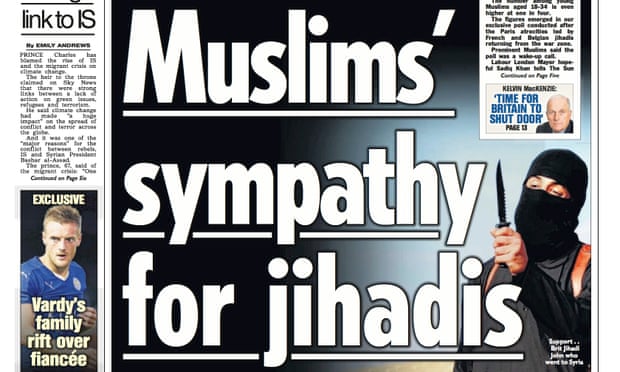
If it's Islamophobia you want, look no further than today’s Sun, a tabloid with the highest circulation in the UK. 


Demolished in The Guardian
by Miqdaad Versi for being  irresponsible, dangerous and grossly misleading. As many commentators have pointed out, the Sun story is precisely what ISIS in their black and white world want.

An interview on RTÉ radio made a big impression on me, if I have time later I'll find the link. A French senator, from the socialist party I infer, defended  the French response to the Paris attack, namely to step up bombing of ISIS positions. She also welcomed a UN security council resolution backing “all necessary measures” to prevent and suppress ISIS terrorist acts on territory under its control.

So far, all according to script. Until at the very end, when the radio presenter asked her about the upcoming French elections, and would the Front National be making gains? Then we got her authentic voice: “I'm scared, I'm really scared” she said, of the right wing backlash that might arise from these attacks.

I see that I confidently asserted just now that I know what ISIS wants, and it occurs to me that I actually know no such thing. I've read  “7 things I learned reading every issue of ISIS's magazine” by one Robert Evans on a website called Cracked. Now I know nothing of Evans nor his website, but find I'm reduced to trawling around the internet for any scraps of insight I can gather, and this just may be worth a read. ISIS it seems has a glossy magazine that Evans has studied at length.  Amongst other things,  the primary target of their hatred is not the United States,  France or Russia; the one "enemy" they devote more time to ranting against than anyone else is the "apostate Muslims", who form the vast majority of their victims. I suppose we knew that already, but in the last week it's all been hidden by events in Paris.

Most propaganda makes enemies appear ugly and brutal, whilst portraying one's own side as shining and blameless, says Evans. But the Islamic State does not do this. And “their fawning ads about various jihadis don't show only happy pictures ... they almost always include a picture of the man's corpse.”

President Holland reacted immediately to the Paris outrages by announcing a new bombing campaign.  Isn't this just revenge, and demeaning to France? Treading in the footsteps of George W Bush and Tony Blair and their war on terror.  You can't make war on an idea, only on a state. ISIS likes to call itself a state and now they’ve all declared war on it, so it is one.  The war ISIS wants, according to Scott Atran on the New York Review of Books website.
 

Atran's article also touches on a question that bothers me and probably you, the horrific, seemingly senseless, violence that ISIS followers engage in.  But to them it's a deeply purposeful part of an exalted campaign of purification through sacrificial killing and self-immolation.  This finding is based, he says, on interviews with youth in Western cities as well as with captured ISIS fighters in the Middle East.

Or is this all wrong, and are they deranged and pathetic?

When it became known ten days ago that the Islamic State militant known as "Jihadi John" had been killed by a US drone, the mother of American journalist James Foley, who was beheaded last year in Syria, said she felt no solace in the killing.  "It saddens me that here in America we're celebrating the killing of this deranged, pathetic young man," Diane Foley says in an ABC video. "Jim would have been devastated with the whole thing. He was a peacemaker. He wanted to know how we could figure out why all this was happening."

Just disjointed thoughts really, and not up to my usual standard, but I hope you find some of the links useful. I'll finish with one more, from the Guardian website again, yesterday. Why do Islamist groups in particular seem so much more sadistic, even evil, asks Kenan Malik. Amongst his answers he suggest that over the past few decades anti-imperialist traditions based on Marxism and other leftwing perspectives have unravelled, leaving political rage against the West nothing but nihilistic, barbaric forms.

As a postscript here are two more links that have been
recommended to me by Dave and Stevey

(1) This article, and its part 2, covers the history of ISIS.  Huffington Post: “You can't understand ISIS if you don't know the history of Wahhabism in Saudi Arabia”

(2)  Atlantic.com:
The Islamic State is no mere collection of psychopaths, but a religious group with carefully considered beliefs, amongst them that it is a key agent of the coming apocalypse.

Saturday, October 24, 2015

A US national park on the Moon?


Buzz Aldrin salutes the US flag on the Moon, 1969. (Wikipedia)
Should the site be a US national park?
I want to say a few words about archaeology in space; and in particular a Bill in the US Congress mandating that the Apollo 11 landing site on the Moon will be a US national park. The Bill was introduced in July 2013; and though I have no reason to believe that it will ever go anywhere, for I've seen nothing about it since, nonetheless, as I started on this story a few years ago, I feel obliged to bring it up to date.

Back in 2012 my eye was caught by a zany act of the state of California a couple of years earlier, placing preservation orders on the Apollo 11 Moon landing site.  A bizarre act of extraterrestrial heritage imperialism I called it, in a blog post called "To boldly preserve where no man has preserved before". 

But a Bill in the US Congress ratchets the whole enterprise up a notch. So it needs to be said that whilst protecting the Apollo sites is laudable, making them US national parks is not.

Now without a doubt, the US Apollo programme was a premier technological accomplishment of the 20th century. Preserving the six historic landing sites of the manned Apollo missions is important, along with the mementos and equipment still lying around on the Moon.  The same goes for other US missions such as Ranger and Surveyor, and indeed the Soviet Luna missions.

But the US National Park System Act states that the parks are “managed for the benefit and inspiration of all the people of the United States”.  A direct conflict therefore with the 1967 Outer Space Treaty, which clearly emphasizes that the exploration and use of space by nations is to benefit all peoples. Article II of the Treaty provides that “outer space, the moon and other celestial bodies are not subject to national appropriation by claim of sovereignty, by means of use or occupation, or by any other means.” Whichever way you cut it, designating a national park on the Moon would amount to a territorial claim. Nor is submitting the Apollo 11 lunar landing site to UNESCO for designation as a World Heritage Site a way out, as World Heritage Sites are located on the sovereign territory of nations. So this would violate the 1967 Outer Space Treaty too.

Science journal in November 2013 (Vol 342, p 1049) makes these points, and proposes instead an international agreement on lunar artefacts among the United States, Russia, and China.  Other states could join in due course. This would be a far superior and long-lasting solution to a unilateral US proclamation, the article claims.

Private property in space

There are plenty of corporations and their henchmen calling for private property rights on the Moon and elsewhere in space, and the 1967 Outer Space Treaty framework needs supporting.

Should you wish to follow up the private property in space debate, I have a website with plenty of links.  You'll find clear expositions of the case for and against space property rights.  My favourite has to be a piece called “Marx on Mars” by one Virgiliu Pop, a Romanian space lawyer. This is a frontal assault on the Moon Agreement’s embracing of the Common Heritage of Mankind principle.  The principle is based (he says) on Marxism, and Marxism (he says) is a fallacy.  Wonderful stuff.

I'm going to Limerick soon to give a talk to the astronomy club there on the ethics of space exploration, and I just wanted to get this update in beforehand. By the way, if undisturbed, the bootprints in the foreground of the Buzz Aldrin photo might outlive all human artefacts on Earth.


Monday, July 6, 2015

Greece: the bell tolls for whom?


Best tweet: The European Union has lost, Europe has won
Yanis Varoufakis, who today surprised us all by resigning as finance minister after the Greek referendum, liked to quote John Donne, “No man is an island, entire of itself; every man is a piece of the continent, a part of the main.”  This was his way of calling for European solidarity, and asserting that a community is judged by how it treats its weakest members.  Though Varoufakis wasn’t really quoting John Donne, he was quoting Ernest Hemingway, who put "No man is an island" on the frontispiece of his 1940 novel For Whom The Bell Tolls, thereby catapulting it into the top 100 quotes in the English language. 

The frontispiece of Hemingway’s For Whom The Bell Tolls
The passage is actually buried deep within one of Donne's rather dull meditations (Meditation XVII, 1624) and I imagine it's Hemingway we have to thank for excavating it from there. Or did someone else quote it before him?

Yanis Varoufakis, it seems, is fond of quoting English poets.  Susanne Moore writes in today’s Guardian of how she heard him on the radio saying that his fellow Greeks chose, “to quote your own Dylan Thomas, to stop going gently into the night and to rage against the dying of the light”.


A Greek woman thanks Yanis Varoufakis for standing up to the EU
My final linguistic thought arising out of the news from Greece, is prompted by today’s Guardian editorial. It says that kicking the can down the road has been the cliché of choice to describe the slow euro crisis that has steadily strangled the life out of the Greek economy; but yesterday Europe ran out of road when the Greek people said no to continuing to engage with their creditors on the same suffocating terms. I want to say something about the kicking the can down the road, and I'll do so soon. It takes me back to a brilliant game we played at school.  And by the way Donne might have written some dull meditations but he wrote some marvellous poems, sometime I must record one for you.

Humph. It occurs to me there's not been a lot of politics in this blog so I'll leave you with Varoufakis's resignation statement. He says the referendum of 5 July will stay in history as a unique moment when a small European nation rose up against debt bondage. And “I wear the creditors' loathing with pride”. 

Monday, May 25, 2015

Reflections on that referendum


Home to vote: image that appeared in the Irish Examiner the day after the referendum with the caption “one of many emigrants that returned home yesterday to vote”.
A few reflections on the Irish marriage referendum, now that the result is known: Yes 62% No 38%, with a turnout of more than 60%.  

The Yes campaign brought about the largest turnout in a referendum in over two decades (we have plenty in Ireland), and it's led to talk of a “social revolution” and a “tsunami of support”.  A mass invasion of polling stations by young people, and the home to vote campaign (which I've only become aware of in the past couple of days). And grandparents turning out to vote yes too. “The people’s resounding approval of gay marriage was influenced by an energetic, orderly, and unprecedented campaign that points to a potential sea change in the future of Irish politics”  in the words of the Irish Examiner.

I'm not sure I can go along with this tsunami business. 60% turnout? Hmm. But what is true is that anyone over 40 can remember when government and people were in thrall to the Catholic Church. And that's now gone.  On Friday night, before the count,
I commented that in this locality Catholic mass attendance by people of my age is high, and I predicted that many massgoers would take their lead from the Catholic bishops.  Well I got a surprise. Looking at the voting figures for our constituency (Cork East) I see they very closely mirror the national average. Fewer Yes's than in Dublin, for sure, where it was over 70% - nonetheless, way higher than I expected.

Archbishop Diarmuid Martin: not wholehearted
It's worth mentioning that the Catholic Church didn't speak with a single voice.  Archbishop Diarmuid Martin of Dublin didn't appear wholehearted in his opposition. “In airing my views in public debate, I do not expect to be listened to on the basis of dogmatic utterance, but on the reasonableness of my argument.”

And more than one Catholic priest publicly stated an intention to vote for gay marriage.  Fr Iggy O’Donovan for one, prompting a reader to the Irish Catholic to write “Dear Editor, I was flabbergasted to read of Fr Iggy O’Donovan’s reported intention to vote yes in regard to the referendum concerning same-sex marriage. I read the article three times to ensure I had not misconstrued the press report!”

An amusing anecdote from the campaign. The loving family appearing in the Vote No poster that featured at the top of my last post, weren't Irish, didn't know about the referendum, and when they found out, came on national radio to explain that they didn't support voting No. Lastly, can I justify the statement that Ireland was recently in thrall to the Catholic Church?  I can but not now.  For a taster I refer to the divorce referendums of 1986 and 1995 (previous post), and what I wrote about the Mother and Child crisis of 1951.


Friday, May 22, 2015

On today's gay marriage referendum in Ireland


Well, have voted in Ireland’s marriage equality referendum, and we’ll have to wait till tomorrow for the count.  All commentators are confident it will be passed. 

The necessity by the way for gay marriage to be put to a referendum, arises due to marriage being enshrined in the Irish constitution; and a constitutional amendment requires a referendum. The amendment voted on today is to add a clause to article 41. I would actually have preferred a different approach. Had I my way, the question on the ballot paper would have been to delete article 41 in its entirety, as it's already a hodge podge.   See for yourself.

It includes the state recognising “that by her life within the home, woman gives to the State a support without which the common good cannot be achieved.” And it contains the grounds for divorce (living apart for at least four years and no reasonable prospect of a reconciliation). Which apart from being too restrictive, just doesn't belong in a constitution, it belongs in legislation.

I should mention the historical background to these divorce clauses being in article 41. The present constitution began life in 1937 and when first adopted included an absolute ban on divorce.  To allow divorce at all, therefore, needed a constitutional amendment; and this was done by the Fifteenth Amendment in 1995.  That was the second divorce referendum. The first was in 1986 where the proposal to allow divorce was defeated by a whopping margin of almost 2:1. The 1937 constitution was a strongly Catholic document, and in 1986 the Catholic Church still held sway to keep it that way. 
Even in 1995, divorce only got through by a whisker.  

Two referendums today


There was another referendum today. It was to reduce the minimum age for candidates for the presidency from 35 to 21. Well, OK, I did vote for this, but heavens above, there are more pressing constitutional amendments that ought to have priority, and were considered by a constitutional convention last year.  Blasphemy for one.  The constitution provides that “the publication or utterance of blasphemous, seditious, or indecent matter is an offence which shall be punishable in accordance with law”, though strangely
blasphemy wasn’t actually legislated against until 2009. No that’s not a typo, 2009.

Apparently there was a high turnout today in urban centres which indicates success for the Yes side,  as the No’s are likely to reside in rural Ireland where the Catholic Church still has some residual influence.  Here's this week’s Mitchelstown mass leaflet.


In this locality, mass attendance by people of my age is high, and many massgoers will, I'm fairly sure, take their lead from the Catholic bishops. Younger generations, less so. Generally, young voters appear to have been hugely energised by the Yes campaign, especially in urban areas.


According to the Irish Times whose website I've just consulted, the turnout across Dublin county was 65%, and in Cork city was above 60%.  For a referendum that's high, apparently.

I forgot to mention what would follow if my plan were to be followed to scrap article 41 entirely.  I would then enact legislation which would delete “marriage” from all laws. The state would register civil partnerships only, and all existing marriages would be reclassified as civil partnerships.  Henceforth marriage would be a cultural event that you could do in church or other venue of your choice.   If you believe that marriage is a union of man and woman, open to the procreation of children, and a gift from God, then there would be no apparent conflict between that belief and the law of the land.


Tuesday, January 27, 2015

Greece: let's prove the Cassandras wrong ... oops


Tsipras: The Cassandras will be proved wrong
I wish Alexis Tsipras well and foresee that soon socialists across Europe will be called upon to demonstrate in support of Greece’s new anti-austerity government. Already two days after being elected it is set on collision course with Brussels, as corporate-friendly politicians and central bankers try to beat the Greek people back into submission.

Cassandra: gift of prophesy
Nonetheless, the Classical Association of Ireland has drawn a faux pas to my attention and I feel duty bound to draw it to yours.  Before an audience of thousands of supporters, Tsipras announced: “Friends, the new Greek government will prove all the Cassandras of the world wrong. [There will be] no mutually destructive clash … We have a great opportunity for a new beginning.”

As the Guardian put it: Cue gasps of horror from Hellenists around the world.

We know of course what Tsipras intended.  By employing the Cassandra trope, he was making a reference to all the aforementioned politicians and central bankers who have variously predicted the end of Greece / the Euro / world economic policy / life as we know it, should his party Syriza get elected.  Cassandra’s prophesies of doom were all wrong, and all today’s prophets of doom will be proved wrong too.

The trouble is that when Cassandra foretold doom she was always RIGHT.  So drawing a parallel with today’s politicians and bankers was the very opposite of what Tsipras wanted, and has exposed him to Twitter ridicule. 

Cassandra was right (but not believed) when she foretold that her brother Paris, by abducting Helen from Sparta to Troy, would cause ten years of war and Troy’s downfall. She was right (but not believed) when she advised the Trojans to leave the Trojan Horse on the beach, and by no means to bring it into the city.  See Beware of Greeks bearing gifts.


Trojan Horse: Cassandra got it right
So who was Cassandra? A princess of Troy, both beautiful, and considered insane and a liar. This was the consequence of being cursed by the god Apollo. She had consented to have sex with him in exchange for the gift of prophecy, and then broke her promise. The curse was that she was simultaneously given the gift of prophesy, and destined never to be believed. This is how the myth is told in Aeschylus’s Agamemnon. There are other versions  if you’re interested, but you shouldn’t be, and neither should I, as we should be interested in what's going to happen in Greece.

The Irish left wing deputy Richard Boyd Barret commented this week:

“While [Irish prime minister] Enda Kenny hob-knobbed in Davos this week with the very people who inflicted such misery on the people of this country and Europe, the Greek people have shown us that our real allies are the ordinary citizens of Europe and that we need a European-wide movement of people power to demand debt relief and an end to austerity."

In closing, let's note alarm that Syriza has felt obliged to go into coalition with the right-wing Independent Greeks who (if my information is correct) are racist and anti-immigrant ... and there are signs already of Tsipras compromising on
Syriza's programme and dropping some of their more radical proposals. But all the more reason to manifest support for Syriza outside Greece. 

Sunday, August 17, 2014

Will Ireland defy tobacco giants?


Were this image from a 1930’s film poster it would suggest cool and sophisticated (though perhaps in the 1930’s cool didn't mean sophisticated). Be that as it may, the image is actually from the Irish Examiner website where it's meant to suggest sinister and harmful, and it heads a story that Irish prime minister Enda Kenny has got a letter encouraging him to scrap plans to become the second country in the world after Australia to impose plain packaging regulations on cigarette companies.

The letter is signed by 27 members of the European parliament, nearly half of them members of Chancellor Angela Merkel’s party. They say plain packaging legislation could threaten Ireland’s financial recovery, and according to an Irish Examiner editorial of 12th August,  the letter is a thinly-veiled threat.  Which is good news in a way as it confirms that existing tobacco controls in Ireland, and plain packaging already introduced in Australia, are working. The Australian regulations came into effect in December 2012. Clearly, tobacco companies fear that these measures might be replicated across an ever-more health conscious European Union.

The Irish Examiner’s main leader last Tuesday flew under the heading “Fighting the tobacco giants - Government should defy lobbyists”, and began “Tobacco conglomerates spent decades challenging the science that proved nicotine was addictive. They dishonestly spent decades rubbishing the science that identified their products as cancerous and the root cause of fatal diseases.”

Read it in full to be reminded of the issues. It concludes by urging the Irish government to press ahead with their plans to make it ever more difficult to sell tobacco in this country and to tell the German lobbyists where to get off.


Other links
 

Irish Examiner analysis piece, by their political reporter, 12th August
Wikipedia, for a history of plain packaging around the world, evidence, criticisms, opposition
 
From this blog
 

January 2013: Irish cancer report gives the lie to Big Tobacco 
September 2011: Australian plans to force tobacco companies to use plain packaging carrying graphic health warnings


Monday, May 26, 2014

In which I keep bad company and rant


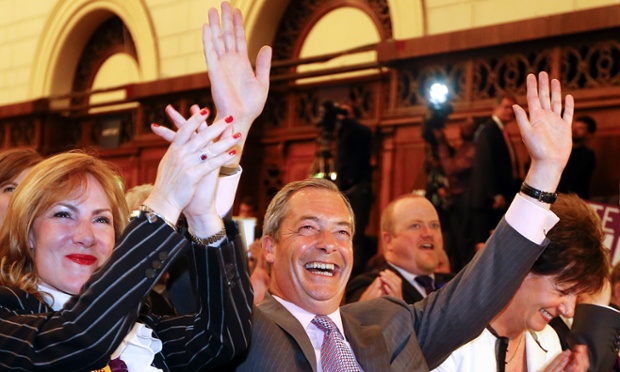
I know otherwise sensible people who share in Farage's celebration of what the Guardian agrees is a political earthquake - 28% on the national poll in European elections last week
This is scarily reminiscent of the 1930’s. We have rampant capitalism imposing austerity on the population, huge numbers of whom – in Britain, France, Greece and elsewhere - reach entirely the wrong conclusion and vote for far right parties. And we have a right-wing European dictator pretending to be a left-wing dictator gobbling up pieces of other countries claiming that "his people" are being maltreated, to cement nationalistic sentiment at home and distract attention from him cosseting billionaires. Not for the first time Prince Charles is right though I seem to be in bad company because when I google this proposition all I get is Fox News and other undesirables.  I read a comment piece in The Guardian trying to convince me that I'm wrong about the Putin/Hitler analogy. I forget where and when I read it but it didn't succeed in its purpose because I remain unconvinced.

I regret the foregoing is a bit of a rant and falls short of the standards I normally aspire to but it will have to do for now.

Tuesday, May 6, 2014

Reflecting on arrest of Gerry Adams


I'm bringing you the thoughts of two columnists in today’s Irish newspapers.  Writing in The Irish Times, Fintan O'Toole says there are two ways of dealing with the legacy of the atrocities: all or nothing. And the McConville case signals a pressing need for an independent commission of inquiry.

He is reflecting on the 1972 abduction, murder and disappearing of Jean McConville, about which Sinn Fein [1] leader Gerry Adams has been interviewed by the Northern Ireland police, and though released on Sunday, may still be charged. It's an atrocity that cries out for accountability, says O’Toole (and if you want to be persuaded of this, listen to a BBC interview with her son, age 11 at the time – he says he knows but daren’t say).

But O'Toole goes on to list numerous other killings – “murder after bloody murder” – about which the same can be said.

No special victims and no special perpetrators

His conclusion: if Gerry Adams had anything to do with the killing of Jean McConville, he should answer for his actions. But it would be far better if he gave those answers to an open, independent commission with a remit to investigate all unsolved killings by state forces or by paramilitary organisations. If, by design or accident, Adams seems to be singled out, while other crimes are ignored, the cycle of selective memory and selective amnesia will go on. There are no special victims and there must be no special perpetrators.

I simply don’t believe him

Also worth reading is a piece by another of my favourite columnists, Fergus Finlay in today’s Irish Examiner, under the headline Adams’ arrest a grim reminder of how fragile the peace process truly is.

“Like thousands of others” says Finlay “I simply don’t believe him when he says he was never in a leadership position in the IRA. But I also believe that without him, the process of ending the violence in Northern Ireland would not have succeeded …  he did succeed in bringing a largely united movement from violence to democratic participation, and that was a historic achievement.”  Finlay also suggests, probably wrongly I think, that Adams could have done this much faster had he wished. 


Left: Thousands believe only the words on that new mural about Adams — leader, peacemaker, visionary. Though the Irish Examiner’s Fergus Finlay is not numbered amongst them. Right: Michael McConville knows but dare not say.
But I want to return to Fintan O’Toole, and to quote him at length (green, with my interpolations in black). Amongst atrocities on a par with the one Gerry Adams is now accused of, O’Toole cites Ballymurphy.  Long after the British army’s parachute regiment left the west Belfast estate of Ballymurphy in September 1971, he writes, one of its members, Harry McCallion, recalled with pride that “we had over 15 confirmed kills but had claimed many more ... It was merely convenient for the IRA that most of them had not been sworn in as members.” 

These “kills” had not been sworn in because they were not members of the IRA at all; they were innocent civilians. Eleven of those killed by the Paras between August 9th and August 11th, 1971, were unarmed. Among them were a Catholic priest, Fr Hugh Mullan – who was clearly carrying an improvised white flag made from a babygro – and a mother of eight children, Joan Connolly, who was shot multiple times as she went to help a wounded boy. These events happened in the chaos of the introduction of internment, when the IRA launched concerted attacks on the British base in Ballymurphy. But the evidence strongly suggests that the victims were not caught in crossfire – they were killed by enraged soldiers in what were, at best, acts of appalling recklessness and, at worst, deliberate murders.

Last week, shortly before Gerry Adams was arrested, Northern Ireland Secretary, Theresa Villiers announced there would be no independent inquiry into the Ballymurphy killings. Sinn Féin rightly pointed to the outrageous double standard implied here. But Villiers also announced that there would be no inquiry into the hideous La Mon hotel fire-bombing in 1978, when the IRA incinerated 12 members of, of all things, the Irish Collie Club. The families of the La Mon victims believe, rightly or wrongly, that transcripts of police interviews with IRA suspects relating to this disgusting crime were deliberately removed from the files in order to protect senior figures of importance for the peace process. Did Sinn Féin complain about the continuing failure to give the La Mon families the comfort of truth? Of course not – it has double standards about double standards.


To make sure the unionist UVF get a mention, he also cites the McGurk’s Bar bombing of December 1971, in which 15 people died. 

People with guns killing people without guns

While the gunmen on all sides preened themselves with talk of “kills” and “war”, the truth is that the conflict was largely about people with guns killing people without guns. So-called republican and loyalist paramilitaries lost between them 563 members. Well over three times as many defenceless civilians were murdered (1,879) – mostly by paramilitaries but in some cases by so-called security forces in or out of uniform. The slaughter of the innocents was not a byproduct of the Troubles – it was the main event.

Competitive necromancy

It was not enough, though, for these poor people to die once, to be the human fuel for a conflict that careened obscenely onwards long after it had lost any semblance of logic. Like souls in Dante’s hell, they have been given an excruciating punishment; they are recruited to fight, again and again, in the strange meta-conflict that replaced the real one – the fight over which of the perpetrators can claim the coveted status of victimhood. There is, rightly, lingering outrage about the IRA’s “disappearing” of victims like Jean McConville, the denial of a decent burial. But in a sense, most victims are still denied a decent burial. Their bodies are figuratively dug up and paraded through the streets or dumped back again into the abyss of amnesia, depending on who needs them for what political purpose. Tribal disputes are still conducted in part as a form of competitive necromancy.

There are just two decent ways of dealing with the legacy of these atrocities: all or nothing. The nothing option has a certain integrity – it at least prevents the political exploitation of the dead. But it denies to bereaved families the right to know what happened to their loved ones. The only way to counter the exploitation of the dead is to start with the most obvious thing about them – that they died horrible, untimely deaths. Death brings a terrible equality: it does not discriminate between Protestant or Catholic, uniformed policeman or masked gunman, or even between innocent and guilty. Every violent death was a rending in the fabric of the lives of spouses, children and families. Each deserves acknowledgement – not for any political purpose but for its own sake and as a condition of a civilised society.


[1] Sinn Fein is an unusual political party in that it embraces two states, Ireland and Northern Ireland, and Gerry Adams is leader of the whole party in both.

Saturday, March 15, 2014

Is there a Moon Agreement and does it matter?


At the British Library in St Pancras y
esterday to improve my understanding of the status of the 1979 Moon Agreement.   

But I wasn’t able to stay long enough, and I'll need to wait for another visit in a few months.  Ten days ago in Galway I gave my lecture on the ethical limits to space exploration and regrettably, for lack of knowledge, I had to skate around the common heritage of mankind principle. This principle (known to insiders as CHM) is enshrined in the Moon Agreement, which hasn’t been ratified by any country of importance. Accordingly, it seems obvious that it’s a dead letter. Yet I find the Moon Agreement is frequently referred to. So is it a dead letter or isn’t it? In the BL I came across an essay explaining at some length how the Moon Agreement is indeed a dead letter [1]. And yet the very lengthiness of the essay suggested to me that the deadness of the letter is a matter of debate. In October I’ll have the chance to listen to a leading space lawyer on the subject. Perhaps I’ll have to wait till then to get a grip on this.

Staking a claim

And what, you may ask (if you’ve stayed with me thus far) has all this to do with the price of cheese?  Well it has to do with the price of minerals. There are corporations that intend to mine asteroids and the moon. This, despite my perhaps ill-chosen illustration, is a serious proposition. The CHM principle says that all minerals in space are the common heritage of mankind, and have to be shared out equitably. Moreover no-one can own asteroids or planets [2]. But the corporations that propose space mining don’t like this at all: they want private property in space.

Asteroid mining: a serious proposition (Credit: The Tech Journal)
Can any law at all apply in space? Jim Benson has something to say about this. He is now deceased and so is his Space Development Corporation, but he’s a seminal figure in space mining, and in 1997 he said he would send a spacecraft with robotic mining equipment to an asteroid. “After landing, we will ‘stake’ any mining and patent claims we believe to be possible, and then will simply declare ownership of the trillion-dollar asset. This will help draw attention to the need to establish private property rights in space.” [3]

Colonising Mars

Other topics I lump together under the ethical limits to space exploration include

•    The debate on the so-called overprotection of Mars – what are planetary protection rules for, and should they be relaxed with respect to Mars? The ultimate relaxation of planetary protection for Mars would be terraforming - is it desirable?

•    Should Mars be colonised? If so why? Are there good and bad reasons for colonising Mars? Is the Mars One project a suicide mission? Does it infringe human rights? And if so, does it matter?

•    How much invasive science should be done, such as vaporising comets?

•    What is space archaeology and is it important? What steps ought to be taken to preserve it? Is there a role for UNESCO?

The militarisation of space, which arguably dwarfs all of the above issues,  is not included. Another day’s work perhaps.

I’ve set up a dedicated website with links, which I shall add to as time and energy allow.  Also has my presentation slides.

      [1] "The 1979 Moon Agreement - where is its today?" by Carl Christol, 1999, p 273 in Space Law (part of "The Library of Essays in International Law", Francis Lyall & Paul Larsen ed., 2007)
      [2] The non-ownership principle is less contested than CHM. It's in the 1967 Outer Space Treaty, Article II
      [3] Kenneth Silber, A Little Piece of Heaven, 1998


Wednesday, March 5, 2014

“Neither Washington nor Moscow but international socialism”


Confused about Ukraine.  There seems to have been a revolution without any input from the left. I suppose this is something I have to get used to; but I'm not used to it yet. Moreover most commentators agree that the far right has played a significant role in the “Euromaidan” occupation in Kiev.

Mark you, I don't think the word revolution is apposite. I prefer to reserve this word for a revolution in the classical Marxist sense of one class superseding another, as in the English revolution of the 1640’s, or the French Revolution on the 1790’s, or the ultimately unsuccessful Russian revolution of 1917.  But whatever about semantics, this movement has forced a change of regime which is rocking international politics. Out of all I've read, my bones tell me that this piece from Socialist Worker has its finger on it. Putin's imperial ambitions (and national populism) clashing with the EU extending its zone of neoliberalism. So it’s no to western military intervention and no to Russian invasion. But the Ukrainian popular movement includes some unsavoury elements ... so it's a tangled mess I certainly haven’t got to the bottom of.

One thought on Socialist Worker’s comment that the Euromaidan movement “unfortunately harbours illusions in the European Union”.  If the choice were between the EU and the mafia capitalism of Russia, I suspect I too might be inclined to harbour illusions in the EU. Be that as it may “Neither Washington nor Moscow but international socialism” is always a handy slogan, and it will do here I suppose.


Socialist Worker uses this image of Russian frigates to illustrate the crucial strategic importance to Moscow of the Crimea, which since the 18th century has served as the base of Russia’s Black Sea fleet, and thereby access to the Mediterranean.
(Pic: Russian Federation Ministry of Defence)
Worth reading are interviews with three protesters who don't sound like fascists to me, on The Guardian website, Tuesday: "We were so naive and optimistic".

Saturday, October 5, 2013

Why I welcome the vote to keep the Irish senate


Two posters both urging a YES in yesterday's Irish referendum. 10/10 for the Socialist Party poster.  0/10 for the inaccurate, dishonest and populist poster put up by Fine Gael, the centre-right main government party.

Irish senate referendum posters, Dublin Socialist Party left, Fine Gael right. The Socialist Party focuses attention on the tiny elite electorate for the senate, congregated in Dublin 4. Dublin 10 is a working class area. They put up similar posters in other cities.
The voters were asked to assent to a government proposal to abolish the upper house of the Irish parliament, Seanad Éireann.  Although you can't argue with the Socialist Party case, I did. I voted no, and I'm glad about the result: YES 48.3%, NO 51.7%,  on a miserable 40% turnout (nearly).

Just to be clear, none of the reasons for keeping the senate are strong and most are invalid. The Irish Seanad bears no resemblance whatever to the US senate (either in its composition or powers) and a very close resemblance to the House of Lords. So why keep it for heavens sake? I certainly don't support keeping the Seanad in its present form (no-one does) and I'm not even wedded to the idea that Ireland needs a 2-chamber parliament. A lot needs fixing in the Irish constitution. The Dáil is (like the House of Commons) a tool of the government of the day, the Seanad is almost powerless, local government has even less independence than in England, corruption is an issue.

Had the abolition proposal come to us as part of a reasoned plan to strengthen the parliament against the government, and to loosen the iron grip of centralisation, it would have had my support. But I objected to being thrown the “less politicians” bone to distract from austerity. This referendum was a stunt pulled by prime minister Enda Kenny and he got the result he deserved.


Tuesday, May 28, 2013

Belated thoughts on Woolwich and other musings


I saw a list of don’t’s for Twitter. One was don’t sit in front of the tele and tweet BREAKING NEWS. Even worse, don’t lend spurious urgency to the thoughts gushing from your overtaxed brain by tweeting BREKAING NEWS. I've done a search on Twitter and people actually do this. Yes really. But there again maybe they're ironising and I just don't get it. Another rule is not to tweet “it's too soon to comment on this story …”. Very true that one. That’s my excuse for coming in with my comments about a fortnight late. So the first story I'm going to comment on late is the Woolwich meat cleaver murder on 22nd May. Shocking though it was, that wasn’t what made it a story. Had the killers run off we wouldn't have read about it. It was the videos. And that they didn't even bring their own cameras. We're sorry you saw this but it happens to Muslims every day. The more arrests are made, 10 at present, the less it can be passed off as the acts of crazed psychopaths. And the bigger the question over Jonathan Freedland’s Guardian piece saying the left should not use Woolwich to make its case on foreign policy. Crazed psychopaths they may be, but there's more to it.  

Health Minister James Reilly with
disgusting plain pack cigarettes
At this point I have to interrupt my flow and infringe my own rules. I'm sitting in front of the tele. And it really is brekaing news. Ireland is to be the second country after Australia to have plain cigarette packs with no logos or trademarks.   A lot of mean things have been said and written about health minister Reilly but hats off for this one. Some thoughts on this a few months ago. Reilly is also likely to introduce a 10% tax on fizzy drinks, sweets, biscuits, crisps, and chocolate as a way of tackling Ireland’s obesity problem. The Irish Examiner editorialised : “One thing can be said with some certainty about the war against sugar and fat misuse — we cannot prevaricate for decades like we did on tobacco before making the right decisions, even if they are the hard ones. The stakes are just far too high.”  Good, but oh dear, also bad. "Prevaricate" doesn't mean put off till tomorrow, it means to be devious.  On NPR in October 2009 Diane Rehm hosted a debate about taxing soft drinks. An industry spokesman arguing freedom of choice. Totally demolished. Worth listening to.  But sadly no longer available for download so ask me for the mp3 file if you like but I'll have to remove this sentence if they catch up with me.

Then there's Google and Amazon not paying tax. The salient fact here is they appear not to have broken any laws. These corporations are smirking at states and politicians. Read Google’s Eric Schmidt in The Observer and hear him gloat. And you’ve got countries like Ireland saying come and pay your taxes here we won't ask for much.  And Britain is little better, read Nick Cohen, also in The Observer, about Britain’s reluctance to pursue multinationals.

Next the US has launched an experimental full size fighter drone aircraft from an aircraft carrier called USS George H W Bush. Bet you didn't know they had a ship of that name. A defence analyst is quoted saying “This will be the future of warfare, and it will be a warfare that is a little less risky for humans”. He forgot to specify which humans he had in mind. My thoughts on this.

That’s all for now. Am working on a piece debunking the notion that neolithic passage tomb builders believed the sun would die in midwinter if they didn't do sacrifices; interesting times in the Catholic church with the new pope; and Eileen’s uncle Mickey’s civil war exploits.

Wednesday, May 15, 2013

Bangladesh union restrictions lifted after pressure


Only just discovered that Bangladesh garment workers are not allowed to form trade unions without prior permission from factory owners.  Perhaps I haven't being paying close enough attention and allowed myself to be misled by the impressive demonstrations following the Rana Plaza factory collapse. (By yesterday afternoon, at least 1,127 people were confirmed to have died - New York Times, 13th May.)
Another Bangladesh clothing factory disaster. Workers outside a building in Dhaka which caught fire. Credit: Ismail Ferdous/AP
Anyhow, all this is set to change. According to The Guardian (and other media including CTV news) there is an old law requiring workers to obtain permission before they could unionize. "No such permission from owners is now needed," a government spokesman is quoted saying. "The government is doing it for the welfare of the workers."

The New York Times has a different emphasis. Permission from owners isn't mentioned; but a list of names of those who want a union has to be submitted to the labour ministry who then pass it on to the employer who is thereby handed a useful tool for harassment and intimidation. This will now stop apparently. The New York Times says the new initiatives are “partly in response to outrage over conditions in the country’s garment sector” after the Rana Plaza collapse.

I'm not clear from reports whether the restrictions on unions are specific to the garment industry. Bangladesh is the world’s third largest exporter of garments and a government minister is quoted as calling the industry “the goose that lays the golden egg”.
 

Yet despite non-unionisation, protests by garment workers in 2010 achieved an 80% hike in the minimum wage to 3,000 takas ($38/£25) a month, according to The Guardian. 

A momentous deal

Since 2005, at least 1,800 garment workers have been killed in factory fires and building collapses in Bangladesh. This is from research by the advocacy group International Labor Rights Forum (ILRF).  I presume this figure includes the 1,127. Meanwhile War on Want is trumpeting the news that global retailers, including Primark, H&M, Tesco, Zara and C&A, have all signed the Bangladesh Safety Accord. War on Want regards this as "a momentous deal" and believes the retailers bowed to pressure from campaigners in the west disgusted by reports of the Rana Plaza collapse.

By the way the other day I was puzzling where to send money (see post below this). Maybe War on Want and the ILRF would be a start.  Thanks to Ben for some of these links, and links that led to links.