Showing posts with label Jane Austen. Show all posts

Wednesday, March 1, 2017

Tell me it's not true!

Ha! … bet you thought it was going to be something about the first six weeks of Trump. No, what concerns me right now is news in the Daily Mirror, about the governor of the Bank of England and what he's putting on a £10 note.

A few weeks after taking up his appointment as Bank of England governor in 2013, Mark Carney shows off the proposed Jane Austen £10 note

There are four things worth remarking about this new banknote, due to be issued later this year. The animal fat it contains; the campaign of abuse and threats against the feminist campaigner Caroline Criado-Perez whose persistence persuaded the Bank to put Jane Austen on the back; the airbrushed portrait ... 

And lastly, an ill-chosen quotation (too small in the photo) placed under Jane Austen's image: "I declare after all there is no enjoyment like reading!“

Last November I was in Dublin to hear John Mullan, author of What matters in Jane Austen?  It was a lecture put on by the Jane Austen Society of Ireland, and half a dozen of us travelled from Cork.  Well worth sitting 6 hours on a bus for. Prof Mullan brought up the no enjoyment like reading quotation, and asked the audience if we could guess the controversy it has provoked. We could, of course. As three years had elapsed since the Mark Carney photo opp, and the new note was still not issued, the professor had reason to hope this delay betokened unease about the said quotation, and that the bank was hunting out a replacement.

Sadly, it appears not ... According to a story posted on the Mirror website on 15th February, no enjoyment like reading is still there. Dearie me ...

Prof Mullan even surmised how it came about; convinced that governor Carney had a gofer called Barney, he imagined the following conversation.


“Barney, there's been a bit of a fuss about needing a woman on the back of the new tenner, Jane Austen would do, be a good fellow and find me an image.” 

Next day Barney produces the Jane Austen image for the new banknote. “That’s terrific Barney, now we could do with a quotation to go with it.”

“What sort of quotation boss?”

“Oh I dunno, something to do with reading would be good.”

Barney goes googling and comes back with “I declare after all there is no enjoyment like reading!”

“Good Barney, very good, and where does that one come from?”

“Pride and Prejudice boss.”

“Wonderful, my fave, now then, we need a meeting about interest rates, set one up for Friday will you, like a good chap.” 

Cue an outcry from all Jane Austen enthusiasts.  If you are one, you'll know the rest. If not, you need to understand that these words from Pride and Prejudice are put in the mouth of the ghastly Caroline Bingley, the novel’s least appealing character, not even excepting the villainous Wickham and the atrocious Lady Catherine.  

Caroline Bingley is deceitful, she's pretentious, she's a snob, and the worst is, she's the sworn foe of English literature's favourite heroine, Elizabeth Bennet.  To cap it all, she has no interest in books, as proved in the scene where in furtherance of her campaign to hook Darcy as a husband, she sidles up to him, purporting to share his interests. Since he is reading a book, she sits next to him and pretends to read one too, which she has only chosen because it's the second volume of his. (At that time, novels were commonly issued in three volumes.)

Here's this scene in full:-

Miss Bingley's attention was quite as much engaged in watching Mr. Darcy's progress through his book, as in reading her own; and she was perpetually either making some inquiry, or looking at his page. She could not win him, however, to any conversation; he merely answered her question, and read on. At length, quite exhausted by the attempt to be amused with her own book, which she had only chosen because it was the second volume of his, she gave a great yawn and said, "How pleasant it is to spend an evening in this way! I declare after all there is no enjoyment like reading! How much sooner one tires of anything than of a book! When I have a house of my own, I shall be miserable if I have not an excellent library."

No one made any reply. She then yawned again, threw aside her book, and cast her eyes round the room in quest of some amusement …

        
Now of course all Jane Austen’s heroines are at odds with Caroline Bingley in this respect, that they are great readers. (Save one. Emma knows she should read, and even makes reading lists, but never quite gets round to it.) Catherine Morland in Northanger Abbey actually reads too much, makes a fool of herself by imagining she’s living out the plot of a gothic novel. Anne Elliott in Persuasion in a crucial scene is overheard by the hero Captain Wentworth discussing books, leading to the happy denouement. In Sense and Sensibility, Elinor and Marianne are fond of reading, and a shallow character called Lady Middleton fancies them satirical as a consequence. Fanny Price reads about the McCartney expedition to China, and Lizzy Bennett is disparaged by her antagonist Caroline Bingley as "a great reader".

Please Governor Carney, choose one of these! Not Caroline Bingley! Tell me it's fake news!


Note: the Pride and Prejudice extract is from ch 11. More Jane Austen extracts about reading, including those mentioned above, on a separate page if you want them.  In the last extract on that page I've suggested a possible alternative quote for the new £10 note - see if you agree. And a final point, we must beware of being too up ourselves over this one, as Jane Austen wouldn't have said … "for she had a lively, playful disposition, which delighted in any thing ridiculous." (P&P ch 3)

Sunday, January 15, 2017

Some curiosities from 'Self Control', an 1811 novel


Jane Austen was very rude about Self Control, a novel by Mary Brunton that came out in 1811, the same year as Austen's first, Sense and Sensibility. Austen said she would go one better and in her next book, have her heroine cross the Atlantic in a boat by herself [1]. This was an unfair swipe at Brunton whose kidnapped heroine Laura escapes her American captors by floating downriver to safety in an Indian canoe, narrowly avoiding drowning in a waterfall. Saved by a farmer, our heroine is conducted to Quebec where she boards a ship for her home in Scotland.

And here's the point: lacking money to pay for her passage, she persuades the captain to accept a banker's draft, which can be cashed at the voyage’s end. On arrival at Glasgow we read: 


“The next morning she gave the captain a draft for the price of her passage; and producing her purse and Mrs De Courcy's ring, offered them as further security; ... The sailor, however, positively refused to accept of any thing more than the draft, swearing that if he were deceived in Laura, he would never trust woman again.” [2] 

Paying for travel by draft as early as 1811? (or the 1790's which is when I suppose the action is set.) I was intrigued … 

But having looked it up I find that ordinary citizens had been able to write cheques since around 1650. Here's one of the earliest surviving handwritten cheques in England, dated 16th February 1659.  

A 1659 handwritten cheque. The amount is £400 - over £40,000 today.
Printed cheques, it appears,  were introduced by the Bank of England in 1717 and the earliest surviving cheque on a printed form is dated 1759.  However, as we have seen, in Self Control Laura gave the captain the draft “the next morning”  so I imagine we are to suppose Laura tendered a handwritten cheque similar to the image above.  The context makes it improbable she would have had time to visit a bank to get a proper form.   

For international merchants using bills of exchange the banking system and cheques seem to go back to the 9th century at least, see Wikipedia.  But it's ordinary people, if you will permit me use that word loosely, that I am interested in. 

Another historical curiosity from Self Control.  Early in the story, Laura and her father have to travel from Edinburgh to London: the surprise here is that they go by sea.  By land would have been more convenient in every way, but much more expensive, so a sea passage was chosen as the mode of conveyance best suited to her father’s finances. "Five days they glided smoothly along the coast. On the morning of the sixth, they entered the river, and the same evening reached London." [3]

Application to the officers of police

I was startled to come across the word “police”.    I had thought this word came into use in the 1840’s, at the very earliest. But to my surprise, in 1811 you could contact the police to report missing persons. After Laura is kidnapped, her friend Mrs De Courcy searches for her, by advertising in every newspaper, and by making “application to the officers of police for assistance in her inquiries” in London. [4]   I see from the Oxford English Dictionary that “police” is first found thirteen years earlier, in 1798. 


In Pride and Prejudice the housekeeper guides Elizabeth and the Gardiners through Pemberley's interior. From Jane Austen's World blog.
A party is got up to view pictures in a country estate, in the owner’s absence [5]– putting me in mind of the Pemberley visit in Pride and Prejudice; an episode which has long puzzled me, that you could just turn up at a grand house and ask to be shown round by the housekeeper. In Self Control, the visit is with the owner’s  prior permission, so the parallel is not exact. But I've subsequently found an essay explaining the protocol of these country houses visits.[6]

It seems that in the 18th century it was accepted that respectable people could view the lavish country homes of the aristocracy and landed gentry.  A tip to the gardener or housekeeper for their trouble was often all that was expected. Though in some cases you bought tickets. The scale of country house tourism at the end of the century was prodigious. In August 1776 the visitor book for Wilton, a great house with a celebrated collection of artwork, showed 2,324 visitors in the previous year; and the second half of the 18th century saw 26 editions of four different guidebooks to this house.  The blog Jane Austen's World is also very good on this topic.

I see I haven't actually told you anything about the novel itself, but maybe that's another day's work. I'm slowly making my way through some of the books that Jane Austen would have had on her shelf, and finding it much more enjoyable than I expected. Next I might say something about Elizabeth Inchbald’s A Simple Story, 1791.


[1] When writing her Plan of a Novel, Austen wrote to her niece: "I will redeem my credit with him by writing a close imitation of 'Self Control' as soon as I can. I will improve upon it. My heroine shall not only be wafted down an American river in a boat by herself. She shall cross the Atlantic in the same way, and never stop till she reaches Gravesend." (Jane Austen's letters,4th ed. Oxford University Press. p. 295)
[2] Self Control chap XXXIV
[3] Self Control chap VII
[4] Self Control chap XXXII
[5] Self Control chap XXIV
[6] “A Fine House Richly Furnished: Pemberley and the Visiting of Country Houses”, Stephen Clarke (2000), in Persuasions, the journal of the Jane Austen Society of North America. Thanks to Eileen Collins for drawing this to my attention.


Wednesday, December 14, 2016

Dr Johnson and a head carved on a carrot

Two months since I wrote anything here, what’s all this delay? Surely I can come up with some insightful and entertaining bon mots pertaining to Jane Austen? Or how about some nugget culled from the dusty byways of English grammar?  Well, perhaps  … but my mind’s been elsewhere,  agonising about Brexit, Trump, the drift towards fascism and what is to be done ...  and just how, why and when did anti globalisation which used to the province of the left, become a plaything for the extreme right. Tonight I've given up trying to pen something on these themes that you haven't read much better elsewhere, so I've decided to talk about Samuel Johnson instead.  Till a few days ago I only knew his definition of oats, “a grain, which in England is generally given to horses, but in Scotland supports the people.”  To which his Scotch friend Boswell retorted, “But Sir, what horses, and what people!”  The dictionary definition is actual, though so far as I can tell Boswell’s retort isn't. I picked up a copy of Boswell’s Life of Johnson in a cancer charity shop in Cork last week, and may I take this opportunity to recommend you get or borrow a copy yourself. Almost every page contains pure entertainment.  

Left to right. Samuel Johnson c. 1772, painted by Sir Joshua Reynolds. “Am I not a man and a brother” – medallion made in 1787 by Josiah Wedgwood [1]. James Boswell at 25, by George Willison

The first thing to say is Johnson was a strong slavery abolitionist, and no friend to the American colonists. Boswell records that in 1777, when in company with some very grave men at Oxford, Johnson’s toast was, “Here’s to the next insurrection of the negroes in the West Indies.” Johnson’s “violent prejudice against our West Indian and American settlers appeared whenever there was an opportunity”, Boswell tells us, revealing his own prejudice.  Of the American colonists, Johnson said: “how is it that we hear the loudest yelps for liberty among the drivers of negroes?”  [2]

His colour sufficient testimony 

It seems that in the year 1777 a negro was claiming his liberty in a Scottish court, and Johnson dictated an argument in his favour.  No law but that of violence, subjects a negro to his master, he argues; and the slaveholder’s pretended claim to the negro’s obedience is based on having “bought him from a merchant of slaves, whose right to sell him never was examined ….  The laws of Jamaica afford a Negro no redress.  His colour is considered as a sufficient testimony against him.”  The argument is worth reading in full, and I have it for you, along with a handful of other extracts from
The Life of Johnson, on a separate page.  Johnson could get vexed when opposed in argument, and after debating slavery and the taxing of the American colonies, two subjects which Johnson and Boswell disagreed on, they went to bed bad friends. 

As you would expect from the writer of the first dictionary, Johnson was jealous of infractions on the English language.  He found fault with Boswell for using the phrase to make money. “Don’t you see (said he) the impropriety of it?  To make money is to coin it: you should say get money.” Boswell doesn't agree though, and thinks the phrase to make money is pretty current. In an object lesson to those of us who would stem the tide of language change, Johnson “was particularly indignant against the almost universal use of the word idea in the sense of notion or opinion, when it is clear that idea can only signify something of which an image can be formed in the mind”. We may have an idea or image of a mountain, a tree, or a building; but Johnson objected to an idea or image of an argument or proposition.  Lawyers “delivering their ideas upon the question under consideration” was modern cant, he thought.[3]

The finest head cut on a carrot 

Going into a convent for fear of being immoral was like a man cutting off his hands for fear he should steal. “There is, indeed, great resolution in the immediate act of dismembering himself; but when that is once done, he has no longer any merit: for though it is out of his power to steal, yet he may all his life be a thief in his heart.”

He argued against the value of sculpture. Painting is okay, as it consumes labour proportionate to its effect; “but a fellow will hack half a year at a block of marble to make something in stone that hardly resembles a man. The value of statuary is owing to its difficulty. You would not value the finest head cut upon a carrot.”  

Two final offerings, Johnson declared “It is commonly a weak man who marries for love”, and thought it was better to shoot a highwayman in the heat of the moment than to testify against him later in cold blood.  You can find all these things in my extracts.

I'm collecting books that Jane Austen had on her own shelves. According to her brother Henry, Johnson was her favourite moral writer in prose [4].  And in a 1798 letter, Austen wrote of getting Boswell’s Life of Johnson.  I'm now reading Johnson’s Rasselas, and have recently finished a handful of other 18th century novels. Which are not, I'm happy to say, as bad as I expected. My mistake was starting with Richardson’s Pamela.  It's dire, but I'm reassured to find Johnson also thought Richardson dire. More of this anon perhaps.

As a postscript, I see that challenged by Boswell about his prejudice against the Scots, Johnson admitted: “Why, I own, that by my definition of oats I meant to vex them.” (1783)


[1] For slave medallion by Staffordshire pottery manufacturer Josiah Wedgwood, see Smithsonian National Museum of American History 

​[2] Another Englishman, the abolitionist Thomas Day, wrote in 1776 that “if there be an object truly ridiculous in nature, it is an American patriot, signing resolutions of independency with the one hand, and with the other brandishing a whip over his affrighted slaves.”  Can't find the source for this.

[3] In Rasselas I find: “Knowledge is certainly one of the means of pleasure, as is confessed by the natural desire which every mind feels of increasing its ideas.” (ch XI) Here Johnson appears to have flouted his own rule.

[4] Henry Austen “Biographical Notice” in the 1st edition of Northanger Abbey (Dec 13th 1817)

Tuesday, January 5, 2016

Younger or youngest? Can Jane Austen err?

By indirections we find directions out.  I'll start with an alleged mistake in the second sentence of Jane Austen’s Emma.  Here we read that Emma “was the youngest of the two daughters of a most affectionate, indulgent father”, and it's the word “youngest” that gave rise to a difference of opinion. To set the scene, it was last November, and we were at lunch before a lecture in Dublin hosted by the Jane Austen society to mark the novel’s bi-centenary.  Professor Darryl Jones of Trinity College thought that Emma is a landmark in the history of the English novel, being the first designed to be read more than once.  It only makes sense on the second or third time of reading, he said, as all the questions Emma gets spectacularly wrong, we do too, the first time.  The most complex of Jane Austen’s novels and one of most complex novels in English.


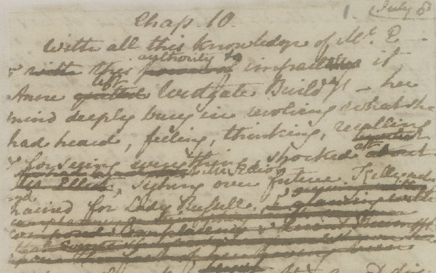
Chapter 10 of Persuasion in the Jane Austen’s Fiction Manuscripts Digital Edition  curated by Prof Kathryn Sutherland

But back to lunch, and Emma being the youngest of two daughters. Someone asserted that Austen was in error here, as you can be the younger of two but not the youngest of two.  And indeed I've subsequently seen numerous posts on websites supporting this ruling.

The first thing to say about this point of view is that it assumes the existence of a Big Book Of English Grammar where such rules are written down.  As I've lived 66 years without encountering such a book, I think I can plausibly suggest there isn't one.

I did however in the heat of debate make an ill-considered statement, which was that Jane Austen can't be wrong, and if she wrote the youngest of two then youngest of two is okay. Reflecting on this later I decided I ought to investigate whether Jane Austen actually took care of such matters; whether "youngest" is what she actually wrote; would she leave a decision about younger/youngest to the printer, and how carefully did she proof-read?  I was travelling down a blind alley of course, because these questions matter not one jot.  What's important is that the text of Emma is what it is, however many hands are responsible; not whether Jane Austen herself was interested in grammar.

William Gifford

Actually my blind alley was not entirely blind, for it led to me some new nuggets of knowledge. One of these is that Jane Austen did have an editor, William Gifford, who took great pains with grammar and punctuation.  Indeed in 2010 a brouhaha erupted over a claim that his influence on the final text was such that Jane Austen’s style can't really be said to be her own.  All this was attributed to Oxford Professor Kathryn Sutherland, though in fact the professor’s remarks seem to have been distorted. Be that as it may, we can be sure that the said Gifford wouldn't allow anything untoward to slip past him, and in the novel’s second sentence of all places.  


Prof Kathryn Sutherland and Jane Austen. The Kathryn Sutherland image is (so far as I know) a good likeness, whereas the Jane Austen one is not

The Kathryn Sutherland controversy makes some fascinating reading, or fascinating to me at any rate, and I have a fellow Jane Austen society member to thank for drawing it to my attention. You could start with this blog by linguist professor Geoffrey K. Pullum. Writing in October 2010 when the spat over Austen's alleged failings in style and grammar was still fresh,  he says he has seen no examples to back these claims up.

Dubious basis

Another nugget that came my way following my “Jane Austen can't be wrong” outburst: it seems that from about 1750 to about 1850 creating new rules of English grammar became a favourite passtime, and a prohibition on the “youngest of two” was being suggested around the time that Jane Austen was writing.  There's plenty on this in the excellent grammarphobia blog which I've newly discovered.   Here they reproduce the conclusion of Merriam-Webster's Dictionary of English Usage on the matter:-

    “The rule requiring the comparative has a dubious basis in theory and no basis in practice, and it serves no useful communicative purpose. Because it does have a fair number of devoted adherents, however, you may well want to follow it in your most dignified or elevated writing.”

The blog authors Pat O’Conner & Stewart Kellerman were kind enough to email me with some additional comments on Jane Austen’s use of “youngest”, and they say that whilst there are differences of opinion here,  it’s probable that Jane Austen  was unaware of any “rule” banning a superlative with only two members; indeed many popular grammar prohibitions emerged only in the latter half of the 18th century and the early part of the 19th, so it’s not fair to call an author “incorrect” for ignoring a convention that was not yet firmly established in common usage at the time she was writing.

As I've already indicated, I'm reluctant to use the word “incorrect” at all, moreover I can adduce plenty of evidence against there being, even today, any firmly established convention that you can't be the youngest of two.

Finally, I nearly wrote "the authoritative" Merriam-Webster Dictionary of English Usage, but then I would stand accused of inconsistency, as I've already suggested that no-one is entitled to lay down rules. And that’s true, but Merriam-Webster is authoritative in this sense, that they have exhaustively investigated English usage, and if you want to know what’s been written and by whom, Merriam-Webster is a good place to look. Maybe all of this leaves you thinking that some of the things that interest me are very dull indeed, in which case I salute you for getting this far.

Wednesday, December 16, 2015

Jane Austen and a shop in Devon

This happened when I was about 10, which would make the year 1959. We were driving home through Devon after visiting my English grandmother in a nursing home in Teignmouth (my father’s mother that is, an explanation I wouldn't need to give were I writing in Swedish).  Passing through a town my mother caught sight of a shop sign and called out to my father to stop and go back because the name on the shopfront was Household. I glimpsed it fleetingly, it looked a substantial affair. No, it was just a household stores said my father. My mother insisted she was sure Household was the proprietor’s actual name, and with so rare a surname it must be some sort of relation, we ought to call and say hello. But my father drove stolidly on refusing to turn back and investigate. Later my mother explained to me the reason for this strange behaviour: my father would be ashamed to be related to anyone engaged in trade.  But it looked like a big shop I protested. No matter, this was the way he had been brought up; my granny, my mother told me, was a snob. We had a small car and a small rented flat in Brighton, and what made me ashamed was that the stuffing was coming out of the arms of the sofa.

Title page of Emma, published
200 years ago this month
(though it says 1816, hmm)
The memory came to me because I'm working on the question of Jane Austen and snobbery. I've promised to lead off a discussion on this topic in a small book group we have in Cork - the Cork Friends of Jane Austen that’s what we call ourselves.  Several prominent snobs feature in Jane Austen’s works. Emma, Darcy, Sir Walter Elliott are names that spring to mind, and the snobbery theme is a staple of Jane Austen criticism. For example in a famous 1957 essay the critic Lionel Trilling wrote of Emma: “Her self-love leads her to be a self-deceiver. She can be unkind. She is a dreadful snob.”  One occasion of her snobbery - and this takes us back to the shop in Devon - is when a family by the name of Cole give a large evening party, an enterprise Emma treats with disdain.  "Nothing should tempt her to go”; the Coles were "of low origin, in trade, and only moderately genteel  …  they ought to be taught that it was not for them to arrange the terms on which the superior families would visit them".  

I must make it clear my mother didn't blame my father for his attitudes, she accepted it was part of his upbringing and couldn’t be changed. And I suppose I must extend the same charity to my grandmother, who grew up part of the landed gentry; my mother grew up in the north of Sweden, the daughter of an engine driver.  I also need to add something about the state of the sofa.  This was due to my parents spending far more than they could afford on my expensive schooling. For better or worse that’s made me what I am, so it's not my place to complain about the stuffing.  

I'll finish on a puzzle. It occurs to me to ask whether and how Jane Austen and her contemporaries talked about snobbery, since according to my understanding, the word was not yet in use.   Did they have another word for it? I don't think they did. I can't help wondering if there's something anachronistic going on when we talk of Jane Austen and snobbery.  It's something I should like to explore, if only I knew where to begin.  I hope to have an answer by the first Tuesday of February.

Note : The Trilling essay is “Emma and the legend of Jane Austen” in Beyond Culture, 1965. The Emma quotation is from ch 25.

Wednesday, November 25, 2015

The glory is departed

Boarzell School in Sussex where Mr Dumbreck taught me English in 1961

I had a terrific English teacher when I was 12 called Mr Dumbreck and were he here today he would strike a big red pencil through that word “terrific”, on the grounds of being a cliché, and furthermore terrific means inducing terror. Another rule for our English compositions was that no sentence was to begin either with the word “it” or the word “suddenly”.

I want to tell you about my swotty boy moment. One day the word “hectic” cropped up and Mr Dumbreck asked us for examples of how it might be used. Up I piped with “yellow, and black, and pale, and hectic red”, a line from Shelley’s “Ode to the West Wind”, which we had recently been reading in class. Mr Dumbreck heaped praise on me for quoting both correctly and appositely, and even after all these years the memory calls up a glow of satisfaction. Lindsay by the bye tells me that at her school quoting Shelley wasn't considered comme il faut, and would quite likely have earnt me a whack on the back of the head with a pencil box.


Mr Dumbreck and the Fifth Form room. The events related here took place in the Sixth Form room next door, but no photo is available.  
All photos courtesy of Michael Salmony

Whenever I think of Mr Dumbreck the phrase “Ichabod, the glory is departed” comes to mind. It's an essay he read to us about a hat box festooned with luggage labels. You have to be as old as I am to remember what this meant. The hat box is sent away for a lock repair and when it comes back it's been steam cleaned, and the lovingly preserved collection of labels has vanished. I've gone looking for this essay, which turns out to be by Max Beerbohm, and after fifty-four years I've just read it again. I see the title is simply “Ichabod”, the phrase “the glory is departed” occuring only at the very end. I imagine Mr Dumbreck read us this verse from the Old Testament: “And she named the child Ichabod, saying, The glory is departed from Israel: because the ark of God was taken, and because of her father in law and her husband.” He was a brilliant teacher. He taught us art too. We weren't allowed erasers, and had to ask to borrow his bungy. This was occasionally permitted but normally he would claim to have lost it.

It's hard to say why I've started reminiscing about Mr Dumbreck. My age you will say. But I think I can trace it back four years when I read PD James's Death Comes to Pemberley and was startled to come across this sentence: “Suddenly Mrs Reynolds was with them.” Proof that PD James had not attended Mr Dumbreck’s lessons, and considering that she was writing a Jane Austen sequel, very bad; for Austen, though she used the word “suddenly” about 50 times in her novels, never once began a sentence with it. I know this because I have the internet. Mr Dumbreck knew it in his bones.

Finally, in a couple of hours we in Cork Astronomy Club will celebrate the centennial of Einstein’s general theory of relativity, which prompts me to ponder the relativity of time. From leaving Boarzell in 1961, to 1972 the year my mother died and I moved to York, was 11 years, and appears to me like half a lifetime. From leaving York to now is nearly 11 years, and it seems like yesterday.

Note 1 : For a read-out of every sentence in which Jane Austen used the word “suddenly”, all you need is this website http://www.pemberley.com/etext/ and about eight seconds of your time. Charles Dickens had no such compunction by the way. I found the following instances in David Copperfield, and I suspect, had I continued searching, would have found many more:-
“Suddenly I came upon a pasteboard placard, beautifully written, which was lying on the desk …” Chap 5
“Suddenly Miss Murdstone gave such a scream that I all but dropped it.” Chap 8
“Suddenly there passed us ─ evidently following them ─ a young woman …” Chap 22

Note 2: The Biblical quotation is 1 Samuel 4:21 in King James version.


Monday, May 18, 2015

Jo Baker, Jane Austen and a catastrophic election


What makes people vote against their class? is a question I saw on Facebook today, the questioner evidently as downhearted as me about the recent UK general election, which right now I can't muster the energy to go into.  Frances O'Grady, the leader of the trade union movement in Britain, warned last year’s TUC annual congress that Britain risks creating a "Downton Abbey-style" society in which social mobility has gone into reverse, with all official blame for the country's ills heaped on the vulnerable while the powerful and privileged sit pretty, and young people are converted into an army of casualised low-paid workers.  

Frances O'Grady was referring to the television serial drama Downton Abbey depicting the early 20th century English upper class and their servants. The series came up last weekend at a Jane Austen event in Dublin. Eight of us from the Cork Jane Austen group travelled up, to hear Jo Baker speak about her novel Longbourn, the servants’ version of Pride and Prejudice. In questions afterwards, Downton Abbey was mentioned as a possible parallel. This Jo Baker roundly dismissed. The programme annoys her:  everyone is happy in their place:  no they're not, she insisted … and apologising for introducing politics (and drawing applause from the audience) lamented that the UK has now got another five years of it.  By the way, you’ve heard of shy Tories, those who didn't admit when asked that they supported Cameron and skewed (so it seems) the opinion polls in the run-up to the UK election. Well I'm a shy Downton Abbey viewer, and I didn't admit this to Jo Baker
when she signed my copy of Longbourn:-


A truly engaging person. From my own review of her book you'll see that I think it illuminates Pride and Prejudice in useful ways; and in Dublin Jo Baker herself illuminated Longbourn.  A massive Jane Austen fan, she told how whilst re-reading Pride and Prejudice she got stuck on a particular line:-  

“If there had not been a Netherfield ball to prepare for and talk of, the younger Miss Bennets would have been in a pitiable state at this time; for from the day of the invitation to the day of the ball, there was such a succession of rain as prevented their walking to Meryton once. No aunt, no officers, no news could be sought after - the very shoe-roses for Netherfield were got by proxy.”  [1]

Who is Proxy she wondered, and how does Proxy feel about being sent in the rain and mud to get accessories for a ball she can't attend?  Baker noted both presences and absences in Jane Austen’s novel. A meal was served … a carriage was brought round ...
but I'm not hearing anything about the person who did this thing”. Absent presences such as these reminded Baker of her own great aunts who were in domestic service, and prompted her to put pen to paper. 

White gloves

A nugget from her historical research for Longbourn. It seems that during the Napoleonic wars, where Pride and Prejudice is set, there was a massive premium on male labour, with all young able bodied men either in the fields, in the army or the navy.  The government discouraged the employment of young men in inessential jobs by taxing it; which led to the unintended consequence that it became fashionable amongst the upper class to have young men standing around in white gloves serving soup, just to show they could afford it.

I'll leave you with a couple more thoughts on that election, a sore I can't help picking at.  A business insider website has analysed the votes and concludes "You'll be surprised to learn that the general election was a huge win for the British left". Whilst I can hardly support the adjective "huge", I was marginally less gloomy, perhaps wrongly so, after I came across this. Finally I do hope the Labour party doesn't in it's coming leadership election attempt to shuffle towards the ever rightward drifting so-called centre ground; though I fear it will.  Read this selection of Guardian readers letters for a flavour of the debate.


[1] Pride and Prejudice vol 1, ch 18

Wednesday, July 30, 2014

Pride and Prejudice below stairs


I've heard it said that the market is saturated with Pride and Prejudice sequels, most of them poor to dreadful. But there are three I recommend, and I'll review one of them here: Jo Baker’s Longbourn. The others which I hope to return to some day are P D James’s Death Comes to Pemberley and Maya Slater’s The Private Diary of Mr. Darcy.

Longbourn has been described as a distant cousin to Pride and Prejudice, one that interacts with its relative rarely. But where it does interact, it does so in unsettling ways. 

Whereas Jane Austen left the Bennet servants as faceless ciphers, in Longbourn they are the central characters, and in particular Sarah whose romantic life mirrors Elizabeth's from Pride and Prejudice, and is equally predictable.

“If Elizabeth had the washing of her own petticoats,  Sarah often thought, she’d most likely be a sight more careful with them”. Baker gives details more sordid than this, which I won't go into here, of the range of menial tasks needed to maintain an upper class Regency household. The workload is excessive for the four thinly-stretched servants, and when a new footman is added, this provides welcome relief.  Nonetheless at first Sarah is suspicious of James, and suspicion hardens into dislike, as she finds herself drawn toward the charming footman at neighbouring Netherfield, who is also the first black man Sarah has ever seen ...

That’s the romance.

But you could say that Longbourn’s main subject is the life of the lower classes in Regency England, the deprivation and suffering that produced the gilded world through which Austen's characters moved, with several hints at suppressed class conflict.

"A private had been flogged"

I've more to say about this book, but if you haven't read Pride and Prejudice you may not find my thoughts entirely riveting, so I'll put them in a separate page.  What I want to dwell on now is a pivotal episode in Longbourn when Sarah, while on an errand in Meryton, is traumatised by unintentionally witnessing a soldier being flogged.

Here's the peg it hangs from, the final sentence of Chapter 12 in Pride and Prejudice:-

"Catherine and Lydia had information for them of a different sort. Much had been done and much had been said in the regiment since the preceding Wednesday: several of the officers had dined lately with their uncle, a private had been flogged, and it had actually been hinted that Colonel Forster was going to be married."

William Cobbett (1763-1835)
opposed flogging
Catherine and Lydia, two silly teenage girls, are the younger sisters of the heroine Lizzy Bennet.  England is at war with Napoleon and a militia regiment has been stationed locally; it appears though to have little to do with the defence of the realm. In the foregoing passage Austen reveals military life as a routine of trivial social engagements and gossip, whilst exposing the vacuity of the sisters and their indiscriminate admiration of the militia officers.

And what of the flogging of the private? It's shocking that this unspeakably brutal event should be mixed in amongst trivialities; but the question arises, is it shocking to modern readers only? Or did Jane Austen expect her readers to find it shocking too?  This is something that has bothered me for a while.

I found the answer at a class I attended last autumn.  It's in a 2002 essay on Jane Austen and the military, which convincingly argues that when Austen has the sisters relate the whipping of an ordinary soldier in the same breath as polite dinners and gossip, she does so to expose their moral sense as sadly lacking.  And a significant fact revealed in the essay is that several members of Austen’s social circle signed a motion objecting to flogging.  (The motion was advocated by William Cobbett, someone I've crossed swords with over irregular verbs, so I welcome this opportunity to rehabilitate him.)

Returning to Jo Baker’s book, when we learn James’s backstory, we find he was flogged for desertion in Portugal.  The charge was false. But James recovers from the ordeal and subsequently really does desert, living the rest of his life in fear of discovery, which gives the narrative its shape.  Sarah, who due to her previous accidental encounter with a flogging knows what it entails, discovers the scars on James’s back and understands what he has endured. It's a gripping read.  I wonder whether it matters if you're not familiar with Pride and Prejudice. Perhaps not but it's hard for me to say.


Tuesday, October 1, 2013

In which Jane Austen illusions are shattered


Fota House near Cork
Happy days. The first session of a Jane Austen class. An evening class in the morning if you will. And just to give us all the right ambience, the venue is Fota House, a stately home near Cork. Mainly ladies of a certain age, plus two blokes of a certain age of which I'm one. It's called “Austen’s World in Novels and Film” and it caught my attention because one of the three films we're going to look at just happens to be my all time favourite: Emma Thompson’s Sense and Sensibility.

Emma Thompson as Elinor in Sense and Sensibility, 1995
Today we did Jane Austen’s world and Regency England. Jane Austen’s well-known opposition to the slave trade came up. But disappointingly for Jane Austen fans, well-known though this opposition might be, it turns out to be well-known on rather slender evidence. One sentence namely in Mansfield Park where the (slightly annoying though that’s not the point here) heroine Fanny Price has her attempt to raise the slave trade as a dinner table topic rebuffed with a general silence.

Another illusion gone: it turns out the famous portrait of Jane Austen may not be a very good likeness. “Hideously unlike” according to a niece. Actually it gets worse. The portrait we are all familiar with is a later copy of the one panned as hideously unlike. 


A copy from an original which was itself “hideously unlike”

Friday, June 28, 2013

How good was Creation? Very or quite?


Creation: only "ganska godt" according to the 1703 Swedish bible
The book of Genesis tells us that following each of the first five days of creation God surveyed his work and in the words of the King James Bible, saw that it was good.  That covers most of creation other than land animals, and man and woman. On the sixth and final day when God had completed his work, he saw everything that he had made, and behold, it was very good; in the Italian bible grandamente buone; in the Swedish bible, mycket gott.

By now you’re wondering where all this is going, and perhaps suspecting it’s going nowhere. But as Polonius says to Hamlet’s uncle, perpend. For our next and final stop is the Swedish bible of 1703 (King Karl XII's bible): and here on the sixth day God says of his handiwork that it’s ganska godt. And finally I’ve come to my point, for to modern Swedish ears that sounds strange, as if God is saying his handiwork was only quite good. In fact I’ve seen a feminist blog claiming these words ganska godt show that up to the moment that God made woman he thought everything he made was just fine, whereas after making woman it all went downhill. Here however our feminist errs. Not in her assessment of the politics of religion, but in her knowledge of the Swedish language. For in 1703 ganska actually meant very, just as mycket in modern Swedish and grandamente in Italian. But the passage of time has diluted ganska’s sense so that now it means no more than quite or rather.  The German ganz from which ganska derives still means very, and so does Danish ganske.   All this I know because I’m spending a week with my mother’s sister Kerstin in LuleÃ¥ where a couple of days ago the sun set at 23:55 and rose at 1:10 and we can read bibles at midnight without artificial light.

Which is handy. Inevitably when I come here the table is soon strewn with bibles in Swedish, English, Russian, French, German, Spanish, Greek, Finnish and Italian. That’s not where it began; but wherever it begins, that’s where it invariably ends. On this occasion it began with Jane Austen.

Jane Austen: repulsive wasn't so bad
I’ve noticed that in the 200 years since Jane Austen used it, the word repulsive has acquired extra strength. To her, repulsive meant (when used of a person) no more than off-putting or stand-offish, as in these two examples: from Mansfield Park, “She had not spirits to notice her in more than a few repulsive looks”; and in the denouement of Persuasion, “Anne could command herself enough to receive that look, and not repulsively.”   Whereas for us today the word is a real nose wrinkler. This trajectory, of a word gaining strength over the years, strikes me as unusual. The direction of travel is normally, I think, the other way. And that’s what I asked Kerstin about, which led to a discourse on the Swedish word ganska, and how it has evolved from very to rather.

Likewise astonished, when used by Milton, meant turned to stone as when Satan says of the fallen angels “The associates and copartners of our loss lie thus astonished on the oblivious pool.”  Whereas nowadays astonished means no more than exceedingly surprised; itself a word whose sense has diluted, for it used to mean ambushed or caught in the act, as when Dr Johnson, discovered in flagrante by his wife who expostulated “Sir I am surprised”, corrected her “No madam you are astonished, it is we who are surprised”; incidentally thereby illustrating that for him astonished had already declined somewhat in value.  Such are the considerations that led my aunty and me to ganska and a midnight table in the north of Sweden heaped with bibles.

Luleå: bible belt

Wednesday, January 30, 2013

Move over Sherlock, Jane Austen was there first


Cork County library celebrated the 200th anniversary of Pride and Prejudice on Monday with three actors depicting scenes from the book, of which I've become a complete devotee. My obsession started only a year ago when PD James brought out Death Comes to Pemberley, a crime novel conceived as a Pride and Prejudice sequel. More of this another day. But crime does have some connection to what I want to say now.

Re-reading Pride and Prejudice last month, my interest was piqued by something I had previously missed. The reprobate Wickham having eloped to London with Lydia, Mr Bennet attempts to track them down. He traces them from Brighton as far as Epsom, where, he finds out, they had transferred to a Hackney coach. Now comes the interesting bit.  Mr
Bennet’s next move is attempting to discover the stand and number of the hackney-coach Wickham had hired, in order to get what information he could from the driver.  (Sadly this initiative was not crowned with success.)

Two surprises for me here. Firstly, that in 1813 a licensing system for Hackney carriages was already in place. And secondly, I was full sure that Sherlock Holmes was the first fictional character to detect using this method.  But no, almost 90 years before the great detective tracked down a villain by means of a Hackney carriage number, in The Hound of the Baskervilles, Jane Austen anticipated this detection technique.


A Hackney coach around 1800 from a Jane Austen blog
As to the licensing of Hackney carriages, this, I now discover, was instituted in 1654. That’s about two centuries earlier than I would have guessed.

I have further and better particulars if you want them: extracts from Pride and Prejudice and The Hound of the Baskervilles, and some information about a 1654 Parliamentary ordinance for the regulation of Hackney-coachmen. Also some comments on the word Hackney.

Saturday, January 5, 2013

Ouch! I fall off my hobbyhorse


President Obama addressing the Business Roundtable on 5 Dec 2012
Speaking to business leaders last month about the need to avoid the fiscal cliff, Barack Obama reportedly said “Nobody wants to get this done more than me" [9]. If commentators are to be believed he’ll have to make the same speech again in February. But let’s not talk politics, let’s talk linguistics. His speech earnt him a wagged finger from ABC News Political Director Amy Walter, who tweeted a grammar correction. The President ought to have said more than I, not more than me, she claimed. Amy Walter was wrong however. Her tweet exposed her own ignorance, not his, and gives me the chance to ride my hobbyhorse.

I rode it with gusto a couple of years ago. This error of I instead of me is too prevalent of late, and should be curbed. Here’s a dreadful example I came across the other day.  “All debts are cleared between you and I”. Any half decent writer of English knows this should read “All debts are cleared between you and me”. Between, and all other prepositions, take the accusative case: and that’s me not I.

Or so I thought. But hey what's this? It turns out that All debts are cleared between you and I occurs in The Merchant of Venice. It's prose, so probably reflects everyday speech, but Shakespeare clearly regarded it as perfectly respectable. If you’ve a mind to, you can to check the context. [1] 


References for all numbered quotes will open in a separate window.

And Shakespeare can't be wrong. Therefore I must be. Humpty Dumpty has had a great fall; I'm unseated from my hobbyhorse. Happily I have others.

By the way Shakespeare wasn’t consistent; in Hamlet we get betwixt you and me [2]. But what's important here is that to Shakespeare both were okay. And what's more, I overlooked this in the King James Bible: My father is greater than I in John’s Gospel [3].

I suppose I should gloss my statement that Shakespeare can't be wrong. He can be antiquated, yes. But that’s not the case here. When he writes prose, it rarely is.

My language gurus: Shakespeare 1564–1616, Jane Austen  1775–1817, Charlotte Brontë 1816–1855, and Fowler’s Dictionary of Modern English Usage (2nd ed 1965). 
Jane Austen agrees with me on “than I”, and so does Fowler.
A bit of history

There's a term in linguistics called the "recency illusion" *, when you wrongly suppose a usage to be new which is in fact old. That’s the very trap I've fallen into. Until this week I imagined than I & between you and I to be a 20th century development.

But look at this evidence that pedants like me have been condemning between you and I for at least 250 years: The satirist Archibald Campbell was taken to task for using this expression in 1767. In his defence, he confessed between you and I to be ungrammatical, but asserted it “is yet almost universally used in familiar conversation” [4]. As it is still.  I have examples of dialogue from Dickens and Trollope [7]
and Casablanca [8] amongst others.

Moving on to the 19th century, several language authorities warned against between you and I, and some of these blamed a campaign against it's me. (I have this information, as well as the next quote, from Merriam-Webster’s Dictionary of English Usage 1994, p 181.)

This point was taken up in the 20th century, by the literary critic Jacques Barzun, who had this to say about between you and I: “This blunder has been the result of a well-meant but foolish conspiracy to root out the use of it's me. The wrongheaded war against that quite idiomatic, informal locution created a bugbear in the minds of the ignorant and timid, which drives them to saying I whenever they have a chance. The upshot is the illiterate between you and I “.

The technical term for avoiding one grammatical trap only to fall into another is hypercorrection. Until a couple of days ago that’s just how I saw the matter.

What do the gurus say?

What of Jane Austen and Charlotte Brontë?  Jane Austen frowns upon than I. Her refined characters say than me [5]. So she and I are on the same side. But Charlotte Brontë isn't. In Jane Eyre, she uses than me once, but than I frequently [6].

So to my other guru, the mighty Fowler.  In his Dictionary of Modern English Usage H W Fowler calls between you and I a solecism. Can’t get much worse than that. But I have to sorrowfully jettison him, because he's wrong in three ways. Whilst he acknowledges that between you and I has a distinguished ancestry, he doesn't think that counts for anything; he's overlooked Charlotte Brontë; and he doesn't take into account (perhaps he didn't know) that he's waging a campaign that’s been pursued for 250 years without success. Sometimes you just have to say: okay you win.

So what now?

I'll continue to use between you and me, and than me. Moreover I suspect it's true that hypercorrection is one reason (but only one reason) that Amy Walter of ABC News and so many others favour I over me.

But still and all, I can't go against Shakespeare, the King James Bible, Charlotte Brontë, and 450 years (at least) of spoken English. So from now on I'll reluctantly keep my views to myself. Fowler’s condemnation is too severe. Maybe we should go along with Merriam-Webster’s conclusion: “you are probably safe is retaining between you and I in your casual speech, if it exists there naturally, and you would be true to life in placing it in the mouths of fictional characters. But you had better avoid it in essays and other works of a discursive nature. It seems to have no place in modern edited prose.”

Postscript 

By the way the infer/imply howler has some parallels with this me/I question. Might have something to say about that sometime. Don't groan.

* Coined by Arnold M. Zwicky, an American professor of linguistics