Showing posts with label Garden House. Show all posts

Saturday, September 3, 2011

The day I met a famous man


Now then, where was I. Pondering Chou En Lai not having said that it was too soon to assess the impact of the French Revolution.
This led my thoughts to the great antiquity of Chinese civilisation, and to gunpowder, printing, and the magnetic compass. Early in the 17th century the English scientist Francis Bacon made the cogent observation that his modern world was distinguished from the ancient one by those three key inventions. Whilst to Bacon the origins of each were obscure, the fact is, all three came from China.

This was unearthed by the Cambridge scholar Joseph Needham, who found also that the stirrup, chains and chain drives, suspension bridges, canals with lock gates, blast furnaces, wheelbarrows, toilet paper, playing cards, kites, inoculation, chess, and an accurate value for π were all invented in China. Not to mention porcelain and silk.

The Needham Question

Joseph Needham - dating I suppose
from around the time I met him
(Needham Research Institute)
This prompts the question, how come modern science and technology developed in Europe, when China seemed so much better placed to achieve it? That’s the Needham Question; something I first came across 5 years ago thanks to BBC's In Our Time.

I met Joseph Needham briefly in 1971. He must have been 70 at the time, and was Master of Caius College, Cambridge. A lifelong Marxist, he had written me a letter of support and encouragement while I was in prison for the Garden House affair, and I called to thank him in the splendour of the Master’s Lodge. At the time I had little idea that he was a colossus in his field. Nor indeed what his field was. I can go further. I can say that while I was at Cambridge I had little idea altogether. What a waste when I think back on it.

For three years (minus one term spent elsewhere) there I was in the midst of a buzz of intellectual activity that has few parallels: and how did I use the time? Stuck to my courses of study that’s what (English literature at first, then 19th and 20th century history). And punted on the river. And yes, attended a demo. I never even visited Ely Cathedral for heavens sake. Actually it’s worse. I don’t remember visiting King’s College Chapel. And I could see it every morning when I got up, 300 yards from my window. It’s truly scandalous.

(I did see some films though, must wrack my brains for them sometime.)

Wasted on the young

All this came back to me a few years ago when I attended a course of lectures at University College Cork on science and society. The lectures were compulsory for humanities undergraduates. As each lecture ended the students clapped their notebooks shut and rushed for the exits, whereupon I and a post-graduate law student by the name of Noel, the only ones not really meant to be there, would nip down to the front and importune the lecturer with questions sometimes for up to half an hour.

Truly education is wasted on the young.

Nowadays, to find this sort of stuff, I have an hour’s bus ride and a half hour walk to get to UCC. Back then, though in the thick of it, I was oblivious.

But I digress. What's the Needham Answer? Well there are several. The one that always seems to come to the top of the list is that in medieval and modern Europe, there were many competing élites. Whereas in China, there was just the emperor. A crucial consequence of this seems to be that Europe and not China sent out the voyages of discovery. Then there's glass. Glass is essential to scientific experiments and observations. By an accident of history, the Chinese failed to produce it. And whilst the Chinese invented stuff, they weren't interested in scientific enquiry for its own sake. This ultimately held them back.

Finally, by cruel irony, the printing press, gunpowder, and the magnetic compass had a huge impact on Europe precisely because they burst suddenly and disruptively on to the European scene; by contrast, their adoption in China was gradual, so less disruptive, and less of a spur to creativity, all due to being invented there.

I've elaborated on these reasons if you're interested. End of essay. A list of resources follows.

Resources

(1) An edition of In Our Time in October 2006 on China and The Needham Question.

(2) "The man who unveiled China", an essay by Simon Winchester. The strapline runs “An English biochemist single-handedly changed the West’s perception of China, revealing its past scientific glories and predicting more to come.” Appeared in Nature 24.7.08. 3 pages

(3) If that's too long, try these notes about Needham (1 page)

(4) The Needham Research Institute, Cambridge

Sunday, February 6, 2011

Dinner seating made me a lefty


In December I gave the background to my involvement in the Garden House affair of 1970.

If you’ve read the Cambridge University magazine (CAM) article that’s linked there, you’ll see I'm quoted as saying “It was the first demonstration I’d been on – I was pretty useless. But I had struck up a friendship with Gottfried Ensslin, probably the only left-wing student in St John’s, and he made it his mission to tutor me in the ways of righteousness. This demo came up and he said we should go.”

A chance event

That is indeed pretty much the way it was. Except for one detail: I don’t actually remember telling the journalist I was pretty useless, but we'll let that one go.

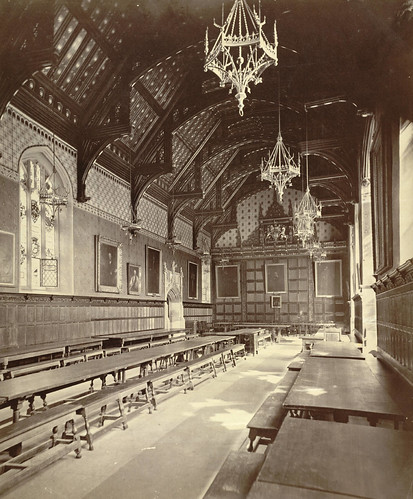
The Hall of St Johns College in 1885.
Little changed in the next 85 years. 
Which leads me to ruminate on the place that chance plays in our lives. Because I can put my friendship with Gottfried down to a single chance event, of no apparent significance at the time.  It was the decision of where to sit down to dinner on my first night at Cambridge.  The venue was the Hall of St Johns College, along with a couple of hundred other students.  It happened that I chose to join a group of half a dozen others who were obviously new like me. And as a consequence of sitting together that night this little group formed a bond which persisted many months, indeed to some extent, for the next three years.  There will have been numerous such groups on that first night, I have no doubt, and for no particular reason I chose this one. Which happened to include Gottfried. And our friendship developed from there.  It's not too fanciful to say that had I sat anywhere else that night, my life would have turned out entirely different.  No Garden House, no prison, no left wingery, no housing officer job in York, no union convenor.

St Johns was noted for being a right wing college.  Besides Gottfried, I was not aware of any other lefties there.  It’s a large college too; so but for those accidental seating arrangements on the first night, it’s entirely possible that Gottfried and I would not have found our paths crossing.  As it was, we had many long conversations about politics, my starting point being what I should now call a mild version of social democracy.

In our second year Gottfried and I shared rooms.  It was during this year that the demo took place.  Travel agents had, with astonishing insensitivity, got together to promote tourism to Greece.  At the time, a very distressed and oppressed country.  Gottfried was extremely exercised about the whole business, and attended several of the pickets outside travel agents that were staged during “Greek Week”, of which the Garden House dinner was the culmination.  I recall we spoke at length during the week about the issues involved, and by Friday I was fully convinced that the Garden House demo was the place I ought to be that night.  Little did I know what I was letting myself in for.

I should like to be able to say that I had a proper grasp of all the issues when I attended that demonstration, but I know that in the opinion of my friends at Cambridge at the time, I didn’t.  They all thought that Gottfried had led me by the nose.

Lets hold that thought, while I pinpoint one other accidental fact, over which I had no control, and which can plausibly be said to have determined the course of my life.  Eight of us from the demonstration were imprisoned, and of these, six spent the first few months of our sentences at Wormwood Scrubs.  We were in what was known as the allocation wing.  This was a staging post before being allocated to other prisons to serve the major part of our sentences.  I was at Wormwood Scrubs for the two months of July and August 1970, and spent the remaining four at Northeye, a semi-open prison outside Bexhill, Sussex. My prison number was 085856. That has just popped into my head as I write this.  But back to the allocation wing at Wormwood Scrubs.  The regime was three to a cell, slopping out, and confined for 23 hours a day. On Sundays 23½ hours.  There was half an hour’s exercise each day (yes just like in the movies) and another 30 minutes for slopping out and collecting meals.  But on Sundays, no exercise.
Wormwood Scrubs Prison
(not a view I ever saw)
My prison education

Now I said there were 6 of us in the allocation wing at Wormwood Scrubs.  And for reasons I am not aware of, three of the six were dispersed in cells with ordinary criminals (you’ll have to forgive the expression) and three were accommodated together in one cell. I was one of these lucky three, together with Rod Caird and Brian Williams.  Both of whom, unlike me, were committed leftwing activists, and willingly took my education in hand, ordering the right books for me to read. Marx, Engels and Lenin figured prominently in the list of authors, along with Gramsci, and works of modern history.  E H Carr’s history of the Russian Revolution was one.

23 hours a day provided limitless opportunity for seminars on all this material.  And I was a strongly motivated learner.  I desired to know in what way my incarceration was not a mere accident but part of the trajectory of human history. And to be able to have an answer to those on the outside who were saying “pity about Peter, he was just in the wrong place at the wrong time”.  It was important for me to be able to say that, on the contrary, I was in the right place at the right time.

Which I firmly believe I was.

But I wouldn't like to predict the outcome had I had different cellmates for those two summer months in 1970.  So that’s the other accidental fact which can be said to have determined the rest of my life.

A resonant phrase

Just one more thing, I see from the CAM article that in a letter to the Cambridge Evening News, in the immediate aftermath of the demonstration, I wrote : “our anger outside the hotel was more justified than the complacency of the diners”.  A resonant phrase, of which I can be justly proud!  Or could be, had I written it.  I have no memory of this letter and so can only go by my what my gut tells me. And my gut tells me that someone else may have been holding the pen! Still and whatever, I have the credit for it now.

Thursday, December 30, 2010

The Greek Colonels - my part in their downfall


In June 1970 I received a 9-month prison sentence, and served 6, for my part in a demonstration in Cambridge. This was the Garden House Hotel demo, which took place on Friday 13th February that year. It has been much on my mind since last March, when a journalist contacted me for a feature he was writing to mark the 40th anniversary. More of this below. This post gives the background. I shall have further comments soon on my involvement, and the role of chance in human affairs.


The picture is from the Cambridge Evening News. I don’t have the original caption. I imagine we are all on our way to the trial at Hertford Assizes in June; though it’s possible it was the magistrates court committal hearing in March or thereabouts. The two cheerful fellows had good reason to be cheerful. They weren’t on trial. Striding out to the left of the picture is Gottfried Ensslin. The cheerful chap with the specs is Stephen Ginsborg, whose brother Paul I shared a house with in York a few years later. Eyeing me disapprovingly, as well he might, is Rod Caird, while I make a spectacle of myself with my tie.

You can read about Gottfried and Rod, and about me for that matter, in the latest issue of Cambridge University’s CAM magazine. Scroll down to page 22 or search for Here six of the protestors recall their part (without quotes).

The magazine ran this feature to mark the affair’s 40th anniversary. I gave a telephone interview to William Ham Bevan, a journalist who had been commissioned to write the piece. It appeared in the October edition of CAM, and was reprinted on 23rd November by the London Independent, whose editor detected a resonance with this year’s student protests over fees.

The Garden House demonstration was to protest against a dinner which was the culmination of ‘Greek Week’, an initiative held in the city to raise Greece’s profile as a holiday destination. We were informed that the Greek embassy had sent down a chef for the occasion, and I imagine this was indeed the case. What made it distasteful was that Greece was in the hands of a fascist military Junta which had seized power by a coup in 1967. The regime, often referred to as the Greek Colonels, was rabidly anti-communist and justified its actions by claiming to save Greece for democracy. Torture was widely used. The Scandinavian countries as well as the Netherlands took a very hostile stance and filed a complaint before the Human Rights Commission of the Council of Europe in September 1967. (The Junta opted to leave the Council of Europe voluntarily in December 1969 before a verdict was handed down.) The United Kingdom voiced criticism about Greece's human rights record but supported Greece’s continued membership in the Council of Europe and NATO because of the country's strategic value. The USA took the same stance as the UK. There is a murky story of close association between Greek military intelligence and the CIA, which I don’t have the details of. But I can tell you that at the time we were convinced that the CIA had a hand in the coup (like Chile later). The regime collapsed in 1974.

I notice that in the preceding paragraph I have used the word “we” twice, which might give the false impression that I was fully integrated into the protest and au fait with the issues at stake. This is far from the truth, as you will see if you study my quotes in the CAM article. I shall have more to say on this soon, when I have got my thoughts in order. My role in the protest was extremely minor, and my presence there almost accidental; but its effect on the rest of my life was total. Everything that happened from then on stems from the night of Friday 13th February 1970. 

Read more here