Showing posts with label History. Show all posts

Sunday, January 15, 2017

Some curiosities from 'Self Control', an 1811 novel


Jane Austen was very rude about Self Control, a novel by Mary Brunton that came out in 1811, the same year as Austen's first, Sense and Sensibility. Austen said she would go one better and in her next book, have her heroine cross the Atlantic in a boat by herself [1]. This was an unfair swipe at Brunton whose kidnapped heroine Laura escapes her American captors by floating downriver to safety in an Indian canoe, narrowly avoiding drowning in a waterfall. Saved by a farmer, our heroine is conducted to Quebec where she boards a ship for her home in Scotland.

And here's the point: lacking money to pay for her passage, she persuades the captain to accept a banker's draft, which can be cashed at the voyage’s end. On arrival at Glasgow we read: 


“The next morning she gave the captain a draft for the price of her passage; and producing her purse and Mrs De Courcy's ring, offered them as further security; ... The sailor, however, positively refused to accept of any thing more than the draft, swearing that if he were deceived in Laura, he would never trust woman again.” [2] 

Paying for travel by draft as early as 1811? (or the 1790's which is when I suppose the action is set.) I was intrigued … 

But having looked it up I find that ordinary citizens had been able to write cheques since around 1650. Here's one of the earliest surviving handwritten cheques in England, dated 16th February 1659.  

A 1659 handwritten cheque. The amount is £400 - over £40,000 today.
Printed cheques, it appears,  were introduced by the Bank of England in 1717 and the earliest surviving cheque on a printed form is dated 1759.  However, as we have seen, in Self Control Laura gave the captain the draft “the next morning”  so I imagine we are to suppose Laura tendered a handwritten cheque similar to the image above.  The context makes it improbable she would have had time to visit a bank to get a proper form.   

For international merchants using bills of exchange the banking system and cheques seem to go back to the 9th century at least, see Wikipedia.  But it's ordinary people, if you will permit me use that word loosely, that I am interested in. 

Another historical curiosity from Self Control.  Early in the story, Laura and her father have to travel from Edinburgh to London: the surprise here is that they go by sea.  By land would have been more convenient in every way, but much more expensive, so a sea passage was chosen as the mode of conveyance best suited to her father’s finances. "Five days they glided smoothly along the coast. On the morning of the sixth, they entered the river, and the same evening reached London." [3]

Application to the officers of police

I was startled to come across the word “police”.    I had thought this word came into use in the 1840’s, at the very earliest. But to my surprise, in 1811 you could contact the police to report missing persons. After Laura is kidnapped, her friend Mrs De Courcy searches for her, by advertising in every newspaper, and by making “application to the officers of police for assistance in her inquiries” in London. [4]   I see from the Oxford English Dictionary that “police” is first found thirteen years earlier, in 1798. 


In Pride and Prejudice the housekeeper guides Elizabeth and the Gardiners through Pemberley's interior. From Jane Austen's World blog.
A party is got up to view pictures in a country estate, in the owner’s absence [5]– putting me in mind of the Pemberley visit in Pride and Prejudice; an episode which has long puzzled me, that you could just turn up at a grand house and ask to be shown round by the housekeeper. In Self Control, the visit is with the owner’s  prior permission, so the parallel is not exact. But I've subsequently found an essay explaining the protocol of these country houses visits.[6]

It seems that in the 18th century it was accepted that respectable people could view the lavish country homes of the aristocracy and landed gentry.  A tip to the gardener or housekeeper for their trouble was often all that was expected. Though in some cases you bought tickets. The scale of country house tourism at the end of the century was prodigious. In August 1776 the visitor book for Wilton, a great house with a celebrated collection of artwork, showed 2,324 visitors in the previous year; and the second half of the 18th century saw 26 editions of four different guidebooks to this house.  The blog Jane Austen's World is also very good on this topic.

I see I haven't actually told you anything about the novel itself, but maybe that's another day's work. I'm slowly making my way through some of the books that Jane Austen would have had on her shelf, and finding it much more enjoyable than I expected. Next I might say something about Elizabeth Inchbald’s A Simple Story, 1791.


[1] When writing her Plan of a Novel, Austen wrote to her niece: "I will redeem my credit with him by writing a close imitation of 'Self Control' as soon as I can. I will improve upon it. My heroine shall not only be wafted down an American river in a boat by herself. She shall cross the Atlantic in the same way, and never stop till she reaches Gravesend." (Jane Austen's letters,4th ed. Oxford University Press. p. 295)
[2] Self Control chap XXXIV
[3] Self Control chap VII
[4] Self Control chap XXXII
[5] Self Control chap XXIV
[6] “A Fine House Richly Furnished: Pemberley and the Visiting of Country Houses”, Stephen Clarke (2000), in Persuasions, the journal of the Jane Austen Society of North America. Thanks to Eileen Collins for drawing this to my attention.


Saturday, December 24, 2016

Utopia, some thoughts

“For what justice is there in this: that a nobleman, a goldsmith, a banker, or any other man, that either does nothing at all, or, at best, is employed in things that are of no use to the public, should live in great luxury and splendour upon what is so ill acquired, and a mean man, a carter, a smith, or a ploughman, that works harder even than the beasts themselves, and is employed in labours so necessary, that no commonwealth could hold out a year without them, can only earn so poor a livelihood and must lead so miserable a life, that the condition of the beasts is much better than theirs? ” 

From Thomas More’s Utopia, 1516. This month is the quincentenary and Verso Books have brought out a commemorative edition. Must get this book. Sadly, came across it too late to drop any hints for Christmas. 


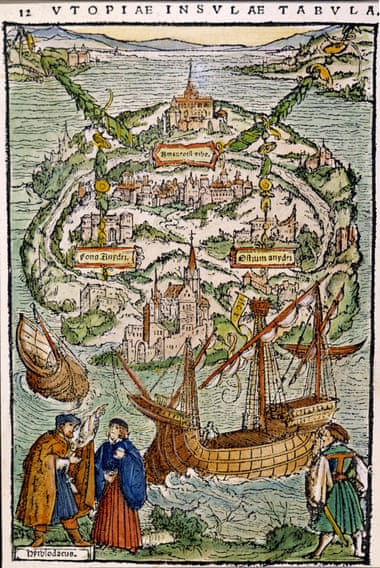
A woodcut by Ambrosius Holbein, illustrating a 1518 edition of Utopia
Utopia – or as we might say, “nowheresville” – was the name of an imaginary republic, usually described as a place in which all social conflict and distress has been overcome. But I need to read it to check this; here's another extract, which is fine till you get to the discordant note of the two slaves:-

They have built over all the country, farmhouses for husbandmen, which are well contrived, and are furnished with all things necessary for country labour. Inhabitants are sent by turns from the cities to dwell in them; no country family has fewer than forty men and women in it, besides two slaves. There is a master and a mistress set over every family; and over thirty families there is a magistrate.

Is utopianism any good?

There have been many utopias over the years, including visions of a socialist society. Utopian Socialism had many advocates in the early nineteenth century, like Charles Fourier and Robert Owen.  Marx and Engels defined their own socialism as scientific socialism in opposition to utopian socialism. The difference being that Marx and Engels thought they had mapped out a route to get from here to there, whereas the utopian socialists merely hoped to persuade the capitalists to hand the stuff over. That’s my second-hand understanding of the distinction in any event. 

Now two positive quotes about utopianism:

China Miéville in the Verso edition : Utopianism isn't hope, still less optimism: it is need, and it is desire

Eduardo Galeano,  Uruguayan journalist, writer and novelist.1940-2015: Utopia is on the horizon. I move two steps closer; it moves two steps further away. I walk another ten steps and the horizon runs ten steps further away. As much as I may walk, I'll never reach it. So what's the point of utopia? The point is this: to keep walking.

477 years

The early voyages of European discovery,  were, I imagine, amongst the influences that prompted More to write Utopia, and this has set my mind wandering off in another direction.  Between Christopher Columbus’s first voyage to the West Indies in 1492, and Apollo 11 landing on the Moon in 1969, is only 477 years. I find this a sobering thought. 

La Niña, 1492.   Apollo 11, 1969
2009 replica of Columbus's ship La Niña. Apollo 11 landed the first humans on the Moon (Neil Armstrong and Buzz Aldrin )

Wednesday, December 14, 2016

Dr Johnson and a head carved on a carrot

Two months since I wrote anything here, what’s all this delay? Surely I can come up with some insightful and entertaining bon mots pertaining to Jane Austen? Or how about some nugget culled from the dusty byways of English grammar?  Well, perhaps  … but my mind’s been elsewhere,  agonising about Brexit, Trump, the drift towards fascism and what is to be done ...  and just how, why and when did anti globalisation which used to the province of the left, become a plaything for the extreme right. Tonight I've given up trying to pen something on these themes that you haven't read much better elsewhere, so I've decided to talk about Samuel Johnson instead.  Till a few days ago I only knew his definition of oats, “a grain, which in England is generally given to horses, but in Scotland supports the people.”  To which his Scotch friend Boswell retorted, “But Sir, what horses, and what people!”  The dictionary definition is actual, though so far as I can tell Boswell’s retort isn't. I picked up a copy of Boswell’s Life of Johnson in a cancer charity shop in Cork last week, and may I take this opportunity to recommend you get or borrow a copy yourself. Almost every page contains pure entertainment.  

Left to right. Samuel Johnson c. 1772, painted by Sir Joshua Reynolds. “Am I not a man and a brother” – medallion made in 1787 by Josiah Wedgwood [1]. James Boswell at 25, by George Willison

The first thing to say is Johnson was a strong slavery abolitionist, and no friend to the American colonists. Boswell records that in 1777, when in company with some very grave men at Oxford, Johnson’s toast was, “Here’s to the next insurrection of the negroes in the West Indies.” Johnson’s “violent prejudice against our West Indian and American settlers appeared whenever there was an opportunity”, Boswell tells us, revealing his own prejudice.  Of the American colonists, Johnson said: “how is it that we hear the loudest yelps for liberty among the drivers of negroes?”  [2]

His colour sufficient testimony 

It seems that in the year 1777 a negro was claiming his liberty in a Scottish court, and Johnson dictated an argument in his favour.  No law but that of violence, subjects a negro to his master, he argues; and the slaveholder’s pretended claim to the negro’s obedience is based on having “bought him from a merchant of slaves, whose right to sell him never was examined ….  The laws of Jamaica afford a Negro no redress.  His colour is considered as a sufficient testimony against him.”  The argument is worth reading in full, and I have it for you, along with a handful of other extracts from
The Life of Johnson, on a separate page.  Johnson could get vexed when opposed in argument, and after debating slavery and the taxing of the American colonies, two subjects which Johnson and Boswell disagreed on, they went to bed bad friends. 

As you would expect from the writer of the first dictionary, Johnson was jealous of infractions on the English language.  He found fault with Boswell for using the phrase to make money. “Don’t you see (said he) the impropriety of it?  To make money is to coin it: you should say get money.” Boswell doesn't agree though, and thinks the phrase to make money is pretty current. In an object lesson to those of us who would stem the tide of language change, Johnson “was particularly indignant against the almost universal use of the word idea in the sense of notion or opinion, when it is clear that idea can only signify something of which an image can be formed in the mind”. We may have an idea or image of a mountain, a tree, or a building; but Johnson objected to an idea or image of an argument or proposition.  Lawyers “delivering their ideas upon the question under consideration” was modern cant, he thought.[3]

The finest head cut on a carrot 

Going into a convent for fear of being immoral was like a man cutting off his hands for fear he should steal. “There is, indeed, great resolution in the immediate act of dismembering himself; but when that is once done, he has no longer any merit: for though it is out of his power to steal, yet he may all his life be a thief in his heart.”

He argued against the value of sculpture. Painting is okay, as it consumes labour proportionate to its effect; “but a fellow will hack half a year at a block of marble to make something in stone that hardly resembles a man. The value of statuary is owing to its difficulty. You would not value the finest head cut upon a carrot.”  

Two final offerings, Johnson declared “It is commonly a weak man who marries for love”, and thought it was better to shoot a highwayman in the heat of the moment than to testify against him later in cold blood.  You can find all these things in my extracts.

I'm collecting books that Jane Austen had on her own shelves. According to her brother Henry, Johnson was her favourite moral writer in prose [4].  And in a 1798 letter, Austen wrote of getting Boswell’s Life of Johnson.  I'm now reading Johnson’s Rasselas, and have recently finished a handful of other 18th century novels. Which are not, I'm happy to say, as bad as I expected. My mistake was starting with Richardson’s Pamela.  It's dire, but I'm reassured to find Johnson also thought Richardson dire. More of this anon perhaps.

As a postscript, I see that challenged by Boswell about his prejudice against the Scots, Johnson admitted: “Why, I own, that by my definition of oats I meant to vex them.” (1783)


[1] For slave medallion by Staffordshire pottery manufacturer Josiah Wedgwood, see Smithsonian National Museum of American History 

​[2] Another Englishman, the abolitionist Thomas Day, wrote in 1776 that “if there be an object truly ridiculous in nature, it is an American patriot, signing resolutions of independency with the one hand, and with the other brandishing a whip over his affrighted slaves.”  Can't find the source for this.

[3] In Rasselas I find: “Knowledge is certainly one of the means of pleasure, as is confessed by the natural desire which every mind feels of increasing its ideas.” (ch XI) Here Johnson appears to have flouted his own rule.

[4] Henry Austen “Biographical Notice” in the 1st edition of Northanger Abbey (Dec 13th 1817)

Wednesday, June 15, 2016

In time of war


The image is a directory of post offices printed by the Reichspostministerium in Berlin in July 1944.  It contains information on how to properly address mail with the correct postal code.  I'm intrigued that at the height of the Second World War they would do such thing.  Only ten months to go before Hitler’s suicide. The book contains a map of all the postal districts in the Grossdeutch Reich, at a time when some of these districts, in the Baltic states, were already in Soviet hands. [1] 

And here's another puzzle.  Postcodes were introduced in Germany on July 25, 1941. This was a world first. Unless you count the London postal districts (NW1 etc) introduced by Rowland Hill in 1856. 

Though on reflection I suppose you could say that the German postcodes contributed indirectly to the war effort by making postal workers more productive, thereby releasing some of them for war work.

Let’s accept that.  But how would you justify choosing 1944 to bring out a new edition of the Shorter Oxford Dictionary?  You could, I suppose, argue that it made civil servants more productive when they were writing memos, though the case is far fetched.  The Shorter Oxford consists of two big tomes, hardly a work to be consulted when you're in a hurry.  So it can only be a matter of pure scholarship, and hats off for that. Were German universities doing the same sort of thing in 1944 I wonder? I've browsed through the German dictionaries at University College Cork and on the web, and the best I could come up with is the Duden spelling and style dictionary published in 1941. It's the official spelling rules in the German Reich and Switzerland, published by the Bibliographisches Institut Leipzig.  


Second World War dictionaries. My Shorter Oxford was not actually printed during the war but the Duden was.

I mention the 1944 edition of the Shorter Oxford Dictionary because it's the one I have on my shelf. It's a 1962 reprint bought second hand in Bristol in 1967.  I took it down recently to see if the word access is listed as a verb, or only as a noun. As I expected it's listed as a noun only. An example from about 1530 is given “At our access to the pope’s presence” (access here meaning entrance).

From this I infer that in 1944 you couldn’t access something, though today you can. 

Nor in 1944 could you highlight the fact that access used only to be a noun, as the word highlight doesn't occur in the main listing, only in the addenda added in 1956.  I have more to say in this subject but first I need to get my ducks in a row.  An expression I've only ever used once before and I vowed never again, but I've broken my vow.

I started with the postal directory issued by the German post office in 1944, and I'll finish with a couple of postage stamps in my collection issued in April 1945, showing that the post office continued doing what it does to the bitter end.  


The stamps shown above were the final issue by the Reichspost, issued on April 21, 1945. They were commemorative stamps, celebrating the assumption of power by the Nazis, the date being the 12th anniversary of that event.  The stamps were placed on sale in Berlin only, for a few days before the fall of the city to the Soviet Army.

The stamp on the left features a Storm Trooper / Military Police Officer (SA).   The stamp on the right features an Elite Storm Trooper (SS).  Here are some other rather fine stamps issued by the Reichspost earlier that year.:


The grey stamp at the left was issued on January 6, 1945 to commemorate the 600th anniversary of municipal l
aw in Oldenburg. Wow! The pink one was issued in February 1945 to commemorate the proclamation of the Volkssturm (People's Militia) in East Prussia to fight the Russians.

But back to those final stamps. They were delivered on April 21 to six Berlin post offices only. Four of the six post offices seem to have been abandoned on or before the day the stamps were issued, the fifth post office closed on April 25, and the last Berlin post office closed on April 28. The city was overrun on May 2.  It seems that none of these post offices were accepting or delivering mail during this period.  Moreover stamp collectors have been unable to find any authenticated franked copies of these final stamps.  Some apparently franked copies do exist, but philatelists believe they were not used for postage, but are manufactured souvenirs, for sale to occupying troops and personnel after the capitulation. [2]


[1] For more on the post office directory with maps, see USM Books
[2] Source for postage stamp information: Stamp Collecting World

Saturday, February 6, 2016

Money is like muck, not good unless it be spread

This aphorism is attributed to King James I of England / VI of Scotland.  The attribution may be false but it's contained in a collection described as a “Royal Chain of Golden Sentences” published in 1650 (25 years after James’s death). This was during the English civil war, which may be significant.

Francis Bacon (1561 – 1626)
The true originator may be the English philosopher and scientist Francis Bacon who in 1625 wrote a piece discussing statecraft titled “Of Seditions and Troubles”.

Above all things, good Policie is to be used, that the Treasure and Moneyes, in a State, be not gathered into few Hands. For otherwise, a State may have a great Stock, and yet starve. And Money is like Muck, not good except it be spread. This is done, chiefly, by suppressing, or at the least, keeping a strait Hand, upon the Devouring Trades of Usurie, Ingrossing, great Pasturages, and the like.

In the same year Bacon attributed a similar saying to a Mr. Bettenham, including the pleasing image of money stinking when kept in a heap instead of being spread. [1]
 

Mr. Bettenham vsed to say; That Riches were like Mucke: When it lay, vpon an heape, it gaue but a stench, and ill odour; but when it was spread vpon the ground, then it was cause of much fruit.

All this you can find in the Quote Investigator.

It started with someone writing in to ask for the origin of a saying of the British entrepreneur Richard Branson who used the image of money stinking when it's in a pile on his website: “If you let money pile up, it starts to stink. But if you spread it around then it can do a lot of good.”  


Francis Bacon by the bye was the first to make the cogent observation that the modern world was distinguished from the ancient one by the three key inventions of gunpowder, printing, and the magnetic compass. All of which, unbeknownst to him, came from China, a fact unearthed by Joseph Needham in the 20th century, see my essay The day I met a famous man.

My closing thought is to wonder if the Levellers used Bacon's saying that money stinks in a pile in their pamphlets, and if the attribution to James I (by a royalist, clearly) was intended to draw the sting out of it. Pure speculation on my part, I've googled in vain to find any connection. 


A pamphlet by Gerard Winstanley printed in 1649

[1] “Apophthegmes New and Old” (1625) (apophthegme being French for aphorism).

Saturday, October 24, 2015

A US national park on the Moon?


Buzz Aldrin salutes the US flag on the Moon, 1969. (Wikipedia)
Should the site be a US national park?
I want to say a few words about archaeology in space; and in particular a Bill in the US Congress mandating that the Apollo 11 landing site on the Moon will be a US national park. The Bill was introduced in July 2013; and though I have no reason to believe that it will ever go anywhere, for I've seen nothing about it since, nonetheless, as I started on this story a few years ago, I feel obliged to bring it up to date.

Back in 2012 my eye was caught by a zany act of the state of California a couple of years earlier, placing preservation orders on the Apollo 11 Moon landing site.  A bizarre act of extraterrestrial heritage imperialism I called it, in a blog post called "To boldly preserve where no man has preserved before". 

But a Bill in the US Congress ratchets the whole enterprise up a notch. So it needs to be said that whilst protecting the Apollo sites is laudable, making them US national parks is not.

Now without a doubt, the US Apollo programme was a premier technological accomplishment of the 20th century. Preserving the six historic landing sites of the manned Apollo missions is important, along with the mementos and equipment still lying around on the Moon.  The same goes for other US missions such as Ranger and Surveyor, and indeed the Soviet Luna missions.

But the US National Park System Act states that the parks are “managed for the benefit and inspiration of all the people of the United States”.  A direct conflict therefore with the 1967 Outer Space Treaty, which clearly emphasizes that the exploration and use of space by nations is to benefit all peoples. Article II of the Treaty provides that “outer space, the moon and other celestial bodies are not subject to national appropriation by claim of sovereignty, by means of use or occupation, or by any other means.” Whichever way you cut it, designating a national park on the Moon would amount to a territorial claim. Nor is submitting the Apollo 11 lunar landing site to UNESCO for designation as a World Heritage Site a way out, as World Heritage Sites are located on the sovereign territory of nations. So this would violate the 1967 Outer Space Treaty too.

Science journal in November 2013 (Vol 342, p 1049) makes these points, and proposes instead an international agreement on lunar artefacts among the United States, Russia, and China.  Other states could join in due course. This would be a far superior and long-lasting solution to a unilateral US proclamation, the article claims.

Private property in space

There are plenty of corporations and their henchmen calling for private property rights on the Moon and elsewhere in space, and the 1967 Outer Space Treaty framework needs supporting.

Should you wish to follow up the private property in space debate, I have a website with plenty of links.  You'll find clear expositions of the case for and against space property rights.  My favourite has to be a piece called “Marx on Mars” by one Virgiliu Pop, a Romanian space lawyer. This is a frontal assault on the Moon Agreement’s embracing of the Common Heritage of Mankind principle.  The principle is based (he says) on Marxism, and Marxism (he says) is a fallacy.  Wonderful stuff.

I'm going to Limerick soon to give a talk to the astronomy club there on the ethics of space exploration, and I just wanted to get this update in beforehand. By the way, if undisturbed, the bootprints in the foreground of the Buzz Aldrin photo might outlive all human artefacts on Earth.


Wednesday, October 7, 2015

In which I seek an historical fact and don't find it

Last week in Portugal I conducted some historical research about Christians under Muslim rule. According to the historian A R Disney, Christian monasteries and nunneries continued to function under Muslim rulers in the 9th, 10th and 11th centuries, and he cites two centres of Christian pilgrimage in the Algarve which were respected by the Muslim authorities.  In search of one of them, a sanctuary of the Virgin Mary, I took the bus to Faro, and was in luck, for prominently displayed in the small municipal museum is a modern tapestry telling the legend of Santa Maria de Faro.  During the years of Muslim rule, Muslims and Christians quarrelled over an image of the Virgin, which for the sake of a quiet life the Christians were obliged to ditch in the harbour. No sooner was the deed done however, than to the distress of the local fishermen all fish disappeared from the sea. Realising their mistake, the Muslims dredged the image up and restored it to its rightful place, whereupon the fishermens’ nets were filled more bounteously than ever before.  This is numbered amongst the miracles of the Virgin. Incidentally, Mary is venerated in Islam, indeed according to Wikipedia is mentioned more times in the Koran than in the New Testament. 


Tapestry in Faro municipal museum. The panels show: a fight, throwing the statue into the sea, empty fishing nets, pulling the statue out of the sea, statue restored on the wall, full fishing nets
I showed the curator the passage in Disney's book (A History of Portugal and the Portuguese Empire) about the shrine to the Virgin, and asked him if any evidence of it has survived. Sadly not. Moreover, whilst he was familiar with the book, he told me that other than the legend, there is no evidence for these events.

Hmm ... history books are full of facts and you can hardly have history without them; but the one and only fact that I've actually checked for myself seems to have evaporated before my eyes.

If I'm back in the Algarve next year I'll dig some more. And I hope I shall be, because I missed out on the museum of dried fruit in Loulé.  A circumstance which when mentioned occasions unaccountable hilarity, but I intend to prove the scoffers wrong.


More about that disputed image

A thought on the dispute between the Christians and Moors over the image of Mary. The legend mentions that the Moors resented the statue, with no explanation offered as to why. It occurs to me that to those who first heard the story no explanation was necessary – for the Moors’ prohibition of images would be too well known to need mentioning, and Mary being a figure of reverence to Muslims would make the Christians’ statue all the more abhorrent.

The source of the legend appears to be an old Spanish poem, or song, translated: “In Faro, there was a statue of the Virgin. It had stood on the seashore since the time of the Christians, and captives prayed to it. Christians called the city ‘Holy Mary of Faro’ because of the statue. The Moors resented this and threw the statue into the sea. As long as the statue lay in the water, the Moors could not catch any fish. When they realised this, the Moors recovered the statue. They placed it on the wall between the merlons [battlements]. Afterwards, the Moors caught even more fish than they had before.”


Note: The poem is “The Moors of Faro who Threw a Statue of the Virgin into the Sea”. It's no 183 in the Cantigas de Santa Maria, a collection of poetry in medieval Galician composed at the Court of King Alfonso X of Castile in the second half of the 13th century. See the Oxford database of Cantigas de Santa Maria. This poem departs from the legend given in the Faro museum, where it's the Christians under duress who threw the statue into the sea, whereas in the poem it's the Moors.

Another note: I've seen medieval Persian depictions of Mohammed, which shows that the detestation of images has not always been a consistent feature of Islam.

Tuesday, October 6, 2015

Algarve chimneys, a speciality on the way to extinction


View of Albufeira
Back from a week in the Algarve, at Albufeira.  A pleasant holiday beside a calm Atlantic in warm sunny weather, never out of shorts, and no need of a sweater even in the evenings.  The only drawback was most of the voices you hear are English and the entire town which was once a fishing village consists of restaurants and bars and shops selling beach umbrellas, and some quite nice pottery.  If you were local it would depress you to behold a hillside quite covered in tourist apartment blocks, and you might wonder what the planning department has been doing. Though since all this is done for my benefit, it's hardly my place to complain.  It is however Abel’s place.  Abel is a new friend I've made in Albufeira and along with a couple of thousand others he’s part of a Facebook group devoted to preserving the distinctive Algarve chimneys, which were first drawn to my attention by a tourist guide last year.  Here are some:-

Photos by João Lelo from the Facebook page
Chaminés Algarvias – Uma Espécie em Vias de Extinção
(Algarve chimneys, a specialty on the way to extinction)
I was astonished to learn that many instances of these chimneys are even now being demolished, and that some of those whose photos I have seen, actually no longer exist. Before I left, I sent a message to the Director of Turismo do Algarve, expressing my dismay and concluding “Surely something should be done?”  There seems little confidence in the local authorities however. A Facebook group member posted (in English) “A very well meant initiative, but probably going to the wrong address. Authorities are the last to take appropriate measures. It's up to every single Portuguese to be aware of their beautiful heritage. But not even most of the architects have the right feeling for it. This group is a good approach to reach that goal!”

By the way for a bit more on the history of the chimneys and of Muslim-Christian relations in Portugal, you can read “Of mosques and chimneys in the Algarve”, a blog I wrote last year.

Sunday, August 16, 2015

Did Magna Carta die in vain?


There are few specific facts that I positively remember learning at school. I thought there were three, but right now I can recall only two, the first of which is the existence of the Indo-European family of languages. I was so enthralled by what I found on this topic in the school library's Encyclopedia Britannica that I read the whole article standing up with the volume resting on a shelf. The other fact came from our history teacher Mr Bruin, and I can visualise the classroom where he told us this. The window was on the left.  He said Magna Carta was unknown till discovered by Parliamentary lawyers in the 1620’s, a fact seemingly corroborated when we studied Shakespeare’s play of King John, in which Magna Carta doesn't even rate a mention.

From the British Library Magna Carta exhibition. An early Chartist poster from 1839. The Chartists chose their name to evoke an echo of Magna Carta
Actually I discovered from the British Library Magna Carta exhibition last week that the case is less clear-cut than I thought, but before I forget may I mention that the exhibition finishes on 1st September and if you’ve not been and have the opportunity to do so, I suggest you look lively and book here. 

I also suggest you put an alarm on your phone to remind you of your transport home.  I thought I had been in the exhibition a mere couple of hours or so, till my watch told me I had been there four hours, and I had to dash for my train back to Derby - from St Pancras Station thankfully, which is next door.

As to Shakespeare not mentioning Magna Carta a variety of
sometimes incompatible reasons are advanced for this. The simplest, that he just hadn’t heard of it, is probably not the case. Though it had not yet become an icon of popular culture, Magna Carta was part of the law, and was first printed in 1508. So what Mr Bruin told us, that Magna Carta was unknown before the 17th century, wasn’t quite right, and I'll return to this soon.  But although Magna Carta was enrolled in the statute book, it was the 1225 version (hold that thought, it's crucial) and not the 1215 version, so maybe Shakespeare just didn't associate Magna Carta with King John.  Or there again, maybe Shakespeare was well aware of the King John connection, but even more aware that his play might be banned if it depicted a successful rebellion against a monarch, as this was the sort of thing Queen Elizabeth and her secret police were awfully touchy about.  Maybe the truth is that to Shakespeare and his audience Magna Carta had not yet become a big thing in English history.  

Enthusiasm for a document they had not read


No to ‘Magna Carta Day’.  An internal civil service memo from 1947
My favourite exhibit? A 1947 internal civil service memo, denouncing a proposed ‘Magna Carta Day’.  An idea had been floated to declare 15th June a public holiday in the British Empire and the United States. These were the early days of the Cold War, and ‘Magna Carta Day’ was intended to emphasise Anglo-American co-operation and to champion the document as a symbol of Western liberty. Some British civil servants opposed the scheme though, fearing that the celebration of civil liberties might provoke opposition to British imperial rule. A memo from one K. W. Blaxter, Assistant Secretary in the Colonial Office, was on display.  He dismissed the plan thus:

In some Colonies where ill-disposed politicians are ever on the lookout for opportunities to misrepresent our good intentions, its celebration might well cause embarrassment and in general there is a danger that the Colonial peoples might be led into an uncritical enthusiasm for a document which they had not read but which they presumed to contain guarantees of every so-called ‘right’ they might be interested at that moment in claiming.
 

Revolutionary yes or no?
 
Was Magna Carta a revolutionary document? Most historians say no, it was in line with coronation oaths made by previous English kings and with contemporary charters in Europe. Like the Statute of Pamiers, 1212, on display, a document the English barons will have known about.  So Magna Carta was part of conventional medieval political theory, the story goes.  This argument is set out in a lecture which is well worth reading by Lord Sumption, a leading British judge. He dispells the myth of Magna Carta as the original foundation of democracy. It was a treaty bound by its own context and the tenets of feudal law.


A republic like Venice

But the conservative historian David Starkey dissents. He claims Magna Carta was revolutionary. This is by virtue of clause 61, the security clause as historians call it.  Clause 61 gave the barons the right to levy distraint if the king infringed the charter, seizing the king’s assets like a debtor or malefactor. 

Starkey claims that the original 1215 Magna Carta (which only lasted 12 weeks) would have made England an aristocratic republic like Venice, with power in the hands of a senate of 25 barons.  It's in his book Magna Carta: The True Story Behind the Charter which I fear I won't get round to reading.  Magna Carta, he claims, is being presented as safe, domesticated, comforting, in this centenary year, but the earliest account of it by a Scottish observer is quite otherwise: ‘A new state of things began in England; such a strange affair as had never before been heard; for the body wished to rule the head, and the people desired to be masters over the king.’

Margaret Thatcher is frequently ridiculed for claiming in her 1988 “Bruges Speech” that Magna Carta was the beginning of parliamentary democracy.  I wonder if this is quite fair.  Her actual words were “We in Britain are rightly proud of the way in which, since Magna Carta in the year 1215, we have pioneered and developed representative institutions to stand as bastions of freedom”.  Now I daresay that like the colonial peoples slighted by the unhappy Blaxter, she was led into an uncritical enthusiasm for a document she had not read.  Yet so far as I can tell the 1215 charter did envisage a sort of parliament.  It established a council of the realm which had to approve taxation. That’s a bit like a parliament, is it not?  To be sure, only a House of Lords, but still a beginning. 

The charter was reissued in 1225 and in this form was later enrolled in the statute book. But the 1225 version had no committee of barons overseeing the king, and no common council of the realm to approve taxation. So no enforcement mechanism. It was completely emasculated. 

More questions

How autocratic were the Angiven kings? This is a question there seems to be divergent views on amongst historians.  It's important for this reason, that if they were normally forced by circumstances to act consensually, then Magna Carta was nothing out of the ordinary for its time. The more autocratic, the more significant Magna Carta becomes.

Sir Edward Coke (1552-1634) invented our idea of Magna Carta
Another question.  In what sense was Magna Carta “rediscovered” in the early 17th century?  My history teacher Mr Bruin isn't the only one to use this term, it was used by an historian in the exhibition.  But my mental image of Sir Edward Coke (pronounced Cook by the way) shouting Eureka when he discovering Magna Carta mouldering in an archive, is too literal.  Magna Carta the document was already known. It was the Magna Carta the idea that Coke rediscovered. Or invented perhaps. Coke it seems is single handedly responsible for putting Magna Carta on the banners of the parliamentary army in the English civil war.


And is likewise responsible for the US Supreme Court regularly citing Magna Carta in its judgments.  I'm still not clear though quite what American judges are doing when they cite Magna Carta. So far as I can tell it has no explicit standing in US law, how could it?  Yet the framers of the constitution and before that the Declaration of Independence had Magna Carta – Coke’s Magna Carta – very much in mind.  There was a video of the US Supreme Court Justice Stephen Gerald Breyer, but sadly it's not included in the videos on the website.  Tony Hancock "Does Magna Carta mean nothing to you, did she die in vain?", is also sadly missing. If you have time for just one video I recommend Joshua Rozenburg.

I've just remembered the third fact I learnt at school, that Muslims revere Jesus as a prophet. This I got from what was still in those days called a Divinity lesson by the school chaplain, a forward thinking chap who taught us what I now know to be comparative religion.  I remember the classroom, and I can see the window, it was on the right hand side.


Friday, May 22, 2015

On today's gay marriage referendum in Ireland


Well, have voted in Ireland’s marriage equality referendum, and we’ll have to wait till tomorrow for the count.  All commentators are confident it will be passed. 

The necessity by the way for gay marriage to be put to a referendum, arises due to marriage being enshrined in the Irish constitution; and a constitutional amendment requires a referendum. The amendment voted on today is to add a clause to article 41. I would actually have preferred a different approach. Had I my way, the question on the ballot paper would have been to delete article 41 in its entirety, as it's already a hodge podge.   See for yourself.

It includes the state recognising “that by her life within the home, woman gives to the State a support without which the common good cannot be achieved.” And it contains the grounds for divorce (living apart for at least four years and no reasonable prospect of a reconciliation). Which apart from being too restrictive, just doesn't belong in a constitution, it belongs in legislation.

I should mention the historical background to these divorce clauses being in article 41. The present constitution began life in 1937 and when first adopted included an absolute ban on divorce.  To allow divorce at all, therefore, needed a constitutional amendment; and this was done by the Fifteenth Amendment in 1995.  That was the second divorce referendum. The first was in 1986 where the proposal to allow divorce was defeated by a whopping margin of almost 2:1. The 1937 constitution was a strongly Catholic document, and in 1986 the Catholic Church still held sway to keep it that way. 
Even in 1995, divorce only got through by a whisker.  

Two referendums today


There was another referendum today. It was to reduce the minimum age for candidates for the presidency from 35 to 21. Well, OK, I did vote for this, but heavens above, there are more pressing constitutional amendments that ought to have priority, and were considered by a constitutional convention last year.  Blasphemy for one.  The constitution provides that “the publication or utterance of blasphemous, seditious, or indecent matter is an offence which shall be punishable in accordance with law”, though strangely
blasphemy wasn’t actually legislated against until 2009. No that’s not a typo, 2009.

Apparently there was a high turnout today in urban centres which indicates success for the Yes side,  as the No’s are likely to reside in rural Ireland where the Catholic Church still has some residual influence.  Here's this week’s Mitchelstown mass leaflet.


In this locality, mass attendance by people of my age is high, and many massgoers will, I'm fairly sure, take their lead from the Catholic bishops. Younger generations, less so. Generally, young voters appear to have been hugely energised by the Yes campaign, especially in urban areas.


According to the Irish Times whose website I've just consulted, the turnout across Dublin county was 65%, and in Cork city was above 60%.  For a referendum that's high, apparently.

I forgot to mention what would follow if my plan were to be followed to scrap article 41 entirely.  I would then enact legislation which would delete “marriage” from all laws. The state would register civil partnerships only, and all existing marriages would be reclassified as civil partnerships.  Henceforth marriage would be a cultural event that you could do in church or other venue of your choice.   If you believe that marriage is a union of man and woman, open to the procreation of children, and a gift from God, then there would be no apparent conflict between that belief and the law of the land.


Saturday, May 2, 2015

Some thoughts on Germanness, a lonely tree and Cinderella


This 1822 painting by Caspar David Friedrich, The Lonely Tree (Der einsame Baum), I saw last November at the British Museum. It was part of an exhibition devoted to the many different ways Germans view their history. You may ask why out of the blue I've decided to write about this today, and there are a couple of reasons, which I'll come to.


But first about this painting. At the centre, an ancient oak stands damaged but alive, its branches dark in silhouette, projecting into the largely overcast morning sky. A shepherd shelters under the leafy lower branches, his flock grazing in a spacious meadow. In the middle distance nestles a village, with tree-clad hills that pile up into blue-grey mountains in the background. The oak tree, according to the exhibition notes, has since the romantic period been a symbol of the German nation; and one interpretation of the painting (I don't know if it's the artist’s own) is that the tree is Germany, battered by Napoleon but unbowed, continuing to shelter the German people. A potent symbol of German nationalism, 50 years before Germany existed as a state.

German nationalism: the very words make us queasy … and yet … why should the Germans uniquely amongst European peoples of the 19th century, be denied their nationalism just because we have the advantage of knowing the history of the 20th? You could say that nationalism has been the bane of world history. It might be a foolish and unhistorical thing to say: but foolish or not, I've said it. And if the statement has any value at all (though I'm ready concede that maybe it doesn't) it applies to German nationalism no more and no less than to Irish nationalism, or any other nationalism.

Grimms Fairy Tales

Now to the two reasons I'm writing about this today. One is that for my birthday six weeks ago Albert gave me Philip Pullman’s Grimm Tales, translations from fairy tales assembled by the Grimm brothers, Jacob and Wilhelm, Kinder- und Hausmärchen (Children's and Household Tales). This work has become a pivotal component in the idea of Germanness, and featured in the same Germany exhibition where I saw the lonely tree painting. The tales were first published in 1812, which as Neil MacGregor points out in his guidebook to the exhibition, is a significant date. 

By that year, Napoleon had conquered and occupied most of Germany and had annexed wide stretches of the Rhineland. Cologne was a city in France. Yet to the brothers Grimm (who were language scholars as well as folk tale collectors) Germany had something of immense value which the French could not claim: a language reaching back into the mists of pre-history. In the time of the Roman Empire, the French had abandoned their Celtic tongue and adopted Latin, the language of the conquerors. Not so the Germans, most of whom lived outside the empire’s borders, and kept their language, which along with their folktales, so the story goes, furnished them with an identity that no foreign invader could eradicate. And the tales, collected by the Grimm brothers, became part of a German political and cultural renaissance.

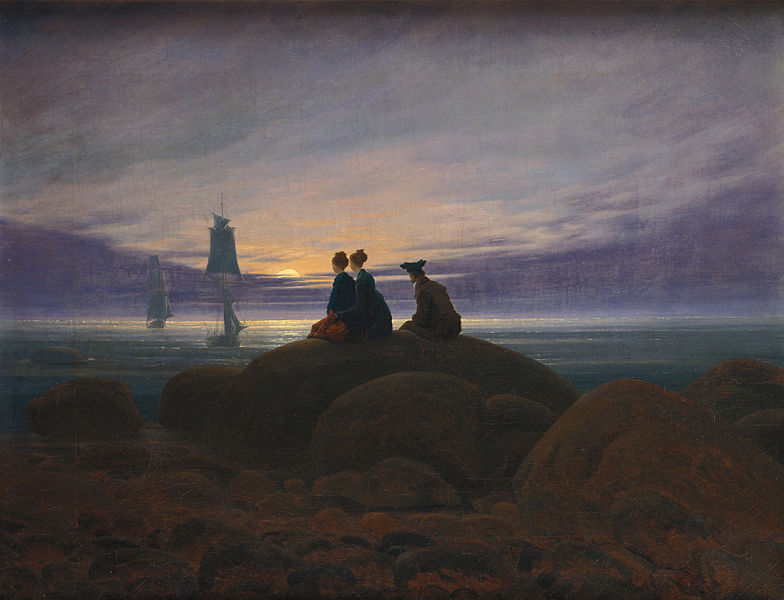
As to the second reason for writing about Caspar David Friedrich now: I'm just back from Vienna where with Cork Astronomy Club members I visited the Vienna university observatory and heard a fascinating impromptu talk by the senior scientist there, Dr Thomas Posch. He drew our attention to another picture by Caspar David Friedrich from the same year 1822, Moonrise over the Sea (Mondaufgang am Meer).


Why this grabs me, and what it has to do with astronomy (I doubt you'll guess) is work for another day.

Ugly sisters not ugly

Finally a few words about Grimms Fairy Tales. They include Cinderella, Snow White and Hansel and Gretel and there are about two hundred more. The Grimm versions are surprisingly, sometimes shockingly, different. Cinderella has no fairy godmother, her ugly sisters are not ugly but they do have their eyes pecked out by pigeons. I recommend an episode of BBC Radio’s In Our Time, where
a few years ago Melvyn Bragg discussed the Grimm tales with three specialists. I'm not sure I prefer Philip Pullman’s translations to an 1853 version I have, but then, without knowing German, how do I know? What I do recommend the Philip Pullman book for is the note at the end of each tale commenting on the story, drawing parallels, and giving the ATU number. Not sure what an ATU number is? I dealt with this a few years ago in connection with King Midas and his asses ears.

Thursday, March 12, 2015

Islamic State puts me in mind of Bamiyan


Hatra, a fortified city that withstood attack by the Romans
Today two linked stories in the media. The Guardian reports Iraq’s director of antiquities confirming that Islamic State militants (don't like the word but more of that another day) have ransacked the ancient city of Dur-Sharrukin near Mosul. This is the group’s latest assault on the country’s 3,000 year heritage, the report following hard on the heels of news of destroyed ruins at the ancient city of Hatra.  (I'm not clear if the destruction includes the city walls in the image above.  The story was on the BBC website a few days ago.)
 

Bamiyan Buddhas. Left, after 1,500 years. Right, after 1,500 years and 25 days
The other linked story I came across today is also from the BBC who have interviewed an Afghani bicycle repair mechanic in Bamiyan, one Mirza Hussain. In March 2001 as a prisoner of the Taliban he was forced to carry explosives to blow the Bamiyan Buddhas up.  "I regretted it at that time, I regret it now and I will always regret it," he says. "But I could not resist, I didn't have a choice because they would have killed me."  He recalls two to three explosions every day to destroy the Buddha, and drilling holes into the statue to plant the dynamite without proper tools.  He remembers the whole process took 25 days, and that the Taliban brought nine cows to slaughter as a sacrifice.
 

I've blogged about the Bamiyan Buddhas before, in 2011. At that time I was exercised by the debate whether they should be left as rubble; a debate that so far as I know continues.  But now the Buddha destruction has a more urgent relevance.  The annihilation of these ancient sandstone carvings, once the world's tallest Buddhas, in an act of destruction that shocked the world, doubtless inspired the recent vandalism of Iraqi heritage sites by Islamic State fighters.   And it's set me thinking about iconoclasm generally. 
Islamic State, which controls large areas of Iraq and Syria, says shrines and statues are "false idols" that have to be smashed.  Carved to the glory of God, and in an act of performance art, smashed to the glory of God.  It could be argued, though not by me, that one act is as valid as the other.   More about this when my thoughts are in order.   

Mirza Hussain today, from the BBC website
As a postscript we should note that according to Newsweek, when the Taliban destroyed the Bamiyan Buddhas, residents hiding in the mountains at the time, heard explosions for three or four days.  Fifty cows were sacrificed at the site for Taliban dignitaries flown in by helicopter for the celebration. Mirza Hussain says 25 days and mentions only 9 cows. The sort of conflict of evidence that journalists and historians have to grapple with daily.  
 

Sunday, January 25, 2015

Coins in a museum - not as dull as it sounds


To the British Museum to see coins. Accidentally though, as my intention was to view a small exhibition about Indian Ocean trade in ancient times, of which more another day perhaps. Weaving my way last Tuesday through the galleries in search of room 69B, coins were in truth far from my thoughts. I normally have little difficulty walking past these quintessential museum objects, as they squat unblinking in their display cabinets. But a cluster of visitors round a small table aroused my curiosity. I discovered they were passing a small collection of coins from hand to hand, encouraged by a young curator named Kate whose only stricture was that we had to hold the coins over the table in case they fell through the cracks between the floorboards.


The bronze bar is mighty heavy. It's a tax remittance
Apart from the bronze bar, the heaviest was a copper 2d (bottom right, that’s a two-penny coin pronounced tuppeny piece) dated 1797. Jane Austen may have handled it. But unlikely, as it proved unpopular due to its excessive weight, and was withdrawn after a couple of years.  Known as a cartwheel.


A gold Dinar from Egypt around 1052 CE (top row, middle). Famed for the purity of its gold, it was much coveted in the West. Also much counterfeited in the West, using low quality gold.

When I was small my father read me Treasure Island of which my only abiding memory is a parrot chattering "Pieces of Eight" perched on Long John Silver’s shoulder, the prototype of all pirates. And that’s more or less all I knew. But now I can tell you that a piece of eight was 8 Reales (top right), also known as a Spanish Dollar. Struck from South American silver, it was the form in which the Spanish galleons transported their bullion across the Atlantic. By the late 18th century Pieces of Eight had become the first worldwide currency. 

A massive bronze bar weighed well over a kilogramme.  To pay your taxes in the Roman Republic, about 300 to 250 BCE, you had to buy one of these 'struck bronze' objects and take it to the tax office, or so we were told.  They are mentioned on this Wikipedia page, but not the bit about tax.

Silver siege money of the English Civil War (bottom row, middle). Minted in Newark in 1646, though minted may not be the right word as it wasn’t really a coin.  'Money of necessity' was issued by towns loyal to the King Charles, perhaps to reassure mercenaries, or simply to allow everyday transactions. Siege money was made from jewellery donated (I wonder?) by the citizens, and the one we handled had a hole near one corner, suggesting it was made into a pendant after the Restoration to proclaim “I fought for the king”.


Fakes, ancient and modern. £1 coins on the left, Roman on the right.
That was the end of the hands on session. Next, in a nearby case I came across the fakes. Roman coins and £1 coins. But the fake Roman coins weren't modern fakes to fool collectors, no: they were faked around 340 CE.  A hoard of 815 coins was found in Suffolk, faked from copper alloy. How do curators know they are fake, one wonders?  It's all here. And another fact: one in every 35 £1 coins in circulation today is a fake.

Lastly, what desperate circumstances impelled someone to bury this jug of gold coins under the floor in a house near Corbridge in Northumberland in 160 CE? They wedged two bronze coins in its neck in an attempt at deception, and never came back to reclaim their hoard. But whoever they were hiding it from didn't discover it either. It was found in 1911. When the jug was lifted the bottom fell out.


If you'd told me I was going to write a blog about coins in a museum I wouldn't have believed you. So there's a little lesson for us all.