Thursday, January 19, 2012

On the uses of religion


Ballygiblin church, Mitchelstown parish
Tonight to a special mass for John, who tomorrow is to have an operation for cancer. I gather it’s an amputation, maybe a life and death affair for all I know. I don’t know John but his brother has done some tiling for us and his sister has a florists shop in town. Ballygiblin church was full, I guess about 300 in the congregation. Canon Tim said that prayer is powerful and the most powerful prayer is when the whole community is gathered together. The gospel reading was Jesus saying take up thy bed and walk to the man who was sick of the palsy. (Except tonight Jesus said pick up your stretcher and the man was a paralytic. It’s the one where his friends lowered him through a hole in the roof. Mark ch 2.)

You can have a secular wedding or funeral, but I've never known a secular version of what happened tonight. Canon Tim was right about the whole community gathering together to pray. When John is told that 300 people have been praying in church for him, that knowledge has got to fortify his immune system, no question.

It was a moving experience to be there, all those people turning out on a cold dark night to pray that John’s operation is successful, and that God will restore him to heath. They prayed for the surgeons and nurses too.

The historian


Man proceeds in the fog. But when he looks back to judge people of the past, he sees no fog on their path. From his present, which was their faraway future, their path looks perfectly clear to him, good visibility all the way. Looking back, he sees the path, he sees the people proceeding, he sees their mistakes, but not the fog ...  and one might wonder: who is more blind? Mayakovsky, who as he wrote his poem on Lenin did not know where Leninism would lead? Or we, who judge him decades later and do not see the fog that enveloped him?

Milan Kundera, born 1929 

I'm afraid I can't vouch for the quote's authenticity but I think it's from his book Testaments Betrayed (1995). Joined the Communist Party of Czechoslovakia while in his teens, was expelled, supported the 1968 Prague Spring. Author of The Unbearable Lightness of Being (1984).

I ought to add that I have read none of these books. Came across the quote in The Irish Catholic. Yes, my secret is out. I read this paper every week. I'm not proud of it. But I feel better for having made a clean breast of it. A longer version appears on the website of the Association of Catholic Priests.

Wikipedia links:
Kundera
Mayakovsky

Thursday, January 12, 2012

Shaw: the unreasonable man


The reasonable man adapts himself to the world: the unreasonable one persists in trying to adapt the world to himself. Therefore, all progress depends on the unreasonable man.

George Bernard Shaw, Man and Superman, 1903

Tuesday, January 10, 2012

To boldly preserve where no man has preserved before


Buzz Aldrin salutes the US flag, 1969. (Wikipedia)
Footprints in foreground: how long will they last?
In a bizarre act of extraterrestrial heritage imperialism, the California state historical commission has placed a preservation order on the Apollo 11 Moon landing site.

Actually they did this two years ago on January 29, 2010. But I've only just found out about it (thanks to Tom) through today's New York Times.

So the state of California has declared that its cultural resource protection law extends to a site outside the state’s territory and, in fact, beyond the surface of planet Earth.  And its historical commission now technically claims to protect the 1969 Apollo 11 landing site. Which contains the discarded landing platform of the lunar module, the American flag planted in the moon dust by astronauts Neil Armstrong and Buzz Aldrin, and various tools and discarded equipment.

Other US states have made similar declarations, all on the grounds that they hosted firms, labs, or government agencies that took part in NASA’s Apollo programme.

The serious point here is that archaeologists and historians are worried lest the next generation of Moon visitors might carelessly obliterate the site of one of humanity’s greatest accomplishments. So these bizarre designations are important first steps toward raising awareness of the need to protect off-world artefacts.

The New York Times cites Beth L. O’Leary as an influential member of the preservation campaign. She’s a professor of anthropology at New Mexico State University and is quoted saying “I think it’s humanity’s heritage … It’s just an incredible realm that archaeologists haven’t begun to look at until now.”

International law

Under international law, the United States government still owns everything it left on the Moon.

On the other hand, 100 nations, including the United States, have signed the Outer Space Treaty, in which they agree not to claim sovereignty over the Moon or any part of it.

It seems federal government officials are wary – and rightly so - that other countries would see granting historic protection to the Apollo sites as a ruse by the United States to put down territorial claims.

New moon missions

NASA was intending to send astronauts back there until the Obama administration changed course a couple of years ago.  But Russia and India plan to send robotic landers.  And crucially, says the New York Times, the Google Lunar X Prize, a competition among 26 teams to become the first private organization to put a spacecraft on the Moon, offered a $1 million bonus for visiting an historic site there.

At least one team announced it was heading for the 1969 Apollo 11 landing site (so-called Tranquillity Base).  But it seems they’ve now backtracked on this and will stay away to avoid obliterating the archaeological record.  The New York Times story suggests that this is due to the publicity attracted by the spurious preservation orders.

Guidelines but no legal force

A couple of months ago, NASA's lunar science institute set guidelines for preserving the Apollo moon landing sites. Robert Kelso, a NASA manager, has catalogued what was left on the moon after the six Apollo landings, and has recommended how to balance historic preservation with the likely desire in the future to investigate how well the materials have lasted.

For Apollo 11, his recommendations ask that any visitor, robotic or human, stay at least 75 meters from the lander. This would protect every footprint and all the flight hardware

For Apollo 17, the suggested protection zone is 225 meters wide because a lunar buggy let the last two men on the moon, Eugene A. Cernan and Harrison H. Schmitt, cover much more ground.

The recommendation for the other landing sites is that visitors can get close but not touch anything.  There are also suggested guidelines for the flight paths of spacecraft overhead, to limit the chance that rocket exhaust will blow around lunar dust and damage the footprints.

None of this has any legal force. “We are hoping that whether it’s an international team or a commercial team, they would honor and recognize the value of these sites and honor these recommendations,” Kelso is quoted as saying.

It would be nice to add the site to the United Nations’ list of world heritage sites. But first the rules would need to be changed. Currently, nations can nominate only sites that are “on their territory.”

How long will the bootprints last?

Will those footprints outlive all human artefacts on Earth? With no atmosphere, perhaps only a direct meteorite strike would obliterate them. I wonder if anyone has estimated how long they will remain intact. Millions of years perhaps? There are moonquakes, but I don’t know if they are strong enough to disturb the dust imprinted by the astronauts’ boots.

By the way, "bizarre act of extraterrestrial heritage imperialism" isn’t my phrase. It comes from a blog I've looked at. I couldn't resist plagiarising it; but I fully support preserving these sites. Though the photo I've included of Buzz Aldrin saluting the US flag is, I admit, ill-suited for harnessing international support for the enterprise.


Thursday, December 29, 2011

Wot! No Winterval stories!


Winterval-hater: The Daily Mail’s
Melanie Philips
Rats!  My pen was sharpened and my green ink bottle uncorked in readiness to write to the papers scorning a story under the headline Christmas cancelled in politically correct frenzy. But alas and alack no such story came to my attention.

There was no shortage last year, but I just didn’t get my letter drafted in time. I would have relied on Oliver Burkeman’s 2006 piece in The Guardian on this theme. This is where he exposed the falsehood that in a bid to appease Muslims the English city of Birmingham had renamed Christmas Winterval.

And I was all eager to quote The Daily Mail's delicious Winterval retraction. This came in the wake of yet another they’ve-cancelled-Christmas lament from columnist Melanie Philips.

The retraction appeared on 8th November:  "Winterval was the collective name for a season of public events, both religious and secular, which took place in Birmingham in 1997 and 1998. We are happy to make clear that Winterval did not rename or replace Christmas." 

Link to article in New Humanist magazine
 

Wednesday, December 21, 2011

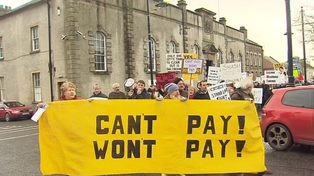
Household tax : protesters’ fox shot?


Protests in Kilkenny & Donegal over €100 Household Charge (RTÉ)
Has the Irish government shot the household tax protesters’ fox?

The protests are against an interim flat tax of €100. But RTÉ has today been reporting that under pressure from growing opposition, the Department of the Environment is urgently examining ways to have a "more progressive and fairer" property tax in place, possibly as early as 2013.

Figures quoted on the radio suggest the tax would be graduated from a minimum of €188 up to €3,125. This would be on houses up to €1.5 million; with even higher amounts on houses over €1.5 million.

Were this plan implemented, the €100 flat tax would apply for the year 2012 only.

This seems to me to torpedo the no-pay campaign. Yes it’s still extra taxation. And yes its purpose is to recompose bondholders for their gambling debts. But it’s going to be a whole lot harder to argue that it’s just this particular tax that should be targeted for protests.

The reason being, that there's almost universal consensus that a progressive property tax is a necessary part of a fair taxation system.

Before 1977 there was just such a progressive property tax, known as “Rates”, abolished to buy that year’s general election. There's a history here that I know only a smattering of. About how the Rates have gradually been replaced, in the teeth of protests, some more successful than others, mounted by the same people who now head the campaign against the household tax.

What little I do know I've put in this pdf file, but I'm hoping that something more comprehensive will appear soon in an op-ed somewhere.

Link to socialist party campaign “Don't register, Don't Pay!”.  Note that the campaign is against water taxes as well as the household tax.

And Thursday’s Irish Times: Environment minister Hogan confirms the process of devising the new tax has been speeded up,

Foxhunting

Incidentally the existence of the expression “to shoot someone’s fox” gives the lie to those who defend fox hunting on the grounds that its a form of pest control.

Friday, December 16, 2011

Household tax campaign. Guess I'm sort of obliged to join this one

 
Thursday's launch of the campaign against the new Household Charge.
Clare Daly TD, Cllr Cieran Perry and activist Eoin Ryan
in Buswells Hotel, Dublin.  Photograph: Frank Miller/The Irish Times
So. The lines are being drawn.  A campaign against the new Household Charge has been launched in Ireland.  Takes me back to my Poll Tax protest days.  In 1991 Eileen and I with millions more refused to pay the Poll Tax, and here's my attachment of earnings order when I was taken before York Magistrates Court, to pay my arrears of £188.45. 

Margaret Thatcher: my part in her downfall
The Household Charge is both like and unlike the Poll Tax. Environment Minister Phil Hogan is quoted in today’s Irish Examiner as admitting it is "not an ideal or a fair system". That's because like Thatcher’s Poll Tax, it’s a flat tax, the super rich pay the same as the almost poor. But the coalition government intends it to be replaced by a graduated tax in future years. And for now it's only €2 a week. So that blunts the flat tax argument.

Taoiseach Enda Kenny is defending the household tax by saying it’s expected to raise €160 million, which will fund local authorities, including fire services, library services and water. But he lies. This is what really makes it objectionable. Because it’s actually to plug the hole left by forking out to the bankers and bondholders.

Is this the campaign we have been waiting for that will focus opposition to the bankers bailout? 


Link to Irish Times article.