Friday, February 18, 2011

6 Billion Ways


An event worth looking at I think, if you live in Britain, are youthful and energetic.  None of which apply to me.

Aims to inform and mobilise a wide range of people on local and global justice issues by advancing beyond single issues and building a broad movement for progressive change.

The organisers include the following, all of which I commend:-

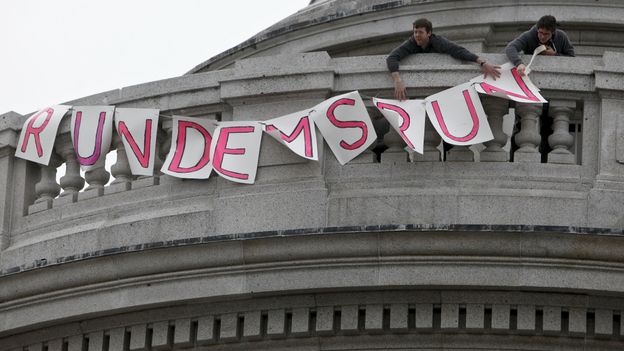
US: Runaway legislators in Democrat fightback


A quirky good news story from the US. Republicans in Wisconsin's Senate today asked the governor to send state troopers after the leader of 14 Democrats who vanished to stall Republican efforts to strip some public workers of their collective bargaining rights.

The runaway lawmakers fled Thursday, delighting tens of thousands of protesters who have descended on the state capitol. The photo shows two of them with a banner on the roof in support of the 14.

The background to all this is that Wisconsin Republican Governor Scott Walker, faced with a $3.6 billion budget deficit, intends to eliminate collective bargaining rights for state, county and local workers. The plan exempts police, firefighters and the state patrol.

Obama has called this "an assault on unions." According to NPR, the flight of the 14 has been hailed by many Democrats as a long-awaited sign that their party was fighting back against the Republican wave created by November's midterm election.

The Democrats’ vanishing act makes the senate inquorate.  It seems that Wisconsin's constitution says absent legislators can be compelled to appear but doesn't say how. It also bars police from arresting legislators while they're in session.


Thursday, February 17, 2011

A German troop train in Sweden

Sometime between 1940 and 1944, a Swedish soldier stands guard over a German troop train while German soldiers stretch their legs and two Swedish railway personnel look on. This is one of the trains that my cousin Tolle wrote about. He says the photo is precisely as he remembers it.  Possibly it was actually taken at Kiruna. 

It's from a book by my mother’s sister Kajsa, called We have no right to forget, which examines certain episodes in the Second World War. Kajsa is no longer alive but her husband Per is, and during the war he was in the Danish resistance. 

One of the book’s themes is Swedish neutrality, and there’s a chapter called “When our neutrality was German”. 

The caption to the photo reads: 

“Swedish neutrality? 2,240,000 German soldiers and 100,000 wagon loads of war material were transported on the Swedish railways to and from Norway and Finland during the 3 years of the German transport agreement.”

My den is a mess. I've avoided tidying it up for the past 5 years. Today I had a shot at it, and came across this book which I had long been looking for.  


Robot - a Czech serf


When I was about 10 (this would be 1959) my school friends and I used to talk often of robots.  But pronounced the word robo, as if the word were French.  Why did we do this?   It's actually from a Czech word, robota, meaning "serf" or "slave" or "forced labour". Throughout the Austro-Hungarian Empire from 1514 to 1789, a system of robota was in force to extract labour from peasants, similar to obligatory work systems elsewhere in Europe.

(In France such forced labour was called corvĂ©e and I was taught at school that it was one of the “causes of the French revolution”.  There’s an informative Wikipedia article on it.  It seems to have had an uninterrupted history going back to the Roman Empire.  It was abolished in 1789.  Interesting that the Austro-Hungarian Empire abolished it the same year.)


The term robot was first imagined as a character in a play by the Czech playwright Karel Capek (1890-1938), performed in Prague in 1921. The play's title was R.U.R., an abbreviation of Rosaum's Universal Robots.  The black and white picture appears to be from a production of the Capek play but I have no more information about it.   It puts me in mind of the Tin Man in The Wizard of Oz, which film I have to admit is a big favourite of mine. 

I saw it when I was about 5 (I suppose) and I was scared by the talking trees as Dorothy and her friends walked through the forrest. I clearly remember grabbing on to my mother's arm at that scene. 

But back to the Tin Man.  Until seeing the the black and white picture at left when I was researching this piece, I had never associated the Tin Man with a robot.  Yet the resemblance of the RUR man and Tin Man is quite striking.  The date of The Wizard of Oz is 1939.

The word `robotic', I have discovered, first appeared in the short story Runaround (1942) by Isaac Asimov, later included in Asimov's famous book I, Robot.

The word is now applied to any manufactured device that is capable of doing work ordinarily done by human beings, and has become an iconic part of modern culture. It had certainly achieved this status by the late 1950's.  How much earlier than this, I am not sure. 

Kathleen Richardson is to give a lunchtime lecture talk entitled ‘Will robots take over the world?’ on 24 February at UCL, and she appeared on BBC’s Start the Week, which is where I found all this out.  I shall be in London on the 24th.  With luck I'll be able to attend.

Wednesday, February 9, 2011

Egypt on Aljazeera


An American correspondent tells me he's been riveted by the Egyptian uprising and has been engrossed with Al Jazeera’s coverage of it. Truly superb journalism he says. 

You may be able to get a live stream of latest developments from Egypt here.  I can't because my internet connection isn't up to the job.  Sometimes we can get Al Jazeera on our satellite TV, and sometimes not.  I must admit I haven't tried recently, very foolish.   They also have a live blog.

What about the Muslim Brotherhood, often described as the main opposition in Egypt?  They sound like bad news but are an enigma to me.  

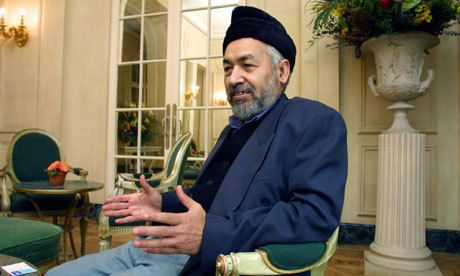
Rachid Ghannouchi, age 69
Then I see that in Tunisia, the Islamist leader Rachid Ghannouchi returned from exile on 31st January, with thousands of cheering supporters crowding round him (Irish Examiner).  Here's something to keep an eye on. It seems he likes to be described as "a democrat within Islamism". In an Al Jazeera interview, asked about his welcome at the airport, he replied “There were tens of thousands who came to the airport, mostly young women and men - some of the women not wearing head-scarves.”  Replying to a follow-up question, that there have been women protesting, concerned about his movement and what it would mean for them, he said “We have continuously defended the right of women and men to choose their own lifestyle, and we are against the imposition of the headscarf in the name of Islam and we are against the banning of the headscarf in the name of secularism or modernity.”

Sunday, February 6, 2011

Dinner seating made me a lefty


In December I gave the background to my involvement in the Garden House affair of 1970.

If you’ve read the Cambridge University magazine (CAM) article that’s linked there, you’ll see I'm quoted as saying “It was the first demonstration I’d been on – I was pretty useless. But I had struck up a friendship with Gottfried Ensslin, probably the only left-wing student in St John’s, and he made it his mission to tutor me in the ways of righteousness. This demo came up and he said we should go.”

A chance event

That is indeed pretty much the way it was. Except for one detail: I don’t actually remember telling the journalist I was pretty useless, but we'll let that one go.
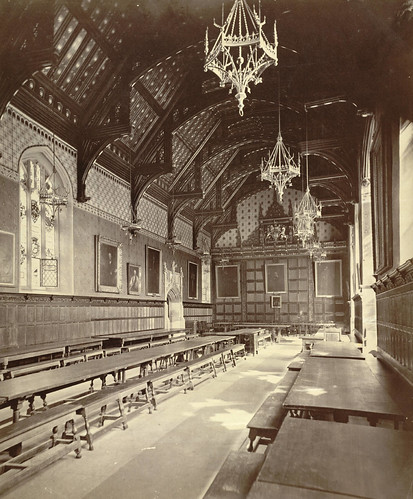
The Hall of St Johns College in 1885.
Little changed in the next 85 years. 
Which leads me to ruminate on the place that chance plays in our lives. Because I can put my friendship with Gottfried down to a single chance event, of no apparent significance at the time.  It was the decision of where to sit down to dinner on my first night at Cambridge.  The venue was the Hall of St Johns College, along with a couple of hundred other students.  It happened that I chose to join a group of half a dozen others who were obviously new like me. And as a consequence of sitting together that night this little group formed a bond which persisted many months, indeed to some extent, for the next three years.  There will have been numerous such groups on that first night, I have no doubt, and for no particular reason I chose this one. Which happened to include Gottfried. And our friendship developed from there.  It's not too fanciful to say that had I sat anywhere else that night, my life would have turned out entirely different.  No Garden House, no prison, no left wingery, no housing officer job in York, no union convenor.

St Johns was noted for being a right wing college.  Besides Gottfried, I was not aware of any other lefties there.  It’s a large college too; so but for those accidental seating arrangements on the first night, it’s entirely possible that Gottfried and I would not have found our paths crossing.  As it was, we had many long conversations about politics, my starting point being what I should now call a mild version of social democracy.

In our second year Gottfried and I shared rooms.  It was during this year that the demo took place.  Travel agents had, with astonishing insensitivity, got together to promote tourism to Greece.  At the time, a very distressed and oppressed country.  Gottfried was extremely exercised about the whole business, and attended several of the pickets outside travel agents that were staged during “Greek Week”, of which the Garden House dinner was the culmination.  I recall we spoke at length during the week about the issues involved, and by Friday I was fully convinced that the Garden House demo was the place I ought to be that night.  Little did I know what I was letting myself in for.

I should like to be able to say that I had a proper grasp of all the issues when I attended that demonstration, but I know that in the opinion of my friends at Cambridge at the time, I didn’t.  They all thought that Gottfried had led me by the nose.

Lets hold that thought, while I pinpoint one other accidental fact, over which I had no control, and which can plausibly be said to have determined the course of my life.  Eight of us from the demonstration were imprisoned, and of these, six spent the first few months of our sentences at Wormwood Scrubs.  We were in what was known as the allocation wing.  This was a staging post before being allocated to other prisons to serve the major part of our sentences.  I was at Wormwood Scrubs for the two months of July and August 1970, and spent the remaining four at Northeye, a semi-open prison outside Bexhill, Sussex. My prison number was 085856. That has just popped into my head as I write this.  But back to the allocation wing at Wormwood Scrubs.  The regime was three to a cell, slopping out, and confined for 23 hours a day. On Sundays 23½ hours.  There was half an hour’s exercise each day (yes just like in the movies) and another 30 minutes for slopping out and collecting meals.  But on Sundays, no exercise.
Wormwood Scrubs Prison
(not a view I ever saw)
My prison education

Now I said there were 6 of us in the allocation wing at Wormwood Scrubs.  And for reasons I am not aware of, three of the six were dispersed in cells with ordinary criminals (you’ll have to forgive the expression) and three were accommodated together in one cell. I was one of these lucky three, together with Rod Caird and Brian Williams.  Both of whom, unlike me, were committed leftwing activists, and willingly took my education in hand, ordering the right books for me to read. Marx, Engels and Lenin figured prominently in the list of authors, along with Gramsci, and works of modern history.  E H Carr’s history of the Russian Revolution was one.

23 hours a day provided limitless opportunity for seminars on all this material.  And I was a strongly motivated learner.  I desired to know in what way my incarceration was not a mere accident but part of the trajectory of human history. And to be able to have an answer to those on the outside who were saying “pity about Peter, he was just in the wrong place at the wrong time”.  It was important for me to be able to say that, on the contrary, I was in the right place at the right time.

Which I firmly believe I was.

But I wouldn't like to predict the outcome had I had different cellmates for those two summer months in 1970.  So that’s the other accidental fact which can be said to have determined the rest of my life.

A resonant phrase

Just one more thing, I see from the CAM article that in a letter to the Cambridge Evening News, in the immediate aftermath of the demonstration, I wrote : “our anger outside the hotel was more justified than the complacency of the diners”.  A resonant phrase, of which I can be justly proud!  Or could be, had I written it.  I have no memory of this letter and so can only go by my what my gut tells me. And my gut tells me that someone else may have been holding the pen! Still and whatever, I have the credit for it now.

Friday, February 4, 2011

Lake Vostok ... conflicting views ... exciting? or actually quite dull?


Lots to watch here.

Russian scientists are drilling through 4km of ice to test the cold dark waters of Lake Vostok beneath. The next few weeks may see the success of this project. Though there’s a possibility the oncoming Antarctic winter will force a delay until October or thereabouts. 

Will Lake Vostok provide insights into possibilities for life on icy moons such as Europa?  Can't see it myself.  Isolated from the rest of the Earth’s biosphere for 35 million years?   Ho hum.  Not nearly long enough to be interesting, I suspect.  But who am I to say? Europa scientists are said to be excited, so I'm excited.

But then, according to a story on NPR (3rd Feb), the lake‘s water changes every tens of thousands of years, making it less interesting still.  Robin Bell, a professor of marine geology and geophysics at Columbia University's Lamont-Doherty Earth Observatory, says so.

What about the drilling process contaminating the lake?  According to New Scientist (5th Jan),  the Russian team has satisfied the Antarctic Treaty Secretariat, the body set up to preserve the continent, as to the methods they are using.  But according to the NPR story, a non-governmental organization called the Antarctic and Southern Ocean Coalition is not very happy about it.  They fear pollution from the drill fluid, kerosene-freon. Or alternatively that the water will turn out to be under such pressure that it will geyser of out the bore-hole until it has degassed.