Friday, May 14, 2010

No T-shirt big enough for final theory shock


An unsettling suggestion in New Scientist 8th May (no 2759) by one Marcelo Gleiser. 
A theory of everything - a final theory that unifies all the secrets of the material world - may not exist, and it may be a mistake even to go looking for one.  Perhaps, he says, belief in a final theory is just the scientific equivalent of the religious belief in oneness.  Going in search of “the Mind of God”, though conceived by most as just a metaphor, may be all too revealing of the real nature of the enterprise.
He also says that life is probably quite rare, a product of asymmetries, imperfections and accidents.  He itemises some of these, though here he gets a bit too technical for me.
So what's unsettling about this?  We've all been led to believe that a theory of everything (TOE) is the holy grail of physics. (Ho! religious metaphor again!) Unification is the big thing. Showing that things previously thought of as separate are actually linked.  Paul Davies is fond of expressing the hope that how all the laws and forces of nature interact can one day be expressed in a neat formula, just as Einstein gave us e = mc^2 to express the unification of matter and energy. 
A t-shirt is the ideal place to put the final formula, Paul Davies reckons.
Then comes this Gleiser chap and says the universe is a mess, you’ll never get a t-shirt big enough for the formula, in fact there isn't one.
I have Lee Smolin’s The Trouble with Physics, which I haven't finished. But chapter 2 is menacingly called “The beauty myth” and the opening sentence goes “The most cherished goal in physics, as in bad romance novels, is unification.”  Does this mean I wonder that if I managed to read to the end, I should find that he too dismisses the theory of everything as a chimera? 
I borrowed The Trouble with Physics from Fermoy library.  I read chapter 2 and decided: I must buy this book.  Here he says that bringing together things previously thought of as different and recognising them as a single entity is the biggest thrill in science.  Once the Sun was understood as being there to warm the Earth and the stars were pinholes in the dome of heaven. Then the new astronomy came along and hey presto the sun is just another star. We have no special place. And the stars are just suns that are very far away.  Heaven isn't just overhead, the universe is vast.  And if the stars are suns, they must have planets and people on them.  We are not alone. Nothing is the same again. 

Sunday, May 9, 2010

PEOPLES OF EUROPE RISE UP


My favourite photo this week.


Friday, May 7, 2010

UK general election - not staying up


Am I staying up all night for the UK general election.  Indeed not. Why would I want to depress myself. 1997 was fun with all the exploding blue towers and Portillo and everything and for one night with the wine flowing we could all pretend to believe socialism had arrived.  
I've already heard talk of an 8% swing to the Tories. That's quite enough for now.

Thursday, May 6, 2010

Stephen Hawking says don’t phone ET


The Arecibo radio telescope broadcast
a message to ET, causing a level 8 hazard
Around the end of April Stephen Hawking presented a TV programme on the Discovery Channel. I didn’t see it but it was called Stephen Hawking's Universe: Fear The Aliens, and from reports I've seen it seems he argued that it’s dangerous to send signals into space because if aliens pick them up they are likely to come and get us.

This question of should we or shouldn't we send signals into space is controversial within the SETI community (search for extra-terrestrial intelligence). The astronomer and former BBC science correspondent David Whitehouse said: “The civilisation that blurts out its existence might be like some early hominid descending from the trees and calling ‘here kitty’ to a sabre-toothed tiger.”

Back to Stephen Hawking’s programme, I saw a critique of it along the following lines : Stephen Hawking is a physicist not a SETI expert, so his views should be given no special weight.   This statement must bring a smile to the lips.  What special expertise, pray tell, does a SETI expert possess when it comes to figuring out if we are under threat from hostile aliens?

Ha! they reply.  We have the San Marino Scale – bet you didn’t know that, eh?

Well, no I didn’t know that, so lets look it up.  Here it is : http://avsport.org/IAA/smiscale.htm

This scale is used to gauge the risk to humanity of broadcasting messages into space. It was adopted by the International Academy of Astronautics in 2007.  The index runs from 1 for an insignificant potential hazard to 10 for an extraordinary hazard. The number is based on intensity of the signal (on a logarithmic scale no less), its duration and information content.  For example, in 1974 the Arecibo radio telescope broadcast a message which included depictions of a man and woman, and the DNA double helix, all encoded in binary.  On the San Marino Scale this would score an 8, meaning that the potential hazard is far reaching.  9 on the San Marino Scale is an outstanding hazard, and 10 is as bad as it gets : an extraordinary hazard.

Am I wrong to poke fun at this stuff?

I'm working on a lecture to give to Cork Astronomy Club sometime within the next year or so called “Just because we can does that mean we should?” and I'm going to include this question,  as light relief mainly.  The main focus will be on colonising Mars, (on which I have a separate post if you're interested), and on crewed as opposed to robotic space exploration.

Tuesday, May 4, 2010

My favourite podcasts


Following a worldwide search, I can confidently assert that the BBC’s In Our Time is the best podcast in English.  Its remit in the history if ideas - science, philosophy, history, religion.  What gives In Our Time its edge is that it’s broadcast live (9am Thursdays) without editing.  There’s a newsletter and a listeners debate page, sometimes very illuminating.
You can access a substantial archive of past episodes, but you can't download, you can only “listen again” online. Downloading must be done within 7 days of the episode being broadcast. This rule applies to all the BBC’s output so far as I know, but doesn’t seem to apply to other broadcasters.
I often make notes of In Our Time episodes, including extracts from listeners’ comments and the newsletter. Available on request.
My best 3 - The Translation Movement, The History of Optics, The Nicene Creed
Other BBC favourites are The Forum (World Service), Start the Week, and Woman’s Hour, also two programmes dedicated to religion: Sunday, and Beyond Belief.
Next a few words about science podcasts. There’s a strong field, and I like that all of them touch on the philosophy of science, including science and religion issues. Top of my list is The Guardian’s Science Weekly, with the Nature podcast next.
The SETI institute’s Are We Alone needs a mention. You may wonder if this is a restricted zone for ET enthusiasts. Not so!  It's good science, often lacking any obvious connection with the Mekon. If the presenter Seth Shostak ever tires of physics he could make a living in comedy.
Also worth a look : Science and the City (New York Academy of Sciences), and the CBC’s Quirks and Quarks
That’s all I want to say about science.
Next, RTÉ.  Here is the list of podcasts.   My No 1 is Off The Shelf
There's a separate page for past series of which my best 3 are: Icons of Irish Science, Judging Dev, and Our War (Ireland and the First World War)
I also need to mention:- 
Words at Large (books), and Ideas (politics and philosophy) are top class.  I've already mentioned the CBC science programme Quirks and Quarks,
In 2008 or thereabouts the CBC produced a 24-part series called "How to Think About Science"  Top class. My favourite Best of Ideas episode: Living on Oxford Time, 21/7/08.  It includes Roger Penrose and his notion that time may not exist, it's all bound up with consciousness.
Top here is The Diane Rehm Show (daily, politics, current affairs), and Fresh Air (extended interviews on almost anything. I sample the site from time to time rather than subscribing to the podcast)
NPR Shuffle is a daily sampler from various mainly current affairs broadcasts. Also try It’s All Politics (weekly, takes a narrow view of “politics”, but informed and entertaining) and The Talk of the Nation Opinion Page (daily interview and phone-in with the writer of a controversial op-ed). NPR also has a science programme called Radiolab which I haven’t heard but it has won an award.
1. Background Briefing. Episodes worth mention :
2008-03-30  The three trillion dollar war - Joseph Stilglitz on the Iraq war
2008-04-06  The climate engineers - the politics and ethics of global climate control is even more interesting than the science.  Transcripts available.
2. Late Night Live – daily - politics, history, philosophy, current affairs, sometimes excellent, sometimes annoying.
3. The Ark is no longer broadcast but the archive is still available on the website. History of religion, taken in a broad sense - for example one episode was devoted to the claim that an Arab astronomer anticipated Copernicus by 200 years. This little programme used to pack a lot into 20-minute episodes. Transcripts available.
4. The Philosophers Zone and All in the Mind.

Love your home!


My late mother was brought up in LuleÃ¥ in the north of Sweden. I've only once visited LuleÃ¥ in winter, and that was for my grandfather’s funeral which was around 3rd January, some years ago. On the morning of the funeral the temperature was –40C. My uncle Sture scandalised his sisters by standing around not wearing a hat; but Sture is a physicist and knew that the stillness of the air caused his head not to feel the full force of the cold.

Afterwards my uncles and aunts were walking along the street, with me following close behind listening.  Now it happens that with the exception of my aunt Kerstin they have long ago all migrated to regions of Sweden much further south; and this was the tenor of their conversation: “In winter 40 degrees of frost and no sunlight, and in summer sun all night and no sleep. Who can possibly live in this inhuman climate?”  Wrong, wrong, wrong I thought to myself, this is wrong. Whatever the climate home is home and you should love it. I said so, but my words cut no ice with them.

The truth is I love the light nights of summer and can't see how anyone could possibly disagree. Once I played a game of Pontoon with my cousins round our grandmother's kitchen table, we sat down at about 11 pm and got up from our game at about 2 am, by which time the sun was streaming in. At no point during the night had anyone thought to get up and switch on the kitchen light.

For a photo see Midnight in Luleå

Thursday, November 12, 2009

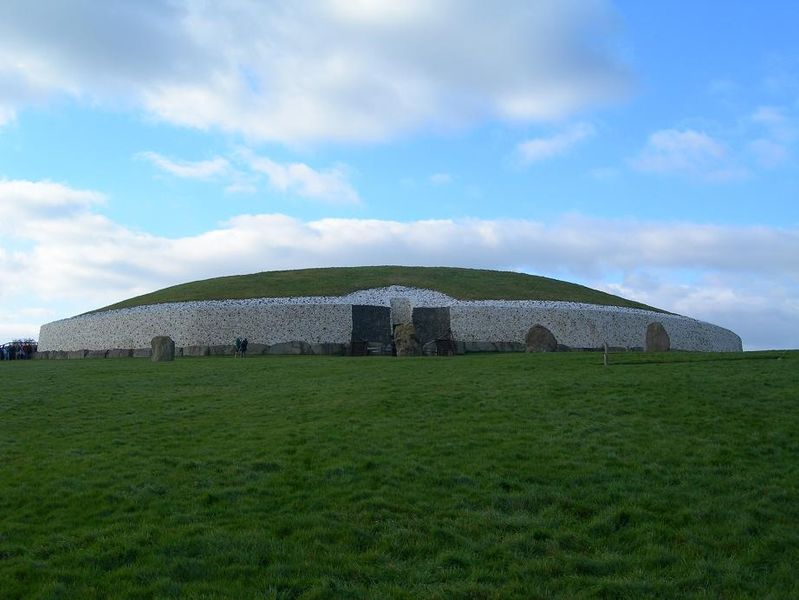
New Grange restored all wrong?


To a lecture about New Grange, by Dr Liam Irwin of Mary Immaculate College, Limerick. It's a neolithic monument not far from Dublin, similar to the pyramids in scale, and a bit older (3200 BCE).


The lecture provoked the question, should archaeologists refrain from restoring ancient monuments? Perhaps they should just build a replica somewhere else instead.
The colour picture shows New Grange restored. The black and white picture shows how the entrance to New Grange looked in 1905. It turns out the restoration is controversial. The high wall should probably be a low sloping retaining wall. But Liam says there's little appetite to change it again. Knossos has the same problem apparently. Prof M J O’Kelly was responsible for the New Grange restoration. Not clear when the work was done, 1970’s?

It’s a tomb. There are 4 types of megalithic tomb in Ireland of which this one is a passage tomb. A chap called I think O’Callaghan stood up and dissented. Said it wasn’t a tomb at all. Perhaps the bones had been brought in by wolves in the modern period, he suggested. I suspect he is not to be taken seriously.

The building materials were brought by sea. Would have taken more than a generation to build. The architect wouldn't have lived to see it completed.

Their houses were flimsy, can only have lasted a couple of generations, but the tombs were permanent and must have diverted huge resources from agriculture and subsistence. Why did they do it? Religion? Belief in afterlife? Fear? Duty? Forced labour?

Gold Roman coins have been found on the site. How to interpret these? Left by Roman tourists, or by pilgrims? Are they evidence of strong connections between Ireland and Roman Britain?

Local buses run from Dublin. Must go there sometime. Maybe Cork Astronomy Club will organise another trip there someday. I missed the last one.

This was a lecture was given to Fermoy Field Club. Dr Irwin told us that Prof O’Kelly was his teacher.