This post is far from a considered essay I'm afraid, more a stream of consciousness. I'll start with French and Irish tricoleurs on a rain soaked street in Cork this afternoon. And an image going the rounds on Facebook of the Malian flag, where French flags have sprung up adorning many users’ pages. These flags have been called forth by an ISIS atrocity in Paris ten days ago, on 13th November, which has dominated the international news. Unlike a similar one in Mali on the 21st, which gave rise to no flags on Facebook. Bombings in Beirut on 12 November, likewise attracted little coverage.
The Guardian’s readers editor, reflecting today on his own paper’s recent opinion pages, made an arresting point about when is the right time to express certain views: “The idea that these horrific attacks have causes and that one of those causes may be the west’s policies is something that in the immediate aftermath might inspire anger. Three days later, it’s a point of view that should be heard.”
He also responded to a complaint that when the Paris story first broke on Friday 13th, the Guardian website didn't immediately open it for comments. This was because there were very few moderators available and, regrettably, a considerable number of people wanted to leave Islamophobic comments, alongside the many others who wanted to engage in legitimate debate.
If it's Islamophobia you want, look no further than today’s Sun, a tabloid with the highest circulation in the UK.
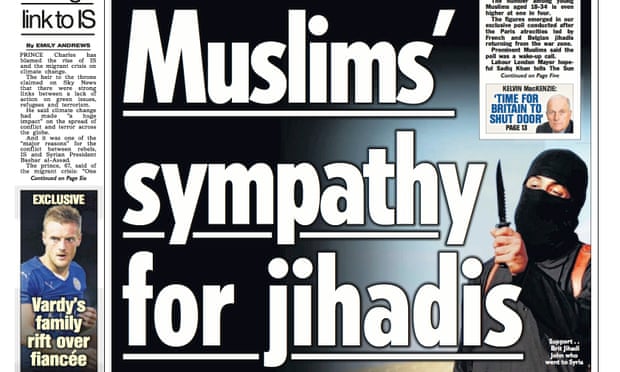
Demolished in The Guardian by Miqdaad Versi for being irresponsible, dangerous and grossly misleading. As many commentators have pointed out, the Sun story is precisely what ISIS in their black and white world want.
An interview on RTÉ radio made a big impression on me, if I have time later I'll find the link. A French senator, from the socialist party I infer, defended the French response to the Paris attack, namely to step up bombing of ISIS positions. She also welcomed a UN security council resolution backing “all necessary measures” to prevent and suppress ISIS terrorist acts on territory under its control.
So far, all according to script. Until at the very end, when the radio presenter asked her about the upcoming French elections, and would the Front National be making gains? Then we got her authentic voice: “I'm scared, I'm really scared” she said, of the right wing backlash that might arise from these attacks.
I see that I confidently asserted just now that I know what ISIS wants, and it occurs to me that I actually know no such thing. I've read “7 things I learned reading every issue of ISIS's magazine” by one Robert Evans on a website called Cracked. Now I know nothing of Evans nor his website, but find I'm reduced to trawling around the internet for any scraps of insight I can gather, and this just may be worth a read. ISIS it seems has a glossy magazine that Evans has studied at length. Amongst other things, the primary target of their hatred is not the United States, France or Russia; the one "enemy" they devote more time to ranting against than anyone else is the "apostate Muslims", who form the vast majority of their victims. I suppose we knew that already, but in the last week it's all been hidden by events in Paris.
Most propaganda makes enemies appear ugly and brutal, whilst portraying one's own side as shining and blameless, says Evans. But the Islamic State does not do this. And “their fawning ads about various jihadis don't show only happy pictures ... they almost always include a picture of the man's corpse.”
President Holland reacted immediately to the Paris outrages by announcing a new bombing campaign. Isn't this just revenge, and demeaning to France? Treading in the footsteps of George W Bush and Tony Blair and their war on terror. You can't make war on an idea, only on a state. ISIS likes to call itself a state and now they’ve all declared war on it, so it is one. The war ISIS wants, according to Scott Atran on the New York Review of Books website.
Atran's article also touches on a question that bothers me and probably you, the horrific, seemingly senseless, violence that ISIS followers engage in. But to them it's a deeply purposeful part of an exalted campaign of purification through sacrificial killing and self-immolation. This finding is based, he says, on interviews with youth in Western cities as well as with captured ISIS fighters in the Middle East.
Or is this all wrong, and are they deranged and pathetic?
When it became known ten days ago that the Islamic State militant known as "Jihadi John" had been killed by a US drone, the mother of American journalist James Foley, who was beheaded last year in Syria, said she felt no solace in the killing. "It saddens me that here in America we're celebrating the killing of this deranged, pathetic young man," Diane Foley says in an ABC video. "Jim would have been devastated with the whole thing. He was a peacemaker. He wanted to know how we could figure out why all this was happening."
Just disjointed thoughts really, and not up to my usual standard, but I hope you find some of the links useful. I'll finish with one more, from the Guardian website again, yesterday. Why do Islamist groups in particular seem so much more sadistic, even evil, asks Kenan Malik. Amongst his answers he suggest that over the past few decades anti-imperialist traditions based on Marxism and other leftwing perspectives have unravelled, leaving political rage against the West nothing but nihilistic, barbaric forms.
As a postscript here are two more links that have been recommended to me by Dave and Stevey
(1) This article, and its part 2, covers the history of ISIS. Huffington Post: “You can't understand ISIS if you don't know the history of Wahhabism in Saudi Arabia”
(2) Atlantic.com: The Islamic State is no mere collection of psychopaths, but a religious group with carefully considered beliefs, amongst them that it is a key agent of the coming apocalypse.
Monday, November 23, 2015
Friday, November 6, 2015
A Dyson sphere, my eye!
When it comes to extraterrestrial life and space colonisation by humans my intuitive response is, this is fantasy stuff, and not worth a second glance.
I'm thinking in particular of the notion that star KIC 8462852 may sport a Dyson sphere. And what, pray, is one of those? Oh yes, it's a hypothesized artificial structure surrounding a star. A structure the size, say, of Earth’s orbit around the sun, consisting of a shell of solar collectors. The idea being that with this model, all (or at least a significant amount) of a star’s energy would hit a receiving surface where it can be used. The physicist Freeman Dyson speculated that such structures would be necessary for the long-term survival of a technological civilization due to its escalating energy needs.
Madness. But madness or not serious scientists looking at the data from the recently discovered KIC 8462852 think it's behaving so strangely, that this Dyson sphere conjecture is worth exploring. Jason Wright, an astronomer from Penn State University, is quoted in The Guardian “Aliens should always be the very last hypothesis you consider, but this looked like something you would expect an alien civilization to build.”
Even as “the very last hypothesis” this is surely loopy! … and yet ... as a mere bystander, who am I to say, no this cannot be?
Space colonies aren't quite so far out and yet I struggle to take them seriously too. Dr Cameron Smith is someone who’s caught my eye. An archaeologist at Portland State University, he has arresting views on how space-born descendants of explorers would evolve culturally and genetically. His theme is the biological and cultural dimensions of human space colonisation.
This will be a process of adaptive evolution, and he thinks evolutionary studies can help plan for its success. He proposes to found a new science that he calls exo-anthropology. He envisages different models of space colonization:-
• Terrestrially-tethered colonies
• Independent colonies on other solar system bodies
• Independent colonies aboard 'closed-system' spacecraft
I recommend listening to an hour-long audio file of a teleconference held last year with scientists from NASA and the University of Texas. There are slides to accompany his talk, and you can find them on this page. (Look for a pptx file.)
Space colonisation will be a natural continuation of 4 million years of adaptation, he believes. Against our nature? No … ever since the human dispersal out of Africa, we’ve always found new places to live. Why would that stop with the atmosphere, he asks? Plenty of technical reasons maybe, but no reason against space colonisation either philosophically, or evolutionarily. Humans have always perceived new environments and then gone on to colonise them.
All except Antarctica that is. There are some scientific stations, but where are the colonies, where are the children, huh? There's the flaw is his scheme surely. Mars is many times less hospitable than Antarctica.
He says we require a science of extraterrestrial adaptation. It will be an evolutionary transition on a par with our ancestors coming down from the trees. Humanity has long considered colonising space, and at present we're at the exploration stage, thinking of individuals and how they could survive on Mars. But as an anthropologist he thinks of groups. Biocultural evolution, co-evolution of genes and culture, that’s what anthropologists study. Up to now the anthropologists have looked at the present and the past. Cameron Smith wants them to turn their attention to the future.
He cites the example of high-altitude societies in the Andes and Tibet. Here genetic mutations allow more efficient blood oxygenation. There's cultural adaptation too, for example in the Andes mothers move down to lower altitude before giving birth. Maybe on Mars there will be a need to give birth in 1g gravity, so, by analogy with practice in the Andes, mothers perhaps will ascend to an orbital station with artificial gravity.
We can expect both beneficial and deleterious mutations to arise off-Earth he says. Evolution will be driven by selection pressures arising from the different gas composition, lower atmospheric pressure, and lesser gravity. All these factors will differ from the Earth conditions that have shaped human embryo development for millions of years. On Mars we'll see the return of natural selection, big time. There will be an increase in infant mortality, he sees no way round this.
The Q&A session following his talk is worth listening to as well. A Mars colony would be physically fragile at first, and highly susceptible to sabotage by any of its members who went awry. A whole new approach to mental illness will be called for.
If a one-hour audio file is too much to digest, Dr Smith also gave a 10-minute talk for SETI Big Picture Science, called “And to space we return”.
I'm thinking in particular of the notion that star KIC 8462852 may sport a Dyson sphere. And what, pray, is one of those? Oh yes, it's a hypothesized artificial structure surrounding a star. A structure the size, say, of Earth’s orbit around the sun, consisting of a shell of solar collectors. The idea being that with this model, all (or at least a significant amount) of a star’s energy would hit a receiving surface where it can be used. The physicist Freeman Dyson speculated that such structures would be necessary for the long-term survival of a technological civilization due to its escalating energy needs.
Madness. But madness or not serious scientists looking at the data from the recently discovered KIC 8462852 think it's behaving so strangely, that this Dyson sphere conjecture is worth exploring. Jason Wright, an astronomer from Penn State University, is quoted in The Guardian “Aliens should always be the very last hypothesis you consider, but this looked like something you would expect an alien civilization to build.”
Even as “the very last hypothesis” this is surely loopy! … and yet ... as a mere bystander, who am I to say, no this cannot be?
![]() |
| When I need an image for a space colony I invariably seem to revert to this representation from the Mars One website |
Space colonies aren't quite so far out and yet I struggle to take them seriously too. Dr Cameron Smith is someone who’s caught my eye. An archaeologist at Portland State University, he has arresting views on how space-born descendants of explorers would evolve culturally and genetically. His theme is the biological and cultural dimensions of human space colonisation.
This will be a process of adaptive evolution, and he thinks evolutionary studies can help plan for its success. He proposes to found a new science that he calls exo-anthropology. He envisages different models of space colonization:-
• Terrestrially-tethered colonies
• Independent colonies on other solar system bodies
• Independent colonies aboard 'closed-system' spacecraft
I recommend listening to an hour-long audio file of a teleconference held last year with scientists from NASA and the University of Texas. There are slides to accompany his talk, and you can find them on this page. (Look for a pptx file.)
Space colonisation will be a natural continuation of 4 million years of adaptation, he believes. Against our nature? No … ever since the human dispersal out of Africa, we’ve always found new places to live. Why would that stop with the atmosphere, he asks? Plenty of technical reasons maybe, but no reason against space colonisation either philosophically, or evolutionarily. Humans have always perceived new environments and then gone on to colonise them.
All except Antarctica that is. There are some scientific stations, but where are the colonies, where are the children, huh? There's the flaw is his scheme surely. Mars is many times less hospitable than Antarctica.
He says we require a science of extraterrestrial adaptation. It will be an evolutionary transition on a par with our ancestors coming down from the trees. Humanity has long considered colonising space, and at present we're at the exploration stage, thinking of individuals and how they could survive on Mars. But as an anthropologist he thinks of groups. Biocultural evolution, co-evolution of genes and culture, that’s what anthropologists study. Up to now the anthropologists have looked at the present and the past. Cameron Smith wants them to turn their attention to the future.
![]() |
| Dr Cameron Smith, exo-anthropologist |
We can expect both beneficial and deleterious mutations to arise off-Earth he says. Evolution will be driven by selection pressures arising from the different gas composition, lower atmospheric pressure, and lesser gravity. All these factors will differ from the Earth conditions that have shaped human embryo development for millions of years. On Mars we'll see the return of natural selection, big time. There will be an increase in infant mortality, he sees no way round this.
The Q&A session following his talk is worth listening to as well. A Mars colony would be physically fragile at first, and highly susceptible to sabotage by any of its members who went awry. A whole new approach to mental illness will be called for.
If a one-hour audio file is too much to digest, Dr Smith also gave a 10-minute talk for SETI Big Picture Science, called “And to space we return”.
Saturday, October 24, 2015
A US national park on the Moon?
| Buzz Aldrin salutes the US flag on the Moon, 1969. (Wikipedia) Should the site be a US national park? |
Back in 2012 my eye was caught by a zany act of the state of California a couple of years earlier, placing preservation orders on the Apollo 11 Moon landing site. A bizarre act of extraterrestrial heritage imperialism I called it, in a blog post called "To boldly preserve where no man has preserved before".
But a Bill in the US Congress ratchets the whole enterprise up a notch. So it needs to be said that whilst protecting the Apollo sites is laudable, making them US national parks is not.
Now without a doubt, the US Apollo programme was a premier technological accomplishment of the 20th century. Preserving the six historic landing sites of the manned Apollo missions is important, along with the mementos and equipment still lying around on the Moon. The same goes for other US missions such as Ranger and Surveyor, and indeed the Soviet Luna missions.
But the US National Park System Act states that the parks are “managed for the benefit and inspiration of all the people of the United States”. A direct conflict therefore with the 1967 Outer Space Treaty, which clearly emphasizes that the exploration and use of space by nations is to benefit all peoples. Article II of the Treaty provides that “outer space, the moon and other celestial bodies are not subject to national appropriation by claim of sovereignty, by means of use or occupation, or by any other means.” Whichever way you cut it, designating a national park on the Moon would amount to a territorial claim. Nor is submitting the Apollo 11 lunar landing site to UNESCO for designation as a World Heritage Site a way out, as World Heritage Sites are located on the sovereign territory of nations. So this would violate the 1967 Outer Space Treaty too.
Science journal in November 2013 (Vol 342, p 1049) makes these points, and proposes instead an international agreement on lunar artefacts among the United States, Russia, and China. Other states could join in due course. This would be a far superior and long-lasting solution to a unilateral US proclamation, the article claims.
Private property in space
There are plenty of corporations and their henchmen calling for private property rights on the Moon and elsewhere in space, and the 1967 Outer Space Treaty framework needs supporting.
Should you wish to follow up the private property in space debate, I have a website with plenty of links. You'll find clear expositions of the case for and against space property rights. My favourite has to be a piece called “Marx on Mars” by one Virgiliu Pop, a Romanian space lawyer. This is a frontal assault on the Moon Agreement’s embracing of the Common Heritage of Mankind principle. The principle is based (he says) on Marxism, and Marxism (he says) is a fallacy. Wonderful stuff.
I'm going to Limerick soon to give a talk to the astronomy club there on the ethics of space exploration, and I just wanted to get this update in beforehand. By the way, if undisturbed, the bootprints in the foreground of the Buzz Aldrin photo might outlive all human artefacts on Earth.
Wednesday, October 7, 2015
In which I seek an historical fact and don't find it
Last week in Portugal I conducted some historical research about Christians under Muslim rule. According to the historian A R Disney, Christian monasteries and nunneries continued to function under Muslim rulers in the 9th, 10th and 11th centuries, and he cites two centres of Christian pilgrimage in the Algarve which were respected by the Muslim authorities. In search of one of them, a sanctuary of the Virgin Mary, I took the bus to Faro, and was in luck, for prominently displayed in the small municipal museum is a modern tapestry telling the legend of Santa Maria de Faro. During the years of Muslim rule, Muslims and Christians quarrelled over an image of the Virgin, which for the sake of a quiet life the Christians were obliged to ditch in the harbour. No sooner was the deed done however, than to the distress of the local fishermen all fish disappeared from the sea. Realising their mistake, the Muslims dredged the image up and restored it to its rightful place, whereupon the fishermens’ nets were filled more bounteously than ever before. This is numbered amongst the miracles of the Virgin. Incidentally, Mary is venerated in Islam, indeed according to Wikipedia is mentioned more times in the Koran than in the New Testament.
I showed the curator the passage in Disney's book (A History of Portugal and the Portuguese Empire) about the shrine to the Virgin, and asked him if any evidence of it has survived. Sadly not. Moreover, whilst he was familiar with the book, he told me that other than the legend, there is no evidence for these events.
Hmm ... history books are full of facts and you can hardly have history without them; but the one and only fact that I've actually checked for myself seems to have evaporated before my eyes.
If I'm back in the Algarve next year I'll dig some more. And I hope I shall be, because I missed out on the museum of dried fruit in Loulé. A circumstance which when mentioned occasions unaccountable hilarity, but I intend to prove the scoffers wrong.
More about that disputed image
A thought on the dispute between the Christians and Moors over the image of Mary. The legend mentions that the Moors resented the statue, with no explanation offered as to why. It occurs to me that to those who first heard the story no explanation was necessary – for the Moors’ prohibition of images would be too well known to need mentioning, and Mary being a figure of reverence to Muslims would make the Christians’ statue all the more abhorrent.
The source of the legend appears to be an old Spanish poem, or song, translated: “In Faro, there was a statue of the Virgin. It had stood on the seashore since the time of the Christians, and captives prayed to it. Christians called the city ‘Holy Mary of Faro’ because of the statue. The Moors resented this and threw the statue into the sea. As long as the statue lay in the water, the Moors could not catch any fish. When they realised this, the Moors recovered the statue. They placed it on the wall between the merlons [battlements]. Afterwards, the Moors caught even more fish than they had before.”
Note: The poem is “The Moors of Faro who Threw a Statue of the Virgin into the Sea”. It's no 183 in the Cantigas de Santa Maria, a collection of poetry in medieval Galician composed at the Court of King Alfonso X of Castile in the second half of the 13th century. See the Oxford database of Cantigas de Santa Maria. This poem departs from the legend given in the Faro museum, where it's the Christians under duress who threw the statue into the sea, whereas in the poem it's the Moors.
Another note: I've seen medieval Persian depictions of Mohammed, which shows that the detestation of images has not always been a consistent feature of Islam.
![]() |
|
Tapestry in Faro municipal museum. The
panels show: a fight, throwing the statue into the sea, empty fishing nets,
pulling the statue out of the sea, statue restored on the wall, full fishing
nets
|
Hmm ... history books are full of facts and you can hardly have history without them; but the one and only fact that I've actually checked for myself seems to have evaporated before my eyes.
If I'm back in the Algarve next year I'll dig some more. And I hope I shall be, because I missed out on the museum of dried fruit in Loulé. A circumstance which when mentioned occasions unaccountable hilarity, but I intend to prove the scoffers wrong.
More about that disputed image
A thought on the dispute between the Christians and Moors over the image of Mary. The legend mentions that the Moors resented the statue, with no explanation offered as to why. It occurs to me that to those who first heard the story no explanation was necessary – for the Moors’ prohibition of images would be too well known to need mentioning, and Mary being a figure of reverence to Muslims would make the Christians’ statue all the more abhorrent.
The source of the legend appears to be an old Spanish poem, or song, translated: “In Faro, there was a statue of the Virgin. It had stood on the seashore since the time of the Christians, and captives prayed to it. Christians called the city ‘Holy Mary of Faro’ because of the statue. The Moors resented this and threw the statue into the sea. As long as the statue lay in the water, the Moors could not catch any fish. When they realised this, the Moors recovered the statue. They placed it on the wall between the merlons [battlements]. Afterwards, the Moors caught even more fish than they had before.”
Note: The poem is “The Moors of Faro who Threw a Statue of the Virgin into the Sea”. It's no 183 in the Cantigas de Santa Maria, a collection of poetry in medieval Galician composed at the Court of King Alfonso X of Castile in the second half of the 13th century. See the Oxford database of Cantigas de Santa Maria. This poem departs from the legend given in the Faro museum, where it's the Christians under duress who threw the statue into the sea, whereas in the poem it's the Moors.
Another note: I've seen medieval Persian depictions of Mohammed, which shows that the detestation of images has not always been a consistent feature of Islam.
Tuesday, October 6, 2015
Algarve chimneys, a speciality on the way to extinction
![]() |
| View of Albufeira |
![]() |
| Photos by João Lelo from the Facebook page
Chaminés Algarvias – Uma Espécie em Vias de Extinção
(Algarve chimneys, a specialty on the way to extinction) |
By the way for a bit more on the history of the chimneys and of Muslim-Christian relations in Portugal, you can read “Of mosques and chimneys in the Algarve”, a blog I wrote last year.
Sunday, August 16, 2015
Did Magna Carta die in vain?
There are few specific facts that I positively remember learning at school. I thought there were three, but right now I can recall only two, the first of which is the existence of the Indo-European family of languages. I was so enthralled by what I found on this topic in the school library's Encyclopedia Britannica that I read the whole article standing up with the volume resting on a shelf. The other fact came from our history teacher Mr Bruin, and I can visualise the classroom where he told us this. The window was on the left. He said Magna Carta was unknown till discovered by Parliamentary lawyers in the 1620’s, a fact seemingly corroborated when we studied Shakespeare’s play of King John, in which Magna Carta doesn't even rate a mention.
| From the British Library Magna Carta exhibition. An early Chartist poster from 1839. The Chartists chose their name to evoke an echo of Magna Carta |
I also suggest you put an alarm on your phone to remind you of your transport home. I thought I had been in the exhibition a mere couple of hours or so, till my watch told me I had been there four hours, and I had to dash for my train back to Derby - from St Pancras Station thankfully, which is next door.
As to Shakespeare not mentioning Magna Carta a variety of sometimes incompatible reasons are advanced for this. The simplest, that he just hadn’t heard of it, is probably not the case. Though it had not yet become an icon of popular culture, Magna Carta was part of the law, and was first printed in 1508. So what Mr Bruin told us, that Magna Carta was unknown before the 17th century, wasn’t quite right, and I'll return to this soon. But although Magna Carta was enrolled in the statute book, it was the 1225 version (hold that thought, it's crucial) and not the 1215 version, so maybe Shakespeare just didn't associate Magna Carta with King John. Or there again, maybe Shakespeare was well aware of the King John connection, but even more aware that his play might be banned if it depicted a successful rebellion against a monarch, as this was the sort of thing Queen Elizabeth and her secret police were awfully touchy about. Maybe the truth is that to Shakespeare and his audience Magna Carta had not yet become a big thing in English history.
Enthusiasm for a document they had not read
| No to ‘Magna Carta Day’. An internal civil service memo from 1947 |
In some Colonies where ill-disposed politicians are ever on the lookout for opportunities to misrepresent our good intentions, its celebration might well cause embarrassment and in general there is a danger that the Colonial peoples might be led into an uncritical enthusiasm for a document which they had not read but which they presumed to contain guarantees of every so-called ‘right’ they might be interested at that moment in claiming.
Revolutionary yes or no?
Was Magna Carta a revolutionary document? Most historians say no, it was in line with coronation oaths made by previous English kings and with contemporary charters in Europe. Like the Statute of Pamiers, 1212, on display, a document the English barons will have known about. So Magna Carta was part of conventional medieval political theory, the story goes. This argument is set out in a lecture which is well worth reading by Lord Sumption, a leading British judge. He dispells the myth of Magna Carta as the original foundation of democracy. It was a treaty bound by its own context and the tenets of feudal law.
A republic like Venice
But the conservative historian David Starkey dissents. He claims Magna Carta was revolutionary. This is by virtue of clause 61, the security clause as historians call it. Clause 61 gave the barons the right to levy distraint if the king infringed the charter, seizing the king’s assets like a debtor or malefactor.
Starkey claims that the original 1215 Magna Carta (which only lasted 12 weeks) would have made England an aristocratic republic like Venice, with power in the hands of a senate of 25 barons. It's in his book Magna Carta: The True Story Behind the Charter which I fear I won't get round to reading. Magna Carta, he claims, is being presented as safe, domesticated, comforting, in this centenary year, but the earliest account of it by a Scottish observer is quite otherwise: ‘A new state of things began in England; such a strange affair as had never before been heard; for the body wished to rule the head, and the people desired to be masters over the king.’
Margaret Thatcher is frequently ridiculed for claiming in her 1988 “Bruges Speech” that Magna Carta was the beginning of parliamentary democracy. I wonder if this is quite fair. Her actual words were “We in Britain are rightly proud of the way in which, since Magna Carta in the year 1215, we have pioneered and developed representative institutions to stand as bastions of freedom”. Now I daresay that like the colonial peoples slighted by the unhappy Blaxter, she was led into an uncritical enthusiasm for a document she had not read. Yet so far as I can tell the 1215 charter did envisage a sort of parliament. It established a council of the realm which had to approve taxation. That’s a bit like a parliament, is it not? To be sure, only a House of Lords, but still a beginning.
The charter was reissued in 1225 and in this form was later enrolled in the statute book. But the 1225 version had no committee of barons overseeing the king, and no common council of the realm to approve taxation. So no enforcement mechanism. It was completely emasculated.
More questions
How autocratic were the Angiven kings? This is a question there seems to be divergent views on amongst historians. It's important for this reason, that if they were normally forced by circumstances to act consensually, then Magna Carta was nothing out of the ordinary for its time. The more autocratic, the more significant Magna Carta becomes.
| Sir Edward Coke (1552-1634) invented our idea of Magna Carta |
And is likewise responsible for the US Supreme Court regularly citing Magna Carta in its judgments. I'm still not clear though quite what American judges are doing when they cite Magna Carta. So far as I can tell it has no explicit standing in US law, how could it? Yet the framers of the constitution and before that the Declaration of Independence had Magna Carta – Coke’s Magna Carta – very much in mind. There was a video of the US Supreme Court Justice Stephen Gerald Breyer, but sadly it's not included in the videos on the website. Tony Hancock "Does Magna Carta mean nothing to you, did she die in vain?", is also sadly missing. If you have time for just one video I recommend Joshua Rozenburg.
I've just remembered the third fact I learnt at school, that Muslims revere Jesus as a prophet. This I got from what was still in those days called a Divinity lesson by the school chaplain, a forward thinking chap who taught us what I now know to be comparative religion. I remember the classroom, and I can see the window, it was on the right hand side.
Sunday, July 12, 2015
He and Me, or, How we played Kick the Can
Kicking the can down the road is a cliché of political journalism that bugs me. It cropped up in a Guardian editorial in connection with Greece, as I mentioned last time. But on this occasion no blame attaches to The Guardian because they acknowledged it as someone else’s cliché. No such excuse however on 27 September 2013:-
Here “kicking the can down the road” appears not only within the article but dear oh dear, in the headline. And dear oh dear, not just any old headline, but an editorial.
And here's a particularly lame instance in the Irish Examiner last year. It's in an op-ed piece which finishes:-
“Scandal has been kicked down the road, where, history warns, it will rear its head again. But with a bit of luck for Shatter and Callinan, that will be on somebody else’s watch.” Two sentences groaning under the weight of three clichés.
I'll spare you further examples. It's a metaphor that appears to have no precise referent. Or maybe there really is a kicking the can down the road game that all other kids played, and I didn't, due to my privileged upbringing? If so then I withdraw that part of the objection. (Note: idly kicking a can down a road doesn't count; it has to be a purposeful game.)
Kick The Can
At my school we did have a game called Kick The Can and very satisfying it was too. No road was involved - we played it in a clearing in the woods at one side of which a steep bank fell away to a pond on which (I think) moorhens swam. The can was a large upside-down floor polish tin. One boy would be “He”, while the rest of us ran to hide behind trees. The He's task was to catch sight of one of us. Suppose he spied me he would shout “one two three Household” and then I was caught, and had to stand at the edge of the clearing. When we were all caught, the He had won the game.
![]() |
| Here I am running up behind the He to kick the can and release three boys who have been caught. However, my run is likely to be in vain, because his foot is on the can. |
It was a brilliant game.
By the way, although I've depicted us all in Billy Bunterish school caps, these were worn only on Sundays, not for kick the can. The caps were similar in style to the one shown but they were pink, indeed Leander pink according to one of my informants. It was a prep school in Sussex called Boarzell that I attended from 1956 to 1961, age 7 to 12. Finally were my illustration accurate, I feel the can would have frequently ended up in the pond. But as I don't recall this happening, at least not often, maybe the pond wasn’t as close as I remember it.
Subscribe to:
Posts (Atom)


