Saturday, September 21, 2013

Major Barbara and uncouth bacilli


G.B. Shaw in 1909,
five years after writing Major Barbara
Have been re-reading GB Shaw’s Major Barbara.  I studied it for A-level English in 1966 and never gave it a second thought until I found it was being performed at the Abbey Theatre in Dublin, where we saw it last Saturday. Much to say about it, but now (oh no not again I hear you cry) I'm sticking to apostrophes.

Shaw called them “uncouth bacilli" and condemned them in the following terms:-

"The apostrophies [sic] in ain't, don't, haven't, etc., look so ugly that the most careful printing cannot make a page of colloquial dialogue as handsome as a page of classical dialogue. Besides, shan't should be sha"n't, if the wretched pedantry of indicating the elision is to be carried out. I have written aint, dont, havnt, shant, shouldnt and wont for twenty years with perfect impunity, using the apostrophe only where its omission would suggest another word: for example, hell for he'll. There is not the faintest reason for persisting in the ugly and silly trick of peppering pages with these uncouth bacilli. I also write thats, whats, lets, for the colloquial forms of that is, what is, let us; and I have not yet been prosecuted."

Now we'll look at a pivotal moment from Act II of Major Barbara, in the 1908 edition of Archibald Constable & Co, London. I've highlighted in green where he's left apostrophes out and in yellow where he's left them in. To my way of thinking it's a mess. Why some and not others?  Shaw doesn't even appear to have followed his own rules.  It's almost enough to make you join the Apostrophe Preservation Society.

BARBARA. Oh, youre too extravagant, papa. Bill offers twenty
pieces of silver. All you need offer is the other ten. That will
make the standard price to buy anybody who's for sale. I'm not;
and the Army's not. [To Bill] Youll never have another quiet
moment, Bill, until you come round to us. You cant stand out
against your salvation.

BILL ... Ive offered to pay. I can do no more.


Shaw didn't get everything right. When almost 89 years old he wrote a letter to The Times published on May 18, 1945, saying Irish premier de Valera was correct in calling on the German ambassador a few weeks earlier to present condolences on Hitler’s death. Shocking. Though technically de Valera was correct and Shaw was correct in saying he was correct. So maybe that’s not an example of Shaw being wrong after all.  But the apostrophe business is, imho. Link to my previous disquisition on apostrophes.

Notes: The Shaw quote is from "Notes on the Clarendon Press Rules for Compositors and Readers." The Author, 1901, quoted in grammar.about.com


For an essay on the history of the apostrophe see the excellent Grammarphobia blog. It came into use in the 1500's, and the possessive apostrophe originally indicated a missing letter. 


Thursday, September 19, 2013

Emmet's speech: is it real?


Robert Emmet’s speech from the dock the night before his execution in 1803 is an icon in Irish nationalist historiography. In preparation for today, the 210th anniversary, I've done a bit of digging. It's the speech that concludes:-

I have but one request to ask at my departure from this world: it is the charity of its silence. Let no man write my epitaph: for as no man who knows my motives dare now vindicate them, let not prejudice or ignorance asperse them. Let them and me repose in obscurity and peace, and my tomb remain uninscribed, until other times, and other men, can do justice to my character. When my country takes her place among the nations of the earth, then, and not till then, let my epitaph be written. I have done.


This day last year I posted the full text. Yet soon after doing so, I began to entertain doubts. Is it genuine? What is the source? Has the speech that has come down to us - it extends to five pages - been "improved"? My suspicious mind had me to wondering if the whole thing is just a bit too good to be true.

After spending a good few hours in University College Cork’s Boole Library, I am somewhat reassured. It turns out that there are several versions of the speech, based on notes taken by Emmet’s friends present in court.  No one version, even those taken in shorthand at the time, agrees exactly with another. The unforgettable final paragraph (quoted above) may be an exception to this; though the most recent account I've found ascribes it to just one note-taker. [1]

Dr Madden

It seems we are indebted for the speech to Dr Richard Robert Madden (1798-1886) who published The United Irishmen, Their Lives and Times in seven volumes between 1842 and 1846. This has been described “an adulatory rather than a scholarly” account. But so far as I can tell historians agree that Dr Madden submitted all the versions of Emmet’s speech to trustworthy persons still alive, and we can be confident that the text that has come down to us contains the substance of the speech, and much of the actual language.

Dr. Madden says: No published report gives any adequate idea of the effect its delivery produced on the minds of his auditors. Emmet pronounced the speech in so loud a voice as to be distinctly heard at the outer doors of the court-house; and yet, though he spoke in a loud voice, there was nothing boisterous in its delivery, or forced or affected in his manner; his accents and cadence of voice, on the contrary, were exquisitely modulated. His action was very remarkable; its greater or lesser vehemence corresponded with the rise and fall of his voice. [2]

“The man is telling the truth”

The trial stretched over one long day, 19 Sept, from 9:30 in the morning till 10:30 at night. Not even a lunch break (huh? what about the judges & jury?) It would have taken longer had not Emmet instructed his lawyers to make no defence of his actions. Leon Ó Brion [3] tells us:

Whenever they wished to overthrow a witness he stopped them, saying, “Don’t, don’t, the man is telling the truth”. He would not even allow them to make the normal speech at the conclusion of the case for the Crown. “Don’t  try to defend me”, he said “it's no use”.

Ó Broin strikes a skeptical note as to the veracity of the speech as we have it. Setting the scene for the speech from the dock, he says
 

Outside in the streets there was a great mass of people, a silent mass, but every single person was sympathetic to the prisoner. These were the people the government wanted to win over to its side. It was of them, also, that Emmet was thinking. He knew how important it was that he should pick and weigh his words carefully. But what he did not know was that neither enemies nor friends would give him the last word.  The government improved on his uncomplimentary references to France, and his friends altered his ideas in other ways, with the result that it is not possible to be sure that we have his speech exactly as it was delivered. The various versions only agree as regards the peroration.

As to the government improving on his uncomplimentary references to France, see below; but I haven't found in what ways his ideas were altered by his friends.


Authorities feared an escape plot

Emmet started his speech at 10 pm, was very tired and asked for judgement to be delayed till the next day. His speech was supremely important to him; perhaps he wanted time to write it; certainly he will have wanted time to collect himself.  But his request was denied. It's likely the authorities feared an escape plot. So, a remarkable performance at the end of a long day, in the knowledge that tomorrow he would almost certainly hang.

Tradition has it that the speech was extempore, but the historian Ruán O’Donnell doesn't go along with this. It was prepared he says; though to an extent Emmet did need to extemporise in response to frequent interruptions from chief justice Lord Norbury.

The accusations ringing in Emmet’s ears were that he was selfishly ambitious, had betrayed his country, was an emissary of France, and that he alone was responsible for all the blood that had been shed.  [T]he speech profoundly stirred all those who heard it. It even moved [chief justice] Norbury, a callous, brutal man who was capable of jesting when consigning poor wretches to the gallows. Now, having sentenced Emmet to be hanged, drawn and quartered the next afternoon in Thomas Street, the scene of the insurrection, he was deeply touched by the tragedy of the situation and burst into tears. That was dramatic enough, God knows, but there was more to come. A group of young men moved over to the dock to bid the prisoner farewell – these were the Trinity students who wore the King’s uniform – and they had to answer later to the authorities for shaking hands with a condemned traitor.  [4]

Castle spies

Unknown to Emmet at least one of his two lawyers (and according to some historians both of them) were actually Castle spies. This made no difference to the trial so far as I can see, as we have already seen that he instructed his counsel not to cross examine witnesses, or state any case.  This was probably part of a secret commitment Emmet had made to Wickham, the Chief Secretary. Emmet would accept responsibility for the rising, and in exchange Wickham would suppress an intercepted letter to Emmet’s lover Sarah Curran. It seems that both Wickham and Emmet honoured this compact.

In a notorious incident at the end of the trial his lawyer MacNally, leaning over the rail of the dock, “Judas-like, kissed him on the cheek”. O’Donnell has it the other way round: “Before leaving the court Emmet embraced his duplicitous defender, MacNally, and kissed him on the forehead.” [5]

Speech bubble

Three artists attended the trial to draw portraits. One was Henry Brocas who had been commissioned by the government anticipating a requirement for a suitable image for its propaganda. The prosecution wanted to make use of the trial to denigrate the whole revolutionary movement. Here's Brocas's famous print of the scene in court:


Someone in the government press office has added a speech bubble. You'll find images of this print sometimes with, and sometimes without, the bubble, which says: “If the FRENCH land in Ireland, Oh my Countrymen! meet them on the Shore with a Torch in one hand – a Sword in the other – receive them with the all the destruction of War - Immolate them in their Boats before our Native Soil should be polluted by a Foreign Foe”.

Now whilst Emmet did say something about opposing the French, what he actually said was: “Were the French to come as invaders or enemies, uninvited by the wishes of the people, I should oppose them to the utmost of my strength ...” and he goes on to deny that the French would have come as invaders or enemies. See page 4 of full text of speech.

That’s the extent of my digging on Robert Emmet’s trial and speech.

[1] Robert Emmet and the Rising of 1803, Ruán O’Donnell, Irish Academic press, 2003
[2] Library Ireland
[3] Leon Ó Brion The Unfortunate Mr Emmet (1958) Ch 27
[4] Ó Brion p 164
[5] O’Donnell p 159


Friday, September 13, 2013

We must support The Guardian


This post is embarrassingly late but I suppose it's better than never. It was around 19th August that I learnt of an alarming series of episodes concerning The Guardian: the detention of the partner of Glenn Greenwald, the journalist publishing Edward Snowden's explosive documents on spying by the NSA and GCHQ; government agents sent to the paper's offices to destroy its computers; and prime minister David Cameron ordering a top aide to threaten the paper that it faced "serious consequences" if it continued reporting.


Today I've become tardily aware of the opportunity to sign an open letter of support for The Guardian and its journalists in withstanding all this pressure from the UK government. The letter was put together on 22 Aug by SumOfUs.

So I've belatedly signed the letter and suggest you do too. SumOfUs claims, correctly so far as I can see, that the UK government is trying to intimidate and shut down The Guardian's investigation into the NSA scandal. “For this to be happening in the UK is chilling” they say, and their letter aims “to show The Guardian, its journalists, and editor that they have public support for their vital work in revealing the true extent of mass spying programmes” and to demonstrate to the UK government and its intelligence agencies that “we will not allow our basic rights and freedoms to be curtailed.”

Here's where you can sign the letter.

The Guardian has established itself as a major force in global journalism, having broken stories on the Wikileaks diplomatic files, the UK phone hacking scandal, and now perhaps its most important scoop, revealing that every person’s phone, email and web history is tracked and stored by the NSA and Western intelligence agencies.

This link dated 19 August 2013 is Guardian editor Alan Rusbridger on David Miranda, schedule 7 and the danger that all reporters now face

SumOfUs by the way is something I had never heard of till today, maybe I ought to have.

Monday, September 9, 2013

Tongue tied on Syria


I've been uncharacteristically quiet for a fortnight; not because I've nothing on my mind but because the one thing that is on my mind I can't work out what to say about, and that's Syria. I have plenty to say about the regrettable decline of strong verbs in English, whether it's good or bad we can live to 150, Jane Austen films, whether artificial intelligence is an illusion, the new pope and liberation theology … but it seems trivial to be writing about any of these when Syria is hanging over my head. And there's Egypt of course, a puzzle all of its own …

A military analyst interviewed in the Irish Examiner on 27th August says there's no doubt in his mind that a so-called surgical strike by the US to eliminate Assad’s chemical arsenal would lead to hundreds, at the least, of civilian casualties. That’s pretty typical I suppose of numerous other analyses we’ve all seen in the past three weeks.  And really what this means is that I've been cudgelling my brains in vain … puzzling over a series of what-if’s which may be fine and necessary, but actually belong in a philosophy classroom ... 


… if we can surely we should …

… but if we can't, if hardly matters whether we should or not …

I came across a piece in the New York Times by someone who’s been thrashing around in the same thicket as me. Rolad Sokol writing about the Antigone principle.  Antigone’s brother had fought on the losing side in a civil war. Creon decreed him a traitor and no-one was allowed to bury him. Accused in the Sophocles play that burying her brother's mortal remains constitutes a crime against the state, Antigone defies Creon: “I never thought your laws had such force that they nullified the laws of heaven, which though unwritten, and not proclaimed, can boast a currency everlastingly valid; an origin beyond the birth of man.”  

Sokol finishes: “In the case of Syria there exists moral agreement that the use of chemical weapons was an atrocity, and perhaps even that Syria committed it, but no consensus will be reached about who should be the 21st century Antigone who must go to Damascus, or what rites need be performed once she gets there.”

Before signing off,  I'll just draw attention to a New Scientist editorial suggesting dropping medicines, not bombs.  Sarin gas antidotes administered in the hours and days after a Sarin attack can save lives and reduce the chances of chronic symptoms in survivors, it claims. And leaflets advising people what to do during a Sarin attack could make a huge difference, too. Many people died in Damascus because they hid in basements, when they would have been safer on the top floors, since Sarin vapour is heavier than air.

Saturday, August 24, 2013

Too much news


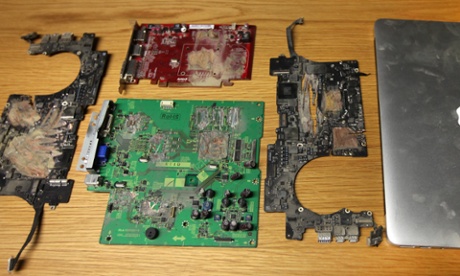
The remains of a computer that held files leaked to the Guardian by Edward Snowden and destroyed while GCHQ officials looked on. Credit: Roger Tooth
Too much news. Hundreds killed in gas attack in Syria. Bradley Manning imprisoned for 35 years. "Sometimes You Have to Pay a Heavy Price to Live in a Free Society"   Egypt!!! Mubarak released from jail. Muslim Brotherhood protest camps really did engage in torture, that wasn’t invented by the military. Guardian smashes its own computer intimidated by Government (but it turns out this happened two months ago so what's going on here??!)  Miranda detained 9 hours under terrorism law and laptop stolen. Can't keep up.  I could perhaps cope with the rest; but the main reason I can't keep up is I'm pre-occupied with my inability to work out what's going on in Egypt.  Can't work out just who supports Tamarod, can't work out the apparent enthusiastic support for the military coup.  By whom? The same people who stood in the square for 3 weeks in February 2011 to oust Mubarak? Those who support the military now will come to regret it that’s definite. Parallels with fascism? By the bye, does the US need the Egyptian military more than the Egyptian military needs the US? Can't work out what I'm meant to think of the Muslim Brotherhood. Before the coup the matter was beyond doubt, now I'm not quite sure. And not being quite sure is a thing I do not like. 

Supporters of Egypt's former Egyptian President Hosni Mubarak (but who are they?) hold his posters and a poster of Army Chief Gen. el-Sissi, left, in front of the Cairo prison where Mubarak has been held, Thursday, Aug 22. (AP Photo/Amr Nabil)

Of if's and but's


A quiz question for Shakespeare buffs: which character speaks the line “If me no ifs and but me no buts”?

Had I to guess, I should have gone for Macbeth, but I would have been wrong.  There's no such line. The nearest Shakespeare got to it was "Grace me no grace, nor uncle me no uncle" in Richard II, and “Talk’st thou to me of ifs” in Richard III.  I'm not the first though to suppose that “but me no buts” is found in Shakespeare. Bernard Levin wrongly included it in his 1983 tour de force on quoting Shakespeare; which must in turn have been read by fictional prime minister Jim Hacker who makes a fool of himself by committing the same error in the 1980’s BBC TV series Yes Prime Minister.

As to "If me no ifs", Elizabeth Gaskell used it in Wives and Daughters (1864). Whilst “but me no buts" first occurs in a 1709 play, and if we believe the script of Yes Prime Minister (which I'm not sure I do) was popularised by Sir Walter Scott in 1816. So far as I can tell however the line “If me no ifs and but me no buts” first appeared in this blog, so perhaps I've achieved a sort of immortality, and who knows I might one day make it to the Oxford Dictionary of Quotations.

You'll find citations for the foregoing on a separate page if you want them. But where did this frolic begin, you may ask? It was the grocer’s apostrophe. Or an accusation thereof. Pondering lab-made hamburgers recently, I said there were a couple of ifs that I didn't have space for: in a perfect world, if anyone would eat meat, and if there would be McDonalds. But I actually wrote if’s, and Albert queried this. He was too tactful to call it a grocer’s apostrophe but that’s what it amounted to.  So here are my thoughts. When debating the if’s that arise from the eating of hamburgers, I reckon the apostrophe looks right. On the other hand in “If me no if’s and but me no but’s” the apostrophes intrude, and spoil the flow.


From here on it's all about apostrophes, so if that’s not your thing, I'm sorry. Are there rules? There's a website called englishforums.com where you'll find someone pronouncing in all solemnity that to write CD’s and DVD’s is incorrect, supporting this by the assertion that an apostrophe properly indicates an omitted letter. I haven't included a link as there will be numerous other places where you can find the same sort of stuff, and it's all poppycock. I've experimented with leaving the apostrophe out and decided I don't like it.  I'm sticking to CD’s and 1980’s. If pressed I could devise a rule to justify this but I lack the energy. If you prefer CDs and 1980s that’s fine with me. No more to be said.


There are advocates of greater or lesser use of apostrophes. Here's an amusing and well-written overview: Should the Apostrophe Be Abolished? The Not-So-Great Apostrophe Debate.

Probably in 50 years time no-one will write CD’s. Nor indeed listen to them. Lynne Truss in her 2003 book Eats, Shoots & Leaves thinks that CDs and 1980s have already arrived in British English, CD’s and 1980’s surviving only in America. But she says if the abolitionists get their way entirely, they’ll regret it as soon as they discover they can't write “Goodbye to the Apostrophe: we're not missing you a bit”.  By the way on the question of if’s, Truss claims there's a rule that the apostrophe indicates the plural of words, as in “Are there too many but's and and’s at the beginning of sentences these days?”.  This shows you can invent a rule to justify any usage you happen to like.

Oho! I've just noticed I wrote in 50 years time. The authorities, Grammar-monster for example, think it should be in 50 years' time. But whilst I see the point of an apostrophe to indicate the possessive case in two days’ pay I don't in two days time. So even with me, it seems the process of abandoning apostrophes has begun …

And finally, what about the derivation of the expression “grocer's (or greengrocer's) apostrophe”? The best I can do is to quote the Wikipedia article on the apostrophe which gives the following tantalisingly incomplete information:  “The term is believed to have been coined in the middle of the 20th century by a teacher of languages working in Liverpool, at a time when such mistakes were common in the handwritten signs and advertisements of greengrocers.”

Friday, August 16, 2013

Egypt: How I foresaw it all


These were my thoughts on 4th July when I heard about the Egyptian coup: The defenders of the Egyptian coup, and the defenders of Morsi are both wrong. Morsi’s attempt to impose dictatorship cost him legitimacy long ago. But the military coup will be even worse.

In my opinion, the revolutionary leaders who called for a military takeover, and supported the coup are the ones who made the mistake. The longer they continue to support the military the worse that mistake will become, because that continued association will taint them in the public eye with whatever the military does. When the military turns its attention from the Muslim Brotherhood, and begins arresting the secular left, how easy will it be for that secular left to mobilize the people in their own defense?

Image in today's Guardian: Egyptian families bury their dead. Credit: Rex Features/APA
How far-sighted I was! Can I prove this far-sightedness though? Sadly not, as I didn't write it down. In fact you may have noticed from the spelling of the last word that I've actually plagiarised the whole thing. It comes from the E-joussour blog. Which can in fact claim to be far-sighted as it's dated 12th July.  

Read too Tawakkol Karman writing in last Friday’s Guardian (9 August): Egypt's coup has crushed all the freedoms won in the revolution. She says she supported the opposition to President Morsi until the military takeover, which all supporters of human rights should reject.

This morning I've just heard an appalling interview with a representative of Egypt’s National Salvation Front (didn't catch the name) justifying Wednesday morning’s killings when armed police broke up the Muslim Brotherhood sit-ins. He justified his support for the police action by allegations that inside their two camps the Muslim Brotherhood were committing torture on their political opponents. These are detailed in a rightwing website called FrontPage. I'm not suggesting it's not true; for this we must wait and see.