Saturday, August 24, 2013
Of if's and but's
A quiz question for Shakespeare buffs: which character speaks the line “If me no ifs and but me no buts”?
Had I to guess, I should have gone for Macbeth, but I would have been wrong. There's no such line. The nearest Shakespeare got to it was "Grace me no grace, nor uncle me no uncle" in Richard II, and “Talk’st thou to me of ifs” in Richard III. I'm not the first though to suppose that “but me no buts” is found in Shakespeare. Bernard Levin wrongly included it in his 1983 tour de force on quoting Shakespeare; which must in turn have been read by fictional prime minister Jim Hacker who makes a fool of himself by committing the same error in the 1980’s BBC TV series Yes Prime Minister.
As to "If me no ifs", Elizabeth Gaskell used it in Wives and Daughters (1864). Whilst “but me no buts" first occurs in a 1709 play, and if we believe the script of Yes Prime Minister (which I'm not sure I do) was popularised by Sir Walter Scott in 1816. So far as I can tell however the line “If me no ifs and but me no buts” first appeared in this blog, so perhaps I've achieved a sort of immortality, and who knows I might one day make it to the Oxford Dictionary of Quotations.
You'll find citations for the foregoing on a separate page if you want them. But where did this frolic begin, you may ask? It was the grocer’s apostrophe. Or an accusation thereof. Pondering lab-made hamburgers recently, I said there were a couple of ifs that I didn't have space for: in a perfect world, if anyone would eat meat, and if there would be McDonalds. But I actually wrote if’s, and Albert queried this. He was too tactful to call it a grocer’s apostrophe but that’s what it amounted to. So here are my thoughts. When debating the if’s that arise from the eating of hamburgers, I reckon the apostrophe looks right. On the other hand in “If me no if’s and but me no but’s” the apostrophes intrude, and spoil the flow.
From here on it's all about apostrophes, so if that’s not your thing, I'm sorry. Are there rules? There's a website called englishforums.com where you'll find someone pronouncing in all solemnity that to write CD’s and DVD’s is incorrect, supporting this by the assertion that an apostrophe properly indicates an omitted letter. I haven't included a link as there will be numerous other places where you can find the same sort of stuff, and it's all poppycock. I've experimented with leaving the apostrophe out and decided I don't like it. I'm sticking to CD’s and 1980’s. If pressed I could devise a rule to justify this but I lack the energy. If you prefer CDs and 1980s that’s fine with me. No more to be said.
There are advocates of greater or lesser use of apostrophes. Here's an amusing and well-written overview: Should the Apostrophe Be Abolished? The Not-So-Great Apostrophe Debate.
Probably in 50 years time no-one will write CD’s. Nor indeed listen to them. Lynne Truss in her 2003 book Eats, Shoots & Leaves thinks that CDs and 1980s have already arrived in British English, CD’s and 1980’s surviving only in America. But she says if the abolitionists get their way entirely, they’ll regret it as soon as they discover they can't write “Goodbye to the Apostrophe: we're not missing you a bit”. By the way on the question of if’s, Truss claims there's a rule that the apostrophe indicates the plural of words, as in “Are there too many but's and and’s at the beginning of sentences these days?”. This shows you can invent a rule to justify any usage you happen to like.
Oho! I've just noticed I wrote in 50 years time. The authorities, Grammar-monster for example, think it should be in 50 years' time. But whilst I see the point of an apostrophe to indicate the possessive case in two days’ pay I don't in two days time. So even with me, it seems the process of abandoning apostrophes has begun …
And finally, what about the derivation of the expression “grocer's (or greengrocer's) apostrophe”? The best I can do is to quote the Wikipedia article on the apostrophe which gives the following tantalisingly incomplete information: “The term is believed to have been coined in the middle of the 20th century by a teacher of languages working in Liverpool, at a time when such mistakes were common in the handwritten signs and advertisements of greengrocers.”
Friday, August 16, 2013
Egypt: How I foresaw it all
These were my thoughts on 4th July when I heard about the Egyptian coup: The defenders of the Egyptian coup, and the defenders of Morsi are both wrong. Morsi’s attempt to impose dictatorship cost him legitimacy long ago. But the military coup will be even worse.
In my opinion, the revolutionary leaders who called for a military takeover, and supported the coup are the ones who made the mistake. The longer they continue to support the military the worse that mistake will become, because that continued association will taint them in the public eye with whatever the military does. When the military turns its attention from the Muslim Brotherhood, and begins arresting the secular left, how easy will it be for that secular left to mobilize the people in their own defense?
![]() |
| Image in today's Guardian: Egyptian families bury their dead. Credit: Rex Features/APA |
Read too Tawakkol Karman writing in last Friday’s Guardian (9 August): Egypt's coup has crushed all the freedoms won in the revolution. She says she supported the opposition to President Morsi until the military takeover, which all supporters of human rights should reject.
This morning I've just heard an appalling interview with a representative of Egypt’s National Salvation Front (didn't catch the name) justifying Wednesday morning’s killings when armed police broke up the Muslim Brotherhood sit-ins. He justified his support for the police action by allegations that inside their two camps the Muslim Brotherhood were committing torture on their political opponents. These are detailed in a rightwing website called FrontPage. I'm not suggesting it's not true; for this we must wait and see.
Monday, August 12, 2013
Climate change is here! And it's good for you!
The Financial Times has seen the future, and it works! Today's edition has Chinese cargo ship sets sail for Arctic short-cut on its front page. The 19,000-tonne Yong Sheng is attempting the first ever commercial transit of the Northeast Passage. The vessel set sail on August 8 from Dalian, a port in north-eastern China, bound for Rotterdam. But whereas the traditional route is through the Suez Canal and Mediterranean (red in the diagramme) the vessel will take the blue route via the Bering Strait and across the top of Russia. This is known as the Northern Sea Route.
And it could shave as much as 15 days off the voyage. $$$$ !!!!
“Changing climate opens a short-cut that promises to reduce shipping times between China and Europe” is how the FT characterises this development. “But analysts caution” continues the FT in downbeat mood “that it will be years before the route, which is only passable for a few months, is commercially viable let alone a rival to the Suez Canal, which handled more than 17,000 ships in 2012.”
The other big “economic prospect for the polar region” according to the FT is oil exploration. But this is progressing at a slower pace than the opening up of the Northern Sea Route.
Such is the language in which the FT frames evidence of the unfolding of a disaster unparalleled in human history.
For more links on this theme see my earler post A result! Ships to sail over North Pole by mid-century.
Tuesday, August 6, 2013
Burgers with a bad taste
Two hamburger stories in today's Guardian.
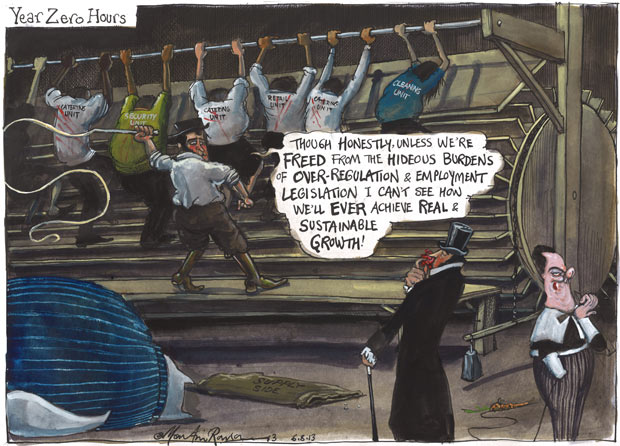
Burger chain McDonald's ties 9 out of 10 workers to zero-hours contracts, we learn. It's Britain's biggest food chain and has 83,000 staff on these exploitative terms. And, no surprise, employers claim the economy needs this sort of flexibility.
I can't really improve on holzy's comment on the Guardian story :
Funny, ain't it ... I mean, the 30+ years of endlessly expanding layers of management and it turns out none of these idiots have a clue how many staff they might need on any given day.
It was prompted by the Institute of Directors attacking calls for a ban on zero-hours contracts, and claiming the UK could be in the same situation as Italy or Spain without a flexible labour market.
| Today's Guardian cartoon |
A strike by McDonalds workers in New York points the way forward. But first the workers need to be organised into a union and I know that’s a tough row to hoe.
The other story was the frying of the world's first lab-grown beefburger, and the crucial question is: how does it taste? So-so appears to be the answer since at the press conference where it was launched the promoters refused a request for a randomly picked member of the audience to sample it. Though of course that’s not actually the crucial question, is it? The crucial question is should The Guardian have devoted a two-page spread to the event funded by a billionaire American businessman? And will it save the world? A Guardian Poverty Matters Blog lambasts the experiment on the grounds that heavily processed food developed at a phenomenal cost in hi-tech western laboratories is the last thing the world's poorest people need to keep them alive. The true solution is for agriculture to reconnect itself with small farmers.
| A cameraman films from a big screen at the press conference as a £250,000 lab burger fries |
Sunday, July 28, 2013
Of atheists and foxholes
One day (but not today you'll be pleased to hear) I shall write my atheist manifesto. Clause 1 of which will say there's little benefit, and scant prospect of success, in attempting to dissuade someone who believes in god from that belief.
![]() |
| War memorial dedicated to atheists in foxholes |
But let us for the sake of argument concede that in a foxhole under fire everyone including me will indeed seek a divine power. The question is, would this be evidence
(a) for the existence of a divine power? or
(b) for divine power being a figment of the human imagination, called forth by the stress of living in a frightening world?
How you answer that one will depend on what you believe about god in the first place; which leads me back to clause 1.
[1] The separation phrase doesn't actually appear in the US constitution but has been used repeatedly by the Supreme Court.
[2] Eisenhower broadcast cited in the Wikipedia entry “There are no atheists in foxholes”
[3] A parallel organisation, the Military Association of Atheists and Freethinkers provides a community for atheists, humanists, and other nontheists in the military, and has something to say about atheists in foxholes on its website.
Saturday, July 27, 2013
Monday, July 15, 2013
I hold Luther's Bible in my hands
Today in the British Library at St Pancras I held in my very hands one of the world's great books: Martin Luther’s original 1534 translation of the Bible into German. Two enormous tomes, clearly designed as lecturn bibles to be read in churches. I was allowed to take them away to a desk and leaf through them at my leisure. The frontispiece and several illustrations were hand coloured as were the leading capitals of each chapter. Very fresh. Like illuminated manuscripts. Which so far as I know were still being made in those days, and I imagine that still in 1534 a printed book would be estimated by some with the disdain that we today might reserve for a photocopy.
The strange thing is, this happened unintentionally. All I desired was a copy of the text of Luther’s bible; the Penguin edition would have sufficed; but I couldn’t work out from the catalogue how to order it so I made a wild stab at Biblia, das ist, die gantze Heilige Schrifft Deudsch and 70 minutes later, as is the protocol, I was issued with this treasure.
My mission by the way was to see whether Luther in the book of Acts had perpetrated a deliberate misquotation from a Psalm and introduced the word bishop. So far as my limited German tells me, he did. Why this is important or even mildly interesting will have to wait another day …
![]() |
| Martin Luther painted by Lukas Cranach, 1529 |
Subscribe to:
Posts (Atom)