Monday, August 12, 2013

Climate change is here! And it's good for you!


The Financial Times has seen the future, and it works! Today's edition has Chinese cargo ship sets sail for Arctic short-cut on its front page. The 19,000-tonne Yong Sheng is attempting the first ever commercial transit of the Northeast Passage. The vessel set sail on August 8 from Dalian, a port in north-eastern China, bound for Rotterdam. But whereas the traditional route is through the Suez Canal and Mediterranean (red in the diagramme) the vessel will take the blue route via the Bering Strait and across the top of Russia. This is known as the Northern Sea Route.


And it could shave as much as 15 days off the voyage. $$$$ !!!!

“Changing climate opens a short-cut that promises to reduce shipping times between China and Europe” is how the FT characterises this development. “But analysts caution” continues the FT in downbeat mood “that it will be years before the route, which is only passable for a few months, is commercially viable let alone a rival to the Suez Canal, which handled more than 17,000 ships in 2012.”

The other big “economic prospect for the polar region” according to the FT is oil exploration. But this is progressing at a slower pace than the opening up of the Northern Sea Route.  

Such is the language in which the FT frames evidence of the unfolding of a disaster unparalleled in human history.

For more links on this theme see my earler post A result! Ships to sail over North Pole by mid-century.


Tuesday, August 6, 2013

Burgers with a bad taste


Two hamburger stories in today's Guardian.

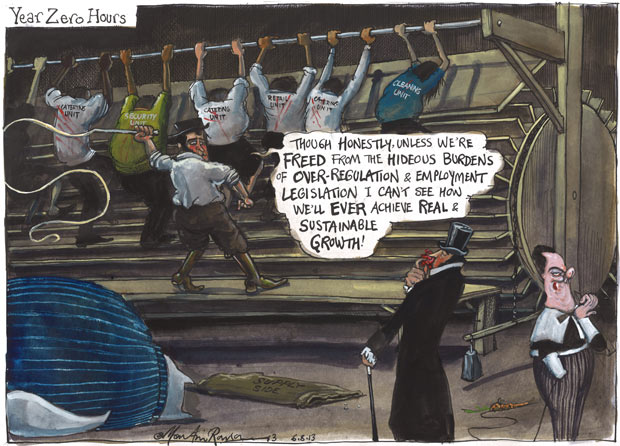
Burger chain McDonald's ties 9 out of 10 workers to zero-hours contracts, we learn. It's Britain's biggest food chain and has 83,000 staff on these exploitative terms. And, no surprise, employers claim the economy needs this sort of flexibility.

I can't really improve on holzy's comment on the Guardian story :

Funny, ain't it ... I mean, the 30+ years of endlessly expanding layers of management and it turns out none of these idiots have a clue how many staff they might need on any given day.

It was prompted by the Institute of Directors attacking calls for a ban on zero-hours contracts, and claiming the UK could be in the same situation as Italy or Spain without a flexible labour market.

Today's Guardian cartoon
A typical clause in these contracts (from another fast food chain) reads: "The company has no duty to provide you with work. Your hours of work are not predetermined and will be notified to you on a weekly basis as soon as is reasonably practicable in advance by your store manager. The company has the right to require you to work varied or extended hours from time to time."

A strike by McDonalds workers in New York points the way forward. But first the workers need to be organised into a union and I know that’s a tough row to hoe.

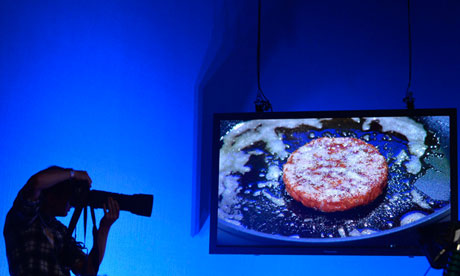
The other story was the frying of the world's first lab-grown beefburger, and the crucial question is: how does it taste? So-so appears to be the answer since at the press conference where it was launched the promoters refused a request for a randomly picked member of the audience to sample it. Though of course that’s not actually the crucial question, is it? The crucial question is should The Guardian have devoted a two-page spread to the event funded by a billionaire American businessman? And will it save the world? A Guardian Poverty Matters Blog lambasts the experiment on the grounds that heavily processed food developed at a phenomenal cost in hi-tech western laboratories is the last thing the world's poorest people need to keep them alive. The true solution is for agriculture to reconnect itself with small farmers.


A cameraman films from a big screen at the press conference as a £250,000 lab burger fries
But maybe this misses the point. If there has to be meat eating, and if there has to be McDonalds – both those if’s need exploring but no space here to do it – maybe lab meat is the answer to the problems this entails: animal welfare, land use, biodiversity, greenhouse gas emissions. It's all in this Guardian background to today’s burger story.

Sunday, July 28, 2013

Of atheists and foxholes


One day (but not today you'll be pleased to hear) I shall write my atheist manifesto.  Clause 1 of which will say there's little benefit, and scant prospect of success, in attempting to dissuade someone who believes in god from that belief.
 

War memorial dedicated to atheists in foxholes
Here I'll just comment on the atheists in foxholes story. It seems a US airforce chaplain has got into hot water for claiming there are none - atheists in foxholes that is. I suppose the hot water flows from the famed separation of church and state mandated by the American constitution [1]. Though this doesn't seem to have inhibited President Dwight D. Eisenhower when he popularised the idea that there are no atheists in foxholes in a 1954 broadcast [2]. But I must get to my point. Simon Singh responded to the airforce chaplain story by tweeting that “no atheists in foxholes” is nonsense, since typically there are foxes in foxholes, and foxes have no organised belief system. But though Singh is a hero of mine, his witticism misses the mark. The proponents of the aphorism (my friend Noel is one, frequently quoting it at me presuming thereby to put a stop to my gallop) mean, I suppose, that when facing an extreme threat, such as soldiers under fire, people habitually seek a divine power. This may be the case, or it may not.   The Freedom From Religion Foundation in the US doesn't believe so, for in the hope that humankind may learn to avoid all war, they have erected a monument in memory of “ATHEISTS IN FOXHOLES and the countless FREETHINKERS who have served this country with honor and distinction”. [3]
 

But let us for the sake of argument concede that in a foxhole under fire everyone including me will indeed seek a divine power. The question is, would this be evidence

(a)    for the existence of a divine power? or

(b)    for divine power being a figment of the human imagination, called forth by the stress of living in a frightening world?
 

How you answer that one will depend on what you believe about god in the first place; which leads me back to clause 1.

[1] The separation phrase doesn't actually appear in the US constitution but has been used repeatedly by the Supreme Court.

[2] Eisenhower broadcast cited in the Wikipedia entry “There are no atheists in foxholes”

[3] A parallel organisation, the Military Association of Atheists and Freethinkers provides a community for atheists, humanists, and other nontheists in the military, and has something to say about atheists in foxholes on its website.


Monday, July 15, 2013

I hold Luther's Bible in my hands


Today in the British Library at St Pancras I held in my very hands one of the world's great books: Martin Luther’s original 1534 translation of the Bible into German. Two enormous tomes, clearly designed as lecturn bibles to be read in churches. I was allowed to take them away to a desk and leaf through them at my leisure. The frontispiece and several illustrations were hand coloured as were the leading capitals of each chapter. Very fresh. Like illuminated manuscripts. Which so far as I know were still being made in those days, and I imagine that still in 1534 a printed book would be estimated by some with the disdain that we today might reserve for a photocopy.

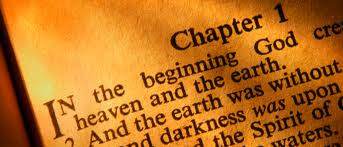
Martin Luther’s 1534 bible: chapter 1 of Genesis (“Das Erst Buch Mose”, the First Book of Moses). The illustration is God creating the world, with a naked Adam and Eve in the centre, but the quality of this image falls far short of the brilliant crispness I held in my hands this afternoon.
The strange thing is, this happened unintentionally. All I desired was a copy of the text of Luther’s bible; the Penguin edition would have sufficed; but I couldn’t work out from the catalogue how to order it so I made a wild stab at Biblia, das ist, die gantze Heilige Schrifft Deudsch and 70 minutes later, as is the protocol, I was issued with this treasure.

My mission by the way was to see whether Luther in the book of Acts had perpetrated a deliberate misquotation from a Psalm and introduced the word bishop.  So far as my limited German tells me, he did. Why this is important or even mildly interesting will have to wait another day …

Martin Luther painted by Lukas Cranach, 1529

Saturday, July 13, 2013

What would happen if you set fireworks off in space?


This question may not previously have occurred to you, but now that it has, you probably welcome the following information:

(1)    They would explode. Oxygen is not necessary. Fireworks have an oxidizer, and a reductant.  (Sorry can't elaborate.)

(2)    The picture shows fireworks being let off in the near vicinity of the Earth and the shards arcing back down as in any normal fireworks display. But suppose you went a long way off into inter-planetary space before letting your firework off, then it would be different.  The shards would continue whizzing outwards pretty much in a straight line forever, faster than on Earth, without slowing. This is because of no atmosphere and little gravity. The only factor that would inhibit this effect would be the gravitational attraction of Jupiter or the Sun. Or some other planet, if nearby. The nearer, the more pronounced an arc there would be towards it.

(3)    The colour would be disappointing. The reaction that imparts a rocket’s metals and metal salts with enough energy to display pretty colours requires oxygen. Unless your fireworks were specially designed for bursting in space, their colours would quickly fizzle out.

(4)    The burst would be completely silent. No atmosphere means no medium to propagate sound waves.

(5)    And by the way you would need to consider carefully how to light your firework. A match, I'm sure, does need oxygen, so my advice would be to provide yourself with a glowing electric filament.

Stefan Bossmann, a chemist and rocket enthusiast at Kansas State University, supplied the foregoing to popsci.com a popular science website. Though he forgot to mention points (2) and (5).

Friday, June 28, 2013

How good was Creation? Very or quite?


Creation: only "ganska godt" according to the 1703 Swedish bible
The book of Genesis tells us that following each of the first five days of creation God surveyed his work and in the words of the King James Bible, saw that it was good.  That covers most of creation other than land animals, and man and woman. On the sixth and final day when God had completed his work, he saw everything that he had made, and behold, it was very good; in the Italian bible grandamente buone; in the Swedish bible, mycket gott.

By now you’re wondering where all this is going, and perhaps suspecting it’s going nowhere. But as Polonius says to Hamlet’s uncle, perpend. For our next and final stop is the Swedish bible of 1703 (King Karl XII's bible): and here on the sixth day God says of his handiwork that it’s ganska godt. And finally I’ve come to my point, for to modern Swedish ears that sounds strange, as if God is saying his handiwork was only quite good. In fact I’ve seen a feminist blog claiming these words ganska godt show that up to the moment that God made woman he thought everything he made was just fine, whereas after making woman it all went downhill. Here however our feminist errs. Not in her assessment of the politics of religion, but in her knowledge of the Swedish language. For in 1703 ganska actually meant very, just as mycket in modern Swedish and grandamente in Italian. But the passage of time has diluted ganska’s sense so that now it means no more than quite or rather.  The German ganz from which ganska derives still means very, and so does Danish ganske.   All this I know because I’m spending a week with my mother’s sister Kerstin in LuleÃ¥ where a couple of days ago the sun set at 23:55 and rose at 1:10 and we can read bibles at midnight without artificial light.

Which is handy. Inevitably when I come here the table is soon strewn with bibles in Swedish, English, Russian, French, German, Spanish, Greek, Finnish and Italian. That’s not where it began; but wherever it begins, that’s where it invariably ends. On this occasion it began with Jane Austen.

Jane Austen: repulsive wasn't so bad
I’ve noticed that in the 200 years since Jane Austen used it, the word repulsive has acquired extra strength. To her, repulsive meant (when used of a person) no more than off-putting or stand-offish, as in these two examples: from Mansfield Park, “She had not spirits to notice her in more than a few repulsive looks”; and in the denouement of Persuasion, “Anne could command herself enough to receive that look, and not repulsively.”   Whereas for us today the word is a real nose wrinkler. This trajectory, of a word gaining strength over the years, strikes me as unusual. The direction of travel is normally, I think, the other way. And that’s what I asked Kerstin about, which led to a discourse on the Swedish word ganska, and how it has evolved from very to rather.

Likewise astonished, when used by Milton, meant turned to stone as when Satan says of the fallen angels “The associates and copartners of our loss lie thus astonished on the oblivious pool.”  Whereas nowadays astonished means no more than exceedingly surprised; itself a word whose sense has diluted, for it used to mean ambushed or caught in the act, as when Dr Johnson, discovered in flagrante by his wife who expostulated “Sir I am surprised”, corrected her “No madam you are astonished, it is we who are surprised”; incidentally thereby illustrating that for him astonished had already declined somewhat in value.  Such are the considerations that led my aunty and me to ganska and a midnight table in the north of Sweden heaped with bibles.

Luleå: bible belt