Tuesday, January 22, 2013

I seek unlucky Fridays in Chaucer and find none


At New Year, traditions about unlucky 13 set me wondering how far back we can trace superstitions about Fridays. I noted that numerous websites concerned with this question trace negativity about Fridays back to the 14th century, citing Chaucer's line "and on a Friday fell all this misfortune”.

The Nun’s Priest and Chauntecleer and the fox. Source unknown
I've now checked this. I find that all these websites have copied each other, and all are wrong. Chaucer mentioned Fridays twice in the Canterbury Tales (so far as I can tell) and in each case, what he stressed was not the day's unluckiness, but its association with Venus.  In medieval astrology each of the planets had a special influence upon a given day of the week. Venus’s day was Friday. (Which is more apparent in Romance languages, where the name of the day comes from Latin Veneris dies,  eg French Vendredi.)

The line "and on a Friday fell all this misfortune” occurs in the Nun’s Priest’s Tale. The misfortune in question is the cockerel Chauntecleer being taken by the fox. The whole tale is a mock epic. The randy seven-wived Chauntecleer is dubbed a devotee of love goddess Venus; and Friday being the day the misfortune fell is the occasion of mock tragic irony, that Venus should have brought her devotee low on her very own day.

Friday also crops up in the Knight’s Tale. Here it's the changeableness of Venus that is paralleled to the changeableness of Friday weather and the changeableness of lovers’ moods.

Chaucer does mention that an earlier author had something to say about Fridays. That was Geoffrey de Vinsauf, writing in the early 13th century, about 170 years before. But I've checked, and the same applies. It's the Venus connection that interested Geoffrey de Vinsauf. Nothing else.

Now none of this actually proves that these authors were unaware of the unlucky Friday tradition. I suppose it’s just conceivable that the unluckiness of Fridays was such a well–embedded idea that it didn't need saying. But I don't think that’s likely. Were it so, I should have expected some mention to creep in, with perhaps a pious reference to Good Friday.

My conclusion: according to my very superficial research, 1592 is the earliest mention in English of Friday being unlucky.

Here are the Chaucer Friday references in case you want to check them.

So what of Friday the 13th?

The special unluckiness of Friday the 13th is even more recent. According to Dick Harrison, professor in history at Lund university, it can at the earliest be found in the mid-1800’s, and spread into popular consciousness in the early 1900’s. The idea won approval especially in literature, for example, in Thomas L. Lawson's novel Friday, the Thirteenth (1907), dealing with panic among stock brokers on Wall Street. In recent decades, we have developed a myth around Friday the 13th by looking back in history in search of various accidents that are said to have occurred on that date. One of the latest additions is the finding that Friday the 13th was the day Philip IV of France attacked the Knights Templar.*

It's the antiquity illusion: the illusion that a recent notion is sanctified by ancient tradition. The opposite of the recency illusion we find in linguistics.

Finally, in medieval theology 13 actually had a positive aspect, according to Encyclopedia Britannica online. This was due to being the sum of 10 + 3, Commandments plus Trinity.

* in Svenska Dagbladet 13th April 2012. See also Wikipedia


Sunday, January 20, 2013

Extraterrestrial rivers - spooky


Perspective view of Reull Vallis, Mars. Image: ESA
The striking image above, taken by ESA’s Mars Express last year, is the upper part of the Reull Vallis region of Mars. 

The river-like structure is believed to have formed when running water flowed in the distant Martian past, cutting a steep-sided channel through highlands before running on towards a vast basin. 

The presumed dried-up river stretches for almost 1500 km (940 miles) across the Martian landscape, flanked by numerous tributaries, one of which can be clearly seen cutting in to the main valley. More images on ESA website.

Not spooky enough?  Then try this

Images of Mars tend to look familiar to us, like desert regions of the Earth. So take a look at a river on Saturn’s huge moon Titan.  The image on the left is just a taster. For the real thing, go to Space.com.

NASA's Cassini spacecraft has captured a crisp image of a long river cutting across Titan’s surface.  Not a dried-up river: it's flowing as you read this. Flowing not with water, but with hydrocarbons (liquid methane mainly I think). At -180° Centigrade. The river stretches more than 250 miles (400 kilometers) from its source to a large sea near Titan's north pole. Cassini's radar image is the first high-resolution shot ever taken of such a vast river system on a world beyond Earth.  Scientists are comparing it to Earth's Nile River in Egypt; not in length, but in straightness. Like the Nile its course is thought to follow a geological fault.

How big is Titan?

Titan is the second largest moon in our solar system. Only Jupiter's moon Ganymede is larger, with a diameter barely 112 kilometers greater. This graphic shows the relative sizes of Earth, Titan and our Moon. Mars if shown would appear larger than Titan but much smaller than Earth.  One more spooky fact: light takes about 80 minutes to reach Earth from Titan. From the Sun, 8 minutes.

L to R: Earth, Titan, our Moon
        Diameters in km:
        Earth 12,760
        Mars 6,790 (not shown)
        Ganymede 5,250 (not shown)
        Titan 5,140
        Earth’s Moon 3,470


Friday, January 18, 2013

Flogging a dead horse


Food waste crime scene
Best horse burger joke so far: Tesco has been flogging a dead horse.  Seriously though what grieves me is the food waste issue. In Ireland (and UK for all I know) they're going to bin thousands of perfectly good burgers just for containing horse meat. Yes mislabelling them is a crime - but throwing them away is a crime too.

And I know we can debate that perfectly good bit ... deeply substandard is nearer the mark. But it's not the horse meat that makes them substandard. Some Irish charity leaders have asked for the burgers to be donated to them. The official line however from Ireland's poverty charity St Vincent de Paul (SVP), in a statement in today’s Irish Times, dissents: “Food poverty is an important issue and one which the SVP has actively sought to highlight. But the SVP nationally does not ask for the distribution of the beef burgers withdrawn from sale to be directed to charities. We do not believe that it is a feasible option in terms of the nature of the product or the logistics in its redistribution.”

If it's true the burgers pose no health risk, which the authorities claim, then the shops ought to put them on sale at a knock down rate with the rubric “These burgers may contain horse”. At the right price they would sell like hot cakes.  If I was king there would be a food waste law to enforce this sort of thing.

(PS: if the horse meat got in there illegally how can the environmental health inspectors be so sure about no health risk? Seeing as they weren't there at the time to check it's not dead racehorses full of noxious chemicals? Still they do seem to be sure.)

Links: a food waste blog in the London Independent last week before the horseburger story broke, and a piece about freegans I wrote 16 months ago .


Tuesday, January 15, 2013

Irish cancer report gives the lie to Big Tobacco


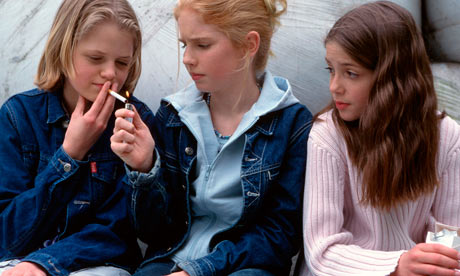
Teenage girls - essential market for tobacco companies
A recent report undermines the tobacco companies' campaign against ugly cigarette packs.

16 months ago I wrote about these packs and predicted ”watch this one get dirty”. Well I haven’t noticed that happening yet, but maybe something has been going on underneath my radar.  Meanwhile Australia’s law forcing tobacco companies to use plain packaging came into force in November. Sludge green packaging with gruesome pictures of rotting teeth, eyeballs, blackened lungs and suffering babies is now mandatory.


Big Tobacco considers it’s fighting for its life on this one. They love to argue that the packaging doesn't have any societal effect, merely distinguishing one brand from another.

Now here's a report that gives the lie to that. It comes from the Irish Cancer Society. Tobacco companies are trying to reel in women, it reveals, by creating candy-coloured packaging, white packaging, ‘women-only’ brands, low-tar, and new, super-slim products.
 

This need to sell cigarettes via their packaging is more acute in countries where smoking advertising is banned, such as in Ireland. In Germany, there are mango and mojito-flavoured cigarettes aimed at young women.

Half of poor, young Irish women are smokers, and are ashamed of their habit but are not able to quit nicotine, according to the Irish Cancer Society.  One in three Irish women smoke, which the society described as “an epidemic”.

Here's an extract from their report revealing their true views on the importance of packaging:

Quotes from the tobacco industry discuss the reasons for and benefits of superslim cigarettes: “Gallaher is launching a range of super-slim cigarettes under its Silk Cut brand packaged in “perfume-shaped” boxes to appeal to the female market. Silk Cut Superslims is positioned as a premium cigarette that rivals Vogue Superslims from BAT. The female-friendly pack design would give it an edge”, said Jeremy Blackburn, Head of Communications at Gallaher.

 “The new design brings elegance and quality to the superslim cigarette sector, which is in its infancy but offering great potential.” (The Grocer, 2008).

Demislim cigarettes were released in 2011: “Vogue Perle delivers a new modern format for the female smoker. The premium quality cigarette provides a satisfying taste experience similar to standard King Size (KS) cigarettes, only designed into a new feminine format and style. The new packaging, designed in Paris also reflects the more refined and accessible cigarette size, with rounded edges, and a soft yet tactile texture” (Talking Retail, 2011).


UK health minister is for ugly packs

In this Guardian blog post last August, health services minister Dan Poulter argues for plain packaging for cigarettes as he debates what needs to be done to prevent young people from taking up smoking. Hats off to the minister. I haven't kept up with what's happened since.


Sunday, January 13, 2013

A coven of witches and other unlucky 13’s


Following my recent notes on the unluckiness of 13, here are three more examples. The first is thirteen witches in a coven. This comes up a lot in documentation of the witch-trials of the seventeenth century, the first recorded mention being in 1662 in the Scottish trial records of Isobel Gowdie. 

Witches hold sabbats, and in a further instance of a connection to the Last Supper, some people interpret the 13 witches at the sabbat as a perversion of that sacred event, the witches gathering with Satan in place of Christ.

Here's a website for anyone who wants to learn about witchcraft, Wicca, and the true path of becoming a practicing witch.  Probably very few readers of my blog fall into this category, but you'll find useful discussions of covens and sabbats there.


Witches, a noose, and the Tarot “Death” card. Not sure of the provenance of the witches image. It looks 17th century to me. The caption as best as I can read it is: A Witch, a Spirit raised by the Witch, a Friar raising his [], a Fairy Ring, a Witch riding on the Devil through the Aire, a [] Candle
According to Wikipedia, the word coven remained largely unused in English until 1921 when one Margaret Murray promoted the idea, now much disputed, that all witches across Europe met in groups of thirteen which they called covens.

The word by the way originated in late medieval Scots (around 1500). It is essentially the same as the English word convent, and both words originally meant a gathering of any kind. Up to 1548 convent could specifically be a gathering of the 12 apostles, so perhaps when Scottish witches called their gatherings covens they had this meaning in mind.

Coven and convent are related to convene, and all three words derive from the Latin root word convenire, meaning convene. For a time in the Middle Ages the n was lost, which is how we get Covent Garden. It was later that convent came to be restricted to a body of monks or nuns.


Another instance of unlucky 13 is the hangman's knot.  Traditionally this was made by coiling it 13 times, so that the noose would be strong enough to snap the person's neck fast and not leave them still alive and in agony.  This grisly subject is one I don't intend to dwell on except to comment that my understanding is that in England up till the 18th century, it was considered very good sport to leave the hanged person alive and in agony as long as possible.  If I'm right, then I wonder how old this tradition actually is.

The third instance is the Tarot "Death" card.  In most forms of Tarot this card is 13. I'm not sure about how old Tarot is or the reason why the Death card is 13.  The link is to Wikipedia, and you can read it all there.

Many thanks to Jenny Butler, who lectures in folklore at University College Cork, for pointing out these three unlucky instances of 13 to me.


Friday, January 11, 2013

Assisted suicide: a way must be found


Marie Fleming lost her case for assisted suicide. Photograph: Niall Carson/PA
Sad but not surprised to see that Marie Fleming has lost her case in the Irish high court clamming her right to assisted suicide so that she can be spared a horrible death and die lawfully and with dignity with her family present. 

RTÉ radio reported that the judges were deeply impressed with Marie Fleming as a witness. President of the High Court, Mr Justice Nicholas Kearns, said: "Her courage in adversity is both humbling and inspiring … She was in many ways the most remarkable witness which any member of this court has ever been privileged to encounter."

Even though she lost her case she has been awarded costs. According to The Irish Times, an appeal is almost certain, and the Supreme Court is likely to facilitate an urgent hearing, possibly within weeks.

It seems it was the “Pandora’s box” argument which won the day ...  “unforeseeable and perhaps uncontrollable” changes in attitude and behaviour regarding assisted suicide ... even with the most rigorous safeguards it “would be impossible to ensure the aged, the disabled, the poor, the unwanted, the rejected, the lonely, the impulsive, the financially compromised and emotionally vulnerable would not avail of this option in order to avoid a sense of being a burden on their family and society” ...  “deeply worrying” evidence of “a strikingly high” increase in involuntary deaths in countries where assisted suicide is legal.

Those issues are crucial, yes, but I'll just say that in my bones a way must be found. If it was me I would want it. I find it hard to believe there's anyone who wouldn't.


Wednesday, January 9, 2013

It's got a name! I feel better already!


It seems the malady I suffer from is called research rapture.  This is defined as: A state of enthusiasm or exaltation arising from the exhaustive study of a topic or period of history; the delightful but dangerous condition of becoming repeatedly sidetracked in following intriguing threads of information, or constantly searching for one more elusive fact.  Otherwise known as addicted to looking things up.

I found this out from an opinion piece in the New York Times by Sean Pidgeon, a publisher of reference books.

Thanks to Tom for diagnosing me.