Tuesday, January 1, 2013

2013 – an inauspicious date


Only once in a hundred years does such a date occur, so all the more reason to wish all my readers a happy new year.

And time for a few hastily compiled notes on the unluckiness of 13.

This belief seems to be widespread in Europe. How much further afield, I'm not sure. I've seen it said that in the Persian culture, 13 is also considered an unlucky number. On the 13th day of the Persian new year (Norouz), people consider staying at home unlucky, and go outside for a picnic in order to ward off the bad luck, apparently. 

To pin down the actual reasons for the belief would be a hopeless quest, but I'll mention those that cropped up most frequently on a quick web trawl.

The Last Supper, Leonardo da Vinci, c. 1496
The most popular origin for European fear of the number 13 is the New Testament story of the Last Supper.  In Mark 14: 17-21 we get:

"And it was in the evening that he came with the twelve. As they were at the table eating, Jesus said 'Truly, I say to you, one of you will betray me, one who is eating with me.' They began to be sorrowful, and to say to him one after another 'Is it I?' He said to them, "It is one of the twelve, one who is dipping in the same dish with me. For the Son of man goes as it is written of him, but woe to that man by whom the Son of man is betrayed! It would have been better for that man if he had not been born.' "

The story carries the inference that one in the group of 13 is doomed. Amongst those who paid attention to this is Franklin Roosevelt who is said to have refused to have a meal with 13 people at the table – also to refuse to travel on a 13th.  The Norwegian playwright Ibsen depicts tragic consequences following a dinner with 13 guests. I think this is in his play The Wild Duck.

Whilst my bones tell me the Last Supper is the right explanation, folklorists appear reluctant to pronounce on this; and we should note that in the Greek world 13 was unlucky even earlier.

Other suggestions I've found from a web search are
 
•    A Norse myth about the unpleasant god Loki. This is another story on the theme of 13 at dinner. 12 gods were at dinner in Valhalla when Loki intruded uninvited, to make a total of 13. Loki tricked Hoder, the blind god of darkness into shooting Balder with a mistletoe tipped arrow. Balder died and his death plunged the Earth into darkness. The whole of Earth, both gods and humans, went into mourning.  I haven't been able to establish whether this is a genuine Norse myth or an invented one, tailored to the interests of people concerned with the number 13.  I hope to check this soon.
 
•    13 is unlucky because it follows 12, which in the ancient world was considered to be a lucky number associated with completion and perfection, due perhaps to having so many factors – 2,3,4 and 6. Evidence for 12 being considered a perfect number includes: 12 months in a year, 12 hours in half a day, 12 signs of the zodiac, 12 labours of Hercules, 12 tribes of Israel, and 12 apostles of Jesus. (I've also seen 12 gods of Olympus on this list, but I'm not convinced about that one.)
   
•    The 13th letter of the Hebrew alphabet, M, was unlucky to the ancient Hebrews due to being the first letter in the word "mavet," meaning death.  This one sounds thin and contrived to me, moreover it doesn't hang together with celebrating bar mitzvah at age 13. But I haven't had time to check it, so who knows.


The "baker's dozen" may have originated as a way for bakers to avoid being blamed for shorting their customers.
Image: Wikipedia
The baker’s dozen deserves a digression. Not that it's unlucky, far from it, you get 13 loaves when you’ve only paid for 12. It's widely believed that this phrase originated from the practice of medieval English bakers giving an extra loaf when selling a dozen in order to avoid being penalized for selling short weight. This attractive story actually appears to be substantially true. The Phrase Finder website carries a useful discussion fleshing out this derivation.

Unlucky Fridays

DePaul University library in Chicago has a webpage commenting that whatever the reasons, it is clear that 13 shows up time and time again in history as a focus for fear and uncertainty.  One of the first texts to reflect this view is Work and Days written in 700 BCE. The Greek poet Hesiod mentions the 13th of the month as an unlucky day for sewing seeds. 

Negativity towards Fridays should be mentioned. The same webpage traces this as far back as the 16th century in western literature, citing the terms "friday-faced" and "friday-look," meaning a sad or solemn demeanour. These surfaced as early as the late 1500’s.  In 1592, Greene wrote, "The Foxe made a Fridayface, counterfeiting sorrow."  The expression was used again in 1681 by Robertson who wrote, "What makes you look so sad, and moodily? with such a Friday face."  Early in the next century Rowley spoke of a "plague of Friday mornings".

Numerous websites cite the line "and on a Friday fell all this misfortune” in Chaucer’s Canterbury Tales. But these people haven’t actually read the tale, they are just copying each other, as this line doesn't in fact refer to the unluckiness of Fridays as such - see I seek unlucky Fridays in Chaucer and find none.

Why there's a negative association with Friday is subject to speculation.  And I've seen it stated that the special unluckiness of Friday 13th didn't arise before the 19th century.

To the Greeks, Tuesday is the unlucky day, associated with the fall of Constantinople. Twice. The city fell to the Fourth Crusade on Tuesday, April 13, 1204, and finally to the Ottomans on Tuesday, May 29, 1453.

Note: The Ides of March in the Roman calendar, notorious since 44 BC as the date of the assassination of Julius Caesar, was the 15th not the 13th.


Sunday, December 30, 2012

I read Ozymandias


        Ozymandias by Percy Bysshe Shelley, 1818

       I met a traveller from an antique land
       Who said: "Two vast and trunkless legs of stone
       Stand in the desert. Near them on the sand,
       Half sunk, a shattered visage lies, whose frown
       And wrinkled lip and sneer of cold command
       Tell that its sculptor well those passions read
       Which yet survive, stamped on these lifeless things,
       The hand that mocked them and the heart that fed.
       And on the pedestal these words appear:
       ' My name is Ozymandias, King of Kings:
       Look on my works, ye mighty, and despair! '
       Nothing beside remains. Round the decay
       Of that colossal wreck, boundless and bare,
       The lone and level sands stretch far away".


Recorded with my new microphone. Thanks Alb!

The ultimate Romantic poem.  For the Romantics the wilderness symbolised spiritual freedom whilst ancient ruins declared the triumph of time and nature over human tyranny.

Shelley’s inspiration was the news of the excavation of a colossal head of Rameses II, for whom Ozymandias is an alternative name. This head would later be shipped to the British Museum, but Shelley never saw it. The ancient Egyptian king reigned 1279-1212 BC.

There are three characters: the traveller who gives the eyewitness account of the ruined sculpture - a kind of Ancient Mariner, though one gifted with brevity; Ozymandias; and the sculptor, whose work outlives the pharaoh. Russian poets, Carol Rumens tells us in a Guardian blog, used to have a saying that the poet outlives the tsar.

Shelley took "Look on my works, ye mighty, and despair!" and the name Ozymandias from a well-known ancient Greek source, Diodorus Siculus. This information comes from John Rodenbeck “Travelers from an antique land: Shelley's inspiration for Ozymandias."

The poem’s haphazard rhyme scheme tends to conceal the fact it's a sonnet. Once you recognise it as one however, it's finality is even more final.


Sunday, December 23, 2012

Seasonal cheer for Christmas anglers


Brasserie Sixty6, Georges St, Dublin
My tale of seasonal good cheer comes from the pages of the Irish Examiner and concerns a lucrative fishing expedition and a fine Christmas dinner at a top Dublin restaurant, all provided gratis to four burglars.

On Christmas Eve 2005, two men broke into Brasserie Sixty6 through the back door, and left with some drinks, leaving the door "on the latch" in order to come back for more.

On Christmas Day, two homeless men, walking in a laneway behind the restaurant, and noticing the back door ajar,  pushed their way in and spent the day in the restaurant, drinking wine and eating food.  On Christmas night, the two original burglars returned and amicably joined the homeless pair, afterwards leaving with electronic equipment, paintings and a "takeaway" of food.


Using fishing rods, they also "fished out" €8,000 in notes from the restaurant’s drop safe.

The intruders were prosecuted and pleaded guilty to their crime.

The foregoing is from a court report dated Wednesday, January 18, 2012. The case reported on was not the prosecution of the burglars, but a civil action between the restaurant and an alarm company, Safe and Secure Ltd.  The court learned that when the company had installed the alarm, they failed to fit wire connectors at the back door. This oversight enabled the unauthorised angling and dining.

The case was settled for €27,400 damages.

Friday, December 21, 2012

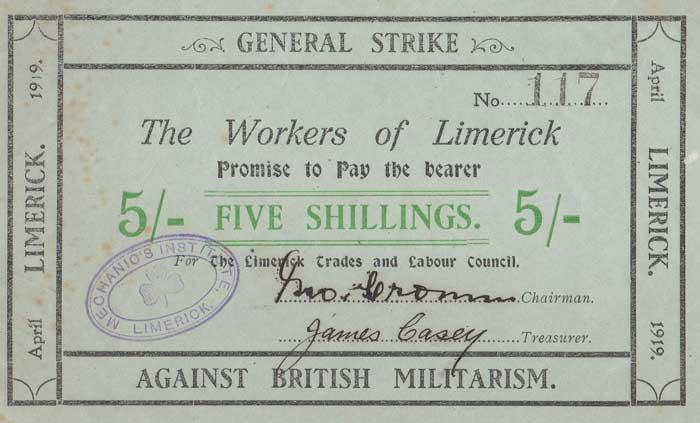
Limerick Soviet 1919 - preserving the workers' heritage


5 shilling banknote issued by Limerick Soviet, 1919
This banknote was issued by the Limerick Soviet that existed from 15 to 27 April 1919.  "Soviet" (meaning a self-governing committee) had become a popular term after 1917 from the workers’ soviets that had taken over factories in St Petersburg and Moscow and had formed the Russian Soviet Socialist Republic.

At the beginning of the Irish War of Independence, a general strike was organised by the Limerick Trades and Labour Council, as a protest against the British army's declaration of a "Special Military Area" covering most of Limerick city and a part of the county. The soviet ran the city for the period, printed its own money and organised the supply of food.

According to labour historian Liam Cahill, the Limerick Soviet and general strike was one of the most important events in modern Irish history. It was the only occasion that organised Labour challenged Sinn Féin and the IRA for leadership of the increasingly powerful movement for Irish independence from Britain.  He claims “It held within its momentous events the prospect that the coming revolution in Ireland would be not merely political, but economic and social as well.”

For sale: the workers' heritage


Last week a banknote similar to the one illustrated was lot 418 in an auction in Limerick, provoking trade union members to threaten to picket the auction house to prevent it being sold out of the city. John Douglas, vice president of the Irish Congress of Trade Unions, told the Irish Examiner that the note should be kept in Limerick, and any sale to an outside bidder would be seen as disrespectful to the workers who ran the Limerick Soviet for two weeks in 1919.

The following day, 13th December, the Limerick Leader reported that Limerick Trades Council had secured the banknote for €1,400. Trades council president Mike McNamara revealed to the paper after the auction that they were prepared to bid as high as €3,500.


Seamus Quinn, president of the Mechanics Institute, and Mike McNamara, president of the Limerick Trades Council, display the banknote after the auction. Picture: Michael Cowhey
The note has now been taken home to the Mechanics Institute on Hartstonge Street.

Mike McNamara told the Limerick Leader:  “It’s a fantastic day for the workers and the trade union movement. It means so much to us. It’s our history and you can’t put a price on history. I think we did the workers of 1919 a great service here today. Most of the Labour politicians in Limerick were borne out of the trade union movement, so it’s a big day for us. We would ask people not to put a price on our heritage, and to come to us with any materials they may have.”

Bravo!

More about the soviet


Two articles worth reading:

•   Remember the Limerick Soviet! from The Red Phoenix, online paper of the American Party of Labor.   (Two of the photos require comment. The funeral of Robert Byrne (first photo) took place in Limerick. The second photo looking like an old school reunion with jackets and ties, is a group shot of the strike committee.)

•  In The Old Limerick Journal, March 1980, by Jim Kemmy, a Limerick stonemason, trade unionist, politician and historian. Thanks to my friend James for this one.  


Jim Kemmy
Both explore the reasons for the demise of the short-lived but powerful Limerick Soviet. There was little support from the rest of the labour movement. One factor discussed is the attitude of Sinn Féin and its affiliated armed wing, the IRA, and divergent accounts of this are on offer. 

According to the Red Phoenix, whilst these organisations offered critical support to the soviet, the party was over-eager to preserve unity between classes and as a result to a degree betrayed the soviet. Sinn Féin founder Arthur Griffith is quoted, who in January 1919, three months before the strike, wrote: “The General Strike is a weapon that might injure as much as serve. It would be injudicious at present and might be injudicious at any time, unless under extreme circumstances …”.

Jim Kemmy, without mentioning Arthur Griffith’s views, reports on the contrary that Sinn Féin wanted the strike continued and condemned the strike committee for caving in.

The role of the clergy was important too. But of this more another time perhaps.


Saturday, December 15, 2012

Keaveney defection: Irish politics gets interesting


On Thursday night, despite days of agonising about the austerity budget amongst backbenchers, only one coalition TD voted against it, and has been expelled from the Labour Parliamentary Party.   But it wasn’t any old backbench TD.  It was Colm Keaveney, Labour Party chair. According to party leader and deputy leader Eamon Gilmore and Pat Rabbitte, being outside the Parliamentary Party is incompatible with being party chairman, and Keaveney should resign from his position.

Left, Colm Keaveney. Right, Labour leader and deputy prime minister Eamon Gilmore.  The Keaveney photo is outside the Dáil Thursday night after he had voted against the Social Welfare Bill. Irish Times correspondent Miriam Lord said he looked shell-shocked. (Credit: Brenda Fitzsimons)
But this is where it gets interesting.
Keaveney was elected by Conference, and is challenging Gilmore to call a special conference to unseat him.  The Irish Times quotes him:

“The graceful thing to do is to honour the mandate I was given by the grassroots of the Labour Party and I said I would honour Labour values. It is a gift of the members of the Labour Party and not of the leader. I will put myself in front of a conference if Eamon Gilmore believes that we need an early conference to talk about the chair. I think we need an early conference on the direction of the Labour Party.”

The specific clause Keaveney voted against seems to have been the reduction in respite care grants.

A selection of tweets during the past few hours:-

> I'm ordinary member who is not normally rebellious but any attempt to force out Colm Keaveney as Chair would lead to members revolt

> After shamelessly lying to the electorate, Pat Rabbitte has some nerve to be abusing and belittling Colm Keaveney over his stance

> Colm Keaveney SHOULD NOT RESIGN Emmet Stag of ALL ppl has a nerve talking about ANYONE embarrassing Labour Party! (Emmet Stag is Labour Party whip, but sorry I don't know his particular misdeeds)

> Absolutely absurd suggestion that Colm Keaveney might not stay on as labour party chairperson. He is democratically elected by the members (this from Patrick Nulty, a left Labour TD who is one of 5 now excluded from the whip)


So ... special conference yes or no?
 

One thing you can be sure of, Gilmore won't be calling a special conference if he can help it. The question is, will Colm Keaveney? Or will his supporters?

Read: Keaveney “determined” to remain Labour party chairman in TheJournal.ie, and Row breaks out over Colm Keaveney's future as Labour Party chairman (RTÉ)

Friday, December 7, 2012

Life thrives in one of Earth's most extreme environments


Lake Vida in the McMurdo Dry Valleys, in East Antarctica
Here's another story about an ice-entombed Antarctic lake, which I found in New Scientist, 26 November.

It's Lake Vida in East Antarctica, which has been buried for 2,800 years under 20 metres of ice.  (But no snow ... weird ... I never knew Antarctica looked like this.)  Those figures are negligible compared to much older, deeper lakes under investigation in Antarctica, most notably lakes Vostok and Ellsworth, which I wrote about a couple of days ago.  Those are 3 kilometres down and may have been isolated for millions rather than thousands of years. 

But here's the interesting bit.
Lake Vida is one of the most extreme environments on Earth. It's seven times as salty as the sea, pitch dark, and 13 degrees below freezing, yet despite all this it teems with life.

We were pondering the chance that extraterrestrial life might exist on planets such as Mars, or icy moons such as Jupiter's Europa.
The discovery of strange, abundant bacteria in a completely sealed, sunless, salty, icebound lake must strengthen this possibility.

New Scientist quotes Peter Doran of the University of Illinois saying "Lake Vida is a model of what happens when you try to freeze a lake solid, and this is the same fate that any lakes on Mars would have gone through as the planet turned colder from a watery past.  Any Martian water bodies that did form would have gone through this Vida stage before freezing solid, entombing the evidence of the past ecosystem."  Doran is co-leader of a team working in the Dry Valleys of Antarctica where Vida is situated.

Energy from
chemicals not sunlight?

The Vida bacteria belong to previously unknown species. It's thought they probably survive by metabolising the abundant hydrogen and oxides of nitrogen that Vida's salty, oxygen-free water has been found to contain. It seems researchers were surprised to find such high concentrations of hydrogen, nitrous oxide and carbon in the water. They speculate that these chemicals might originate from reactions between salt and nitrogen-containing minerals in the surrounding rock. Over the centuries, bacteria denied sunlight may have evolved to be completely reliant on these chemicals for energy.

Some of the extracted cells are being grown in a lab, in order to better understand the physical or chemical extremes they can tolerate.  


Here's how the researchers think the lake got so salty. As the top and edges of the lake progressively froze, all the salt became concentrated in the remaining water, which as a result can stay liquid below -13 °C.

More on US Antarctic Programme website.

There are other extreme environments on Earth where life thrives. Beside hot deep ocean vents, for example. But more of them another day perhaps.


Wednesday, December 5, 2012

I find an optimistic comment about pharao Morsi


President Morsi - “pharaonic” decree
Haven't said anything abut the Arab Spring recently because I'm a bit down in the mouth about the whole thing. But for a dose of optimism, read Mehdi Hasan in the New Statesman, on 29 November.  

Hasan says we should ignore the neocons, he refuses to give up on Egypt, or the Arab spring.  Despite the murmurs about Morsi’s “pharaonic” decree and the Syrian bloodbath, he refuses to lose faith in the people of the Arab world.  For a start, we should all be celebrating the backlash against Morsi’s decree and how instant it was.

One point I need to take issue with him though.

Pointing out that revolutions are measured in years and decades, not weeks and months, he quotes Chinese premier Zhou Enlai’s remark “It is too soon to say” made in 1971, when asked for his view on the success of the French Revolution of 1789.

That one, sad to say, has been nailed.