Friday, October 26, 2012

NASA's latest polar sea ice images, north and south


Sea ice September 2012. Arctic summer, Antarctic winter. Yellow outlines indicate previous averages.
Credit: NASA/Goddard Space Flight Center Scientific Visualization Studio and NASA Earth Observatory/ Jesse Allen
NASA doesn't only explore the solar system, it has an Earth monitoring programme and employs climate scientists. A few days ago they issued two striking images of Arctic and Antarctic sea ice.  Enlarged images available on NASA Earth page.

September 2012 witnessed two opposite records.

Left: the Arctic Ocean's ice cap experienced an all-time summertime low for the satellite era.

Right: Two weeks later, Antarctic sea ice reached a record winter maximum. (In extent, though not thickness.) 

The yellow outlines are for comparison, indicating recent averages. In the Arctic image, average sea ice minimum extent from 1979 to 2010. In the Antarctic image, median sea ice extent in September from 1979 to 2000.
 

Dr James E. Hansen
NASA says that sea ice in the Arctic has melted at a much faster rate than it has expanded in the Southern Ocean, as can be seen in this image by comparing the 2012 sea ice levels with the yellow outline.

Dr Claire Parkinson, a climate scientist with NASA's Goddard Space Flight Center is quoted saying : "There's been an overall increase in the sea ice cover in the Antarctic, which is the opposite of what is happening in the Arctic. However, this growth rate is not nearly as large as the decrease in the Arctic.”


Lest we take the Antarctic image as a hopeful sign, she cautions that
some areas of the Southern Ocean cooling and producing more sea ice does not disprove a warming climate.

"Climate does not change uniformly: The Earth is very large and the expectation definitely would be that there would be different changes in different regions of the world.  That's true even if overall the system is warming.”

Another recent NASA study showed that Antarctic sea ice slightly thinned from 2003 to 2008, but increases in the extent of the ice balanced the loss in thickness and led to an overall volume gain.

NASA's Goddard Institute for Space Studies is led by James Hansen, a noted climatologist who has become a hate figure for oil companies due to his warnings about human-induced climate change.  


Wednesday, October 24, 2012

6 years for seismologists? What about economists?


The earthquake in L'Aquila destroyed the city and
killed more than 300 people in 2009. (Irish Times)
Let’s talk about the six Italian seismologists and a civil servant who this week face 6 years jail for failing to give adequate warning of a deadly earthquake. 

Best tweet so far is from Ursula ‏@UrsulaWJ :

what, seriously, they've sentenced scientists to jail for failing to predict an earthquake? I'm off to round up the economists.

Yet defence of the convictions - if not the sentences - is coming in from surprising quarters. (For a catch-up on the story so far, see foot of this post.)

New Scientist says that whilst it's easy to feel outrage at the jail terms - how could anyone hope to have predicted the earthquake? – the fact is that failure to predict is not what the seven men have been convicted of. The prosecution case was about poor risk communication; it was built on an accusation of giving out "inexact, incomplete and contradictory information".

Likewise Stuart Clark in a Guardian blog asks: was this trial about science or communication? Whilst the media is filled with stories about science being on trial, claiming that the scientists have been convicted of failing to predict the earthquake, he says the conviction was actually for errors in communication.

Still and all, I think we ought to contribute to the defence fund, which I haven't seen notice of yet, but I'm sure we shall very soon.

I'm not a seismologist but I think it's a fair bet that “inexact, incomplete and contradictory” would pretty well describe the state of that science. The lesson: they ought to have issued a statement saying WE CAN’T PREDICT EARTHQUAKES, submitted their expenses claims, and gone home.

Italian science on trial again?

Stuart Clark draws a parallel with the Galileo trial and says that, too, has been misinterpreted: the Vatican wasn’t against astronomy, just about the way Galileo communicated it.  Galileo was arraigned for communicating too much, the seismologists for too little.

To digress, Stuart illustrates his blog with the famous picture by Cristiano Banti  "Galileo facing the Roman Inquisition" (1857):


This is 19th century romanticisation, I fear. Galileo’s demeanour at his trial was very far from the defiance depicted here. More like grovelling actually.

The story so far

The controversial earthquake sentence was handed down Monday by an Italian court sitting in L’Aquila, the city destroyed on April 6th, 2009, with more than 1,000 people injured, and hundreds of others killed in their sleep.

The seven, all members of an official body called the National Commission for the Forecast and Prevention of Major Risks, were accused of negligence and malpractice in their evaluation of the danger of an earthquake and their duty to keep the city informed of the risks.

The case has drawn wide condemnation from international bodies including the American Geophysical Union, which said the risk of litigation may deter scientists from advising governments or even working to assess seismic risk.

According to today's Irish Times, the speaker of the Italian senate, Renato Schifani, commented: “This is a strange and embarrassing sentence. In future, [experts] asked to serve on committees like this will simply refuse.”

And one of those sentenced, Prof Enzo Boschi, said he was “desperate”, claiming he had been expecting to be acquitted. “I don’t even understand what I have been accused of, I never issued any reassurance to anyone, not I. All I said was that earthquakes are unpredictable .... I would never have excluded the possibility of a major quake in the Abruzzo, I’d have to be mad to do that.”

At the heart of the case (says Reuters) was whether the government-appointed experts gave an overly reassuring picture of the risks facing the town, which contained many ancient and fragile buildings and which had been partially destroyed three times by earthquakes over the centuries.

The case focused in particular on a series of low-level tremors which hit the region in the months preceding the earthquake and which prosecutors said should have warned experts not to underestimate the risk of a major shock.


Saturday, October 20, 2012

Planet with four suns – can they do astronomy there?


A discovery of a planet with four suns. It orbits one of a pair of stars and is in turn circled by a second pair.  Also in the news this week, an Earth-like planet discovered around the nearest star to our own Sun.

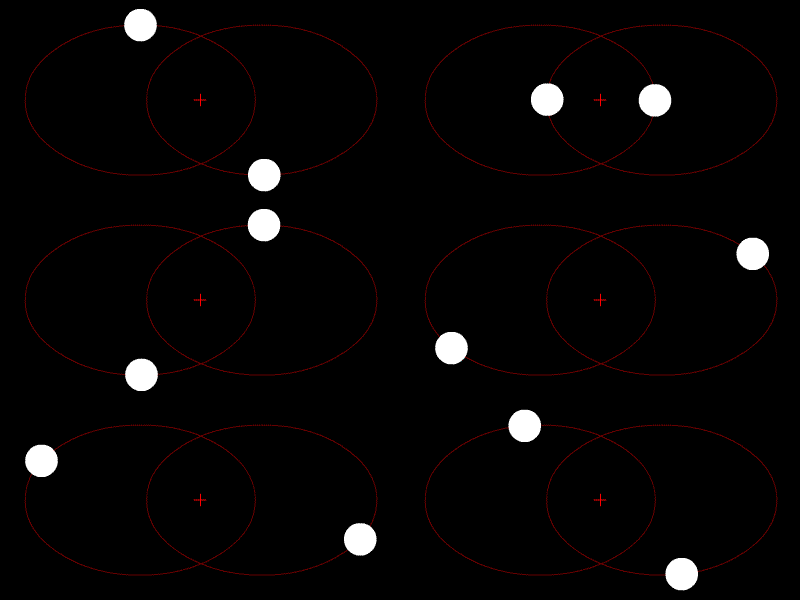
But it's the planet with four suns that interests me more. A pair of stars is called a binary star, and here's a graphic. It shows the two stars orbiting around their common center of mass.


In this case we have two binary stars, so four stars in all. Imagine each dot is itself a binary star. The recently discovered planet is a gas giant orbiting one of the stars. It's been called PH1.

So four suns light up its skies. 


Graphic showing planet PH1 in foreground and a binary star (two suns) in the distance. Pity it doesn't show all four suns.  The suns are imagined as rather feeble, permitting the sky to be full of stars. But what if the suns were stronger and blotted out all stars?   
Can they do astronomy?

Suppose beings inhabited this planet PH1. Which they can't as it's a gas giant, but lets suppose.  Would they experience night?  Perhaps never.  Perhaps there would always be at least one sun in the sky. Imagining this to be so, can we speculate what sort of astronomy the inhabitants of PH1 can do?  They would think the universe consisted of their planet and four suns. If there were one or more moons, they would be dimly aware of them perhaps, if on rare occasions they showed up in the perpetual daylight.

But the stars – these they would never see. Though the four suns might have numerous planets besides PH1, they would be unaware of these too.  Unless, like Venus, a planet occasionally showed up in the daylight sky.

Or suppose the PH1 beings experience an occasional brief night when all four suns happen to line up on the other side of their world. What an amazing spectacle for them!  Then they would briefly see the stars as pricks of light in a dark blanket and say to each other “what on PH1 is that?!”

But would the stars stay around long enough to prompt any investigation?  That's the question I'm posing.  Would they have time to notice that some of the stars behaved oddly and were planets?

Astronomy was born, I think, when sky watchers, having studied the heavens night after night, distinguished the wandering planets from the fixed stars, and charted the planets' courses.  And it came of age when Copernicus realised that the Earth is itself a planet.

So astronomy on PH1 would be depressingly limited.

No night sky, no Copernicus

If they had a Ptolemy, he would devise a fearsomely complicated scheme of spheres and epicycles to account for the movements of the four suns. If they had a Copernicus he would propose it would be so much simpler to imagine the suns orbiting each other and their planet orbiting one of the suns.

But wait! … could they have a Copernicus? I don't think so.

First Copernicus (our Copernicus I mean) had to know about planets. Then he was able make the leap that the Earth itself is one. But a Copernicus on PH1 could know nothing of planets. So how could he make that leap.

No. I fear PH1 astronomy would stop with Ptolemy.

No Copernicus, no Galileo, no Newton, no Einstein.

Saturday, October 13, 2012

Barcelona: and a Roman aqueduct I nearly missed


The aqueduct at Badalona, Spain, with location map
To Barcelona last week. We stayed in Badalona, and there I walked a short way along a Roman aqueduct. It's underground now but the archaeologist at the local museum tells me that originally it was partially embedded in the natural clay, meaning I imagine that the roof was above ground.  I imagine this photo of an aqueduct in Germany possibly gives an idea of it:

Left: The Eifel aqueduct near Cologne showing vaulted roof and inspection manhole. Right: cross section of typical aqueduct at Lyon showing vaulted roof, foundations and cement lining of channel. Illustrations from Roman Aqueducts & Water Supply by A. Trevor Hodge (1992).
There’s a 38m stretch you can visit but I wasn’t comfortable crouching so I didn't venture far along, which is a pity, as at the far end I should have found a manhole in the roof for cleaning and maintenance. 

From the archaeologist I also have the following information. That no conservation work has been done – the duct’s perfect state of preservation is exactly as it was at the time of its discovery in the 1970’s. That it was located under one of the streets that ran from north to south (known as cardines). That it is presumed to have brought water to the town of Baetulo from the lower part of the Coastal Range. (Not sure what that makes the total distance - 25km perhaps.) That it was built in the early years of the reign of Tiberius and in use until the end of the first century AD. (So that's from c. 20 AD to c.100 AD. How do they know these things with such precision I wonder? Moreover it struck me as a remarkably brief period of use, requiring some sort of explanation, though the archaeologist didn't actually agree.)

Due to the steepness of the streets, the duct had a 7% fall, but a pavement of opus signinum (a tough type of mortar) prevented erosion of the duct. (According to Trevor Hodge, 1.5% to 3% was the usual gradient, anything steeper causing excessive erosion.)

They know about a stretch of 96 meters in all, the rest of the duct having disappeared due to modern construction work.

The duct has a width of 1.30 m and its maximum height is 1.50 m. The roofing system is a barrel vault with identical construction to the walls. Pepita PadrĂ³s is the archaeologist who has supplied all this information and many thanks for her trouble.

I very nearly missed the whole thing. The signage is poor. Not to put too fine a point on it, it's nonexistent. I was pondering a manhole in the street and a scruffy looking garage door when a man approached me, asked if I wanted to see the aqueduct and opened it up for me and led me down some steps.

Gaining access to the aqueduct
I have Trevor Hodge's aqueducts book (where the black and white illustrations come from) and one day if I have time I'll tell you more about what it has to say. It's fascinating stuff.

I'll need to visit this aqueduct again, and I think there's a good chance. Badalona where we stayed is a suburb just north of Barcelona, with a good metro link, hotel right next to the beach, perfect in every way. Can give recommendations if you ask. 


Friday, September 28, 2012

I recommend "Democracy Now!"


Democracy Now! is a left wing American daily news program. I download the audio and listen to it as often as I can which isn't often enough sadly. It's also available as video.  I highly recommend it.

Taking a recent episode more or less at random, here's the one sent out on 13th September. (From this you can tell how behind I am with my listening!).


Anti-U.S. protests prompted by the Youtube clip defaming Islam were spreading across the Middle East. Tariq Ramadan, professor of contemporary Islamic studies at Oxford University was on the show. (For many years he was barred from entering the United States by President George W. Bush, but that’s really a testament to Bush’s stupidity, as Tariq Ramadan isn't quite that dangerous!)

Populism is everywhere, he said. There is religious populism in the Muslim-majority countries as much as populism in the USA.  Political parties in the Middle East had to condemn the film, or risk being outflanked but the Salafists, the literalists. In Egypt the Nour Party is the largest Salafi party.

The United Nations resolution on a no-fly zone for Libya was taken as permission for NATO to go there and intervene.  But the motive wasn’t saving Libyans, rather it was economic and “It’s quite clear now that all the economic interest and the access to resources is secured between four countries” namely the US, France, Britain and Qatar. The reaction of Russia and China to Syria should be understood in the light of what happened in Libya, he says,  because Russia and China lost out in their access to the oil resources there.

Another in-depth interview in the same episode was with anti poverty campaigners scholar Cornel West and broadcaster Tavis Smiley (pictured). They are launching a “Poverty Tour 2.0”.

Data from the Census Bureau, a US government agency, shows economic inequality continued to widen in the United States last year. The wealthiest Americans increased their share of total wealth by 4.9 percent, while the median income reached its lowest level since 1995. Some 46.2 million Americans were classified as living in poverty.

Smiley and West think that Obama would like to sweep poverty under the rug in the presidential election campaign - they claim this is what he did in 2008 - and they hope by their campaign to ensure this can't happen again.

Democracy Now! Is presented by Juan GonzĂ¡lez & Amy Goodman (pictured). It's funded entirely through contributions from listeners, viewers, and foundations, and every episode ends with an appeal for donations. 

On their website they say they maintain their independence by refusing to accept advertisers, corporate underwriting, or government funding.

Give it a try.

Today’s edition has an interview Alice Walker on the 30th Anniversary of The Color Purple. Racism and violence against women are global issues. She is also a longtime advocate for the rights of Palestinians, whose conditions are "more brutal" than in the US South of 50 years ago, she says.


Thursday, September 27, 2012

Another human bootprint on the fragile Earth


Or the fragile ocean in this case. Plastic debris has reached the Southern Ocean, previously thought to be pristine.

This is reported by researchers following a two-and-a-half-year 70,000-mile voyage by the schooner Tara (pictured) to investigate marine ecosystems and biodiversity under climate change.


The scientific co-ordinator of Tara Oceans, Chris Bowler, is quoted in today’s Guardian saying: "We had always assumed that this was a pristine environment, very little touched by human beings … The fact that we found these plastics is a sign that the reach of human beings is truly planetary in scale."  Moreover, even if future pollution is mitigated by less waste and substituting biodegradable materials,  "It's too late to do much about what's already out there at this stage, as this stuff is going to hang around for thousands of years."
 

The fatal impact of plastic pollutants on the marine environment has been widely observed, the Great Pacific Trash Vortex being the most notorious example, see this Wikipedia article.

Birds and fish regularly consume waste products, mistaking them for jellyfish or other prey. The plastics cannot be degraded in the stomach and slowly release toxins and other chemical substances that work their way up the marine food chain.

Tara Oceans seems so rely on charitable funding mainly from France and the USA. Its
objectives are to finance scientific research into the impact of global warming on ecosystems, to increase general awareness about environmental issues, and to diffuse scientific data for educational and policy purposes.

Worth supporting I think. Here's their donations page

Wednesday, September 26, 2012

I report a fireball - or did I see a UFO?


No picture accompanies this report
I wonder if anyone reading this saw the fireball on Friday night, 21st Sept? It appeared over Ireland, and parts of Britain, at about 22.55 BST on Friday 21 September.

It seems to have been space junk, a dead satellite perhaps.  See this Irish Times report (updated Sunday, September 23).

If you did see it you should file a report.  Believe it or not in this day and age, that really is how astronomers work out what's happened. By people sending reports, saying what they saw, how bright, at what elevation in the sky, travelling in which direction and most important of all, your precise location, and what direction which you were looking in.

Here's what I saw. About 11 o’clock I just happened to be admiring a cloudless night sky when the fireball crossed my field of view. Though at the time I had no idea what I was looking at. I actually muttered to myself, only half in jest, Spooky! I've seen a UFO. A string of brightly glowing yellow spots travelling horizontally across the sky.  Much brighter than any Venus I've seen, and definitely yellow. From where I was standing it was only visible for 15 seconds. They appeared to me to be quite near and quite low and travelling quite slowly. Say 100 mph, at about half a mile distant from me. It put me in mind of nothing so much as one of those low-flying biplanes pulling an advertising slogan across the sky that I used to see at the seaside. Or a string of Chinese lanterns a few hundred yards away. The apparition travelled due East to West then passed behind some trees.  That’s what it felt like at the time, but of course it wasn’t half a mile away, nor a few hundred yards, it was, I now know, about 250 km away over County Down.

What baffled me, and still does, was that the thing was travelling horizontally, parallel with the ground. A meteor, I thought to myself, should be falling out of the sky and towards the Earth.  This wasn’t like that at all. That could all be an optical illusion of course, compounded by a faulty memory.  All I can do is send in the report as I recall it.

When I tell them that I was 52 deg N, and 8 deg W, and according to my inexpert estimate the fireball was at an elevation of 10 degrees above the horizon, that information, once combined with reports from elsewhere, will help scientists work out at what height the stuff was actually travelling. You would think there would be radar reports that would answer all that, and maybe there are, maybe there aren’t, it all happened so quickly.

So if you did see it and can file a report, here's Armagh Observatory's Fireball report form.