Wednesday, August 15, 2012

Louie died this week RIP


I used to call him the Beast from the Pit.   I'm sorry for doing so.   Not that I'm necessarily conceding it was a false statement.   Louie was, it can plausibly be argued, in league with the Evil One.   I could mention the occasion of the cooked chicken.   All day long I looked forward to tucking into this for my tea, only to spy Louie lolloping across the yard with a guilty demeanour and clutching the chicken in his maw.   Or the day I was to catch a bus to fly to Sweden, and I had lavished particular care on preparing sandwiches for the journey.   It was at the bus stop I noticed them missing, and on my return that I discovered the wrapper in the special place behind the hedge which Louie designated for enjoying the proceeds of crime.  Still and all I'm sorry for calling him that bad thing.   Louie endured many a cross word from me but I never had a cross word from him.   Mighty dog, rest in peace.

Thursday, August 9, 2012

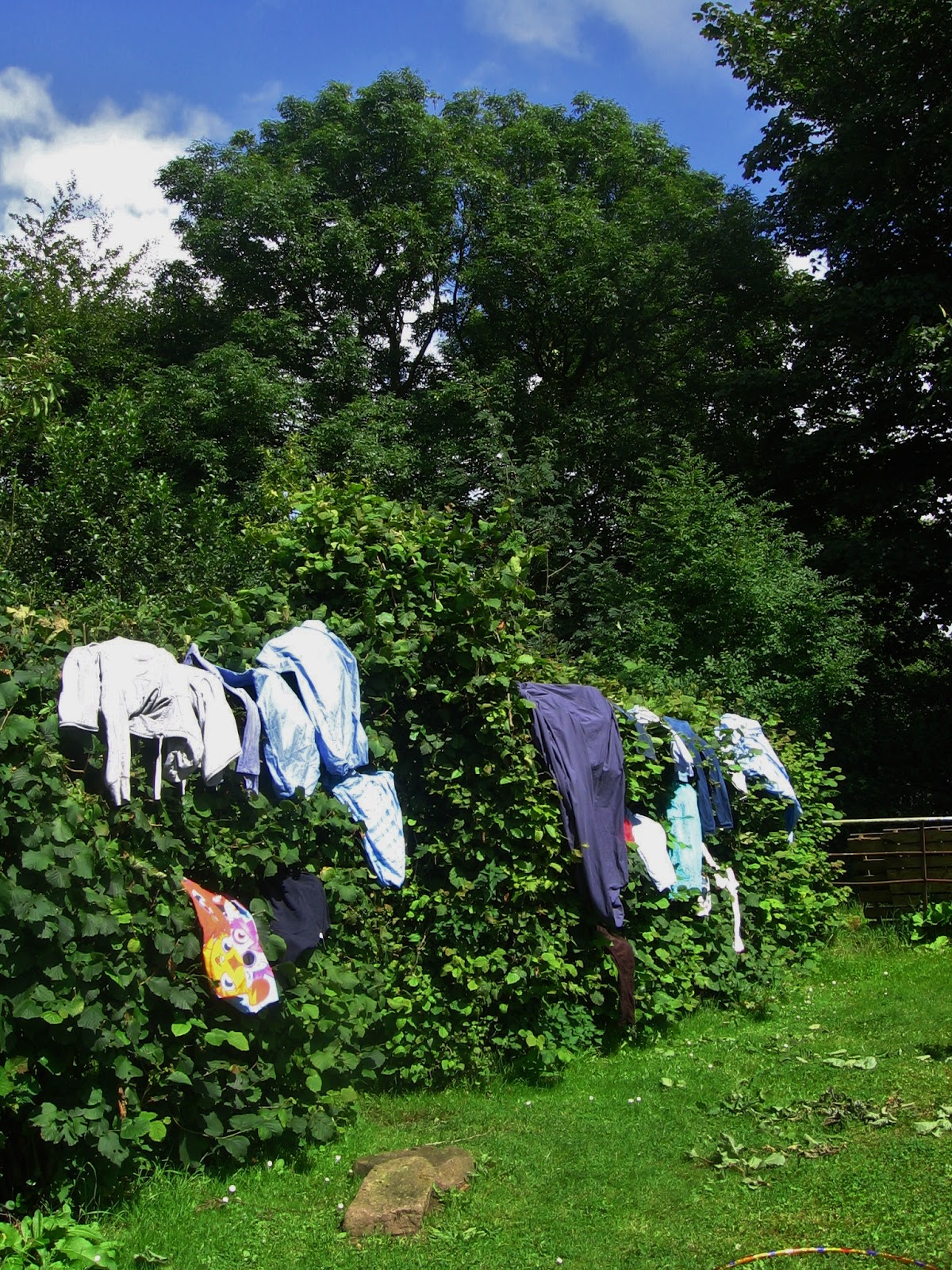
Clothes horse, winter hedge, or maiden


Today there was too much laundry for our clothes lines so I dried some of it the old fashioned way. I threw the clothes on the hedge. Very effective and intensely satisfying. 

The antiquity of this method is attested by the term "winter hedge", for what I call a clothes horse.  “Winter hedge” goes back at least as far as Old English (about 800 years). And so far as I can tell by looking at a few websites, was common until quite recently in northern England - specifically West Yorkshire, south Lancashire, and Derbyshire. 

I'm sure this design for a winter hedge will have altered little since the days of the Anglo-Saxons:


It's almost exactly what our clothes horse at home looked like. (Ours had three leaves instead of two as shown. My father used to make the damp washing into a tent and put a paraffin heater inside it. Pretty dangerous really now I look back on it.)

Another name for the thing is "maiden". In a discussion board devoted to Old English words and their survival in modern dialects, the topic of alternative names for “clothes horse” came up, and someone wrote in to say:

“Definitely a maiden here in East Manchester. There is an item in a local Will called a 'winter hedge' which our local historian interpreted as a maiden. I still call my clothes airer a maiden.”  Another contributor suggested that "clothes horse" is an expression that belongs to the south of England.

Monday, August 6, 2012

What Curiosity can tell us about life in the universe


An image transmitted from Curiosity this morning shows the rover's own shadow cast on the surface of Mars, confirming a successful landing. (Photograph: Nasa TV)

So it landed safely then. The questions now are, will it find existing live microbes under the surface, or failing that evidence of long dead ones? If live microbes, then will they turn out to be closely related to Earth life? The most exciting discovery would be life which is unrelated to Earth life.

Essentially there are 4 possibilities,

(1)    The emergence of life from inanimate matter is a fluke of extreme improbability. This fluke occurred on Earth and perhaps nowhere else in the entire universe.

(2)    As (1) but microbes have travelled from Earth to Mars on meteorites, or indeed in the other direction.  So life is present on both Mars and Earth; but otherwise is extremely rare and perhaps non-existent.

(3)    The emergence of life from inanimate matter given the right circumstances is an easy trick and has occurred countless times in the universe. (Although possibly only once is the solar system.)

(4)    Life emerged once only, early in the universe’s history, and has been transported around the universe in comets. This is the panspermia hypothesis.

Discovering no life on Mars, or life closely related to Earth life, would be consistent with any of the above scenarios.

But were life to be found on Mars that is entirely unrelated to Earth life, doesn't use DNA for example, that would suggest there has been a second genesis. This would support scenario 3, from which we can be certain that life is abundant in the universe and that somewhere there are little green men (technically known to astronomers as lgm).

This picture in the New York Times captures the jubilation at NASA’s mission control center as they read out, “Touchdown confirmed. We are safe on the surface of Mars!”. Story and more pics.


Saturday, August 4, 2012

Curiosity - best chance to find Martian life


The Sky Crane will deliver the rover to the surface of Mars.
Many nails will be bitten!  (Image: NASA)
On Monday NASA's Curiosity rover will land on Mars.  It's the best chance yet to find evidence for ancient or even current Martian life. Curiosity will explore the huge Gale Crater and use its built-in chemistry lab to analyse the composition of rocks and look for organic molecules.

NASA video and audio.

The landing will be an autonomous procedure, and has been dubbed nail-bitingly intricate. 

This is the rover known formally as the Mars Science Laboratory (MSL), and it will undertake an unprecedented two-year hunt for signs of alien life.  It's the biggest, most expensive, and probably boldest, Mars mission ever attempted.

You can follow the landing in a live, 4-hour webcast on August 6th starting at 03:00 UTC (04:00 BST).  During the webcast, scientists, engineers and other experts will provide unique insight into the rover and the landing. Viewers can interact and ask questions.

It's hosted by Universe Today’s Fraser Cain, along with Dr. Pamela Gay and Dr. Phil Plait [1]. That’s an excellent line-up and it should make good viewing. The webcast will feature interviews with special guests, a live video feed from NASA of the landing, and reporters on location to interview members of the MSL team.

An alternative way to follow the landing is The Guardian’s live blog.

The landing itself is scheduled for 05:31 UTC Aug. 6.

For more on Mars ... read next ...

[1] I highly recommend Universe Today and their podcasts. Links : Recent podcasts; and their home page where you can subscribe to podcasts.

One-way trip to Mars planned for 2023


Artist’s impression of the living units that await Mars One colonists.
The inhabitants of these pods will never see Earth again except as a planet in the night sky. (Photo: Mars One)
An announcement I missed in June. A Dutch company called Mars One plans to settle humans on Mars in 2023.  This will be a one-way trip.  No return tickets available.  The participants emigrate, living and working on Mars for the rest of their lives. This is what makes this plan feasible, says the Mars One website. “It goes without saying that we are taking care of the living needs of the settlers.”

Is this a serious operation? It has serious names associated with it. In this promotional video they’ve persuaded the Nobel prize-winning physicist Prof Gerard 't Hooft to endorse the project.


On the Mars One website he says: "The aspect that made all the previous plans so unbelievably expensive and complex, was the uncompromising condition that all Mars travellers must return back to Earth. A return journey would demand launching techniques and manoeuvres that have not been properly investigated, and would double, triple, quadruple the price.”

Eighteen months ago I was surprised to find Paul Davies proposing this one-way trip to Mars thing, and I put together a few thoughts on the ethics of the idea. Would those who sent these colonists be colluding in their suicide?  Read my thoughts here: Can we? Perhaps. Should we? Perhaps not

Mars One mission leader Bas Lansdorp says that by using only previously tested technologies they will avoid expensive research and testing, and keep costs down to about $6 billion for the first settlement of four astronauts.

Mars colonisation meets Big Brother

Now for how they plan to pay for this.  Should we feel queasy when we read on the company's website that media coverage is "a vital component of Mars One's plan"?  With the help of Big Brother creator Paul Römer they will turn the astronaut selection, training, and mission completion into a media spectacle.  "The concept of a 'one-way' mission is both outrageous and exciting," he's quoted as saying. "These aspects are what brought me to the idea of making the mission the biggest media event in the world. Reality meets talent show with no ending and the whole world watching. Now there's a pitch!"

Starting in 2016, supply vessels, solar panels and living infrastructure will be delivered, and in 2018 a rover will comb the landscape for prime locations to place the colony.

Dr. Robert Zubrin, president of the Mars Society and author of The Case For Mars told The Huffington Post: "This is something that has amazing historic value - the transformation of humanity from a single planet species to a multiplanet species  … You only live once. To have the chance to do something like this is profound."

I read The Second Coming


William Butler Yeats (1865-1939)
A recent visit to W B Yeats's grave has inspired me to record this reading of his poem The Second Coming.  In this poem written in the aftermath of the First World War, history’s pattern seems to be breaking up: “Mere anarchy is loosed upon the world”.  Yeats foretells a new cosmic revelation, a destructive god arriving in a ghastly parody of Christ’s coming again to the Earth.


         THE SECOND COMING

Turning and turning in the widening gyre
    The falcon cannot hear the falconer;
    Things fall apart; the centre cannot hold;
    Mere anarchy is loosed upon the world,
    The blood-dimmed tide is loosed, and everywhere
    The ceremony of innocence is drowned;
    The best lack all conviction, while the worst
    Are full of passionate intensity.
    

Surely some revelation is at hand;
    Surely the Second Coming is at hand.
    The Second Coming! Hardly are those words out
    When a vast image out of Spiritus Mundi
    Troubles my sight: somewhere in sands of the desert
    A shape with lion body and the head of a man,
    A gaze blank and pitiless as the sun,
    Is moving its slow thighs, while all about it
    Reel shadows of the indignant desert birds.
    

The darkness drops again, but now I know
    That twenty centuries of stony sleep
    Were vexed to nightmare by a rocking cradle.
    And what rough beast, its hour come round at last,
    Slouches towards Bethlehem to be born?

There are several versions of this poem. This is the one I did at school for A-level.  

A few years ago the National Library in Dublin displayed some of Yeats’s manuscripts, and The Second Coming was one of them. You could see where in the poem's last line, Yeats originally had “Marches”, crossed out, with “Slouches” written in its place.  One word changes everything.

Was Yeats a detestable reactionary? Perhaps. Does the text refer to the Russian Revolution of 1917, and is this poem Yeats taking the side of the counter-revolutionaries? Maybe. Does any of this matter? No. 


A note about the beast.  This is an allusion to the Book of Revelation, the last book of the Bible: "And the beast which I saw was like unto a leopard, and his feet were as the feet of a bear, and his mouth as the mouth of a lion: and the dragon gave him his power, and his seat, and great authority."   I have more extensive quotes if you need them.

Thursday, August 2, 2012

Lot 201: SS La Blanca


This is SS La Blanca, the ship on which my great uncle Axel died when it was torpedoed in 1917. My cousin Anders succeeded in obtaining this image two days ago after much perseverance. A bit spooky to see the ship at last, the more so in that it has a black funnel. This, it appears, is an indication that the ship belonged to the Argentine Cargo Line. 


The painting is by one H. Crane and was auctioned as lot 201 in July 2008 by Toovey's, in West Sussex.