Tuesday, June 5, 2012

The Transit of Venus 10 hours from now


An astronomer points to Venus on a projection
from the solar telescope at the Astrophysical
Institute of Potsdam in Germany on 8 June 2004.
Photograph: Sven Kaestnerj/AP
The transit starts at tonight at 22.04 UTC [1] (that’s 11.04pm BST, 4 minutes after midnight Central European Time, and if you're in the US, 6.04pm EDT). 

Venus takes nearly seven hours to cross the face of the sun.

From most of Europe the transit will be in progress at sunrise on Wednesday, and the last hour or more of it will be visible. Just about the worst place to see it is in County Cork, Ireland.  Only a few minutes if you're lucky. Despite the odds, a number of Cork Astronomy Club members are having a crack at it. None of us will ever see this again.

There are more websites than enough devoted to this event but here is my small selection of the most useful:

[subsequent note: have shortened this by deleting links that disappointed ]

# For beginners, a Q & A from The Guardian

And two NASA ScienceCasts. 

# An intro to the Transit of Venus and the history:

# The transit from the International Space Station:
http://www.youtube.com/watch?v=w5Lx4fC42KI&feature=relmfu

[1] Coordinated Universal Time (UTC) is what I used to call Greenwich Mean Time

Friday, June 1, 2012

Judi Dench reads "Love is not love, which alters when it alteration finds"


     Let me not to the marriage of true minds
     Admit impediments. Love is not love
     Which alters when it alteration finds,
     Or bends with the remover to remove:
     O no! it is an ever-fixed mark
     That looks on tempests and is never shaken;
     It is the star to every wandering bark,
     Whose worth's unknown, although his height be taken.
     Love's not Time's fool, though rosy lips and cheeks
     Within his bending sickle's compass come:
     Love alters not with his brief hours and weeks,
     But bears it out even to the edge of doom.
        If this be error and upon me proved,
        I never writ, nor no man ever loved
.

                   Sonnet 116


It seems Judi Dench remarked to the BBC’s James Naughtie that she liked to read a Shakespeare sonnet every day, so he asked her to recite just one. She obliged with sonnet 116.  Apparently this happened impromptu
on 23rd May at a Royal Academy party marking the contribution of the creative arts in Britain during the last 60 years, to celebrate the Diamond Jubilee.


Thursday, May 31, 2012

The first ever Transit of Venus - is this picture right?


"The Founder of English Astronomy", a painting by Eyre Crowe, 1891
I hope someone can tell me exactly what is going on in this 1891 painting, where the artist Eyre Crowe imagines Jeremiah Horrocks at the moment he witnessed the 1639 Transit of Venus.  What an evocative name. The goddess of love, and the brief and transitory nature of existence. The next one is in 6 days time on 5th or 6th June (depending on where you are [1]). In Ireland it's at dawn on Wednesday June 6th, and only the last few minutes will be seen, just as the Sun rises. And the next after that will be December 11, 2117 (a Saturday). [2]

In the painting Horrocks is projecting the image of the Sun, with Venus a small dark spot crossing it, on to a piece of card, on which he marks Venus’s trajectory.  

The 2004 transit (Wikipedia)
The event depicted is taking place late in the afternoon of 4 December 1639. Does the horizontal alignment of the telescope imply that the Sun is just about to set? Or am I trying to over-interpret Eyre’s painting? Perhaps he didn't know much about astronomy? I've seen it said that Horrocks actually used a camera obscura for his observation [3].

If the painting is right, then has Horrocks set up some arrangement of mirrors not shown?  How, I wonder, did he keep the telescope focussed on the piece of card throughout the transit, as the Sun and Venus declined in the sky?  And what is the contraption on the middle of the room?  

Horrocks witnessed the transit for about half an hour from 3.15 till sunset which might have been about 3.45 I suppose.  His prediction of when the transit would occur was accurate to (I think) a few minutes, but distrusting his calculations, he had been checking on the Sun continually, whenever free of clouds, for the previous 24 hours. Then just when the transit began, he was called away on urgent business (unspecified, but maybe as a clergyman he had to conduct a church service) so missed the beginning of it.

All this is in June’s edition of History Today which I saw in the public library in Cork but sadly don't have to hand as I write this. This link shows the first few paragraphs only.

Horrocks was the only person to predict the 1639 Transit, and he and his friend William Crabtree were the only two people to observe and record it. Horrocks was just 21 at the time, and died two years later. What a loss to science.  In several books I've looked at, his name doesn't even appear in the index.

Measuring the solar system

Venus transits are big events in the history of science.  In 1761 and 1769, astronomers undertook extraordinary expeditions to far-flung locations in the first global scientific collaboration.  I can recommend a Nature podcast on this. [4]

They were hoping to use their observations to calculate the size of the solar system. You can use a Transit of Venus to do this by comparing observations from widely different latitudes on Earth, and using the principle of parallax, trigonometry, and Kepler’s laws of planetary motion, which tell you the relative (though not absolute) distances of each planet from the Sun.

The June 2012 transit will help scientists to refine techniques to be used in the search for exoplanets, some of which are detected when they transit their stars.

[1] Worldwide map issued by NASA showing regions where the 2012 Transit is visible from, and when.

[2] The recurrence pattern is gaps of:  8 years, 121 years, 8 years, 105 years.

[3] John North, Fontana History of Astronomy and Cosmology (1994), p 349.

[4] Chasing Venus : Nature Podcast Extra (16 minutes).  Nature is one of the foremost scientific journals. Subscribe to their podcast and hear scientists talking to scientists.  As a taster try the episode of 26 January 2012, available on this page: hunting for 2,500 year old shipwrecks off the coast of Crete, insights into Alzheimer's from reprogrammed cells, and a research tool called 'primitive facebook' with hunter gatherers in southern Africa.


Why I'm voting No in the Irish austerity referendum


Socialist Party Vote No poster
To be honest it's only a gesture but gestures do matter. We’ve all heard the slogan a No vote is a vote against austerity. In itself that slogan sounds naïve - as the parties supporting a Yes have been quick to point out.

So a No vote is empty without a commitment to an ongoing campaign against austerity, and an expression of solidarity with the people of Greece. I'm afraid I'm too old and washed up to do a lot of campaigning these days but at least I'm supporting to the no household charge campaign. 

Incidentally the word austerity is much misused by politicians of the right, and most us have unwittingly fallen in with them. The original age of austerity was postwar Britain.  But the 1945 Labour government set up the welfare state and the NHS.  Look it up in a dictionary and you'll find austerity means the trait of great self-denial especially refraining from worldly pleasures.  But today austerity is being imposed because men in suits say that it’s necessary to satisfy the invisible gods of the financial markets, and it's used for a package of measures that increase inequality (already on the rise throughout the world for the past 30 years) and impacts mainly on the poor, and the people for whom worldly pleasures are already hard to come by.

The Irish referendum is to change the constitution to allow the government to sign up to the European Fiscal Stability Treaty, which will impose penalties on any government that runs a deficit budget.  It's supported by Fine Gael, Labour (the coalition parties) and Fianna Fáil, and opposed by the United Left Alliance and Sinn Fein. The vote is tomorrow.

A final point, there's no doubt a raft of new cutbacks and tax hikes has already been prepared, but will not be announced until after the referendum. The government got a fright from the backlash against the household charge, and you can be sure it is deliberately suppressing news.

Thursday, May 17, 2012

What scientists say about science


Anthologies of scientific quotations are already countless but here's one more. It was about 8 years ago I became interested in science when I attended an evening class in York on the Big Bang, following which Phil & Lindsay gave me Simon Singh’s book of the same title for Christmas. This was 2004. The book tells the history of astronomy; which turns out to be almost the same thing as the history of science itself. It's peppered with wonderful quotes, and that’s when I discovered that scientists are also philosophers.

In proof of which, I'm now going to treat you to my own collection of quotes by scientists talking about science. First a video clip of Richard Feynman describing the scientific method.  Feynman, who died in 1988, was an American physicist and Nobel laureate, and renowned as a spellbinding lecturer. Before PowerPoint, the lecturer’s skill was to hold their audience’s attention with their back turned writing on a blackboard.  The video was shot at Cornell University in 1964.  


This is what he says:  Now I'm going to discuss how we would look for a new Law.  In general we look for a new Law by the following process.  First we guess it.  No, don't laugh, that is the real truth.  Then we compute the consequences of the guess, to see what, if this law that we guessed is right, what it would imply.  And then we compare those computation results to Nature; or we say compare to experiment or experience.  Compare it directly to observation to see if it works.  If it disagrees with experiment, it's wrong.  In that simple statement is the key to science.  It doesn't make a difference how beautiful your guess is, it doesn't make a difference how smart you are, or what your name is.  If it disagrees with experiment, it's wrong.  That's all there is to it.

I've put together a 16-page compendium of my favourite quotations from scientists, but in case you don’t have time for that right now here are a few choice ones. First, one more on the scientific method, from Henri Poincaré, French mathematician, 1854–1912:

Science is built up of facts, as a house is built of stones; but an accumulation of facts is no more a science than a heap of stones is a house.

The biggest insight I got from Simon Singh’s book was that great scientists are normally very modest about science’s achievements, freely admitting how few of nature’s secrets have been unlocked, and perhaps will ever be unlocked.  Here's Albert Einstein on this theme:

Nature shows us only the tail of the lion.  But I have no doubt that the lion belongs to it even though he cannot reveal himself all at once because of his large size.  We can see him only the way a louse sitting on him would.

and:

Everyone who is seriously interested in the pursuit of science becomes convinced that a spirit is manifest in the laws of the universe - a spirit vastly superior to man, and one in the face of which our modest powers must seem humble.

Next Steven Weinberg, American Nobel laureate in physics, born 1933.

The effort to understand the universe is one of the very few things that lifts human life a little above the level of farce and endows it with some of the grace of tragedy.  On another occasion he said:  The more the universe seems comprehensible, the more it also seems pointless.

Some scientists have expressed surprise that the human mind can in fact understand anything about the universe at all.  Einstein (I'm afraid we can't avoid his name cropping up) expressed it this way, that the most incomprehensible thing about the universe is that it is comprehensible.  Eugene Wigner had a similar thought when he suggested that it is not at all natural that "laws of nature" exist, much less that man is able to discover them. *

Saving the best till last, what is science for?  Robert Wilson when Director of the US National Accelerator Laboratory, was obliged in 1969 to go in front of a congressional committee to seek government funding for the construction of a particle accelerator. 

Robert R. Wilson at the
Fermilab groundbreaking ceremony
(Wikipedia)
It would be 4 miles long and massively expensive, but he knew the only hope of uncovering the fundamental laws of nature, was to persuade governments to stump up costly kit like this.  Facing that committee must have been a critical moment in his career, and cross-examined by Senator John Pastore, Wilson had to answer the question he will have dreaded: would the project give the USA any advantage over the Russians in the Cold War?  

No, said Wilson.  It has no military application.  He continued:

What it has to do with is: Are we good painters, good sculptors, great poets? I mean all the things that we really venerate and honor in our country and are patriotic about.  In that sense, this new knowledge has all to do with honor and country; but it has nothing to do directly with defending our country, except to help make it worth defending.

Wilson got the funding: the accelerator was later known as Fermilab.  More in my compendium, page 10.

Wilson by the way has an interesting history.  A veteran of the Manhattan atomic bomb project, he was one of those scientists for whom the work raised deep questions about science and society.  In 1945, when Nazi Germany surrendered, Wilson attempted to raise the question at the lab of whether they should continue with their work. He deplored the actual use of the bomb at Hiroshima. He sounds to me like a good egg, and some day I'll write more about him, and other physicists who worked on the atomic bomb.  On page 16, I have quotes from a couple of them.

I'm putting this on my blog now as a sort of tribute to my friend Stu who died last week. Several years ago I showed him an early draft of this collection of quotes and we talked far into the small hours about the philosophy of science, politics, religion and probably much besides.   I was looking forward to showing him my final list, but the day never came. 

* In his 1960 paper The Unreasonable Effectiveness of Mathematics in the Natural Sciences, cited in the pdf file though I didn't have room for this particular quote

Saturday, May 12, 2012

Sign here to save the Rainforest


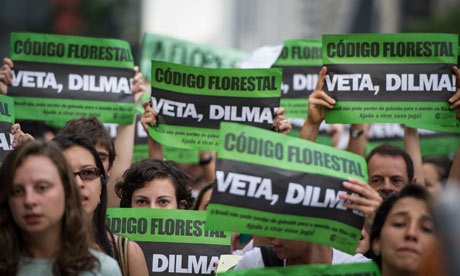
If you like online petitions (which I don't really) here's one that may be worth a look.  A bill has passed the Brazilian parliament relaxing the law on illegal logging. The petition calls on Brazil’s President Dilma Rousseff to save Brazil's precious forests by exercising her veto.

Brazilian protesters demand that president Dilma Rousseff veto a forest code approved
last month by the congress.    Photo: Yasuyoshi Chiba/AFP/Getty Images
Last month President Dilma Rousseff's party lost a vote on the law, which critics fear will unleash a wave of deforestation, by 274 votes to 184.

The result confirms the Brazilian parliament's bias for the interests of large landowners, according to Deutsche Welle, Germany's international broadcaster. It also reveals a tension within the current administration. The majority of members of the largest coalition partner, the Brazilian Democratic Movement Party (PMBD), voted for the law.  President Rousseff's Workers' Party (PT) voted almost unanimously against it.

Which is where the petition comes in.  It seems the president is both entitled to veto and politically disposed to do so, and therefore international encouragement through actions such as online petitions might just be the deciding factor. I suppose it's worth a shot anyway.

An extra factor is Rousseff's presumed desire to avoid embarrassment when she hosts the UN's Rio +20 Earth summit next month. More than 125 heads of state as well as 45,000 delegates are expected to attend the world's largest environment conference in a generation, pledging to protect forests and develop the "green economy".

The petition also urges the president “to prevent further murders of environmental activists and workers by increasing law enforcement against illegal loggers and ramping up protection for people at risk from violence or death. The world needs Brazil to be an international leader on the environment. Your strong action now will safeguard the planet for future generations.”
 
Logged Brazilian rainforest
I can't remember whether I've come across Avaaz before. It may be a site worth keeping an eye on.

Here's the story in The Guardian

Monday, May 7, 2012

Astronomy symposium venue sparks controversy

A 1610 portrait of Johannes Kepler by an unknown artist, probably in Prague.
Cork Astronomy Club went there to study his laws of planetary motion.
A Cork Astronomy Club symposium on Kepler’s laws, held recently in Prague, has given rise to divergent views.  At issue was the venue for this prestigious occasion in the astronomical calendar.  One club member who does not wish to be named said : “Holding it in Prague was an imaginative idea but the trouble was there were two many bars, and ultimately this negated the symposium’s serious purpose. Next year I think the committee should consider hiring a seminar room at UCC instead.”

Asked to recite Kepler’s three laws of planetary motion, the unnamed member said “Well actually I can only remember two of them and that more or less proves my point.”

A spokesperson for Cork Astronomy Club said: “Kepler did his most important work in Prague and we saw his house and Tycho Brahe’s tomb. But the point about all the bars is a fair one and we'll certainly give it due consideration in planning next year’s event.”

Other members praised the astronomical clock in the Old Town Square. 

Cork astronomers gather at the Prague
astronomical clock
Constructed in 1410 the clock was already nearly 200 years old when Kepler was in the city.  On the hour a figure of death pulls on a bell rope, the apostles pass by a window, and a real live trumpeter plays at the top of the tower, as shown in the video, at the end of which cheering Cork Astronomy Club members can be seen thronging the square hundreds of feet below. 


The clock displays the current zodiac sign and the Moon's phase, and tells the time in Old Bohemian Time, Sidereal Time and the Babylonian hour.

The symposium was held from 26th to 29th April.  Rumour has it that next year’s symposium will be held on an apple farm in Leicestershire and will be devoted to Isaac Newton’s law of gravitation.

After a punishing round of seminars, Cork astronomers relax in a Prague restaurant
Tomb of Danish astronomer Tycho Brahe in St Nicholas cathedral, Prague