Monday, May 7, 2012

Astronomy symposium venue sparks controversy

A 1610 portrait of Johannes Kepler by an unknown artist, probably in Prague.
Cork Astronomy Club went there to study his laws of planetary motion.
A Cork Astronomy Club symposium on Kepler’s laws, held recently in Prague, has given rise to divergent views.  At issue was the venue for this prestigious occasion in the astronomical calendar.  One club member who does not wish to be named said : “Holding it in Prague was an imaginative idea but the trouble was there were two many bars, and ultimately this negated the symposium’s serious purpose. Next year I think the committee should consider hiring a seminar room at UCC instead.”

Asked to recite Kepler’s three laws of planetary motion, the unnamed member said “Well actually I can only remember two of them and that more or less proves my point.”

A spokesperson for Cork Astronomy Club said: “Kepler did his most important work in Prague and we saw his house and Tycho Brahe’s tomb. But the point about all the bars is a fair one and we'll certainly give it due consideration in planning next year’s event.”

Other members praised the astronomical clock in the Old Town Square. 

Cork astronomers gather at the Prague
astronomical clock
Constructed in 1410 the clock was already nearly 200 years old when Kepler was in the city.  On the hour a figure of death pulls on a bell rope, the apostles pass by a window, and a real live trumpeter plays at the top of the tower, as shown in the video, at the end of which cheering Cork Astronomy Club members can be seen thronging the square hundreds of feet below. 


The clock displays the current zodiac sign and the Moon's phase, and tells the time in Old Bohemian Time, Sidereal Time and the Babylonian hour.

The symposium was held from 26th to 29th April.  Rumour has it that next year’s symposium will be held on an apple farm in Leicestershire and will be devoted to Isaac Newton’s law of gravitation.

After a punishing round of seminars, Cork astronomers relax in a Prague restaurant
Tomb of Danish astronomer Tycho Brahe in St Nicholas cathedral, Prague
 

Tuesday, April 17, 2012

How we colonised the night


Craig Koslofsky’s book
At last! A history of night-time. Something I've long been waiting for.
It's Evening's Empire: A History of the Night in Early Modern Europe, by Craig Koslofsky, published last June.

I've often wondered how and when we adopted the habit of going to bed in the middle of the night and getting up half way through the morning. If you sleep 8 hours, then a rational arrangement of your day would surely be to retire at 8 and rise at 4. 

And it turns out that’s indeed how it was until very recently. In 1710, Richard Steele wrote in The Tatler of a visit to an old friend just come up to town from the country. Calling at 8 in the evening Steele was surprised to find his friend already gone to bed. He returned at 11 the following morning, only to be told that his friend had just sat down to dinner. “In short”, Steele commented, “I found that my old-fashioned friend religiously adhered to the example of his forefathers, and observed the same hours that had been kept in his family ever since the Conquest”.

A theme of Fanny Burney’s novel Evelina published in 1778, is the unsophisticated country girl’s surprise at fashionable London customs, which include, she finds, eating dinner “when the day is almost over”. [1]

I'll just digress here to mention the Fianna Fail politician Mark Killilea, active in the 1980’s, who considered himself as representing the plain people of Ireland, "the people who eat their dinner in the middle of the day" – a remark often quoted, nowadays normally ironically.

But my theme was night, so back to Richard Steele, writing in 1710. During the previous generation or so “nocturnalisation” had occurred: elites across Europe had moved their clocks forward by several hours. No longer a time reserved for sleep, the night was now a time of recreation for the rich and work for those who waited on them. Presumably the elites started this as they could afford the most candles. But even so, just because you can do something, doesn't mean you do it. What was the actual motive? And when did the peasants and workers follow suit?

18th century chandelier - light to rule by
And now here’s a book that tells us these things.

Two reviews: one from Times Literary Supplement and one from History Today.  

Here's a curiosity from the History Today review. It seems that in early rural communities there were two segments of sleep with a waking interval. Huh? Sounds like a siesta. That can't be right. Which was replaced in cities with a single phase of sleep. Then the schedule of the urban day slipped back: and rising, mealtimes and sleep all occurred later.

I must get hold of this book. According to other reviews I've seen it's overly academic but worth the slog.

As a postscript, Jared Diamond or someone has calculated that whereas it now costs us 5 cents for the electrical energy needed to read for an hour at night, in the 18th century an agricultural worker would have to work for two hours to afford an hour’s worth of candle and in the 12th century they would have to work for a day. I've made those figures up because I can't lay my hands on the reference. I thought it was in Jared Diamond’s Guns Germs and Steel but I've failed to locate it there.  I understand poor Saxons used rush lights (rushes dipped in animal fat).  Can't find an image of one of these.

PS Just come across another book that might cover some of the same ground: Brilliant: The Evolution of Artificial Light by Jane Brox “a sweeping history of our transformative relationship to light”. Published 2010, I think. 


[1] “Before our dinner was over yesterday Madame Duval came to tea; though it will lessen your surprise, to hear that it was near five o'clock, for we never dine till the day is almost over.” Evelina, Penguin Classics 1994, Letter XVI. An editor’s note explains that this implies dining at three-thirty or four o’clock, although eve more fashionable people had already pushed the dinner hour to 6 o’clock

Tuesday, April 10, 2012

Why my Swedish great uncle is remembered at Tower Hill


Tower Hill Memorial, London, 17th February 2012
An obliging passerby took this picture of me in February at Tower Hill Memorial. This memorial, a couple of hundred yards from Tower Hill tube station, was erected in 1928, dedicated to merchant seamen who perished in the 1914-18 war. 

I went there to pay my respects to the memory my grandfather’s younger brother, Axel Vilhelm Åkerlund. In fact I could say, to be the first member of my family to be privileged to do this, for this reason. The discovery that Axel’s name is here was made only recently by my cousin Anders. My mother lived 22 years in England, and my grandfather Albert visited London in 1967, but they didn’t know about this memorial.

Axel Åkerlund was born 11 January 1897 in Luleå. This port at the top of the Baltic Sea is where my mother and Anders’s were brought up. Their sister Kerstin lives there still.  The family knew that Axel perished in 1917 on a British ship, but details were sparse until Anders’ recent research, which began in the archives of Luleå's cathedral and in the port's merchant marine office.

It turns out that Axel served on several Swedish merchant ships, a Russian ship and finally a British one: SS La Blanca, which was torpedoed in the English Channel on 23 November 1917. 

More in these pdf files.  Axel’s life and death at sea summarises what's known of his life as a seaman and his final voyage. Evidence for how he joined La Blanca and how the ship came to be sunk are to be found in the Agreement and Account of Crew and in a House of Lords debate in December 1917.

Axel Vilhelm Åkerlund, 1897 to 1917
Studio portrait by a Luleå photographer
Undated but perhaps taken in September 1914
The portrait of Axel has come down through one of Albert’s sisters, Berta (that would be a great aunt to me). Possibly taken when his ship (SS Torne) was loading iron ore in Luleå, with copies given to his three sisters and to Albert.

At Tower Hill Memorial

Bronze plates with the sailors’ names in relief cover the memorial’s pillars.  12 thousand names in all, according to Wikipedia. They are in alphabetical order by name of ship. La Blanca comes at the top of one list on Pillar 10. The ships in this list are:-.

La Blanca, Liverpool – 2 names: Akerlund A. & Stowe J. J.
Laconia, Liverpool – 6 names
Lodoga, Leith – 25 names (about)
Lady Ann, Sunderland - 11 names
Lady Helen, Sunderland – 6 names
Lady Ninian, Cardiff – 1 name
Lady Salisbury, London – 3 names
Laertes, Liverpool – 14 names
Lake Michigan, Liverpool – 1 name
Lampada, London – 5 names
Landonia, London – 15 names

Just around the corner of pillar 10 you come to Lusitania.

Being at the very top, La Blanca is hard to see from the ground, but I was helped by a photo that Anders had supplied.  As I stared up at the top of the pillar, avoiding being blinded by the sun which was right behind it,  and my eyes got accustomed to the light, I was at length able to make out my grandfather’s brother’s name - Akerlund A.

As a final detail, the U-boat commander was Heinrich Jeß and he lived a long life.

I'll close with the digression that my cousin’s husband Tom did research for his father who was on an American merchant ship that was sunk by a German torpedo during the Second World War.  He learnt that crew members from the American ship and German U-boat met up at several reunions in Germany in their old age.

Friday, April 6, 2012

I ponder folk religion


Have been giving some thought to folk religion, but as yet these thoughts are scattered and unfocussed. So forgive the bullet points, which represent a hodge podge of facts that I hope some day to weave together into a coherent essay.
  • Academic interest in folk religion seems to have begun in the German Lutheran church at the start of the 20th century, with a project to help ministers deal with the people in rural congregations, whose conception of the Christian religion was often radically different from the official doctrine preached by the clergy. So interest in folk religion first arose from an attempt, within organized religion, to narrow the understanding gap between pulpit and pew. [1]

  • Irish bishops at the Vatican, February 2010, discussing child abuse scandal
  • Last month, a Vatican delegation to investigate the church in Ireland noted with concern “a certain tendency, not dominant but nevertheless fairly widespread among priests, religious and laity, to hold theological opinions at variance with the teachings of the Magisterium.” [2]

  • The Vatican officials haven't publicly elaborated on what they are getting at here, so we can only surmise. I wonder if they have encountered folk religion and they don’t like it. 

  • I've noticed Catholic priests at Irish funerals habitually gloss over the existence of purgatory. See Why purgatory is no laughing matter. Could this be an example of what the Vatican officials object to? 

  • In the 18th and 19th centuries the Roman Catholic church in Ireland tried to stamp out wakes and the celebration of local saints days (“pattern days”) because these events entailed too much rowdiness and too little orthodoxy. [3]

  • Richard Dawkins has recently researched the views of “Census-Christians” in the UK. [4] He wanted to know to what extent adults recorded as Christian in the 2011 census believe, know about, practise and are influenced by Christianity. He found over a third almost never pray outside a church service, only 10% seek most guidance from religion in questions of right and wrong, just a third believe Jesus was physically resurrected, and half do not think of him as the Son of God. 

  • The definition of folk religion is a matter of debate, and I'm some way from feeling my way to a definition that satisfies me. Nor do I know whether “popular religion” is something else or just another term for the same thing.

  • The goddess Lakshmi
  • In “village Hinduism” there are many gods, one in the shape of a woman with many arms, another with the head of elephant and so on. But in élite Hinduism these so-called gods are just aspects of the Atman, the unknowable godhead of whom nothing can be said. According to the Christian writer Louis Cassels, it is rash to reach sweeping conclusions about Hinduism after reading the Hindu scriptures, since “a great gulf exists between the philosophical Hinduism that we encounter in these scriptures, and the popular Hinduism that is actually practiced in the villages of India. The latter always has been, and still is, a polytheistic religion that rises little, if at all, above the level of primitive idol-worship.” [5]

  • According to a recent New Scientist article, [6] theological incorrectness is seen across all cultures and religious systems. When asked in experiments to talk or think about gods' thoughts and actions in stories, religious people immediately and completely abandon theologically correct doctrines in favour of popular religion. Even if they have just affirmed and recited the theologically correct doctrines. The way they think and talk reveals that they see God as a superhero, not as the omniscient, omnipresent and omnipotent ruler of the universe in whom they say they believe. 
I need to do some pondering on all these things.

[1] “Toward a Definition of Folk Religion” by Don Yoder in Western Folklore, Vol. 33, No. 1, [Jan., 1974], pp. 2-15. Preview.

[2] The Magisterium is a grand sounding term for the teaching authority of the Roman Catholic church. Report issued on 20th March, see Apostolic visitation calls for overhaul of Church in Ireland  (Catholic News Agency release 20 March 2012). The visitation was prompted by the child abuse scandal. 

[3] I got this from an evening class at University College Cork last autumn on Irish folklore. It was excellent but I attended by mistake! I thought it would be about tales of heroes long ago. 

[4] Richard Dawkins Foundation for Reason and Science, Ipsos MORI Poll How religious are UK Christians? 

[5] What’s the Difference? A Comparison of the Faiths Men Live By by Louis Cassels, 1965, Chapter 11: The Oriental Religions 

[6] “Natural Religion, Unnatural Science” by Robert N McCauley in New Scientist 2856, 17 Mar 2012, p 45.

Thursday, March 29, 2012

Pictures in an exhibition


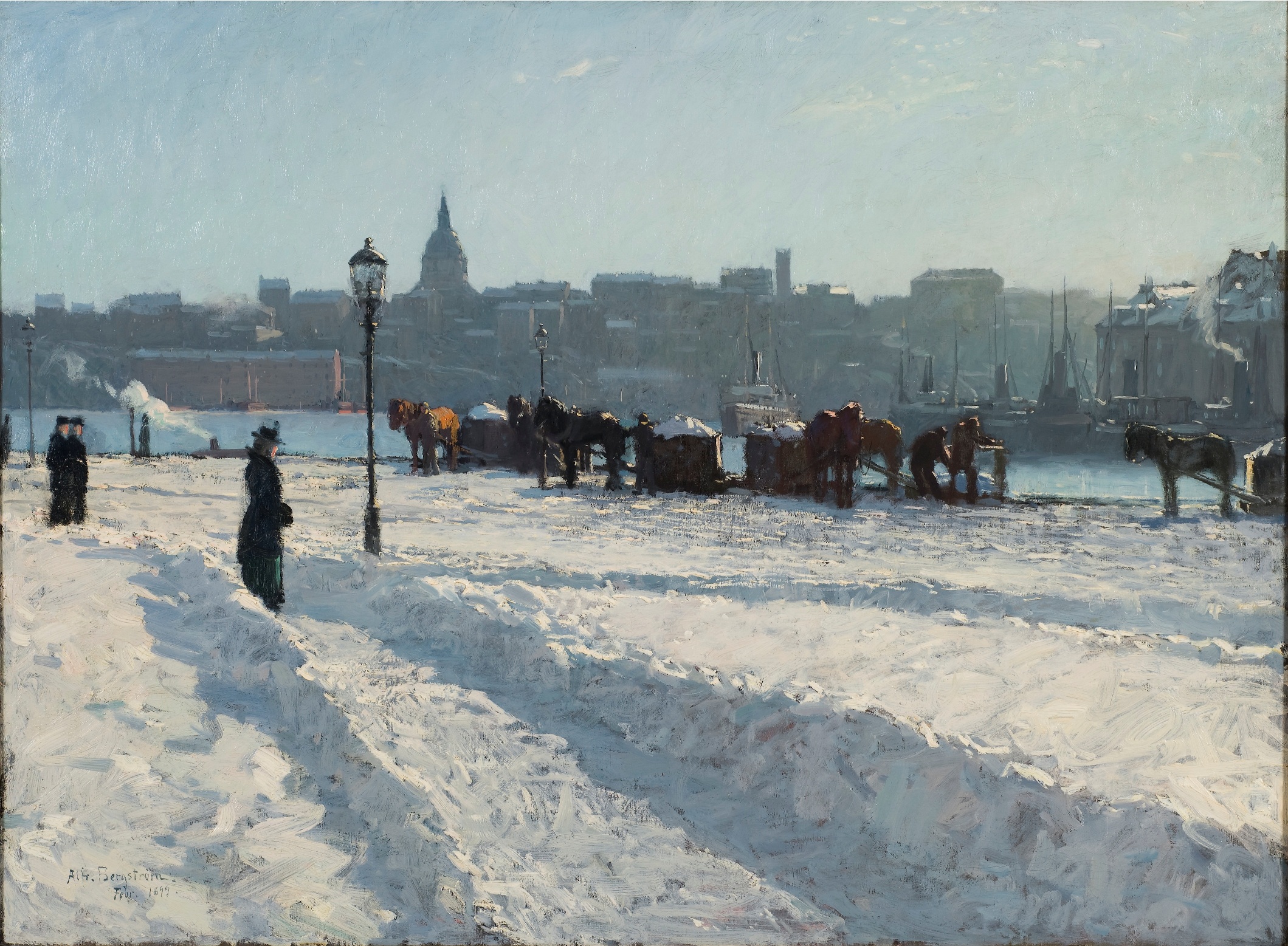
Alfred Bergström (1869-1930), Vintermotiv vid Stockholms ström, 1899
To Stockholm’s national museum and an exhibition of paintings illustrating the succession of the seasons. A very Swedish preoccupation according to my cousin Anders who took me there. Here's my number one favourite. Alfred Bergström captures shades of violet as snow, shovelled in brilliant sunshine from the quayside, is dumped from carts into Stockholm harbour in 1899.

And here's one by Prince Eugen. A peaceful Spring day in 1891, and on three slender birch trees the leaves are just opening. His full name was Prince Eugen Napoleon Nicolaus of Sweden and Norway, Duke of Närke.  The Exhibiton was called “The Four Seasons”.  Vivaldi was not played.  Anders and I were in no doubt that our uncle Gösta would have loved this exhibition.  He would have been our guide and fellow wanderer.  We buried him yesterday.

Prins Eugen (1865 - 1947), Lövsprickning, Balingsta, 1891
Exhibition details in Swedish and English

Thursday, March 22, 2012

I meet a woman from Tahrir Square and hear there is still torture in Egypt


Dr. Basma Abdelrahman
To a lunchtime lecture at UCC by an Egyptian activist Dr. Basma Abdelrahman. She calls herself a human rights defender. Front Line Defenders is an international foundation for the protection of human rights defenders. Defending the defenders you might say. Their mission is “fast and effective action to help protect human rights defenders at risk so they can continue their work as key agents of social change.”

Dr Abdelrahman is a psychiatrist with the El Nadeem Centre for the Management & Rehabilitation of Victims of Torture in Cairo, working with survivors of torture and their families. She has campaigned for an end to the use of torture in Egypt and to bring the perpetrators to justice.

In January 2011 she was present every day for 10 days at the protests in Tahrir Square during the demonstrations to put an end to the emergency law and the prevailing repressive regime in Egypt.

Once, disorientated by tear gas, she was pulled from behind by a man. She was frightened and shouted who are you. She wondered if it was her brother. He brought her to safety across a bridge and said I'm an Egyptian like you, and disappeared.
Egyptian protesters point to the "Made in USA"
tag on a tear gas canister in Cairo's Tahrir Square
on 20 Nov 2011. (Photo: AFP - Khaled Desouki).
Published Monday, November 21, 2011
Someone told her how brave she had been. But she felt safer in the square than sitting at home wondering what was happening.  On one occasion in Tahrir Square there was shouts of “live ammunition”. She turned back, but others went on. 

Torture

Thankfully she didn’t give actual details of the torture. I almost didn’t attend, fearing that is what might happen. 15 years ago when the El Nadeem Centre began monitoring torture reports, they plotted red dots on the map to indicate the police stations where torture occurred. But the whole map became uniformly spotted in red. So they stopped doing this. It became clear that torture was systemic. And both the methods and equipment were standardised (some imported from the West.)

In the 1960’s torture was reserved for opponents of the regime, but under Mubarak it came to be used indiscriminately on anyone. Sometimes for no other reason that the settling of personal scores.

She used the expression Egyptian revolution. But it didn’t sound as if there has been one. Since the elections in November 2011, the Muslim Brotherhood have a large bloc in the parliament and support the military regime. Torture continues unabated. 

Dr. Abdelrahman isn't disillusioned in the Muslim Brotherhood because she never had any illusions. But many are disillusioned, especially the illiterate poor who saw the Muslim Brotherhood being oppressed and tortured under the old regime and gave credit for using the name Muslim.  Now they ask how can it be we voted for them? (Well of course that happens in every country I suppose.)

A magical moment

What first brought the protesters to the squares was the brutal death of Khaled Mohamed Saeed in June 2010, and the before and after photos on the internet, (see it in Wikipedia if you like).

Not just Tahrir Square in Cairo but in several cities. The chant was “bread freedom and social justice”. For once the police found the boot on the wrong foot. No longer was a small group of protesters surrounded and outnumbered by police while the population looked on cowed and silent. The activists were taken by surprise. Thousands came, only a few of whom had computers and Facebook. “It was a magical moment”, “romantic” to be there with family and friends.

Ahmed Harara -
Dr. Abdelrahman showed this photo
Eyes were targeted. Showed us a group photo of protesters half of whom had lost an eye. Also one who had lost two. This was Ahmed Harara who lost his right eye on January 28 during protests leading up to the ousting Hosni Mubarak, and lost his left eye on November 19, according to social media activists. "I would rather be blind, but live with dignity and with my head held up high,” Harara was quoted as saying.

Muslim Brotherhood - what is it exactly?

I asked about the Muslim Brotherhood. According to many reports, some of the protesters had been Muslim Brothers, so could she explain to us what the Muslim Brotherhood actually is?

The Muslim Brothers who protested were the younger element. For a brief period in January (I think) 2011, the leadership felt obliged to support the protests, but soon withdrew support.

The relationship with the old regime was complicated. Yes the Muslim Brotherhood were subject to oppression, arrest and torture. But they were also a privileged opposition. At universities Muslim Brother students were allowed to engage in political activity using laptops whereas other students had to make posters with marker pens.

Dr. Abdelrahman is unimpressed with al Jazeera. This TV channel supported the first wave of protest. But when the Muslim Brotherhood abandoned the revolution so did al Jazeera. The slogan is: Trash your TV!

She ended her talk saying that the government hasn’t changed, but the people have. But was this the optimism of a prepared speech? In answer to a question later about treatment for torture survivors, she said what really hurts is not the torture but being derided. “Why did you protest: things are worse now than before”. 

Monday, March 19, 2012

Oh joy! This week's New Scientist all about God


This is the 17th March edition. My copy hasn’t arrived yet, due to today being a public holiday in Ireland.  But the blurb on the New Scientist website says “New science of religion - Can't live with him, can't live without him. In a special series of articles we lay out a new vision that resets the terms of the debate”. The article titles are:-

We are all born believers (Our minds solve fundamental problems in a way that leaves a god-shaped space just waiting to be filled by religion.)

Religion is the key to civilisation (As early humans expanded beyond hunter-gatherer groups, religion was the glue that held societies full of strangers together.)

Science won't loosen religion's grip  (Those who would dance on religion's grave are underestimating its staying power.)

God is a testable hypothesis (Whether an ultimate creator as envisaged by religion exists or not is a question that science can address.)

Alain de Botton's religion for atheists (Alain de Botton explains why atheists need to reclaim the useful bits of religion, which is not literally true but neither is it total nonsense.)

In the shops till Friday 23rd, I think.