Sunday, October 23, 2011

A divinity that shapes our ends


New Cambridge Shakespeare (not the 1936 edition)

Hamlet Act 5, Scene 2.

   … and that should teach us
There's a divinity that shapes our ends,
Rough-hew them how we will.


Hamlet tells Horatio how on the ship to England he rashly ventured from his cabin at night and found the letter that would have sealed his fate, enabling him to substitute a forgery, so that Guildenstern and Rosencrantz went to their deaths instead of him.

It seems there's a famous footnote to these lines in John Dover Wilson's 1936 Cambridge edition of Hamlet. A gentleman named Malleson (whose son later mentioned this in a letter to Wilson) happened on a craftsman and his mate making fence posts, and the craftsman told him :-

"He rough-hews them and I shape their ends".

Yes really.

It appeared in The Guardian correspondence page on the who-wrote-Shakespeare theme, as evidence that whoever did was familiar with labourer’s talk. I shall get hold of Dover Wilson's 1936 Hamlet when I get the chance and look the note up, to see what he makes of it.

False memory syndrome

Theatre director Trevor Nunn believes Shakespeare really did write Shakespeare's plays, and in The Guardian on Friday 14 October he relates that many years ago an actor friend of his was walking down a country lane in Warwickshire.  Passing two men at work hedging, he stopped and asked, what are you two doing? To which one of them replied, "It's quite simple, I rough-hew them and he shapes their ends."

An instance of false memory, perhaps. Probably (as Hugo Barnacle points out in a reader’s letter on 22 October) Trevor Nunn is actually recalling the Dover Wilson note of 1936, yet really believes that he talked to an “actor friend”, who met two Warwickshire labourers hedging, one of whom uttered a sentence about rough-hewing and the shaping of ends.

In case you want to follow the discussion about who did write Hamlet (which personally I don’t) here's a link to the Trevor Nunn interview in The Guardian. 

Will Shakespeare’s acting pals who all knew him well, plus Ben Jonson, were in no doubt who wrote the plays, and they published them after Will’s death. That they could all have been mistaken beggars belief.

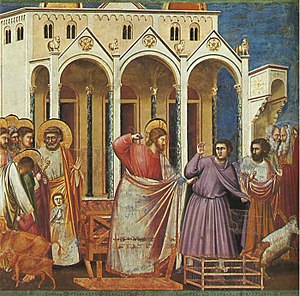
Church pathetic not prophetic


Casting out the money changers by Giotto, 14th century (Wikipedia)

In yesterday’s Guardian Zoe Williams derides St Pauls cathedral, for closing its doors in the face of London's anti-capitalism protest. A Church of England vicar told her why he supports the protesters:-

" In the gospels, Jesus makes a courageous and subversive stand against the corruption of the powers that be, and against the implicit assumption that the rich will get richer and the poor will get poorer. You feel Jesus's anger in his protest, which actually wasn't that peaceful. "

He's referring to Jesus’s own anti-capitalism protest in the Temple. It’s the only account of Jesus using physical force in any of the gospels, and occurs in all four them.

In this episode Jesus and his disciples travel to Jerusalem for Passover, where he expels the money changers from the Temple, accusing them of making it a den of thieves through their commercial activities. In doing so he stood in the tradition of Old Testament prophets railing against the rich’s treatment of the poor. Zoe Williams suggests it will sadden Christians even more than atheists, which side the cathedral came down on.

Any dominant class rules by persuading a submissive population that existing arrangements are necessary, right and inevitable. Occupy Wall Street and the similar protests in numerous cities worldwide pose the question: oh yeah, who says?

Thursday, September 29, 2011

Getting things by their right names, as the Chinese say

The first step to wisdom, as the Chinese say, is getting things by their right names.  (E O Wilson, Consilience, 1998, p 2)

What do you do about alleged Chinese proverbs? Try to source them and discard them if they prove phoney?


“May you live in interesting times”, the supposed Chinese curse, is often asserted to be phoney, although according to this Wikipedia article the argument isn't all on one side. [But see note.] The fact is, that whether or not it’s ever been a Chinese curse, it’s certainly become an English saying, of which the first use known to the Wikipedia contributor was by Robert F. Kennedy in 1966. Actually the more I think about it, the less plausible it is that living in interesting times is an idiom that can be freely exchanged between Chinese and English.

Which brings us back to The first step to wisdom is getting things by their right names. Well, I like it. So let’s just say that the first step to wisdom, as E O Wilson says the Chinese say, is getting things by their right names, and leave it at that. Let's not concern ourselves with whether it really is ancient Chinese wisdom.


E O Wilson in 2007, age 78
Of course we need to be alive to the possibility that E O Wilson is simply fooling with us. He could have opted for “the start of any philosophical discussion must be correct terminology”, which would have been true but unmemorable. He could have said “The first step to wisdom is getting things by their right names”, which has a zing but might have sounded pretentious. Throwing in “as the Chinese say” may be nothing more than a device for disclaiming wisdom for himself and displacing it to long ago and far away.

I'm told by the way (see this review for example) that were I to read to the end of E O Wilson's book, I may not like it. Be that as it may, to find a pearl on page 2 isn't bad going.

Note added January 2017. The Wikipedia article has recently been amended, and if you follow the link you will find that actually the argument really is all on one side, that is to say, despite being known as "the Chinese curse", the saying is apocryphal, and no actual Chinese source has ever been produced. Moreover it appeared in English in 1936 not 1966.

Tuesday, September 27, 2011

Djado, ruined Saharan slave city


The ruined city of Djado, with nomadic women gathered in the foreground. October 1989. (Wikipedia)
Seem to have dwelt on old ruins quite a bit lately. Here's something I'd never heard of. Djado is a ruined city sticking up from the Djado Plateau in the Sahara, in north eastern Niger. It is known for its cave art (often of large mammals long since absent from the area), but is now largely uninhabited, with abandoned towns and forts visible.

Today Niger is one of the most undeveloped and poorest countries in the world, recently coming to international prominence due to the story that Gaddafi had escaped there. The city of Djado is thought to have developed as a station on a slave-trading route between Niger and Libya, long before Europeans arrived. (I'm not sure when that was, 16th century?)

Surrounded by malarial swamps, the dwellings are now the abode of scorpions and snakes.

The building material is adobe, which is made from sand, clay, water, blended with some kind of fibrous or organic material (sticks, straw, and/or manure).

Google map

Source: The Guardian 8.9.11 and Wikipedia. Can't find anything in online Britannica.

Friday, September 23, 2011

Massive Roman shipyard found


Like the look of this one. Archaeologists think they have found an ancient shipyard about 20 miles (32km) from Rome, at Portus. Ships for the Roman empire were built or repaired and maintained there, they think. This is definitely a story to keep an eye on, as I presume excavations are ongoing, and more finds will come to light.


It's in a press release dated yesterday. So far archaeologists have excavated the remains of a building five storeys high. It’s said to date from about 117 AD, The illustration is a computer graphic reconstruction imagining this as a shipyard building, with ships under construction. They think it was used for ships that traversed the Mediterranean. A tiny figure of a workman gives the scale. (Image credit: University of Southampton.)

The archaeologists believe it had some form of imperial connection and might have been used for a base for galleys that transported emperors, such as Hadrian, across the empire. But so far as I can tell there's no direct evidence ships were actually built there. Professor Simon Keay of the University of Southampton is quoted as saying "We need to stress there is no evidence yet of ramps which may have been needed to launch newly constructed ships."

Portus was a crucial trade gateway linking Rome to the Mediterranean throughout the Roman period.

Tacks have been found which would have been used to nail lead on to the hulls of ships inside one of the bays. They hope to dig down and find more evidence of the shipbuilding use of the site.

Afterlife - and a note of caution

Whist the hypothetical reconstruction is fascinating, what I find even more fascinating about ancient structures is their after-life. The Southampton University press release says the building underwent many changes since its construction in the time of the Emperor Trajan, AD 98-117. Excavation within one of the bays has revealed that its use changed, once 90 years into its life with the construction of a series of inner partition walls, and then again in the late 5th century AD when changes were made to allow the storage of grain. In the early to mid-6th century AD, parts of the building were systematically demolished, probably as a defensive measure during wars between the Byzantines and Ostrogoths, AD 535-553.

A note of caution though – whilst we may like to read history forwards, archaeologists have to read it backwards. First they found the grain store, then they surmised an earlier use as a shipyard. Prof Keay says, and note his words carefully:

“At first we thought this large rectangular building was used as a warehouse, but our latest excavation has uncovered evidence that there may have been another, earlier use, connected to the building and maintenance of ships. Few Roman Imperial shipyards have been discovered and, if our identification is correct, this would be the largest of its kind in Italy or the Mediterranean.”

A good reason to do reconstructions on a computer rather than on the ground. See my post on the Bamiyan Buddhas and whether they should they be left as rubble.

(Incidentally, does this imply even larger Roman shipyards have been found elsewhere I wonder?)

Tuesday, September 20, 2011

Eating from supermarket waste bins – disgusting!


What a freegan eats. Image credit: Tristram Stuart
I was musing on food waste. Well actually I was musing on Al Capone, and that led me to food waste. And now to Tristram Stuart, who's a fregan, he takes food out of waste bins. The giant bins that lurk in the loading bays behind supermarkets. Some people find this disgusting. But, he says, the really disgusting thing is that good food is put there in the first place. He's written a book Waste, and in July 2009 he talked to Andrew Marr about it on BBC Radio 4's Start the Week.

If you're in the UK, it's here on BBC iPlayer. You’ll find Tristram 21 minutes into the programme. If that doesn’t work for you, here’s a clip I've made. The whole clip is 20 minutes, of which the first half is Tristram, and the rest is David Haslam on his book Fat, Gluttony and Sloth.

Or you can see Tristram on this Youtube clip, interviewed by David Frost on Al-Jazeera's Frost over the World, 2 Oct 2009 (9.30 minutes into the programme).


A couple more links may be of interest. Jonathan Bloom is an American who writes about food waste. This is his blog. He is the author of American Wasteland - how America throws away nearly half of its food, and what we can do about it.

He welcomes the new UK regulations, see next post on Al Capone (though my understanding is that they are not regulations, just unenforceable guidance.)

Finally here's
Wikipedia on food waste


Sunday, September 18, 2011

Did Al Capone invent sell-by dates and was that a good or bad thing?


A flurry in social media about Al Capone pioneering sell-by dates. On milk. It seems Billy Connolly revealed this fact a few days ago on his new Route 66 programme on ITV.

There's a move in the UK to dispense with sell-by dates, and I imagine this is what prompted Billy Connolly to look into the subject. Studies have shown that sell-buy and eat-by dates contribute to the horrendous waste of food in the West. 

I used to suspect them to be the invention of corporate lawyers rather than nutritionists. However it seems it was neither, but actually Al Capone in good guy mode.

Here's a story discussing food expiration dates and crediting Capone with introducing them. It’s the website of something called Times News Inc. I can't vouch for it. It says that whilst the Federal government viewed Capone as a gangster, to many people in his adopted city of Chicago, he was a modern-day Robin Hood. He was the first person to open a soup kitchen to feed the poor during the Depression, the article claims. At a time of 25% unemployment, Capone's kitchens served three meals a day to ensure that everyone who had lost a job could get a meal. And he even served the food out himself.

The Time Magazine cover depicting Alphonse “Scarface” Capone was March 24, 1930, and the story was his release from prison under a special Governor’s order.

As to eat-by dates, treat these as a rough guide only. Nature supplied us with noses, we should use them. For more see this story in the London Independent, 16th September. It says supermarkets oppose a new date labelling regime and claim it will increase and not reduce food wastage.