Thursday, December 2, 2010

Mr Browning, what rhymes with Timbuktu?


It is related that the 19th century poet Robert Browning boasted he could make a poem to rhyme with any word. A man at his London club challenged him: What about Timbuktu?

    Once a Cassowary
        in Timbuktu
    Ate a missionary
        and his hymn book too.

 
Missionary needs to be said as “mission airy”. A Cassowary, since you ask, is an ostrich-like bird native to New Guinea; hence unlikely to be found in Timbuktu.  The word rhyme has an interesting history.  Until the 17th century it was written rime, derived from Old French.  My English teacher, Mr Dumbreck, told us that it was changed to rhyme due to false etymology, associating it with rhythm (of Greek origin).  However the OED says that ultimately the English word rime and the Greek word rhythm do have the same source, so perhaps Mr Dumbreck was a little too severe.

Monday, November 29, 2010

Climate change scientists warn 4C global temperature rise will create hellish world

Turkana nomadic pastoralists herd goats and sheep to an
almost dry dam in northwestern Kenya, December 2009.
Photograph: Stephen Morrison/EPA (The Guardian)
A hellish vision of a world warmed by 4C within a lifetime has been set out by an international team of scientists. The agonisingly slow progress of the global climate change talks that restart in Mexico today makes the so-called safe limit of 2C impossible to keep. A 4C rise in the planet's temperature would see severe droughts across the world and millions of migrants seeking refuge as their food supplies collapse.

Story in Guardian.  Comments also worth reading.

Royal Society publication :  'Four degrees and beyond: the potential for a global temperature increase of four degrees and its implications'

Sunday, November 28, 2010

Stir up we beseech thee, the wills of thy faithful people


Last Sunday, 21st November, was Stir-up Sunday, an informal term in the Anglican church for the last Sunday before Advent. The term comes from the opening words of the collect for the day. This is to be found in the Book of Common Prayer, first published in 1549 and after many revisions re-issued in 1662.


Stir up, we beseech thee, O Lord, the wills of thy faithful people; that they, plenteously bringing forth the fruit of good works, may of thee be plenteously rewarded; through Jesus Christ our Lord. Amen.

Through an association of ideas (I'm quoting from Wikipedia here) the day subsequently became connected, especially in England, with the preparation of Christmas puddings.

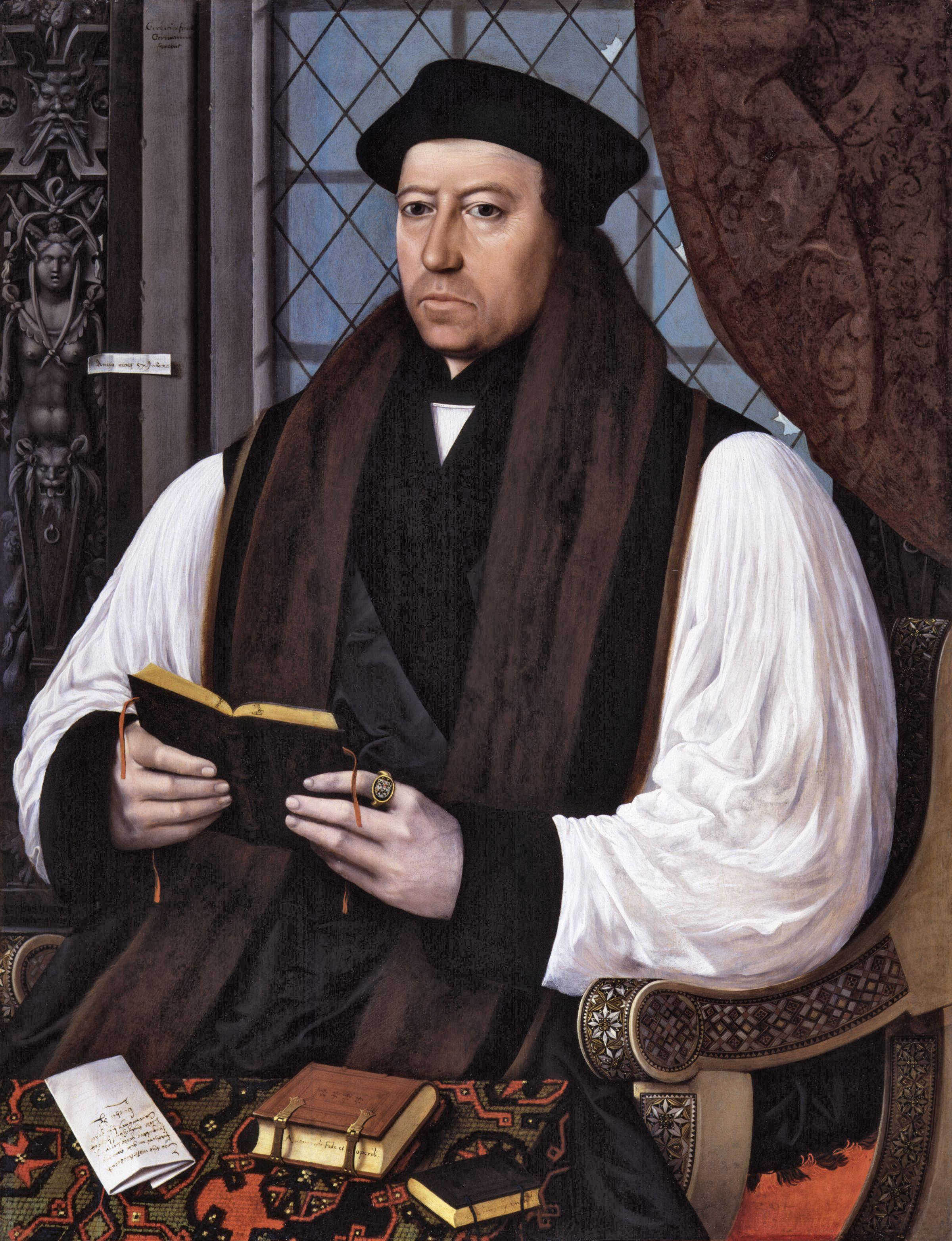
Archbishop Cranmer
National Portrait Gallery, London
English literature is a mountain range of many peaks. The Book of Common Prayer sits atop one of them. Most of the collects (maybe all?) were closely based on translations from the Latin of the Roman Missal. So far as I know the translating was all done by Archishop Thomas Cranmer. If so then Cranmer must be numbered with Shakespeare, Chaucer and William Tyndale (more of him another time) amongst the fathers of the English language.

(Actually I see from an exhibition at the British Library, Feb 2011 that he only headed up a committee.)


Cranmer was tried for treason and heresy after the Catholic Queen Mary Tudor came to the throne. Imprisoned for over two years and under pressure from the Church authorities, he made several recantations and apparently reconciled himself with the Roman Catholic faith. However, on the day of his execution, 21 March 1556, he dramatically withdrew his recantations, thrusting his right hand (the hand that has signed the recantations) first into the fire, to die a heretic (to Catholics) and to Protestants, a martyr.


Here's a another collect, or it is just prayer, I don't know the difference:

Lighten our darkness, we beseech thee, O Lord; and by thy great mercy defend us from all perils and dangers of this night; for the love of Thy only Son, our Saviour, Jesus Christ. Amen.

When I was at prep school between the ages of 7 and 13, we used to go chapel every morning and every evening for a 15-minute service, and on Sundays for a one-hour service in the morning and about half an hour in the evening. I suppose these were matins and evensong, though I don't recall those terms actually being used. At Sunday evensong we used to sing the Magnificat and Nunc Dimittis. Every day there would be a collect from the Book of Common Prayer, and the consequence is that there are numerous collects which are so familiar to me that they summon up my childhood like a sharp jolt. Here is another collect. I know now, but didn't then, that it's the Collect for Ash Wednesday and is repeated every day throughout Lent. Since Lent lasts 40 days, this repetition could account for it being ingrained so deeply in my memory.

Almighty and everlasting God, who hatest nothing that thou hast made and dost forgive the sins of all them that are penitent, create and make in us new and contrite hearts, that we, worthily lamenting our sins and acknowledging our wretchedness, may obtain of thee, the God of all mercy, perfect remission and forgiveness; through Jesus Christ. Amen

A few weeks ago I announced a competition for the three most sublime passages in the English language, and shortlisted a tale told by an idiot from Macbeth. I now add the following Collect for Grace. This morning I almost choked with tears when I read it. But not now, how strange. Does it objectively deserve such a high accolade? Or is it all mixed up with some childhood memories that I'm not fully aware of?

O Lord our heavenly Father,
almighty and everlasting God,
who hast safely brought us to the beginning of this day;
defend us in the same with thy mighty power;
and grant that this day we fall into no sin,
neither run into any kind of danger,
but that all our doings may be ordered by thy governance,
to do always that is righteous in thy sight;
through Jesus Christ our Lord.

Saturday, November 27, 2010

Solar furnace melts rock - video


In this clip from BBC One’s “Bang Goes the Theory,” a high-performance solar furnace focuses normal sunshine into a heat-ray that reaches 3,500 deg C, hot enough to melt rocks. Watch it here : Video

Did stories make us human?


It’s been suggested that telling stories is what made us human. We devote a huge proportion of our lives to enjoying fictions.  Novels, film, television and before that travelling story-tellers.  Perhaps this has been so since the dawn of our species. Maybe what made our remote ancestors special was the ability to explore scenarios verbally, so that trial and error took place, so far as possible, around the campfire, not out on the perilous savannah.


I heard this on a podcast, which I hope I have saved somewhere, though for the life of me I can't lay my hands on it. I think it was the CBC (Canadian) programme Ideas, but I may be wrong. I badly need to listen to it again. The foregoing paragraph will be the opening to the preface of my putative book of childrens stories. I've just found out that there is a website called blurb.com where you can publish your own book. Hugely excited about this. Even if I can't sell my book, I'll be able to print it for Martha and Charlie and give a few copies away as presents. But I'll need to look lively, or Martha and Charlie will be too old!

Tuesday, November 23, 2010

ICTU demo 27th November


Here's a demonstration I'll be sad to miss, I'll be at the races in Newcastle, England.  See Irish Congress of Trade Unions website.
 

One-way trip to Mars – can we, perhaps – should we, perhaps not


A rock-strewn plain on Mars

Should we allow a one-way crewed mission to Mars? Two scientists, invoking the spirit of Star Trek, contend in a scholarly article entitled To Boldly Go, that human travel to Mars could happen much more quickly and cheaply if the missions are made one-way.  The scientists are Paul Davies of Arizona State University (the main man in my book) and Dirk Schulze-Makuch of Washington State University (previously unknown to me).  Their article has appeared in the Journal of Cosmology (October-November edition).

"The astronauts would go to Mars with the intention of staying for the rest of their lives, as trailblazers of a permanent human Mars colony,"  the article says.  They argue that it would be little different from early settlers to North America, who left Europe with little expectation of return.  "The main point is to get Mars exploration moving," Schulze-Makuch told the Irish Examiner (which is where I first saw the story). 

In addition to offering humanity a "lifeboat" in the event of a mega-catastrophe, a Mars colony is attractive for scientific reasons, the article says. (I don’t like this lifeboat business, see my earlier post against preserving the human species.)

They cite these scientific benefits : That a base on Mars could be a unique opportunity to study an alien life form and a second evolutionary record.  An intensive study of ancient and modern Mars will cast important light on the origin of life on Earth. Mars conceals a wealth of geological and astronomical data that is almost impossible to access from Earth using robotic probes. The base would open the way to comparative planetology on a scale unimagined by any former generation. It would offer a springboard for human/robotic exploration of the outer solar system and the asteroid belt.

Paul Davies - main man
Finally, establishing a permanent multicultural and multinational human presence on another world would have major beneficial political and social implications for Earth, and serve as a strong unifying and uplifting theme for all humanity.  (I like the motivation, even if it’s a bit unrealistic.)

The authors note that Mars is a six-month flight away, possesses surface gravity, an atmosphere (huh? not much of one), abundant water, carbon dioxide and essential minerals. They propose the missions start by sending two 2-person teams, in separate ships. More colonists and regular supply ships would follow.  The technology already exists, or is within easy reach, they write.

The one-way mission idea has been mooted before but I'm pretty sure this is the first time it has been seriously proposed by academics.  It doesn’t find favour in official circles, with NASA or ESA. At least not yet. The Irish Examiner contacted retired Apollo 14 lunar astronaut Ed Mitchell, who was critical of the one-way idea.  "This is premature," Mitchell wrote in an e-mail. "We aren’t ready for this yet."

Davies and Schulze-Makuch deny they’re proposing a "suicide mission".  They recognise the idea is a tough sell for NASA, with its intense focus on safety.  They think the private sector might be a better place to try their plan.  "What we would need is an eccentric billionaire," Schulze-Makuch told the Examiner. "There are people who have the money to put this into reality."

Defining suicide


I've heard it said, and I'm sure it's true, that there would be plenty of volunteers for a one-way mission.  Even so, is it right? 

Would those who sent these colonists be colluding in their suicide? What's the definition of suicide?  If the probability of dying is 1 that’s suicide for sure, but say the probability is 0.9, what then?   And how soon does the death have to occur?  Say that (provided they survived the landing) there's a high probability the colonists will survive 6 months but only a small probability they will survive a year.  Would that be suicide?  And if the colonists know the risks but willingly accept them in a spirit of adventure?

Another scientific ethical dilemma for the lecture I'm working on, “Just because we can does that mean we should”. I hope to give it to Cork Astronomy Club one day. 

Update on this story August 2012.