Friday, February 24, 2012

Sombre or Somber?


I hesitated before writing somber. My first thought was sombre and it turns out my first thought was right.  The grammarist blog tells me that somber and sombre are both used,  somber being preferred in American English, whilst sombre is preferred in all other major varieties of English.   It gives three examples of each.

From The Guardian:

      Derek Cianfrance’s film is a sombre, painful portrait of a toxic marriage ...

And from The Washington Post:

      Those events complete a somber week at the White House ...

Delighted to have found this blog which I'm sure I shall be visiting again some time. Actually, the blog says while sombre, not whilst sombre. Whilst is better here.

Thursday, February 23, 2012

Happy and somber days in London


In London last week. Spent a couple of happy days in the British Library. Also saw Three Days in May. At the Library, besides trawling through old copies of New Scientist and visiting the manuscripts exhibition (see below and below) I looked up: Einstein quotations, mid-20th century references to the canals of Mars, and John Dover Wilson’s 1936 edition of Hamlet.

Might have something to say about all of these in due course, as well as explaining why I visited this memorial, beside Tower Hill tube station, to merchant seamen who perished in the First World War:- 

At Tower Hill Memorial, 16 Feb 2012

Tuesday, February 21, 2012

Of microwaves and a physicist-chef


“It is a sad reflection on our civilisation that we can, and do, measure the temperature of the atmosphere of Venus, yet we don’t know what goes on inside soufflés.”

The words in 1969 of physicist Professor Nicholas Kunti.  I stumbled across them last week in the New Scientist edition of 3rd April of that year while looking up the canals of Mars in the British Library.

It seems the good professor enjoyed amongst his friends and closer acquaintances an enviable reputation as a bon viveur and cook.  In furtherance of which, he proposed that physicists get together with the great chefs to invent a new cuisine for the microwave oven.

His own inventions included an inverted Baked Alaska : instead of ice cream surrounded by fruit, with meringue outside (the traditional arrangement), the prof had fruit inside, surrounded by meringue, with ice cream outside. 5 seconds in the microwave cooks the fruit from the inside mingling juices with the meringue, and leaving the ice cream on the outside cold.

He used a hypothermic syringe to inject pineapple juice into roasting pork.

And he devised a system for measuring and reading off the temperature inside a soufflé, fulfilling his ambition of placing this branch of haute cuisine on a par with the exploration of Venus.
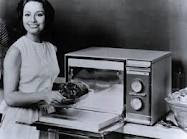
A happy housewife shows off the
Amana Radar Range microwave oven in 1967
The surprise to me was that they had microwave ovens so far back. An innovation I thought belonged to the 1980’s.  But I find they were an accidental by-product of Second World War radar research.

Dr. Percy LeBaron Spencer
Radar used magnetrons, these being vacuum tubes that produce microwave radiation (a type of electromagnetic radiation that has a wavelength between 1 mm and 30 cm).  In 1946, the American engineer Dr. Percy LeBaron Spencer was working on magnetrons, and happened to have a candy bar in his pocket. He found it had melted, and linked this effect to the microwaves he was working with.

Experiments led him to the discovery that microwaves will cook foods faster than conventional ovens that cook with heat.

The Raytheon Corporation, his employer, produced the first commercial microwave oven in 1954. It was called the 1161 Radar Range. It was large, expensive, and had a power of 1600 watts.  I have all this from the website of the Southwest Museum of Engineering, Communication and Computation in Arizona, which has photos of the early monstrosities, and informs us that microwave ovens began to be used in home kitchens in 1967 when the first domestic model was produced by Amana (a division of Raytheon). This information is accompanied by the happy housewife illustration above.

I ought to add that the caption is mine not theirs.

Saturday, February 18, 2012

I finger parchment in the British Library


Henry IV's Great Bible, 1410
To the Royal Manuscripts exhibition at the British Library. Runs till 13th March. Parchment and vellum on display, with the notice beloved of modern curators “please touch!”  Parchment is sheepskin, vellum calfskin.  You wouldn’t know it, felt like top quality, thick shiny-surface paper.  Well actually you would know it, since it hadn't been cut up, it still had the shape of an animal skin.

The British museum didn’t used to scruple, and maybe still doesn’t for all I know, to disfigure priceless medieval manuscripts with their stamp: MVSEVM BRITANNICVM about an inch square in red ink.

Some truly massive tomes, none more so than the Great Bible of King Henry IV, from about 1410.  630 mm (25 inches) tall, probably used for readings in the royal chapel.  That's it to the left, but for a real feel of it, take a look at this popup image.

Several manuscripts looked as fresh as if they had been made yesterday and boasted large expanses of a startlingly bright blue pigment, of which they were clearly proud. Made from lapis lazuli, a blue stone imported from Afghanistan. This popup is a good example.

Saw the first known instance of a reference book arranged alphabetically. A manuscript encyclopaedia of world knowledge in medieval Latin, dating from about 1370. Omne bonum, about all good things. Open at a page delineating ancilla (servant) and Anglia (England).  By an Exchequer clerk named James le Palmer. Apparently compiled and written for his own personal use, covered topics such as theology, canon law, natural sciences, the history of man, and the liberal arts. A medieval layman's quest for knowledge. A man after my heart you could say.

Monday, February 13, 2012

Beware of Greeks bearing gifts


I'm writing the story of the Trojan Horse, as part of my collection of children’s stories. Which I hope one day will make me rich. If that occurs I'll let you know.

Meanwhile, what of the proverb “Beware of Greeks bearing gifts”? 

The Trojans drag the wooden horse into their
city - as imagined by Wolfgang Petersen in
his 2004 film epic
Troy. Soon Greek soldiers
climb out and open the gates, and the city falls

The scene you are meant to picture is the beach under the walls of Troy. The Trojans are inspecting an enormous wooden horse and debating what it is, what to do with it, and why after 10 long years the besieging Greek army has suddenly disappeared. Some say the horse is a peace offering, some a gift from the gods, and some a trick.

The priest Laocoön declares “Beware of Greeks bearing gifts”. Although of course he doesn’t, he speaks Latin. For it’s the Latin epic poem The Aeneid which is the source for this story.

Laocoön’s actual words are : Equo no credite Teucri!  Quidiquid id est, timeo Danaos et dona ferentes.

The first part of which means “Place no faith in that horse Trojans! Whatever it is …”. As for the phrase timeo Danaos et dona ferentes, Latin can pack lot of meaning into a few words. Translated literally, this phrase could be “I fear the Greeks even (or perhaps especially) when they come with gifts” or “I fear the Greeks and those who bring gifts”.

The 18th century poet John Dryden, has "Trust not their presents, nor admit the horse." Here's Laocoön’s speech in full, as rendered by Dryden in his 1697 translation.

The saying “Beware of Greeks bearing gifts” has become so embedded in the English language that it’s now hard to think of the Latin translated any other way. What I haven't yet found out is, who first came up with this translation?  The Oxford Dictionary of Quotations, 2004, lists it under Proverbs as “Fear the Greeks bearing gifts”. First found in print late 19th century, but no author given.

What of other modern languages? The only ones I've checked are German and Swedish. Neither has an expression equivalent to “Beware of Greeks bearing gifts”, though both use the expression “Trojan Horse” the same way that English does, to indicate a treacherous, invasive, gift.

Saturday, February 11, 2012

A field full of shallow holes


The immature student seeking the water of knowledge, said the Buddha, will dig a three-foot well here, a three-foot well there, until he has a field full of shallow holes, but no water.

I heard this on the radio, and I thought: Oh dear. Sounds like me. Perhaps I should devote myself to digging just one deep well.

Except that although this feels like a saying of the Buddha, I have it on good, I'm tempted to say unassailable, authority, that it isn't. He should have said it, and for all anyone knows he did, but no such statement has ever been attributed to him.  A pity really.

It seems more likely there's an ancient proverb from India about the desert: if you want to strike water, don’t dig ten wells six feet deep, dig one well sixty feet deep.

Friday, February 3, 2012

Giles Fraser for Pope!


Giles Fraser is my kind of Christian. He quotes the Magnificat, extolling a God who puts down the mighty from their seats. Any politician advocating such measures today, he comments, would be accused of class war.

    He hath shewed strength with his arm : 
       he hath scattered the proud in the imagination of their hearts.
    He hath put down the mighty from their seat : 
       and hath exalted the humble and meek.
    He hath filled the hungry with good things : 
       and the rich he hath sent empty away.

I've lost track of whether the Occupy London protesters have been evicted from the vicinity of St Pauls. The last I saw was on Monday. The Guardian reported they had been evicted from a disused office block, and implied the St Pauls encampment is next.

Giles Fraser and the St Pauls encampment
Which brings us to Giles Fraser. Formerly canon chancellor of St Paul's, he resigned on 27th October over a decision by the cathedral chapter to seek an injunction against the protesters.

He sees it as particularly appropriate that the anti-capitalist camp should be outside St Paul's, where it sits on a "fault line between God and Mammon".  He claims "economic justice is the number one moral issue in the Bible," and believes the Occupy protest was a tremendous opportunity for the cathedral.

Or, to express the matter the other way round, as one Guardian commentator did, but sadly I've lost the piece now: the protesters handed the Church of England a heaven sent opportunity to prove itself irrelevant.

Giles Fraser isn't out of a job, he's now working for The Guardian. You can see his stuff here.

On Christmas Day he was on BBC Radio 4's Start the Week discussing Constantine, the man who invented Christmas. A war-mongering Roman Emperor, Constantine reinvented Christianity for his own military ends. Whilst delighted to dwell on the baby in a manger, and the crucifixion, he wasn’t so keen on all the anti-establishment preaching that came in between. Which is why the Nicene Creed, written under Constantine’s supervision, doesn’t mention it.

Worth listening to. As indeed Start the Week usually is.