Showing posts with label Sweden. Show all posts

Friday, October 14, 2016

The awkwardness of "Awkward"

I've come across another word that describes itself. 


Stare at awkward long enough and I think you'll agree with me. What an awkward word,  with that wkw in the middle. It turns out to be a combination of the Middle English adjective “awk” and the directional suffix “-ward.”

It seems  “awkward” was coined in the 1300's in Scotland and northern England, where it meant “turned in the wrong direction”.  The word "awk" meant the wrong way round, backhanded. Other possible meanings are sinister, ominous, perverse.

Here’s an example of the sinister/ominous meaning of "auke" from Philemon Holland’s 1600 translation of Livy’s history of Rome and the Roman people. In this passage Livy refers to those who disparage the Roman practice of augury:

Now let them mocke on and scoffe at our religions. Let them deride our ceremonies. What makes matter (say they) if those pullets pecke or eat not? What if they come somewhat late out of their coupe or cage? What if a bird sing auke or crowe crosse and contrarie? How then?


And here's a late example from 1674, where perhaps perverse is meant. It's in a scientific treatise from the 17th century clergyman Nathaniel Fairfax: 


What we have hitherto spoken, will seem to have less of auk in it, 

That is, what we have hitherto spoken, will seem less perverse.   Fairfax was keen to use native English words only, and I suspect that by 1674, having “less of auk in it” already sounded old-fashioned, or dare I say, awkward.  (I have more on Nathaniel Fairfax and the context of this quotation in an appendix.  It interests me because of a connection to the history of science. He seems to have been exploring some of the thoughts that gave rise to calculus at about the same time.)

For an early instance of "awkward", there's the Middle English poem Pricke of Conscience (1340): the world thai all awkeward sette (they turned the world all awry).


A bit of etymology


“Awk” is Scandinavian in origin.  Its equivalent in modern Swedish is “avig”. Suppose you were to put a shirt on back-to-front, this in Swedish would be “att ha skjortan avig”, literally to have the shirt the wrong way.  There's a German word "Abweg" meaning the wrong way, which looks as if it ought to be related, but so far as I can tell it isn't. 


I can't account for why,  but it tickles me that the “ward” in awkward has something to do with direction, as in northward, onward, backward, inward, and so on. We can perhaps think of awkward as equivalent to the non-existent word wrongward.

My Shorter Oxford Dictionary tell me that the suffix ”-ward” gives the meaning of having a specified direction, and is connected with the Latin verb vertere (to turn). I find that an especially fruitful piece of etymology as it helps us to think of “–ward” as having the meaning turned in the direction of.  So: turned in the direction of in, turned in the direction of out, turned in the direction of north, etc.  Then there's "toward", and the interesting case of "untoward". In Middle English there was a word “fromward”; which in Old English apparently meant "about to depart; doomed to die; with back turned."

“-ward” can in principle be added to any location, to suggest progressing or pointing towards that place.  As in she raised her eyes heavenward.  Or this sentence from H. G. Wells, The War of the Worlds (1898): In the road that runs from the top of Putney Hill to Wimbledon was a number of poor vestiges of the panic torrent that must have poured Londonward on the Sunday night after the fighting began. And in a recently published legal history of New York we find: It was not until the colony became a state that the pendulum of emigration and settlement swung New Yorkward.[1]

I thank the excellent Grammarphobia blog [2] for calling my attention to the awkwardness of “awkward”. It puts me in mind of the opposite case, the mellifluousness of “mellifluous”.  A curiosity I had something to say on back in May.

“Awkward” and “mellifluous”  are autological words, words that describe themselves – or so it seems to me.  


[1] Courts and Lawyers of New York: A History, 1609-1925, Volume 1 (2010) by Alden Chester

[2] The blog is the source of many of the foregoing quotations and I've even plagiarized the title of this post from it. You'll find more information in an email from the blog editors reproduced in the appendix.

Thursday, March 10, 2016

Changing day length in Luleå

Spring soon.  Evenings stretching out apace, wasn’t really dark tonight till seven. Though here in County Cork we're in the wrong time zone. This means that sun-wise, it would be truer to say it got dark about a quarter past six. 

I now want to say something about the stretching of the days in Luleå during my recent stay there. In Cork the shortest day is 7 hours 46 minutes, and the longest 16 hours 43 minutes: hence between midwinter and midsummer the sun has almost 9 hours to chase. In Luleå, the difference is nearly 20 hours; consequently the stretching of the days is more rapid, and I was hoping to be able to observe this effect over the course of the seven days I was there. But I was disappointed, and if you bear with me I shall explore the reasons for this.

My visit was from 18th to 25th February, during which time the days lengthened by 49 minutes. I know this from tables available at timeanddate.com.

Over those seven days, sunrise moved 26 minutes earlier, and sunset 24 minutes later. That adds up to a 49 minute increase (due to rounding). This is almost double the difference in Cork, where during the same week sunrise got 14 minutes earlier and sunset 12 minutes later. You can see all this in the table next to the map.


Location map for Luleå, and sunrise/sunset table for Luleå and Cork. Minutes are rounded.

To put it another way, when I arrived in Luleå, the day was 1 hour 20 minutes shorter than in Cork, and when I left, it was 1 hour 6 minutes shorter.  Today it was a mere 24 minutes shorter. Come the 21st March (just to remind you) the days in Cork and Luleå will be the same length, namely 12 hours, indeed the same all over the globe. [1]

I said I was disappointed. I actually noticed no change while in Luleå, no stretching of the mornings or evenings. This was partly because for several days skies were overcast.  But only partly. On reflection I realise that two factors work against each other.  The further from the equator, the shallower the sun’s trajectory in the sky. This makes sunrise and sunset more gradual, extending the period of twilight; and it means that during the northern spring, even though the daily increment in sunlight becomes greater as you travel north, the stretching of the days becomes harder to mark.

I cast my mind back to Trinidad where I spent a year in 1968. In the tropics the sun never rises and sets far from 6 o’clock.  A typical sunset conversation would go: “You noticed the sun’s setting much later now?” ... “Yes, tonight it was 7 minutes past. A few weeks ago it was 4 minutes past.”

Here is a table comparing Luleå, Cork and Trinidad for the week in question. It shows that where the daily increment in daylight is greater, twilight is also longer.  [2]


The paradoxical consequence is that in Trinidad, even a tiny difference in day length can be more noticeable over a short period of time than a very significant increase over the same period in Luleå.
 

I have a set of three diagrammes which may help to illustrate this. They apply to the winter solstice, 21st December, and show sunrise, sunset and the sun’s altitude at midday, comparing the cases of Luleå (midday sun altitude 1°), Cork (15°) and Trinidad (56°).

Daylength table
anomaly

I'll now mention an anomaly I can't get to grips with.  This arises from studying the daylength tables in preparation for writing this blog post.

In the spring, as the sun sets further and further north each day, the daily increment in day length ought to peak around the equinox (21st March), and after that gradually lessen. From equinox to midsummer, though the days continue to get longer, the increment from one day to the next becomes less and less marked. When midsummer arrives, the day to day increase is zero; the sun no longer sets further north but stands still and then starts to set further south; so that after 21st June (the solstice) the day length begins to decrease again.

Why is it called the solstice? A digression


Solstice is a bad word. It means sun stands still in Latin - but who knows or cares for Latin? In Swedish it's
solstånd (sun-stand) and in German Sonnenwende (sun-turn). Much better.


Thus in Cork, the daily increment in day length peaks in mid March at 4 minutes 1 second, and begins to decline after the 27th.  During April the daily increment slows, so that at the end of that month the daily increment is down at 3 minutes 35 seconds.  The decline in the daily increment continues during May, down to under 2 minutes. By 12th June it's down to 54 seconds.  All that is good and just as it ought to be.

But the day length table for Luleå tells a strange tale.

Throughout February the daily difference is just over 7 minutes - oddly 4 seconds longer at the beginning of February that at the end.  For most of March - when you would expect the daily day length increment to be at its maximum – it dips just under 7 minutes. Then, throughout April, when the daily increment ought to be slowing,  it again tops 7 minutes.  The daily difference is 7 minutes 22 seconds on 30th April and continues to rise, peaking, extraordinarily, in the second half of May, at 7 minutes 40 seconds.  And it doesn't dip under 7 minutes till 9th June. Weird!  I must find out why this is, something to do with the Earth wobbling on its axis or being a funny shape I suppose.

Notes:

[1]  In most of the tables I've looked at, it's actually 18th March when the day length hits 12 hours.  The leap day on 29th February distorts the picture of course, but even adjusting for that, you get the 19th March. I don't know why this is.  And what about the two Poles I ask myself?  I haven't found any table for them.  My understanding is that they have only one day and one night, sunrise at the North Pole on 21st March and sunset on 21st September. South Pole vice versa. So is “12 hours all over the globe” correct or not?

[2]  About twilight. I've used civil twilight: the limit of which is defined by the sun's centre being 6° below the horizon. Solar illumination is insufficient, even under clear weather conditions, for terrestrial objects to be clearly distinguished, and artificial light is needed to carry on most outdoor activities. There are actually three definitions of twilight, the other two being nautical twilight and astronomical twilight, but civil twilight is most relevant for my purposes today.

Friday, March 4, 2016

A winter diary from Luleå

I pose in the town centre beside two ice sculptures. And cars heedless of an icy road.
A few notes I made whilst in Luleå for a week with two of my mother’s sisters, Kerstin and Barbro. Normally I come in summer, this was my first winter visit for many years.

Thursday 18 Feb

Clear sky but not very cold, only -3°. A couple of weeks ago was -20°. Snow heaped by the roadside.  As there's been a recent fall, it's all white. In late winter the roadside snowheaps tend to get very grubby, I remember this from being here in 1967, age 18. The roadway, I was surprised to see, consisted largely of compacted snow. On the way from the airport my cousin made some tight turns at a fair old speed, which on our tyres in Ireland would have been catastrophic, but here their winter tyres can cope with ease. Inspected them later, small studs which looked insignificant to me but they certainly do the job.

Walked into town with Barbro. Today's temperature -4.9°.  My boots are good and comfy, and the ice grips work well.  To the Culture House to use the wifi.    Couldn’t get it to work, thought it was stupidity on my part, but it turns out the system had been changed the previous night. The three staff went into a huddle to figure it out for me. 

Anxious about walking home in the dark in a dark coat, but Barbro says it doesn't matter, you show up against the snow. She remarked that the other day when it had been somewhat colder, she feared a packet of spinach leaves in her rucksack would freeze and be spoilt before she got home.


Luleå's Culture House. And a Semla bun.
A digression about Semla buns

A semla is a wheat flour bun, flavoured with cardamom and filled with almond paste and whipped cream, a bit rich for my taste.  They start eating them the first Sunday in Lent. A heathen tradition if ever I saw one, as Lent (fastan in Swedish) is meant to be a time of fasting and self denial. 

These buns are blamed for a royal demise. King Adolf Frederick of Sweden died of digestion problems on February 12, 1771 after consuming a meal consisting of lobster, caviar, sauerkraut, smoked herring and champagne, topped off by fourteen helpings of semla.

The tradition is rooted in fettisdag (Shrove Tuesday, or Fat Tuesday) when, like pancakes in England, the buns were eaten at a last celebratory feast before the Christian fasting period of Lent. At first, a semla was simply a bun eaten soaked in hot milk (known as hetvägg, ughh!).

At some point Swedes grew tired of the strict observance of Lent, added cream and almond paste and started eating semla every Tuesday between Shrove Tuesday and Easter.  The foregoing is partly what I was told and partly what I looked up, with some unresolved inconsistencies between the two.


Friday 19 Feb

Kerstin told me a sad tale that occurred in the 1930’s. It concerned a family who lived in a distant part of Sweden, he being a train conductor and she a school teacher. For several summers they looked after Kerstin and her brother Gösta, an arrangement which started so far as I can tell when Kerstin was 4 and Gösta 8.

They had several children who had died as babies, but did have one surviving daughter, much older than Gösta & Kerstin, who became pregnant out of wedlock, and on account of social ostracism, she and her boyfriend killed themselves in a wilderness area. Kerstin, age 4 at the time, witnessed the mother’s grief when she was told of this. At the time Kerstin was bemused, it was only later in life that she realised what all this was about. There are several details of this story I didn't follow. One such detail is how they died: poisoning themselves with sulphur from matches and starvation were both mentioned. Barbro knows the story in outline only, can't add anything.

Kerstin indignant about the cruelty of neighbours whose job it is to help not to condemn. An immoral morality she says. But the neighbours are afraid too of course, that's how they get you.  I can't help remarking that it's a pity the same spirit of rebellion that leads to cream buns in Lent wasn't exercised in this case as well. There is of course a larger question of whether the church leads or follows popular morality.

Drinking Earl Grey tea. It's actually rather good as long as you leave the tea bag in a nice long time.


A Systembolag (pic from the internet). And the Luleå-Kiruna railway.
Sat 20 Feb

This afternoon walked to town on my own. My errand was to the Systembolag for wine and brännvin (snaps). -4.9° again and the wind in my face, which Barbro was concerned about when I came back, but was in fact no problem to me. Whilst my boots grip perfectly on the ice, I'm not so at ease in town where the main pavements are completely clear, or in shops, and I actually prefer walking in the roadway where there's snow and ice for the studs to grip on. The tie-on ice grips which I brought with me are called brådar, and Barbro approves them, says they are just the thing.


Cycling past a snow heap in the town centre, note the heated pavement in foreground. And a postman on a moped.
Found out how the pavements in the main shopping street are so clear of snow. They are heated. Is this ecological I wonder? Still surprised that in general the Swedes are content for both roadways and footpaths to remain covered in snow and ice. People cycle and we saw a postman on a moped.

The Systembolag displays a sign saying they will not serve anyone under 20, nor anyone who appears under the influence, nor anyone who is suspected of making purchases for another person who is in either of the foregoing categories. "This is important to us, our prime motive is not profit but restricting alcohol problems."  I should explain that the Systembolag is a state-run chain of off-licenses and is the only place you can buy alcohol stronger than medium-strength beer.  I had to buy a white wine suitable for salmon with a lemon sauce. Barbro told me to ask the staff for advice, which I did, she says they go on courses for this sort of thing, and like to be asked to demonstrate their skill.

This puts me in mind of a story that I think my cousin Tolle told me. In the 1930’s the Systemet had an even more severe protocol. Alcohol was rationed and everyone had a ration book called a motbok. Tolle's father Calle and Albert (my granddad) were brothers-in-law and both engine drivers on the Kiruna-Luleå route. Calle asked Albert to get him some bottles during his break in Luleå, and lent Albert his ration book. There was nothing inherently wrong with this proceeding, the only problem being that Albert noticed Calle’s motbok was invalid as he had forgotten to sign it. Albert was in Luleå and Calle 200 miles away in Kiruna, so there was nothing for it but to forge Calle's signature. Here the problem began, for when he presented the motbok, the cashier went to fetch the manager, and Albert had to go into the office to answer the question "whose signature is this?".  It turns out that Calle had remembered his oversight and had rung ahead to the Luleå Systembolag in order to explain!  Quick thinking was called for. "That damned idiot!" expostulated Albert, "He can't remember from one minute to the next what he's been doing, of course this is his signature!"

Tonight Barbro and I stayed up late writing our dairies. Interruptions from time to time, the latest about religion.  I told her how when I was in Trinidad in 1968 I made it my mission to investigate which of the three religions there, Christianity, Islam, and Hinduism, was true, and at the year's end I concluded none was.

Barbro has given me tomorrow's weather forecast. There will be a blizzard and the wind will be 15 m/sec. Not enough to be called a storm but still strong. Surprisingly, they have no dedicated word for blizzard, they just use snöstorm. But it's interesting that wind speed is sufficiently important to be measured in meters per second, and also that they concern themselves with tenths of a degree. Kerstin's thermometer has measured -4.9° for a couple of days now. I thought it was broken, but apparently it's not unusual for the temperature to remain constant over a 24-hour period, day and night.

Here English is extremely clumpy. Where I have to say "over a 24-hour period, day and night " in Swedish I would simply say "för ett dygn", or if emphasis was needed "för ett helt dygn".

Sunday 21 Feb

Last night there was neither blizzard nor snowstorm but there is about an inch of fresh snow, kramsnö Barbro called it, and demonstrated that you can squeeze it into a snowball. This means you must go carefully, as it sticks to the ice grips under your boots making them ineffective. We saw some boys having a snowball fight. Here it's called a snowball war, snöbollskrig.

A Spanish Ido-comrade called Pilar sent Kerstin a nice grey blouse for her birthday. Kerstin thanked Pilar, writing in Ido of course. Ido is a harmless eccentricity that Albert was keen on, and has infected several members of the Åkerlund family.


Cycles outside Kerstin's flat. And walking on the frozen harbour.
Three cycles left out all winter in a rack outside Kerstin's window have given rise to comments on how some people are so careless of their possessions. Covered in snow almost to the tops of the wheels. Took photos of them on my first and last day to be used as a snowfall meter.

Monday 22 Feb

Tonight Barbro and I discussed the refugee problem. In Barbro's view this consists in the fact that Swedish people ought to be more welcoming. There have been instances of refugee centres being attacked and attempts to burn them down. There is one in Sundsvall near her, a disused school. They are given Swedish ready meals.  What sort of idea do these refugees get of Swedish food, she asked, when they have to make do with ready meals here, whilst having such fantastic food in their homelands. She told how the refugees delivered leaflets in the locality inviting the Swedes to the centre for a meal, and a marvellous meal it was too, the only downside was all the Swedes were sitting together, there wasn't enough mixing.

There's a magazine here with a piece on an initiative called the Invitation Department.  It's about inviting a refugee into your home for dinner. Members of Barbro's family participate in the scheme. Subsequently found a New York Times article on this.

Tuesday 23 Feb

At breakfast Kerstin looked up bible quotations. The question of a serving woman's son came up and this led us to the Epistle to the Galatians amongst other places. English bible, Swedish bible and bible dictionary all on the breakfast table.

Brilliant sun on the snow this morning and I walked into town, leaving Kerstin & Barbro to follow in the special taxi. We are to meet Tolle and have lunch at the Culture House. The restaurant gives a marvellous view over the frozen harbour, a distant prospect of people walking and skiing on it, and a tractor ploughing the path and ejecting snow through a chute. Like a combine harvester ejecting grain. Apparently there's an 8-km walk to an island with a restaurant on it. I don't mean the island is 8 km out to sea, it's just that you have to walk around a headland to get to it. A superb lunch praised by all, with huge thanks expressed to Eileen, and regrets that she wasn't there. 

The Culture House is an excellent institution: library, art gallery, theatre, restaurant, café, tourist information, and spacious open areas, in two of which lunchtime piano recitals were in progress.

Later asked Tolle about längre än mig as opposed to längre än jag, exactly equivalent to "taller than me" or "taller than I". At first he gave a convoluted grammatical justification for the "taller than I" option (just like Kerstin & Barbro). But when I told him I wanted to speak Swedish like a person and not like a schoolmistress, he admitted that many people said längre än mig, and so does he from time to time, and there is nothing wrong with it. Later when I brought the subject up, Kerstin & Barbro admitted that it is in common use, including amongst educated people, which they deplore.

Tolle talked of his UN tour in Cyprus where he had the temporary rank of Second Lieutenant in charge of a platoon. Repeated the story of how in 1940 his father had thrown all the German cigarettes, about four or five packets, in the stove, when Tolle, age about 11, had done errands for German soldiers travelling on Swedish trains. "Never again bring any more German stuff into this house."  On the Norwegian-Swedish border in the vicinity of the railway line linking Kiruna to Narvik, there was a forbidden zone 400 metres wide with Swedish and German soldiers stationed opposite each other, and Tolle went skiing there with some friends. The Swedish soldiers waved and Tolle and his companions waved back. When the soldiers shot in the air, the skiers grasped the situation, and later had a big telling off from the police. Gave me the recipe for gravad lax, though this may not be popular at home. Discussed the two Swedish words for large rivers: flod and älv. The word flod is only used for a large river outside Scandinavia, and the word älv is only used for a large river within Scandinavia. Looked in several dictionaries. One suggested that flod is for tidal rivers. This sounds implausible to me, and in any event Norwegian rivers are tidal, which seems to kibosh it.

Learnt a brilliant saying but it doesn't work in English. The translation would be "Everyone else is busy thinking about themselves, I'm the only one thinking about me." The Swedish has a zing to it that I can't reproduce: Alla tänkar på sig, det är bara jag som tänkar på mig.


By the harbour: a remarkably silly dog, and a snow castle.
Wednesday 24 Feb

My last day in Luleå. Down to the quay in brilliant sunshine. A snow castle with kids playing. A dog owner throwing snowballs for the dog to chase after -  searching for snowballs in the snow, what a silly dog. Many people coming and going on the ice, some skiing, some skating, most walking, so decided to join them. Surprised how many people bare-headed even though between -7° and -5.5°.

Sunday, January 25, 2015

Frederick Douglass and coffee at the embassy


Group photo in the embassy, includes 4½ Swedes - Tom's book - Tom (right) presents book to ambassador
Last Monday to a coffee morning hosted by the Irish ambassador in London. We have Frederick Douglass to thank, a major figure in US 19th century history, though little known on this side of the Atlantic.  Indeed I had never heard of Douglass till Tom told me about him. That’s Tom Chaffin, husband of my Swedish cousin Margareta and a professor of history at the University of Tennessee. The occasion was Tom presenting the ambassador with his book Giant’s Causeway: Frederick Douglass’s Irish Odyssey and the Making of an American Visionary

Frederick Douglass - Daniel O'Connell
When they met in 1845
Douglass was about 27, O'Connell was 70.
So you could say these images are ill-chosen, for which I can only apologise
A memorable day, and what I didn't expect, the ambassador, Dan Mulhall, was himself an historian and a specialist on Daniel O'Connell, so had a real and not mere diplomatic interest in Tom's book, which includes Frederick Douglass's meeting with O'Connell in 1845. O'Connell is himself a colossus of Irish 19th century history. Dublin’s main street and bridge are named in his honour. A little digression here, the original name was Sackville Street changed in 1924 amidst a flurry of patriotic post-independence re-naming, and I always assumed O'Connell Bridge got its name at the same time as the street. But I crossed the bridge last week and was surprised by a plaque saying the Dublin Corporation re-named it in 1882. And to heap digression on digression, according to Wikipedia O'Connell Bridge is unique in Europe as the only traffic bridge wider than it is long: a circumstance evident in the photo below, though it had previously escaped me. Douglass’s bridge is in Washington DC, but I've sought in vain for any idiosyncratic facts about it to entertain you with.

Top, O'Connell Bridge over the Liffey in Dublin: broader than it is long.
Bottom, Frederick Douglass Memorial Bridge over the Anacostia in Washington, D.C: rather dull.
A bit more about Douglass. He escaped bondage in Maryland in 1838 aged about 20, and eventually earnt a living as an abolitionist lecturer, travelling widely across the North, enthralling audiences and raising funds for the campaign. When his prominence brought him into danger from slave catchers he crossed the Atlantic to lecture in the British Isles. Tom’s book is about the four months he spent in Ireland, and Daniel O’Connell’s influence on him. There were complex reasons why Douglass avoided taking sides on the Irish national question, which Tom deals with in this 2011 New York Times article.  Also worth reading, this one about Douglass and Lincoln, and how he influenced the president’s thinking on the emancipation question in the latter half of the Civil War.  An aspect of Irish and American history that I find of abiding interest, is the widespread Irish-American support for slavery, and hostility towards abolitionists. Here's a review of Tom’s book that focuses on this, and also on Douglass and the famine.

 
A salute

Can't finish this post without saluting John Green, Chairman of the Glasnevin Trust, who was the fixer for the day. Not only did he fix the embassy meeting, but also a lecture for Tom at Dublin’s Glasnevin Museum a couple of days earlier, and moreover he fixed a guided tour of London’s Tower Hill Memorial where my Swedish great uncle Axel is remembered. My mother’s sister Barbro was especially keen to see this. Axel lost his life on a torpedoed British merchant ship in 1917.

No space here for an essay on Glasnevin Cemetery. Originally established by Daniel O’Connell in 1828. If you’ve an interest in Irish history, the cemetery and museum are a must. My cousin Meta and I had a guided tour in twilight, magical! 


And finally, I said Douglass is little known on this side of the Atlantic. But Meta tells me our uncle Gösta used to give his books as presents, so maybe I ought to have said “little known to me” …  

John Green, fixer and Chairman of Glasnevin Trust

Friday, September 19, 2014

On being British


The day of the Scottish referendum is a good time to say a few words about being British. Which is something I'm not.  I sometimes say I'm English, and sometimes half English and half Swedish. But never British.  Half English and half Swedish is an ungainly expression, so I think in future I'll say “both English and Swedish”.  The other day I caught myself calling Luleå my home town.  A surprising thing to say, perhaps, seeing as the longest I have ever spent there is six weeks when I was 17. But though I was brought up in the south of England, there's no one place we lived more than a few years. Consequently no place in England I can think of as my home town.  I spent more than half my life in York. But you can't call a place your home town if you didn't get there till you were 23. Whereas Luleå is the one place that has been in my life ever since I can remember. I still have my mother’s sister Kerstin there and my cousin Tolle, and we visit every other year or so.  By contrast, when I go to either Bristol or Brighton (which I haven't done for a long time, and maybe never again) I don't feel as if I'm going home, and I have no connections there. 

Luleå: my home town in the north of Sweden
But I've drifted from the Scottish referendum. I just need to comment that it was a disappointing result.  A vote for an independent Scotland would have shaken politics up a bit. Whether it would have shaken English politics up in a good way is a question worth pondering. Maybe it would have boosted English nationalism which has always been a right wing phenomenon. Unlike Scottish nationalism which has a wholesome social democratic flavour. Taken all in all, nationalism has been and remains the bane of world politics and if I could abolish it I would. A foolish and unhistorical thing to say, but there I've said it.

But back to Scotland. The question has to be asked, and would have been asked loudly had the vote been for independence: independence from whom and from what? Who would have governed Scotland, the government in Edinburgh or the multinational corporations? Escaping from under the neoliberal Tory yoke suggests a hopeful answer to that question; but the soon to resign Alex Salmond’s support for the Transatlantic Trade and Investment Partnership between the European Union and the United States (TTIP) suggests a bad answer. 

The TTIP deal hands sovereignty to multinationals, but according to Salmond “For Scotland, given that the United States is our largest individual trading partner outside the UK, this agreement will be especially good news”. 


Feeling English


This essay, I am beginning to see, is a ramshackle affair. Because now I am going to tack back to the beginning and say something about feeling English and not British. And I just want to address those who, for fear of being suspected of Ukippery or racism, would be shy of saying they feel English.  Whilst England is a place, Britain and British to me are political expressions and suggest the Empire.  My father was a big believer in the British Empire and its unique civilising mission in world history, and was always intensely proud to call himself British. But that’s not for me. English is Shakespeare, Milton, the Lollards, the Levellers, William Blake’s Jerusalem (which requires a separate essay but I'll spare you it on this occasion), Thomas Paine, the Luddites (another essay), the Tolpuddle Martyrs.  When I say I'm English, that’s what I associate myself with.

Finally, these ramblings have been an exercise in displacement activity, since what's really important, and what's stopped me writing on this blog for the past month, is the Islamic State. I still haven’t yet worked out what to say about it - and until I do, I don't really feel like writing about anything else. But the Scottish referendum handed me an excuse for this riff on Britishness.


Friday, June 28, 2013

How good was Creation? Very or quite?


Creation: only "ganska godt" according to the 1703 Swedish bible
The book of Genesis tells us that following each of the first five days of creation God surveyed his work and in the words of the King James Bible, saw that it was good.  That covers most of creation other than land animals, and man and woman. On the sixth and final day when God had completed his work, he saw everything that he had made, and behold, it was very good; in the Italian bible grandamente buone; in the Swedish bible, mycket gott.

By now you’re wondering where all this is going, and perhaps suspecting it’s going nowhere. But as Polonius says to Hamlet’s uncle, perpend. For our next and final stop is the Swedish bible of 1703 (King Karl XII's bible): and here on the sixth day God says of his handiwork that it’s ganska godt. And finally I’ve come to my point, for to modern Swedish ears that sounds strange, as if God is saying his handiwork was only quite good. In fact I’ve seen a feminist blog claiming these words ganska godt show that up to the moment that God made woman he thought everything he made was just fine, whereas after making woman it all went downhill. Here however our feminist errs. Not in her assessment of the politics of religion, but in her knowledge of the Swedish language. For in 1703 ganska actually meant very, just as mycket in modern Swedish and grandamente in Italian. But the passage of time has diluted ganska’s sense so that now it means no more than quite or rather.  The German ganz from which ganska derives still means very, and so does Danish ganske.   All this I know because I’m spending a week with my mother’s sister Kerstin in Luleå where a couple of days ago the sun set at 23:55 and rose at 1:10 and we can read bibles at midnight without artificial light.

Which is handy. Inevitably when I come here the table is soon strewn with bibles in Swedish, English, Russian, French, German, Spanish, Greek, Finnish and Italian. That’s not where it began; but wherever it begins, that’s where it invariably ends. On this occasion it began with Jane Austen.

Jane Austen: repulsive wasn't so bad
I’ve noticed that in the 200 years since Jane Austen used it, the word repulsive has acquired extra strength. To her, repulsive meant (when used of a person) no more than off-putting or stand-offish, as in these two examples: from Mansfield Park, “She had not spirits to notice her in more than a few repulsive looks”; and in the denouement of Persuasion, “Anne could command herself enough to receive that look, and not repulsively.”   Whereas for us today the word is a real nose wrinkler. This trajectory, of a word gaining strength over the years, strikes me as unusual. The direction of travel is normally, I think, the other way. And that’s what I asked Kerstin about, which led to a discourse on the Swedish word ganska, and how it has evolved from very to rather.

Likewise astonished, when used by Milton, meant turned to stone as when Satan says of the fallen angels “The associates and copartners of our loss lie thus astonished on the oblivious pool.”  Whereas nowadays astonished means no more than exceedingly surprised; itself a word whose sense has diluted, for it used to mean ambushed or caught in the act, as when Dr Johnson, discovered in flagrante by his wife who expostulated “Sir I am surprised”, corrected her “No madam you are astonished, it is we who are surprised”; incidentally thereby illustrating that for him astonished had already declined somewhat in value.  Such are the considerations that led my aunty and me to ganska and a midnight table in the north of Sweden heaped with bibles.

Luleå: bible belt

Saturday, March 30, 2013

Of Easter, Påsk and a pagan goddess


Today an Easter greeting from my aunt Kerstin prompted me to look into something I've long idly wondered about, and that’s why the Swedish for Easter is Påsk (pronounced Posk).  I was led to the following information from Wikipedia.  The 8th century English scholar Bede, describing the state of affairs in England a couple of hundred years before his own day, stated that the Anglo-Saxon word for April was Easter Month (Ēosturmōnath) during which feasts were held in honour of the goddess Ēostre. All this had died out by Bede’s time, replaced by the Christian "Paschal month". 

Left: A stained glass window from Germany depicting the Passover Lamb, a concept integral to the foundation of Easter. The inscription reads Osterlam. Pötting parish church of the Holy Cross.
Right: Bede was a priest and monk in the town of Jarrow in England who died in 735, often called the greatest scholar of his time in the Western Church. From a psalter in the British Library.

Paschal (which I suppose I ought to have known already but didn't) means pertaining to Easter or Passover, as in Paschal lamb and Paschal candle - an exceptionally large candle lit in church today (Holy Saturday) and kept on the altar till Ascension Day.  And Paschaltide it turns out is a period in the liturgical calendar, between Easter and Pentecost. 

The word Paschal is derived from the Hebrew word for Passover, Pesach.  The dates of the two festivals, Easter and Passover, normally coincide within five or fewer days, but about every tenth year they go adrift by a whole month. There's a long history of debates as to how Easter should be calculated which I won’t go into here.

What about Easter in other European languages? In the Romance and Celtic languages, as in the Scandinavian languages, it's derived from Hebrew (French Pâques, Italian Pasqua, Irish Cáisc [1]). But in German it's Ostern, the same root as English.

The goddess Ēostre is a form of the widely attested Indo-European dawn goddess (hence East), and there are theories connecting Ēostre with records of Germanic Easter customs including hares and eggs.


An invention of Bede's?


Here's a curious note to end on. The evidence for the Anglo-Saxon goddess whose name gives rise to "Easter" has not, it seems, been universally accepted, and some scholars have proposed that Ēostre may have meant "the month of opening" or that the name Easter may have arisen from the designation of Easter Week in Latin as in albis. (Not quite sure how you get from in albis to Easter.)

It's even possible it was Bede who invented the Anglo-Saxon goddess Ēostre.  But whether he did or didn't, it seems odd that the English church should have chosen the name Easter, thereby connecting their principal festival with
either a pagan goddess or a supposed pagan goddess.

My £10 donation to Wikipedia last month was money well spent, but there's more to find out yet.


[1] “Cáisc” (Irish for Easter) is, despite appearances, related to Latin “Pascha” and Hebrew “Pesach”.  That confusing initial “C” in place of “P” occurs because Irish is a q-Celtic language, and tends to have a “c” sound where Latin-derived words have a p-sound.

Thursday, August 2, 2012

Lot 201: SS La Blanca


This is SS La Blanca, the ship on which my great uncle Axel died when it was torpedoed in 1917. My cousin Anders succeeded in obtaining this image two days ago after much perseverance. A bit spooky to see the ship at last, the more so in that it has a black funnel. This, it appears, is an indication that the ship belonged to the Argentine Cargo Line. 


The painting is by one H. Crane and was auctioned as lot 201 in July 2008 by Toovey's, in West Sussex.   

Tuesday, April 10, 2012

Why my Swedish great uncle is remembered at Tower Hill


Tower Hill Memorial, London, 17th February 2012
An obliging passerby took this picture of me in February at Tower Hill Memorial. This memorial, a couple of hundred yards from Tower Hill tube station, was erected in 1928, dedicated to merchant seamen who perished in the 1914-18 war. 

I went there to pay my respects to the memory my grandfather’s younger brother, Axel Vilhelm Åkerlund. In fact I could say, to be the first member of my family to be privileged to do this, for this reason. The discovery that Axel’s name is here was made only recently by my cousin Anders. My mother lived 22 years in England, and my grandfather Albert visited London in 1967, but they didn’t know about this memorial.

Axel Åkerlund was born 11 January 1897 in Luleå. This port at the top of the Baltic Sea is where my mother and Anders’s were brought up. Their sister Kerstin lives there still.  The family knew that Axel perished in 1917 on a British ship, but details were sparse until Anders’ recent research, which began in the archives of Luleå's cathedral and in the port's merchant marine office.

It turns out that Axel served on several Swedish merchant ships, a Russian ship and finally a British one: SS La Blanca, which was torpedoed in the English Channel on 23 November 1917. 

More in these pdf files.  Axel’s life and death at sea summarises what's known of his life as a seaman and his final voyage. Evidence for how he joined La Blanca and how the ship came to be sunk are to be found in the Agreement and Account of Crew and in a House of Lords debate in December 1917.

Axel Vilhelm Åkerlund, 1897 to 1917
Studio portrait by a Luleå photographer
Undated but perhaps taken in September 1914
The portrait of Axel has come down through one of Albert’s sisters, Berta (that would be a great aunt to me). Possibly taken when his ship (SS Torne) was loading iron ore in Luleå, with copies given to his three sisters and to Albert.

At Tower Hill Memorial

Bronze plates with the sailors’ names in relief cover the memorial’s pillars.  12 thousand names in all, according to Wikipedia. They are in alphabetical order by name of ship. La Blanca comes at the top of one list on Pillar 10. The ships in this list are:-.

La Blanca, Liverpool – 2 names: Akerlund A. & Stowe J. J.
Laconia, Liverpool – 6 names
Lodoga, Leith – 25 names (about)
Lady Ann, Sunderland - 11 names
Lady Helen, Sunderland – 6 names
Lady Ninian, Cardiff – 1 name
Lady Salisbury, London – 3 names
Laertes, Liverpool – 14 names
Lake Michigan, Liverpool – 1 name
Lampada, London – 5 names
Landonia, London – 15 names

Just around the corner of pillar 10 you come to Lusitania.

Being at the very top, La Blanca is hard to see from the ground, but I was helped by a photo that Anders had supplied.  As I stared up at the top of the pillar, avoiding being blinded by the sun which was right behind it,  and my eyes got accustomed to the light, I was at length able to make out my grandfather’s brother’s name - Akerlund A.

As a final detail, the U-boat commander was Heinrich Jeß and he lived a long life.

I'll close with the digression that my cousin’s husband Tom did research for his father who was on an American merchant ship that was sunk by a German torpedo during the Second World War.  He learnt that crew members from the American ship and German U-boat met up at several reunions in Germany in their old age.

Thursday, March 29, 2012

Pictures in an exhibition


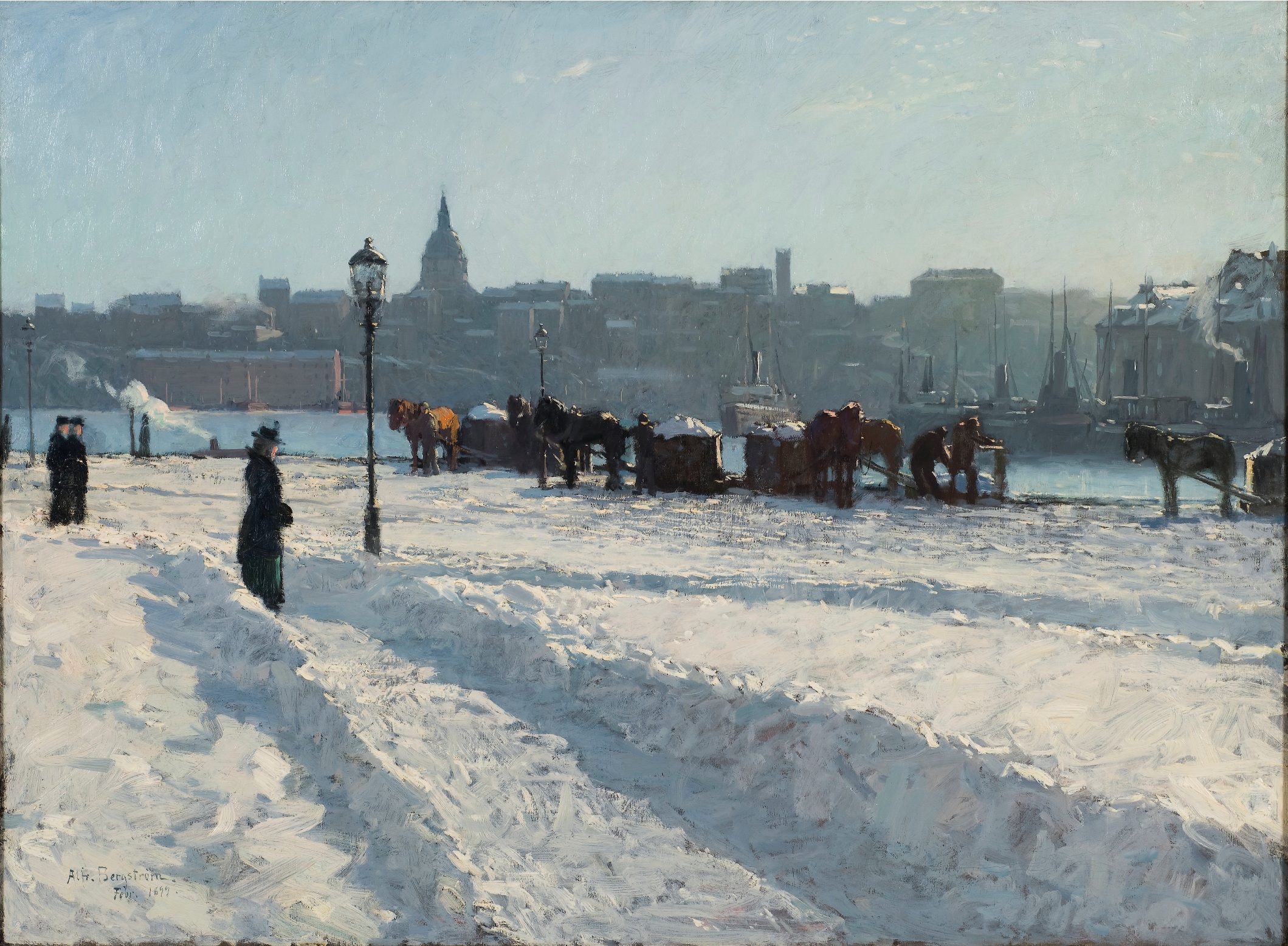
Alfred Bergström (1869-1930), Vintermotiv vid Stockholms ström, 1899
To Stockholm’s national museum and an exhibition of paintings illustrating the succession of the seasons. A very Swedish preoccupation according to my cousin Anders who took me there. Here's my number one favourite. Alfred Bergström captures shades of violet as snow, shovelled in brilliant sunshine from the quayside, is dumped from carts into Stockholm harbour in 1899.

And here's one by Prince Eugen. A peaceful Spring day in 1891, and on three slender birch trees the leaves are just opening. His full name was Prince Eugen Napoleon Nicolaus of Sweden and Norway, Duke of Närke.  The Exhibiton was called “The Four Seasons”.  Vivaldi was not played.  Anders and I were in no doubt that our uncle Gösta would have loved this exhibition.  He would have been our guide and fellow wanderer.  We buried him yesterday.

Prins Eugen (1865 - 1947), Lövsprickning, Balingsta, 1891
Exhibition details in Swedish and English

Monday, February 27, 2012

Gösta min morbror


My uncle Gösta as I like to remember him. He died on Saturday morning aged 88 (I think) after a period of undeserved suffering, despite the best medical care. He was a kind man. A phrase I don’t often use, but may he rest in peace. I used to tease Gösta about the small vocabulary Swedish has compared to English, such as the old standbys of pig/pork, sheep/mutton etc. He in turn delighted to cite cases where the opposite is true. For instance, I said just now he was my uncle. But that doesn’t actually tell you all you want to know. In Swedish I would say he is my morbro. From this you would gather not merely that he's my uncle but also that he's my mother’s brother. As another instance, he liked to call attention to the inelegant expression “Swedish has a small vocabulary”. In Swedish you can say Svenska är ordfattig: literally Swedish is word poor. Far preferable. And tends to belie the very point being made. Is there a word for that I wonder. Just the sort of puzzle that would send us scurrying for the dictionaries … 

I took the photo in 1978 at Luleå as Gösta boarded the night train to Stockholm after Hilda’s funeral (his mother, my grandmother, or as the Swedes say, min mormor).

Thursday, November 17, 2011

Of Swedes and turnips


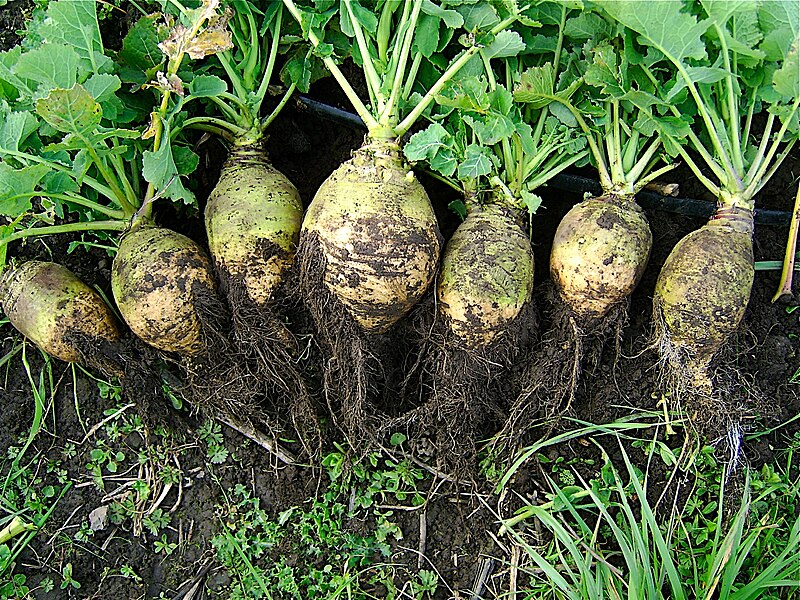
A swede
Here’s a tasty dish I enjoyed while staying with my cousin in Stockholm last week. Root vegetable gratin. Various root veg including potatoes, carrots, swede, turnip, also celery, onions, leeks. Slice thin and bake with cream and a vegetable stock cube in a shallow dish.

The conversation at table turned to the English word swede, and whether it’s connected in any way with Sweden. Such has occasionally been suggested to me in a spirit of fun, but I had always supposed that the similarity between the name of my mother’s native land and a big turnip was mere coincidence.

Not so, it seems. My Shorter Oxford Dictionary tells me that Swede has the following three meanings:

(1) a native of Sweden (first use 1614)
(2) a Swedish ship (rare, first use 1799) and
(3) a large variety of turnip with yellow flesh introduced from Sweden in 1781-2 (first use 1812, earlier known as Swedish turnip).

So “carrots, swede, turnip” is incorrect. It ought to be “carrots, Swede, turnip”.  However since I write “rugby ball” and not “Rugby ball” I'll stick to swede for what I eat and Swede for what I half am.

Harvesting swedes
If the date of introduction, 1781-2, is right that would fit in with the 18th century agricultural improvement drive in Britain. But Wikipedia suggests an earlier date.

The swede originated as a cross between the cabbage and the turnip, something that would I imagine be readily apparent to anyone that’s actually grown them, which I haven’t. The Swedish for swede is kålrot (cabbage root).

Wikipedia says that in North America the common term for the plant is “rutabaga”, derived from the old Swedish word “rotabagge”, root bag.

(Subsequent note 19th Nov. I cooked the dish last night but not a complete success. I thought crème fraisch might be a good idea but it wasn't. More liquid needed, and a slow oven.)

Sunday, August 7, 2011

More on Swedish neutrality in the 2nd World War

Holiday snap in Stockholm, 17 July 2011
My cousin Kim took this picture of me standing on the steps of the Stockholm office of the Swedish employers federation three weeks ago. The address is Södra Blaiseholmen 4a, and during the Second World War it was the German embassy. My aunt Inger once said: “during the war we were ruled from that building.”

German military trains, known in Swedish as permittenttåg, were allowed to use Sweden’s rail network to transport troops to and from occupied Norway. As Sweden was neutral, this was and remains controversial.

During my visit last month the 70th anniversary occurred of the permittenttåg. The TV news showed an interview with an elderly German who, as a junior officer in the Wehrmacht, had travelled on these trains. It was like travelling through a friendly country, he said, he encountered no hostility. A black and white movie clip was shown, taken from the moving train. Two Swedish girls standing by the track waved at the German soldiers as the train passed by. OK, so the clip was probably from a Nazi propaganda film, but nonetheless, the evidence accumulates.

My aunt and her sister reminisced about their life in Stockholm during the war, and how Stockholm was full of Nazi sympathisers. They had a Jewish sounding surname, and one day they discovered a swastika daubed on the door of their apartment. Inger (who would have been about 12 at the time) cried “I wish we weren't called Levin”, according to her sister.

These are all anecdotes. When I have time, I intend to look up some of the history.

For a different angle on those trains, see a couple of pieces I posted early this year:

A German troop train in Sweden

My Swedish cousin and the German cigarettes

And see also Irish & Swedish neutrality during the Second World War

Saturday, July 30, 2011

The Swedes have a word for it: Murdoch chose wrong salad


Today I'm back home after visiting cousins and aunts in Sweden. As usual I came away with a list of new words and expressions to memorise. Some are a bit specialised and may come in useful only rarely. Last Friday night for example I learnt the expression “att pissa i fel sallad”; which captures the mistake that led to Murdoch’s downfall with such precision that I doubt I shall ever again find a context as apt.


I hope you’ll forgive the crudity and agree with me that the day Murdoch’s hirelings hacked Milly Dowler’s phone they “pissed in the wrong salad”.

Thursday, April 28, 2011

Royal wedding - what surprise is in store?


Last night on BBC television, the BBC's royal correspondent (Nicholas Witchell I think) said we should all be ready for a surprise.  Maybe he used the word wow factor, I'm not sure. So he knows something. What? Two possibilities present themselves. One is that Kate Middleton will upstage Sweden’s Princess Victoria by parading up the aisle with William, and will thus abolish at a stroke the repugnant tradition of the bride being given away.  That’s unlikely.  To be fair this is a much bigger ask in Britain than it was in Sweden where the giving away tradition is not actually embedded.  I discussed this Swedish controversy last year.


Wedding scene from Ang Lee’s Sense and
Sensibility
. Emma Thompson as Elinor
The other possibility is she won't wear white. Ang Lee’s 1995 film of Jane Austen's Sense and Sensibility, which ends with a double wedding, has both sisters in their colourful finery; and I found out from Bath’s fashion museum the other week that the first white wedding dress in their collection is 1828.  The commentary said it’s unknown exactly when and why white became obligatory but it was thought to be around that time, that is to say roughly 15 years after Austen wrote the novel.

So having assured everyone that you’ve got to be joking if you think I'm going to be watching the royal wedding,  I might just have a peep at the entrance ceremony to see if I'm right about either of these outlandish suggestions.

As a final comment, I notice people in Ireland tend to refer to the forthcoming event as “the royal wedding”. Even RTÉ presenters and correspondents do so. Which some find annoying, and rightly so in my opinion, as the correct phrase would be “the British royal wedding”.

Subsequent note , Friday, April 29 : No surprise. I was misled. Ah well silly me I allowed my imagination to run away with me. Just the same old royal wedding stuff.

Thursday, February 17, 2011

A German troop train in Sweden

Sometime between 1940 and 1944, a Swedish soldier stands guard over a German troop train while German soldiers stretch their legs and two Swedish railway personnel look on. This is one of the trains that my cousin Tolle wrote about. He says the photo is precisely as he remembers it.  Possibly it was actually taken at Kiruna. 

It's from a book by my mother’s sister Kajsa, called We have no right to forget, which examines certain episodes in the Second World War. Kajsa is no longer alive but her husband Per is, and during the war he was in the Danish resistance. 

One of the book’s themes is Swedish neutrality, and there’s a chapter called “When our neutrality was German”. 

The caption to the photo reads: 

“Swedish neutrality? 2,240,000 German soldiers and 100,000 wagon loads of war material were transported on the Swedish railways to and from Norway and Finland during the 3 years of the German transport agreement.”

My den is a mess. I've avoided tidying it up for the past 5 years. Today I had a shot at it, and came across this book which I had long been looking for.  


Saturday, January 22, 2011

My Swedish cousin and the German cigarettes


Last year my cousin Tolle related this childhood episode from the Second World War.  Prompted by the neutrality debate earlier this week, I asked him to remind me of it, and here's an email I got from him today which I have translated (eller läs Tolles meil på Svenska) :-   

The Luleå - Kiruna - Narvik railway. 
The iron ore is mined at Kiruna

As you know Germany had permission from the Swedish government to send military personnel by train through Sweden [to German-occupied Norway].  This has been heavily criticised both during and since the war.  What sort of neutrality?  

In Kiruna there were two railway stations, the central station, but also a small one which administered the iron-ore trains to Narvik.  The German trains, as we called them, always halted some hours at the small station.  We small boys (I was 11 – 12 years) were of course curious and used to collect beside these trains. Then it happened that the soldiers in the train wanted to have their water bottles filled with fresh water, and we had permission from the Swedish military who stood guard over the trains, to fill the bottles. For this we got cigarettes. All tobacco was rationed and the allowance was rather small. Since my dad smoked I thought he would be glad of an extra portion. But he wasn’t. He was absolutely furious.  He threw the cigarettes on the fire and forbad me to go errands for the Germans. As you perhaps know he was an engine driver, as was Albert [my grandfather] and drove mainly iron-ore trains between Kiruna and Narvik, where he had many good friends, which as a result he wasn’t able to meet. The ore trains were driven to Luleå instead. But he died in 1942, so it was only a short time he drove the Luleå trains.

He was anti-Nazi to his fingertips, so it’s easy to see why he burnt the cigarettes.

Tolle at the Luleå rail museum, 2005


Tolle's father and my grandfather (Albert) married two sisters.  

The map shows the railway line over which they drove engines such as the one in the photo pulling the iron-ore trains.  

Kiruna was where my mother was born, and Luleå was where she grew up, in this house.