Showing posts with label Words and language. Show all posts

Thursday, December 29, 2016

My worst day at school

I'm going to tell you about my worst memory from school.  This would be when I was six.  For some reason I associate it with Christmas, and I imagine this is because it was the last day of the Christmas term.  There was a test, or a sort of quiz, and the lady teacher called out the questions, we wrote down the answers, then at the end we had to swap answer sheets and score each other’s work. And here's my worst moment. The question was, what sort of dog is Sarah? Sarah being the school dog. Actually I tell a lie as Sarah was not the dog’s name, that was another dog at another school, an Airedale Terrier. The dog I'm going to tell you about wasn’t an Airedale Terrier and wasn’t called Sarah, but as I've forgotten the name, Sarah will do for now.

I agonised over the answer to this question, of what sort of dog Sarah was. And I really do mean agonised. I can feel the agony now. And what made it worse, another child was going to mark my work. Here's what I wrote down on my answer sheet:-


I stared at what I had written, and the more I stared, the wronger I knew it was. I knew it was wrong in three ways, at least: I knew I hadn’t spelt black right. Moreover I knew one of the letters was formed wrong, though I couldn’t fathom which, or how.  But most all I knew I had made a category error, as I think it's called.  I knew that black, however spelt, wasn’t the answer looked for. I sensed that I wasn’t being asked what colour Sarah was.  I sensed I was being asked some other sort of question.   Though without any inkling what that question might be.  The question was, of course, what breed Sarah was - though I didn't know the word breed, didn't have the concept of breed, couldn’t name any breeds, knew nothing about dogs. I was sure all the other children did, they all had dogs and ponies and stuff at home.  This was a private kindergarten in Sussex you see. I can tell you now, that Sarah was in fact a black Labrador, and LABRADOR was the answer sought.  Probably none of the other children could spell Labrador but though I can derive comfort from that thought now, I couldn't then.  

Eventually I ran out of time, the papers were to be swapped, and I handed my paper over, with that shaming word BLAC on it. This is my worst memory from school and it's associated with Christmas. 

Friday, October 14, 2016

The awkwardness of "Awkward"

I've come across another word that describes itself. 


Stare at awkward long enough and I think you'll agree with me. What an awkward word,  with that wkw in the middle. It turns out to be a combination of the Middle English adjective “awk” and the directional suffix “-ward.”

It seems  “awkward” was coined in the 1300's in Scotland and northern England, where it meant “turned in the wrong direction”.  The word "awk" meant the wrong way round, backhanded. Other possible meanings are sinister, ominous, perverse.

Here’s an example of the sinister/ominous meaning of "auke" from Philemon Holland’s 1600 translation of Livy’s history of Rome and the Roman people. In this passage Livy refers to those who disparage the Roman practice of augury:

Now let them mocke on and scoffe at our religions. Let them deride our ceremonies. What makes matter (say they) if those pullets pecke or eat not? What if they come somewhat late out of their coupe or cage? What if a bird sing auke or crowe crosse and contrarie? How then?


And here's a late example from 1674, where perhaps perverse is meant. It's in a scientific treatise from the 17th century clergyman Nathaniel Fairfax: 


What we have hitherto spoken, will seem to have less of auk in it, 

That is, what we have hitherto spoken, will seem less perverse.   Fairfax was keen to use native English words only, and I suspect that by 1674, having “less of auk in it” already sounded old-fashioned, or dare I say, awkward.  (I have more on Nathaniel Fairfax and the context of this quotation in an appendix.  It interests me because of a connection to the history of science. He seems to have been exploring some of the thoughts that gave rise to calculus at about the same time.)

For an early instance of "awkward", there's the Middle English poem Pricke of Conscience (1340): the world thai all awkeward sette (they turned the world all awry).


A bit of etymology


“Awk” is Scandinavian in origin.  Its equivalent in modern Swedish is “avig”. Suppose you were to put a shirt on back-to-front, this in Swedish would be “att ha skjortan avig”, literally to have the shirt the wrong way.  There's a German word "Abweg" meaning the wrong way, which looks as if it ought to be related, but so far as I can tell it isn't. 


I can't account for why,  but it tickles me that the “ward” in awkward has something to do with direction, as in northward, onward, backward, inward, and so on. We can perhaps think of awkward as equivalent to the non-existent word wrongward.

My Shorter Oxford Dictionary tell me that the suffix ”-ward” gives the meaning of having a specified direction, and is connected with the Latin verb vertere (to turn). I find that an especially fruitful piece of etymology as it helps us to think of “–ward” as having the meaning turned in the direction of.  So: turned in the direction of in, turned in the direction of out, turned in the direction of north, etc.  Then there's "toward", and the interesting case of "untoward". In Middle English there was a word “fromward”; which in Old English apparently meant "about to depart; doomed to die; with back turned."

“-ward” can in principle be added to any location, to suggest progressing or pointing towards that place.  As in she raised her eyes heavenward.  Or this sentence from H. G. Wells, The War of the Worlds (1898): In the road that runs from the top of Putney Hill to Wimbledon was a number of poor vestiges of the panic torrent that must have poured Londonward on the Sunday night after the fighting began. And in a recently published legal history of New York we find: It was not until the colony became a state that the pendulum of emigration and settlement swung New Yorkward.[1]

I thank the excellent Grammarphobia blog [2] for calling my attention to the awkwardness of “awkward”. It puts me in mind of the opposite case, the mellifluousness of “mellifluous”.  A curiosity I had something to say on back in May.

“Awkward” and “mellifluous”  are autological words, words that describe themselves – or so it seems to me.  


[1] Courts and Lawyers of New York: A History, 1609-1925, Volume 1 (2010) by Alden Chester

[2] The blog is the source of many of the foregoing quotations and I've even plagiarized the title of this post from it. You'll find more information in an email from the blog editors reproduced in the appendix.

Monday, May 16, 2016

Yellow is not yellow

Image from wordables.com
The word “long” isn't long, but the word “short” is short.  And riddle me this: “multisyllabic” is multisyllabic, and "pentasyllabic" is pentasyllabic, but “unisyllabic” isn't unisyllabic. On the other hand, “word” really is a word, “noun” really is a noun, and “unhyphenated” really is unhyphenated.  This all began with the verb “to verb”.   Some people critique verbing and would like to elbow it out of the language. I'll blog about that another day; for now let me just  highlight that “to verb” is an instance of itself, like “word” and “noun” - and noticing this, I began to wonder what other examples exist, and is there a name for a word describing itself. 

It turns out there is.   Words that describe themselves are called “autological,” sometimes “homological”.  [1]

Autological words I've already used are “multisyllabic”, "pentasyllabic", “unhyphenated”, “word”, “noun”, and “to verb”.  All those words are instances of themselves.  As I suppose is “mellifluous”.

“Yellow” is not yellow

Most words are heterological, that is to say their meanings don’t apply to them.  “Long” is heterological because, as I noted at the top,  it's not a long word.  Likewise, the word “yellow” is not actually yellow, nor is the word “square” a square. [2]

Autological words seem to have a devoted fan base, and you’ll find lots of websites devoted to them.  Indulge me while I mention a few more:   “erudite” is erudite, “obfuscatory” (designedly unintelligible) is obfuscatory,  and “recherché”  (rare, exotic, or obscure) is recherché.  “Terse” is terse, “twee” (impossibly cute) is twee, “prefixed” is prefixed,  “adjectival” is adjectival, "pronounceable" is pronounceable.  All of these I've found elsewhere, but one I've come up with myself is “noun phrase” which (if I remember my school grammar correctly) is a noun phrase.

I won't weary you with any more.  Henry Segerman  collects them. He has a list of clearly autological words, and a separate list of more doubtful cases.  “Meaningful” is a doubtful case. Yes it has meaning, but is that enough?  Surely to be meaningful you need an above average amount of it (which I don't think “meaningful” has).  Judging from the internet evidence, coming up with autological words is meaningful to many people.

Curiosities

I'll end on a couple of curiosities. “Hellenic” is Hellenic, “English” is English, and “Afrikaans” is Afrikaans. But we must beware of being too quick to suggest others in this category.  Is “Hebraic” Hebraic? “Swedish” certainly isn’t Swedish; nor is “German” German or “Dutch” Dutch, see the following table.  Very few  languages call themselves what English calls them.  Afrikaans and Portuguese are rare exceptions.   As are Indian languages - so far as I know, “Hindi”, “Urdu” and “Gujarati” are respectively Hindi, Urdu and Gujarati. 


My last curiosity is this: does "heterological" describe itself?  If so, it’s autological, because that’s what autological words do, they describe themselves.  But wait!  If "heterological" is autological, then it doesn't describe itself.  Which makes it heterological; so it actually does describe itself, meaning it's autological. Welcome to the Grelling-Nelson Paradox.  The link is to a Wikipedia article which I don't entirely follow. For example it casts doubt on whether “autological” is autological, which to my mind is indisputable.

Finally a thank you to Pat O’Conner & Stewart Kellerman of the grammarphobia blog.  It's to them I turned when I first noticed that “to verb” and “word” are instances of themselves, and I wanted to know if there were other examples of this phenomenon, and is there a name for it. They sent a full reply from which most of the foregoing, and the notes below, are culled.

Notes

[1] The adjective “autological” originally had to do with self-knowledge when it first entered English in the 18th century. It came from the rare 17th-century noun “autology” (self-knowledge or the study of oneself), according to the Oxford English Dictionary.

But a new meaning emerged in the early 20th century, the OED says, when “autological” was used to describe a word, especially an adjective, “having or representing the property it denotes.”

The dictionary’s earliest recorded use of the word is from a paper by F. P. Ramsey published in 1926 in Proceedings of the London Mathematical Society: “Let us call adjectives whose meanings are predicates of them, like ‘short,’ autological; others heterological.”

[2] See article by the linguist Arika Okrent : http://theweek.com/articles/459441/17-words-that-describe-themselves. I've used several of her examples.

Thursday, January 14, 2016

Hey! You with the stained sink!

This one’s about TV adverts and grammar.

There's plenty to irritate in TV adverts and I'll mention one irritation in particular, presumptuous injunctions such as “Organize that messy closet” or “Get rid of those unsightly stains in your sink.”  Where the copy writer pretends to be on such familiar terms with you that they have peered into your home.  Why they do it, and why it irritates, is easy enough to see; but exactly how do they do it?


A tidy closet, or should I say wardrobe

It's the word “that” and its plural, “those”, the grammatical name for which is demonstrative adjectives.  In the foregoing slogans “that” and “those” modify a noun, in effect pointing at it; thereby indicating, from amongst all the possible closets and sinks, which one (or ones) the speaker is referring to - yours.


A stained sink - or it was when the photo was taken, but please be assured, not now!

Putting advertising aside for a minute, let me take this sentence spoken by a normal person: “Sam misses that dog.”

Or this:  “These sneakers belong to Janet.”

The demonstrative adjectives demonstrate which dog Sam misses, which sneakers belong to Janet.  “That” and “these” refer to nouns that actually exist—dog, sneakers.  The speaker and the audience both take for granted that the dog and sneakers indicated are known and exist.

Now back to the advertising slogans, with an anonymous voice telling you to “organize that messy closet” or “get rid of those unsightly stains”. The voice isn’t pointing to an actual condition in your house - but instead is presupposing its existence and treating it as a fact.  It seems linguists have a name for this, and  the slogans are examples of “presupposition.”

The Cambridge Grammar of the English Language says, “The information contained in a presupposition is backgrounded, taken for granted, presented as something that is not currently at issue.”  In the cases in point,  the presupposed information is that you have a messy closet and a sink with unsightly stains.

In a study entitled “Presupposition, Persuasion and Mag Food Advertising” (2012), Tamara Bouso uses the example “Do you expect to fit into that beach bikini in the New Year?”  This sales pitch presupposes not only that the consumer has such a bikini but that she’s probably too fat to wear it.

In this way, demonstrative adjectives are employed to create a false sense of familiarity, of intimacy with the consumer. It's a forced intimacy that can strike listeners as intrusive or annoying, but whether it's more intrusive and annoying to those with tidy closets and spotless sinks, or messy closets and stained sinks, is hard to say.

Two names have been proposed by linguists for demonstrative adjectives used in this presumptuous way: “affective demonstratives” and  “emotive demonstratives.”  “Emotive” because such terms convey a sense that both speaker and listener share some relevant knowledge or emotion about the referent of the demonstrative—that is, the closet or sink it points to.  And “affective” to imply an emotional element—in this case familiarity and a shared experience of a closet or a sink.

How do I know all this?  Well yesterday I didn't, but today I've read my daily email from the Grammarphobia Blog and it's all there, with links and references. I've used the word closet because they do, it's an American blog.

Tuesday, January 5, 2016

Younger or youngest? Can Jane Austen err?

By indirections we find directions out.  I'll start with an alleged mistake in the second sentence of Jane Austen’s Emma.  Here we read that Emma “was the youngest of the two daughters of a most affectionate, indulgent father”, and it's the word “youngest” that gave rise to a difference of opinion. To set the scene, it was last November, and we were at lunch before a lecture in Dublin hosted by the Jane Austen society to mark the novel’s bi-centenary.  Professor Darryl Jones of Trinity College thought that Emma is a landmark in the history of the English novel, being the first designed to be read more than once.  It only makes sense on the second or third time of reading, he said, as all the questions Emma gets spectacularly wrong, we do too, the first time.  The most complex of Jane Austen’s novels and one of most complex novels in English.


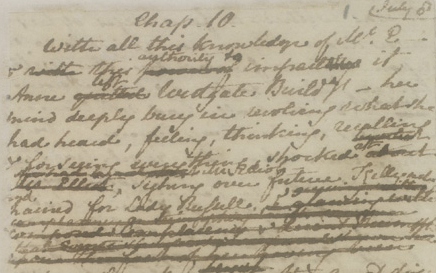
Chapter 10 of Persuasion in the Jane Austen’s Fiction Manuscripts Digital Edition  curated by Prof Kathryn Sutherland

But back to lunch, and Emma being the youngest of two daughters. Someone asserted that Austen was in error here, as you can be the younger of two but not the youngest of two.  And indeed I've subsequently seen numerous posts on websites supporting this ruling.

The first thing to say about this point of view is that it assumes the existence of a Big Book Of English Grammar where such rules are written down.  As I've lived 66 years without encountering such a book, I think I can plausibly suggest there isn't one.

I did however in the heat of debate make an ill-considered statement, which was that Jane Austen can't be wrong, and if she wrote the youngest of two then youngest of two is okay. Reflecting on this later I decided I ought to investigate whether Jane Austen actually took care of such matters; whether "youngest" is what she actually wrote; would she leave a decision about younger/youngest to the printer, and how carefully did she proof-read?  I was travelling down a blind alley of course, because these questions matter not one jot.  What's important is that the text of Emma is what it is, however many hands are responsible; not whether Jane Austen herself was interested in grammar.

William Gifford

Actually my blind alley was not entirely blind, for it led to me some new nuggets of knowledge. One of these is that Jane Austen did have an editor, William Gifford, who took great pains with grammar and punctuation.  Indeed in 2010 a brouhaha erupted over a claim that his influence on the final text was such that Jane Austen’s style can't really be said to be her own.  All this was attributed to Oxford Professor Kathryn Sutherland, though in fact the professor’s remarks seem to have been distorted. Be that as it may, we can be sure that the said Gifford wouldn't allow anything untoward to slip past him, and in the novel’s second sentence of all places.  


Prof Kathryn Sutherland and Jane Austen. The Kathryn Sutherland image is (so far as I know) a good likeness, whereas the Jane Austen one is not

The Kathryn Sutherland controversy makes some fascinating reading, or fascinating to me at any rate, and I have a fellow Jane Austen society member to thank for drawing it to my attention. You could start with this blog by linguist professor Geoffrey K. Pullum. Writing in October 2010 when the spat over Austen's alleged failings in style and grammar was still fresh,  he says he has seen no examples to back these claims up.

Dubious basis

Another nugget that came my way following my “Jane Austen can't be wrong” outburst: it seems that from about 1750 to about 1850 creating new rules of English grammar became a favourite passtime, and a prohibition on the “youngest of two” was being suggested around the time that Jane Austen was writing.  There's plenty on this in the excellent grammarphobia blog which I've newly discovered.   Here they reproduce the conclusion of Merriam-Webster's Dictionary of English Usage on the matter:-

    “The rule requiring the comparative has a dubious basis in theory and no basis in practice, and it serves no useful communicative purpose. Because it does have a fair number of devoted adherents, however, you may well want to follow it in your most dignified or elevated writing.”

The blog authors Pat O’Conner & Stewart Kellerman were kind enough to email me with some additional comments on Jane Austen’s use of “youngest”, and they say that whilst there are differences of opinion here,  it’s probable that Jane Austen  was unaware of any “rule” banning a superlative with only two members; indeed many popular grammar prohibitions emerged only in the latter half of the 18th century and the early part of the 19th, so it’s not fair to call an author “incorrect” for ignoring a convention that was not yet firmly established in common usage at the time she was writing.

As I've already indicated, I'm reluctant to use the word “incorrect” at all, moreover I can adduce plenty of evidence against there being, even today, any firmly established convention that you can't be the youngest of two.

Finally, I nearly wrote "the authoritative" Merriam-Webster Dictionary of English Usage, but then I would stand accused of inconsistency, as I've already suggested that no-one is entitled to lay down rules. And that’s true, but Merriam-Webster is authoritative in this sense, that they have exhaustively investigated English usage, and if you want to know what’s been written and by whom, Merriam-Webster is a good place to look. Maybe all of this leaves you thinking that some of the things that interest me are very dull indeed, in which case I salute you for getting this far.

Wednesday, November 25, 2015

The glory is departed

Boarzell School in Sussex where Mr Dumbreck taught me English in 1961

I had a terrific English teacher when I was 12 called Mr Dumbreck and were he here today he would strike a big red pencil through that word “terrific”, on the grounds of being a cliché, and furthermore terrific means inducing terror. Another rule for our English compositions was that no sentence was to begin either with the word “it” or the word “suddenly”.

I want to tell you about my swotty boy moment. One day the word “hectic” cropped up and Mr Dumbreck asked us for examples of how it might be used. Up I piped with “yellow, and black, and pale, and hectic red”, a line from Shelley’s “Ode to the West Wind”, which we had recently been reading in class. Mr Dumbreck heaped praise on me for quoting both correctly and appositely, and even after all these years the memory calls up a glow of satisfaction. Lindsay by the bye tells me that at her school quoting Shelley wasn't considered comme il faut, and would quite likely have earnt me a whack on the back of the head with a pencil box.


Mr Dumbreck and the Fifth Form room. The events related here took place in the Sixth Form room next door, but no photo is available.  
All photos courtesy of Michael Salmony

Whenever I think of Mr Dumbreck the phrase “Ichabod, the glory is departed” comes to mind. It's an essay he read to us about a hat box festooned with luggage labels. You have to be as old as I am to remember what this meant. The hat box is sent away for a lock repair and when it comes back it's been steam cleaned, and the lovingly preserved collection of labels has vanished. I've gone looking for this essay, which turns out to be by Max Beerbohm, and after fifty-four years I've just read it again. I see the title is simply “Ichabod”, the phrase “the glory is departed” occuring only at the very end. I imagine Mr Dumbreck read us this verse from the Old Testament: “And she named the child Ichabod, saying, The glory is departed from Israel: because the ark of God was taken, and because of her father in law and her husband.” He was a brilliant teacher. He taught us art too. We weren't allowed erasers, and had to ask to borrow his bungy. This was occasionally permitted but normally he would claim to have lost it.

It's hard to say why I've started reminiscing about Mr Dumbreck. My age you will say. But I think I can trace it back four years when I read PD James's Death Comes to Pemberley and was startled to come across this sentence: “Suddenly Mrs Reynolds was with them.” Proof that PD James had not attended Mr Dumbreck’s lessons, and considering that she was writing a Jane Austen sequel, very bad; for Austen, though she used the word “suddenly” about 50 times in her novels, never once began a sentence with it. I know this because I have the internet. Mr Dumbreck knew it in his bones.

Finally, in a couple of hours we in Cork Astronomy Club will celebrate the centennial of Einstein’s general theory of relativity, which prompts me to ponder the relativity of time. From leaving Boarzell in 1961, to 1972 the year my mother died and I moved to York, was 11 years, and appears to me like half a lifetime. From leaving York to now is nearly 11 years, and it seems like yesterday.

Note 1 : For a read-out of every sentence in which Jane Austen used the word “suddenly”, all you need is this website http://www.pemberley.com/etext/ and about eight seconds of your time. Charles Dickens had no such compunction by the way. I found the following instances in David Copperfield, and I suspect, had I continued searching, would have found many more:-
“Suddenly I came upon a pasteboard placard, beautifully written, which was lying on the desk …” Chap 5
“Suddenly Miss Murdstone gave such a scream that I all but dropped it.” Chap 8
“Suddenly there passed us ─ evidently following them ─ a young woman …” Chap 22

Note 2: The Biblical quotation is 1 Samuel 4:21 in King James version.


Sunday, July 12, 2015

He and Me, or, How we played Kick the Can


Kicking the can down the road is a cliché of political journalism that bugs me. It cropped up in a Guardian editorial in connection with Greece, as I mentioned last time. But on this occasion no blame attaches to The Guardian because they acknowledged it as someone else’s cliché.  No such excuse however on 27 September 2013:-


Here “kicking the can down the road” appears not only within the article but dear oh dear, in the headline.  And dear oh dear, not just any old headline, but an editorial.

And here's a particularly lame instance in the Irish Examiner last year.  It's in an op-ed piece which finishes:-

“Scandal has been kicked down the road, where, history warns, it will rear its head again.  But with a bit of luck for Shatter and Callinan, that will be on somebody else’s watch.”  Two sentences groaning under the weight of three clichés. 

I'll spare you further examples. It's a metaphor that appears to have no precise referent. Or maybe there really is a kicking the can down the road game that all other kids played, and I didn't, due to my privileged upbringing? If so then I withdraw that part of the objection.  (Note: idly kicking a can down a road doesn't count; it has to be a purposeful game.)

Kick The Can

At my school we did have a game called Kick The Can and very satisfying it was too. No road was involved - we played it in a clearing in the woods at one side of which a steep bank fell away to a pond on which (I think) moorhens swam. The can was a large upside-down floor polish tin. One boy would be “He”, while the rest of us ran to hide behind trees. The He's task was to catch sight of one of us. Suppose he spied me he would shout “one two three Household” and then I was caught, and had to stand at the edge of the clearing. When we were all caught, the He had won the game.

Here I am running up behind the He to kick the can and release three boys who have been caught. However, my run is likely to be in vain, because his foot is on the can.
But there was a catch. While shouting “one two three Household”, the He had to have his foot on the can, else it didn't count. If another boy ran from behind a tree and succeeded in kicking the can while the He’s foot wasn’t on it, then all those who had been caught were released, and the He had to run to retrieve the can, giving us all time to hide again. Or the He was deposed, and the can kicker became the new He. Of course the He could avoid all this inconvenience by the simple contrivance of staying put in the middle of the clearing with his foot placed firmly on the can. But this defensive tactic entailed disadvantages. Firstly, the He would be unlikely to discover any of us who were hiding. To have a good chance of this, it was necessary to go on patrol amongst the trees. The other disadvantage was the rest of us from our hiding places would taunt him with a chant of “Can Sticker! Can Sticker!”

It was a brilliant game.

By the way, although I've depicted us all in Billy Bunterish school caps, these were worn only on Sundays, not for kick the can. The caps were similar in style to the one shown but they were pink, indeed Leander pink according to one of my informants. It was a prep school in Sussex called Boarzell that I attended from 1956 to 1961, age 7 to 12. Finally were my illustration accurate, I feel the can would have frequently ended up in the pond. But as I don't recall this happening, at least not often, maybe the pond wasn’t as close as I remember it.  

Monday, July 6, 2015

Greece: the bell tolls for whom?


Best tweet: The European Union has lost, Europe has won
Yanis Varoufakis, who today surprised us all by resigning as finance minister after the Greek referendum, liked to quote John Donne, “No man is an island, entire of itself; every man is a piece of the continent, a part of the main.”  This was his way of calling for European solidarity, and asserting that a community is judged by how it treats its weakest members.  Though Varoufakis wasn’t really quoting John Donne, he was quoting Ernest Hemingway, who put "No man is an island" on the frontispiece of his 1940 novel For Whom The Bell Tolls, thereby catapulting it into the top 100 quotes in the English language. 

The frontispiece of Hemingway’s For Whom The Bell Tolls
The passage is actually buried deep within one of Donne's rather dull meditations (Meditation XVII, 1624) and I imagine it's Hemingway we have to thank for excavating it from there. Or did someone else quote it before him?

Yanis Varoufakis, it seems, is fond of quoting English poets.  Susanne Moore writes in today’s Guardian of how she heard him on the radio saying that his fellow Greeks chose, “to quote your own Dylan Thomas, to stop going gently into the night and to rage against the dying of the light”.


A Greek woman thanks Yanis Varoufakis for standing up to the EU
My final linguistic thought arising out of the news from Greece, is prompted by today’s Guardian editorial. It says that kicking the can down the road has been the cliché of choice to describe the slow euro crisis that has steadily strangled the life out of the Greek economy; but yesterday Europe ran out of road when the Greek people said no to continuing to engage with their creditors on the same suffocating terms. I want to say something about the kicking the can down the road, and I'll do so soon. It takes me back to a brilliant game we played at school.  And by the way Donne might have written some dull meditations but he wrote some marvellous poems, sometime I must record one for you.

Humph. It occurs to me there's not been a lot of politics in this blog so I'll leave you with Varoufakis's resignation statement. He says the referendum of 5 July will stay in history as a unique moment when a small European nation rose up against debt bondage. And “I wear the creditors' loathing with pride”. 

Tuesday, January 27, 2015

Greece: let's prove the Cassandras wrong ... oops


Tsipras: The Cassandras will be proved wrong
I wish Alexis Tsipras well and foresee that soon socialists across Europe will be called upon to demonstrate in support of Greece’s new anti-austerity government. Already two days after being elected it is set on collision course with Brussels, as corporate-friendly politicians and central bankers try to beat the Greek people back into submission.

Cassandra: gift of prophesy
Nonetheless, the Classical Association of Ireland has drawn a faux pas to my attention and I feel duty bound to draw it to yours.  Before an audience of thousands of supporters, Tsipras announced: “Friends, the new Greek government will prove all the Cassandras of the world wrong. [There will be] no mutually destructive clash … We have a great opportunity for a new beginning.”

As the Guardian put it: Cue gasps of horror from Hellenists around the world.

We know of course what Tsipras intended.  By employing the Cassandra trope, he was making a reference to all the aforementioned politicians and central bankers who have variously predicted the end of Greece / the Euro / world economic policy / life as we know it, should his party Syriza get elected.  Cassandra’s prophesies of doom were all wrong, and all today’s prophets of doom will be proved wrong too.

The trouble is that when Cassandra foretold doom she was always RIGHT.  So drawing a parallel with today’s politicians and bankers was the very opposite of what Tsipras wanted, and has exposed him to Twitter ridicule. 

Cassandra was right (but not believed) when she foretold that her brother Paris, by abducting Helen from Sparta to Troy, would cause ten years of war and Troy’s downfall. She was right (but not believed) when she advised the Trojans to leave the Trojan Horse on the beach, and by no means to bring it into the city.  See Beware of Greeks bearing gifts.


Trojan Horse: Cassandra got it right
So who was Cassandra? A princess of Troy, both beautiful, and considered insane and a liar. This was the consequence of being cursed by the god Apollo. She had consented to have sex with him in exchange for the gift of prophecy, and then broke her promise. The curse was that she was simultaneously given the gift of prophesy, and destined never to be believed. This is how the myth is told in Aeschylus’s Agamemnon. There are other versions  if you’re interested, but you shouldn’t be, and neither should I, as we should be interested in what's going to happen in Greece.

The Irish left wing deputy Richard Boyd Barret commented this week:

“While [Irish prime minister] Enda Kenny hob-knobbed in Davos this week with the very people who inflicted such misery on the people of this country and Europe, the Greek people have shown us that our real allies are the ordinary citizens of Europe and that we need a European-wide movement of people power to demand debt relief and an end to austerity."

In closing, let's note alarm that Syriza has felt obliged to go into coalition with the right-wing Independent Greeks who (if my information is correct) are racist and anti-immigrant ... and there are signs already of Tsipras compromising on
Syriza's programme and dropping some of their more radical proposals. But all the more reason to manifest support for Syriza outside Greece. 

Wednesday, April 23, 2014

Will Shakespeare’s 450th


Here's my contribution to Will Shakespeare’s 450th birthday.

              
            Sonnet 29


When in disgrace with Fortune and men's eyes,
I all alone beweep my outcast state,
And trouble deaf heaven with my bootless cries,
And look upon myself and curse my fate,
Wishing me like to one more rich in hope,
Featured like him, like him with friends possess'd,
Desiring this man's art, and that man's scope,
With what I most enjoy contented least;
Yet in these thoughts myself almost despising,
Haply I think on thee, and then my state,
Like to the lark at break of day arising
From sullen earth, sings hymns at heaven's gate;
       For thy sweet love remember'd such wealth brings
       That then I scorn to change my state with kings.


Had I chosen one speech to read, it would be Macbeth: full of sound and fury and signifying nothing. But there's a perfection in a sonnet that you don't find, can't find, in a play.   When I studied Shakespeare at Cambridge we didn't pay much attention to the sonnets, at least I didn't. For example it was only yesterday in Wikipedia that I discovered the word volta (turn). It seems this usually occurs in the ninth line. In this sonnet the volta is “Yet in these thoughts myself almost despising”. It's where the poem turns from anxiety to resolution. It's not an easy line to get right and I don't think I've achieved it. In fact I've discovered that reading a Shakespeare sonnet aloud is a good deal harder than I thought.

If you want to hear how it ought to be done, listen to the sublime Judi Dench reciting (impromptu apparently) "Let me not to the marriage of true minds". But on the Bard’s birthday we must each bring our own tribute, flatfooted though it may be.

Thursday, December 5, 2013

An apology the world will little note nor long remember


Something I missed recently, but I'll include it here in case you missed it too:  coinciding with the 150th anniversary of the Gettysburg Address on 19th November, a retraction of an 1863 newspaper editorial dismissing the speech as “silly remarks”.

“We pass over the silly remarks of the President. For the credit of the nation we are willing that the veil of oblivion shall be dropped over them and that they shall be no more repeated or thought of.” With these stinging words did the Patriot & Union of Harrisburg, Pennsylvania achieve infamy in the annals of journalism, by panning the presidential speech that lives as one of the most treasured orations in the English language.

Three weeks ago, the successor paper Patriot-News revisited this unkind judgement, suggesting that their predecessors were perhaps under the influence of partisanship, or of strong drink - whilst wittily observing that “the world will little note nor long remember” the paper's apology.

This is all good fun, but ahistorical, of which more below.

Lincoln at Gettysburg (unknown date)
First, here's the full text of the Gettysburg address. [1]

Four score and seven years ago our fathers brought forth on this continent, a new nation, conceived in Liberty, and dedicated to the proposition that all men are created equal.

Now we are engaged in a great civil war, testing whether that nation, or any nation so conceived and so dedicated, can long endure. We are met on a great battle-field of that war. We have come to dedicate a portion of that field, as a final resting place for those who here gave their lives that that nation might live. It is altogether fitting and proper that we should do this.

But, in a larger sense, we can not dedicate - we can not consecrate - we can not hallow - this ground. The brave men, living and dead, who struggled here, have consecrated it, far above our poor power to add or detract. The world will little note, nor long remember what we say here, but it can never forget what they did here. It is for us the living, rather, to be dedicated here to the unfinished work which they who fought here have thus far so nobly advanced. It is rather for us to be here dedicated to the great task remaining before us - that from these honored dead we take increased devotion to that cause for which they gave the last full measure of devotion - that we here highly resolve that these dead shall not have died in vain - that this nation, under God, shall have a new birth of freedom - and that government of the people, by the people, for the people, shall not perish from the earth.


Now to the question of how the Patriot & Union came to overlook history being made that day. It's worth reading “Living on the wrong side of history? The Harrisburg Patriot & Union's notorious 'review' of the Gettysburg Address”  from Patriot-News website.

This deals with the issue historically, and discounts the playful suggestion that their 1863 predecessors were under the influence of strong drink. In the first place, the newspaper's own reporter described the President's speech in Gettysburg like this: "The President then arose and delivered the dedicatory address, which was brief and calculated to arouse deep feeling."  But the crux is that the Patriot & Union supported the Democratic party, and was hostile to Lincoln, his conduct of the war, and his war aims. Moreover, the paper’s editors had been in put in jail for sedition a year before. So there was stuff going on.

As a final thought, I've often wondered if Lincoln really believed that the world would little note, nor long remember, what he said that day.  He well knew he had crafted a masterpiece … surely he entertained the hope that the world would recognise this?

[1] This is the text most often reproduced. There are others, see Abraham Lincoln Online.


Saturday, September 21, 2013

Major Barbara and uncouth bacilli


G.B. Shaw in 1909,
five years after writing Major Barbara
Have been re-reading GB Shaw’s Major Barbara.  I studied it for A-level English in 1966 and never gave it a second thought until I found it was being performed at the Abbey Theatre in Dublin, where we saw it last Saturday. Much to say about it, but now (oh no not again I hear you cry) I'm sticking to apostrophes.

Shaw called them “uncouth bacilli" and condemned them in the following terms:-

"The apostrophies [sic] in ain't, don't, haven't, etc., look so ugly that the most careful printing cannot make a page of colloquial dialogue as handsome as a page of classical dialogue. Besides, shan't should be sha"n't, if the wretched pedantry of indicating the elision is to be carried out. I have written aint, dont, havnt, shant, shouldnt and wont for twenty years with perfect impunity, using the apostrophe only where its omission would suggest another word: for example, hell for he'll. There is not the faintest reason for persisting in the ugly and silly trick of peppering pages with these uncouth bacilli. I also write thats, whats, lets, for the colloquial forms of that is, what is, let us; and I have not yet been prosecuted."

Now we'll look at a pivotal moment from Act II of Major Barbara, in the 1908 edition of Archibald Constable & Co, London. I've highlighted in green where he's left apostrophes out and in yellow where he's left them in. To my way of thinking it's a mess. Why some and not others?  Shaw doesn't even appear to have followed his own rules.  It's almost enough to make you join the Apostrophe Preservation Society.

BARBARA. Oh, youre too extravagant, papa. Bill offers twenty
pieces of silver. All you need offer is the other ten. That will
make the standard price to buy anybody who's for sale. I'm not;
and the Army's not. [To Bill] Youll never have another quiet
moment, Bill, until you come round to us. You cant stand out
against your salvation.

BILL ... Ive offered to pay. I can do no more.


Shaw didn't get everything right. When almost 89 years old he wrote a letter to The Times published on May 18, 1945, saying Irish premier de Valera was correct in calling on the German ambassador a few weeks earlier to present condolences on Hitler’s death. Shocking. Though technically de Valera was correct and Shaw was correct in saying he was correct. So maybe that’s not an example of Shaw being wrong after all.  But the apostrophe business is, imho. Link to my previous disquisition on apostrophes.

Notes: The Shaw quote is from "Notes on the Clarendon Press Rules for Compositors and Readers." The Author, 1901, quoted in grammar.about.com


For an essay on the history of the apostrophe see the excellent Grammarphobia blog. It came into use in the 1500's, and the possessive apostrophe originally indicated a missing letter. 


Saturday, August 24, 2013

Of if's and but's


A quiz question for Shakespeare buffs: which character speaks the line “If me no ifs and but me no buts”?

Had I to guess, I should have gone for Macbeth, but I would have been wrong.  There's no such line. The nearest Shakespeare got to it was "Grace me no grace, nor uncle me no uncle" in Richard II, and “Talk’st thou to me of ifs” in Richard III.  I'm not the first though to suppose that “but me no buts” is found in Shakespeare. Bernard Levin wrongly included it in his 1983 tour de force on quoting Shakespeare; which must in turn have been read by fictional prime minister Jim Hacker who makes a fool of himself by committing the same error in the 1980’s BBC TV series Yes Prime Minister.

As to "If me no ifs", Elizabeth Gaskell used it in Wives and Daughters (1864). Whilst “but me no buts" first occurs in a 1709 play, and if we believe the script of Yes Prime Minister (which I'm not sure I do) was popularised by Sir Walter Scott in 1816. So far as I can tell however the line “If me no ifs and but me no buts” first appeared in this blog, so perhaps I've achieved a sort of immortality, and who knows I might one day make it to the Oxford Dictionary of Quotations.

You'll find citations for the foregoing on a separate page if you want them. But where did this frolic begin, you may ask? It was the grocer’s apostrophe. Or an accusation thereof. Pondering lab-made hamburgers recently, I said there were a couple of ifs that I didn't have space for: in a perfect world, if anyone would eat meat, and if there would be McDonalds. But I actually wrote if’s, and Albert queried this. He was too tactful to call it a grocer’s apostrophe but that’s what it amounted to.  So here are my thoughts. When debating the if’s that arise from the eating of hamburgers, I reckon the apostrophe looks right. On the other hand in “If me no if’s and but me no but’s” the apostrophes intrude, and spoil the flow.


From here on it's all about apostrophes, so if that’s not your thing, I'm sorry. Are there rules? There's a website called englishforums.com where you'll find someone pronouncing in all solemnity that to write CD’s and DVD’s is incorrect, supporting this by the assertion that an apostrophe properly indicates an omitted letter. I haven't included a link as there will be numerous other places where you can find the same sort of stuff, and it's all poppycock. I've experimented with leaving the apostrophe out and decided I don't like it.  I'm sticking to CD’s and 1980’s. If pressed I could devise a rule to justify this but I lack the energy. If you prefer CDs and 1980s that’s fine with me. No more to be said.


There are advocates of greater or lesser use of apostrophes. Here's an amusing and well-written overview: Should the Apostrophe Be Abolished? The Not-So-Great Apostrophe Debate.

Probably in 50 years time no-one will write CD’s. Nor indeed listen to them. Lynne Truss in her 2003 book Eats, Shoots & Leaves thinks that CDs and 1980s have already arrived in British English, CD’s and 1980’s surviving only in America. But she says if the abolitionists get their way entirely, they’ll regret it as soon as they discover they can't write “Goodbye to the Apostrophe: we're not missing you a bit”.  By the way on the question of if’s, Truss claims there's a rule that the apostrophe indicates the plural of words, as in “Are there too many but's and and’s at the beginning of sentences these days?”.  This shows you can invent a rule to justify any usage you happen to like.

Oho! I've just noticed I wrote in 50 years time. The authorities, Grammar-monster for example, think it should be in 50 years' time. But whilst I see the point of an apostrophe to indicate the possessive case in two days’ pay I don't in two days time. So even with me, it seems the process of abandoning apostrophes has begun …

And finally, what about the derivation of the expression “grocer's (or greengrocer's) apostrophe”? The best I can do is to quote the Wikipedia article on the apostrophe which gives the following tantalisingly incomplete information:  “The term is believed to have been coined in the middle of the 20th century by a teacher of languages working in Liverpool, at a time when such mistakes were common in the handwritten signs and advertisements of greengrocers.”

Friday, June 28, 2013

How good was Creation? Very or quite?


Creation: only "ganska godt" according to the 1703 Swedish bible
The book of Genesis tells us that following each of the first five days of creation God surveyed his work and in the words of the King James Bible, saw that it was good.  That covers most of creation other than land animals, and man and woman. On the sixth and final day when God had completed his work, he saw everything that he had made, and behold, it was very good; in the Italian bible grandamente buone; in the Swedish bible, mycket gott.

By now you’re wondering where all this is going, and perhaps suspecting it’s going nowhere. But as Polonius says to Hamlet’s uncle, perpend. For our next and final stop is the Swedish bible of 1703 (King Karl XII's bible): and here on the sixth day God says of his handiwork that it’s ganska godt. And finally I’ve come to my point, for to modern Swedish ears that sounds strange, as if God is saying his handiwork was only quite good. In fact I’ve seen a feminist blog claiming these words ganska godt show that up to the moment that God made woman he thought everything he made was just fine, whereas after making woman it all went downhill. Here however our feminist errs. Not in her assessment of the politics of religion, but in her knowledge of the Swedish language. For in 1703 ganska actually meant very, just as mycket in modern Swedish and grandamente in Italian. But the passage of time has diluted ganska’s sense so that now it means no more than quite or rather.  The German ganz from which ganska derives still means very, and so does Danish ganske.   All this I know because I’m spending a week with my mother’s sister Kerstin in Luleå where a couple of days ago the sun set at 23:55 and rose at 1:10 and we can read bibles at midnight without artificial light.

Which is handy. Inevitably when I come here the table is soon strewn with bibles in Swedish, English, Russian, French, German, Spanish, Greek, Finnish and Italian. That’s not where it began; but wherever it begins, that’s where it invariably ends. On this occasion it began with Jane Austen.

Jane Austen: repulsive wasn't so bad
I’ve noticed that in the 200 years since Jane Austen used it, the word repulsive has acquired extra strength. To her, repulsive meant (when used of a person) no more than off-putting or stand-offish, as in these two examples: from Mansfield Park, “She had not spirits to notice her in more than a few repulsive looks”; and in the denouement of Persuasion, “Anne could command herself enough to receive that look, and not repulsively.”   Whereas for us today the word is a real nose wrinkler. This trajectory, of a word gaining strength over the years, strikes me as unusual. The direction of travel is normally, I think, the other way. And that’s what I asked Kerstin about, which led to a discourse on the Swedish word ganska, and how it has evolved from very to rather.

Likewise astonished, when used by Milton, meant turned to stone as when Satan says of the fallen angels “The associates and copartners of our loss lie thus astonished on the oblivious pool.”  Whereas nowadays astonished means no more than exceedingly surprised; itself a word whose sense has diluted, for it used to mean ambushed or caught in the act, as when Dr Johnson, discovered in flagrante by his wife who expostulated “Sir I am surprised”, corrected her “No madam you are astonished, it is we who are surprised”; incidentally thereby illustrating that for him astonished had already declined somewhat in value.  Such are the considerations that led my aunty and me to ganska and a midnight table in the north of Sweden heaped with bibles.

Luleå: bible belt

Sunday, June 9, 2013

Half a dozen obvious propositions


The English common law consists of about half a dozen obvious propositions, but unfortunately nobody knows what they are. 

Why does this aphorism, which I've just stumbled on, tickle me? It's known to us through Harold Chaloner Dowdall (1868-1955), a high court judge. Whilst he didn't invent it, he was sufficiently impressed by it to record it for posterity in the following letter to The Times in 1932, relating a remark he heard many years earlier when a junior barrister. 

Lord Sterndale [another high court judge] once said, “The common law consists of about half a dozen obvious propositions, but unfortunately nobody knows what they are.” He was reading a case I had looked up for him, and I did not know whether he was speaking to himself or enlightening a junior barrister in the mysteries of the law, and as his clerk immediately called him into Court the matter dropped. He was a leader at the time, and I think it was not long after he had taken silk. The observation is so witty and true that, unless it is already familiar, it deserves record; but as the number of those who knew Lord Sterndale diminishes, it would be interesting if any of your readers ever heard him make a similar observation.

The clerk immediately calling Lord Sterndale into court puts one in mind of the person from Porlock. Harold Chaloner Dowdall besides being a judge was also a regular commentator on ecclesiastical affairs, and in 1908-9 served as lord mayor of his native Liverpool. 

The phrase “taken silk” referred to a barrister becoming a Senior Counsel. I know all this from the Quote Investigator, who has additional information with citations if you want it.

Saturday, March 30, 2013

Of Easter, Påsk and a pagan goddess


Today an Easter greeting from my aunt Kerstin prompted me to look into something I've long idly wondered about, and that’s why the Swedish for Easter is Påsk (pronounced Posk).  I was led to the following information from Wikipedia.  The 8th century English scholar Bede, describing the state of affairs in England a couple of hundred years before his own day, stated that the Anglo-Saxon word for April was Easter Month (Ēosturmōnath) during which feasts were held in honour of the goddess Ēostre. All this had died out by Bede’s time, replaced by the Christian "Paschal month". 

Left: A stained glass window from Germany depicting the Passover Lamb, a concept integral to the foundation of Easter. The inscription reads Osterlam. Pötting parish church of the Holy Cross.
Right: Bede was a priest and monk in the town of Jarrow in England who died in 735, often called the greatest scholar of his time in the Western Church. From a psalter in the British Library.

Paschal (which I suppose I ought to have known already but didn't) means pertaining to Easter or Passover, as in Paschal lamb and Paschal candle - an exceptionally large candle lit in church today (Holy Saturday) and kept on the altar till Ascension Day.  And Paschaltide it turns out is a period in the liturgical calendar, between Easter and Pentecost. 

The word Paschal is derived from the Hebrew word for Passover, Pesach.  The dates of the two festivals, Easter and Passover, normally coincide within five or fewer days, but about every tenth year they go adrift by a whole month. There's a long history of debates as to how Easter should be calculated which I won’t go into here.

What about Easter in other European languages? In the Romance and Celtic languages, as in the Scandinavian languages, it's derived from Hebrew (French Pâques, Italian Pasqua, Irish Cáisc [1]). But in German it's Ostern, the same root as English.

The goddess Ēostre is a form of the widely attested Indo-European dawn goddess (hence East), and there are theories connecting Ēostre with records of Germanic Easter customs including hares and eggs.


An invention of Bede's?


Here's a curious note to end on. The evidence for the Anglo-Saxon goddess whose name gives rise to "Easter" has not, it seems, been universally accepted, and some scholars have proposed that Ēostre may have meant "the month of opening" or that the name Easter may have arisen from the designation of Easter Week in Latin as in albis. (Not quite sure how you get from in albis to Easter.)

It's even possible it was Bede who invented the Anglo-Saxon goddess Ēostre.  But whether he did or didn't, it seems odd that the English church should have chosen the name Easter, thereby connecting their principal festival with
either a pagan goddess or a supposed pagan goddess.

My £10 donation to Wikipedia last month was money well spent, but there's more to find out yet.


[1] “Cáisc” (Irish for Easter) is, despite appearances, related to Latin “Pascha” and Hebrew “Pesach”.  That confusing initial “C” in place of “P” occurs because Irish is a q-Celtic language, and tends to have a “c” sound where Latin-derived words have a p-sound.

Wednesday, January 30, 2013

Move over Sherlock, Jane Austen was there first


Cork County library celebrated the 200th anniversary of Pride and Prejudice on Monday with three actors depicting scenes from the book, of which I've become a complete devotee. My obsession started only a year ago when PD James brought out Death Comes to Pemberley, a crime novel conceived as a Pride and Prejudice sequel. More of this another day. But crime does have some connection to what I want to say now.

Re-reading Pride and Prejudice last month, my interest was piqued by something I had previously missed. The reprobate Wickham having eloped to London with Lydia, Mr Bennet attempts to track them down. He traces them from Brighton as far as Epsom, where, he finds out, they had transferred to a Hackney coach. Now comes the interesting bit.  Mr
Bennet’s next move is attempting to discover the stand and number of the hackney-coach Wickham had hired, in order to get what information he could from the driver.  (Sadly this initiative was not crowned with success.)

Two surprises for me here. Firstly, that in 1813 a licensing system for Hackney carriages was already in place. And secondly, I was full sure that Sherlock Holmes was the first fictional character to detect using this method.  But no, almost 90 years before the great detective tracked down a villain by means of a Hackney carriage number, in The Hound of the Baskervilles, Jane Austen anticipated this detection technique.


A Hackney coach around 1800 from a Jane Austen blog
As to the licensing of Hackney carriages, this, I now discover, was instituted in 1654. That’s about two centuries earlier than I would have guessed.

I have further and better particulars if you want them: extracts from Pride and Prejudice and The Hound of the Baskervilles, and some information about a 1654 Parliamentary ordinance for the regulation of Hackney-coachmen. Also some comments on the word Hackney.