Monday, August 11, 2014

Of fundamental particles and logs


This is a plug for the Guardian’s Science Weekly podcast. In fact for Guardian podcasts overall. I reckon that were the Guardian a radio station it would be up there with BBC Radio 4 as one of the world’s best. The episode of Monday 28 July featured British physicist Professor Jon Butterworth discussing his work at the Large Hadron Collider.  Just a lot of quite ordinary people getting on with their jobs in a building with shabby corridors, he says, yet they're unlocking the laws of nature and the secrets of the universe.

The whole episode lasts 44 minutes and the Jon Butterworth interview takes up the second half, starting at minute 22:40.  If you have time for just a three minute snippet, try from minute 36:30 to 39:36. Listen to the professor’s thoughts on finding that the Higgs particle is really there, and seeing confirmation of the Z-boson.  By the way don't worry, there's no need to understand exactly what the Higgs or the Z are, other than to know that they are fundamental particles that it takes expensive equipment to detect ... and upon their existence or non-existence rests our whole conception of the laws of nature.

Hear Jon Butterworth say “The fact that we understand nature so well, that when we turn on the Large Hadron Colider for the first time, we see the Z-boson, and it's where it should be, still impresses me, I still get goosebumps even talking about it now.” 


A bicycling engineer leans on a magnet in the 27km-long tunnel of the Large Hadron Collider
(Image: Cern/Maximilien Brice)
The thought he's expressing here isn't new, but when I hear a scientist say it gives them goosebumps, I get goosebumps myself.  I'm put in mind of another physics professor Frank Close, commenting on Dirac’s achievement in predicting the particle known as the positron (a positive electron). Dirac predicted the positron using maths alone, four years before the particle was actually discovered by experiment in 1932. 

“To me it’s remarkable, in a strange way I find it quite uncomfortable, that Dirac is writing things on paper, and the equations say: you can’t just have an electron, you must have a positive version as well.  And it turns out the equations know about nature; for then we go out and do an experiment, and we find that’s how it is.  It’s a very profound, in some way, a disturbing thing.” 

Prof Close was speaking on BBC Radio 4’s In Our Time in 2007. His words made such an impression that I included them in my personal collection of quotes from scientists talking about science.

To conclude about that episode of Science Weekly, Prof Butterworth was invited into the studio to talk about his new book Smashing Physics, his insider's account of the discovery of the Higgs boson. And the first half of the episode is a report from a symposium on the origins of life - did life begin on Earth or elsewhere, and how likely is it that we are alone. Science Weekly is presented by Guardian journalist Ian Sample. The episode of 4th August is another must-listen-to: “How AI could be the end of us”, in which Nick Bostrom believes if we're not careful, the creation of a super-intelligent computer could be our last invention. 

I listen to Science Weekly through my headphones as I go about my morning yard duties, and here's a picture to prove it:-


The log carrier by the way is a little thing of my own invention, loosely based on a traditional Swedish carrier made of birch bark.

Wednesday, July 30, 2014

Pride and Prejudice below stairs


I've heard it said that the market is saturated with Pride and Prejudice sequels, most of them poor to dreadful. But there are three I recommend, and I'll review one of them here: Jo Baker’s Longbourn. The others which I hope to return to some day are P D James’s Death Comes to Pemberley and Maya Slater’s The Private Diary of Mr. Darcy.

Longbourn has been described as a distant cousin to Pride and Prejudice, one that interacts with its relative rarely. But where it does interact, it does so in unsettling ways. 

Whereas Jane Austen left the Bennet servants as faceless ciphers, in Longbourn they are the central characters, and in particular Sarah whose romantic life mirrors Elizabeth's from Pride and Prejudice, and is equally predictable.

“If Elizabeth had the washing of her own petticoats,  Sarah often thought, she’d most likely be a sight more careful with them”. Baker gives details more sordid than this, which I won't go into here, of the range of menial tasks needed to maintain an upper class Regency household. The workload is excessive for the four thinly-stretched servants, and when a new footman is added, this provides welcome relief.  Nonetheless at first Sarah is suspicious of James, and suspicion hardens into dislike, as she finds herself drawn toward the charming footman at neighbouring Netherfield, who is also the first black man Sarah has ever seen ...

That’s the romance.

But you could say that Longbourn’s main subject is the life of the lower classes in Regency England, the deprivation and suffering that produced the gilded world through which Austen's characters moved, with several hints at suppressed class conflict.

"A private had been flogged"

I've more to say about this book, but if you haven't read Pride and Prejudice you may not find my thoughts entirely riveting, so I'll put them in a separate page.  What I want to dwell on now is a pivotal episode in Longbourn when Sarah, while on an errand in Meryton, is traumatised by unintentionally witnessing a soldier being flogged.

Here's the peg it hangs from, the final sentence of Chapter 12 in Pride and Prejudice:-

"Catherine and Lydia had information for them of a different sort. Much had been done and much had been said in the regiment since the preceding Wednesday: several of the officers had dined lately with their uncle, a private had been flogged, and it had actually been hinted that Colonel Forster was going to be married."

William Cobbett (1763-1835)
opposed flogging
Catherine and Lydia, two silly teenage girls, are the younger sisters of the heroine Lizzy Bennet.  England is at war with Napoleon and a militia regiment has been stationed locally; it appears though to have little to do with the defence of the realm. In the foregoing passage Austen reveals military life as a routine of trivial social engagements and gossip, whilst exposing the vacuity of the sisters and their indiscriminate admiration of the militia officers.

And what of the flogging of the private? It's shocking that this unspeakably brutal event should be mixed in amongst trivialities; but the question arises, is it shocking to modern readers only? Or did Jane Austen expect her readers to find it shocking too?  This is something that has bothered me for a while.

I found the answer at a class I attended last autumn.  It's in a 2002 essay on Jane Austen and the military, which convincingly argues that when Austen has the sisters relate the whipping of an ordinary soldier in the same breath as polite dinners and gossip, she does so to expose their moral sense as sadly lacking.  And a significant fact revealed in the essay is that several members of Austen’s social circle signed a motion objecting to flogging.  (The motion was advocated by William Cobbett, someone I've crossed swords with over irregular verbs, so I welcome this opportunity to rehabilitate him.)

Returning to Jo Baker’s book, when we learn James’s backstory, we find he was flogged for desertion in Portugal.  The charge was false. But James recovers from the ordeal and subsequently really does desert, living the rest of his life in fear of discovery, which gives the narrative its shape.  Sarah, who due to her previous accidental encounter with a flogging knows what it entails, discovers the scars on James’s back and understands what he has endured. It's a gripping read.  I wonder whether it matters if you're not familiar with Pride and Prejudice. Perhaps not but it's hard for me to say.


Monday, July 28, 2014

Some belated and incomplete thoughts on Gaza


Someone I once worked with and if you're reading this you know who you are, used to accuse me of displacement activity, devoting my time to congenial tasks as an excuse for putting off difficult ones. This I vigorously denied but though it may have been damnably false then it perhaps fits better now: as for most of this month, whenever I've put pen to paper, it's been about anything except what's important, namely Gaza. I've been fiddling about with Jane Austen, Columbus, lopsided arches in churches, and some more pictures of Portuguese chimneys.  I haven't posted any of this stuff, because ever since 6th July when Operation Protective Edge began, it seemed frivolous.  As to Gaza I'm still trying to shape my thoughts into some sort of order.  And so I've been silent, but the trouble with silence is that no-one else can tell whether you’re thinking hard or you just can't be arsed. 

A couple of letters in today’s Irish Independent are part of the story. One refers to the Jews as a race of people who were systematically tortured and killed in the biggest ethnic cleansing horror of our history.   Barry Mulligan of Co Sligo says they have not learnt the lessons of the past, and are inflicting a similar torture on the Palestinians, a people who have the right to live life with some kind of dignity. “Weak, poor, living in awful conditions in such a small compressed area. Does this ring a bell? Reminiscent of the Jewish ghettos of World War II.” I could take issue with some of this, especially referring to the Jews a race, and also equating the state of Israel with Jewishness. But there's an important germ of truth here. It calls to mind the finding that child abusers are themselves often the victims of child abuse.

Another correspondent says that both the Israelis and Palestinians are condemned to fight for control of a small area of the Middle East because European powers in two world wars ordained it so.  A Leavy of Dublin 13 says Europeans should reflect on this and display a bit more introspection in the debate.  This prompts the thought that Zionism was born at the end of the 19th century when colonialism was fashionable, but only came to fruition in 1948 when colonialism was deeply unfashionable, so why did the world connive at it?  Holocaust guilt will be the answer there. I'm not suggesting that’s the reason the state of Israel was established, which had a lot do to with American imperialism, but perhaps it's the reason this colonial enterp
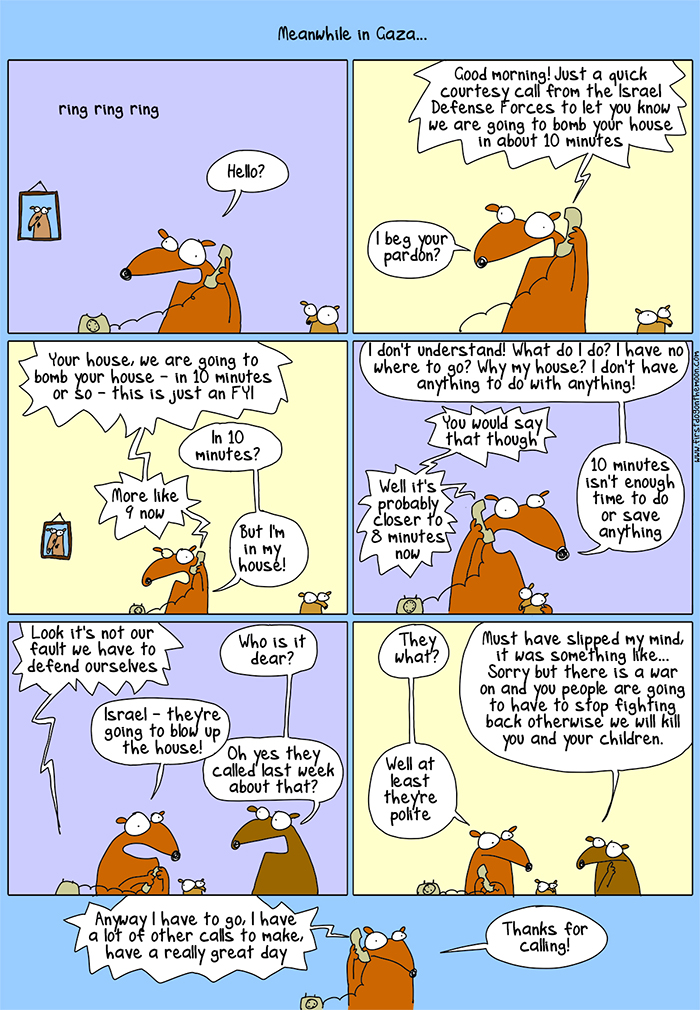
rise was connived at.  So skipping over a few steps, we now have Palestinians confined in what is habitually referred to as the world’s largest open air prison in Gaza for the crime of having been expelled from their land.  Much more needs to be said – my thoughts on the Guardian cartoon (21st July), Hamas and the Talibanisation of Gaza, how can I justify being so exercised about Israel as opposed to for example Sri Lanka, why the state of Israel should be dissolved, what's the point of holding such an unrealistic opinion, and how it differs from Hamas.


As a final instance of displacement activity, I'll just praise Barry Mulligan of Co Sligo for using the verb form “learnt” as distinct from “learned” in his letter. This is now regrettably rare, in both spoken and written English, but for how long it's been rare I'm not sure. I intend to find out, and when I do I'll let you know. But Barry earns a brickbat as well as a bouquet. "World War II" is a dreadful expression which should be banned. The name of the war, in English, is the Second World War. 


Tuesday, July 1, 2014

Of mosques and chimneys in the Algarve


We spent last week in Albufeira on the Algarve.  Not the place to go, according to the Rough Guide, if you're looking for unspoilt Portugal, but it has an archaeological museum of which more below. The image on the left is an ornament in the garden of our apartment block. It's a typical Algarve chimney, and if you look closely at the image on the right, the view from our balcony, you'll see several more, all inspired by Moorish design. Probably not in use, as none of them are sooted. 

But used or not, a remark by our tour guide Carlos led me enquire into the history of Jews and Muslims under Christian rule in Portugal. Pointing out these distinctive Algarve chimneys, Carlos told us they are descended from minarets which Muslims erected on their houses after the Christian reconquest when all the mosques were abolished. And their Christian neighbours were so impressed with these domestic minarets that they copied them, and over the course of time the minarets became chimneys. This tale had a dubious ring to it, and I checked it out with the archaeologist at the local museum, a helpful lad called Luís, who flatly contradicted it. It's a story favoured by anthropologists he told me, for which there is no archaeological evidence.  These Moorish chimneys first appear in the 18th century.

Nonetheless, all this set me wondering about the lives of Muslims immediately following the reconquest. Reconquest by the way is a highly loaded term but it's the cornerstone of Iberian historiography and usually capitalised as “Reconquista”.

My reason for disbelieving the story about minarets and chimneys was the implausibility of Muslims wishing to advertise their presence when their religion was banned and inquisitors were prowling around. But since coming home I've done a bit of digging and discovered that my reasoning was quite mistaken.

Iberia in 1147 (Wikipedia). No-one in 1147 would have predicted that by the 16th century Muslim rule would be finished and all the Christian kingdoms except for Portugal would be merged and called Espania. In this map The Algarve is still part of Almohad territory. It was conquered by the king of Portugal in 1250.
Because for at least 250 years there were no inquisitors. Religious pluralism was the rule. After the reconquest, Jewish and Muslim minorities of various sizes cohabited more or less peacefully alongside a dominant Christian population. Jews and Muslims were permitted to practise their faiths and live in autonomous communities under royal protection, provided that they paid discriminatory taxes and did not challenge the Catholic religion. All this I got from Google Books: The persecution of the Jews and Muslims of Portugal: King Manuel I and the end of religious tolerance (1496-7) by François Soyer, 2007.

This history of religious toleration under Christian rule was quite new to me and it set me wondering, during this time, where did the Muslims pray? Because the way I've heard it, as soon as the Christians conquered a city they converted all the mosques to churches.  

I've had a long email from François dealing with that question, but as I've probably gone on long enough, I'm going to put all that in a separate file so you can follow it up if you're interested. Other questions I've looked at are: how did they view mosque to church conversions, what distinctions were made during the period of religious pluralism between Jews and Muslims, and how did the regime compare to Christians and Jews under the previous Muslim rulers?

A final note about those chimneys. I've heard that identical chimneys, though perhaps less elaborate, exist in North Africa and Spain. And by the way if despite the Rough Guide you decide on Albufeira I can highly recommend the apartment - we'll probably go back next year. Look up Apartamentos Rainha D. Leonor.

Friday, May 30, 2014

A statue of a king with horse's ears, perhaps


On a trip to Armagh with Cork Astronomy Club I missed the tour of Armagh Observatory but in the crypt of Armagh protestant cathedral I was delighted to find this statue. The photo, I fear, is unprepossessing, but it's the best I could do. It's either of Lowry Lynch or Queen Macha.  I hope it's Lowry Lynch, because I like his story, which I'll outline in a minute.

The protestant (Church of Ireland) cathedral is built on Ard Macha – the Hill of Macha, which gives Armagh its name.  It is this hilltop enclosure which St Patrick is said to have acquired and within which he built his first ‘Great Stone Church’.  If that story is true, there's been a church on this site since the 5th century.

Armagh Church of Ireland Cathedral
As to Macha, she was an ancient goddess, or a warrior queen, a key figure in the Ulster Cycle, a series of pre-Christian tales that have deep historical significance for Armagh. These tales are the spiritual account of the early Celtic people of Ulster and tell of legendary warrior heroes and heroines who fought great battles against Queen Maeve and the warriors of Connaught. 

Horse’s ears

The statue is medieval and eroded and stands between two and three feet high.  It was found somewhere on the site, but I couldn’t find out much more about it; perhaps not much more is known. The cathedral guide, a very helpful fellow who took me on a personal conducted tour of the crypt, told me the statue is either a bare-breasted Queen Macha holding her bow aloft, or else King Lowry Lynch holding out his horse’s ears.  Lowry Lynch was ashamed of his horse’s ears and each time he had his hair cut he put the barber to death so he couldn’t tell. But at length his shameful secret was told by a singing harp, and Lowry Lynch repented of all the barbers he had put to death and admitted his shameful secret.

And maybe, the cathedral guide told me, this statue is him doing just that, in an it's-a-fair-cop gesture.

For the full Lowry Lynch tale and the Greek myth of King Midas on which it is based, you can read a children’s story I've written.


Monday, May 26, 2014

In which I keep bad company and rant


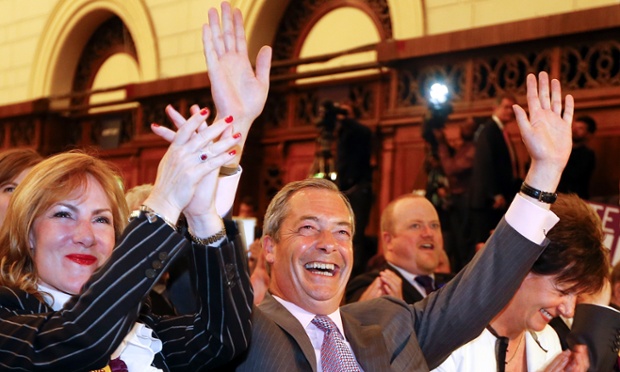
I know otherwise sensible people who share in Farage's celebration of what the Guardian agrees is a political earthquake - 28% on the national poll in European elections last week
This is scarily reminiscent of the 1930’s. We have rampant capitalism imposing austerity on the population, huge numbers of whom – in Britain, France, Greece and elsewhere - reach entirely the wrong conclusion and vote for far right parties. And we have a right-wing European dictator pretending to be a left-wing dictator gobbling up pieces of other countries claiming that "his people" are being maltreated, to cement nationalistic sentiment at home and distract attention from him cosseting billionaires. Not for the first time Prince Charles is right though I seem to be in bad company because when I google this proposition all I get is Fox News and other undesirables.  I read a comment piece in The Guardian trying to convince me that I'm wrong about the Putin/Hitler analogy. I forget where and when I read it but it didn't succeed in its purpose because I remain unconvinced.

I regret the foregoing is a bit of a rant and falls short of the standards I normally aspire to but it will have to do for now.

Tuesday, May 6, 2014

Reflecting on arrest of Gerry Adams


I'm bringing you the thoughts of two columnists in today’s Irish newspapers.  Writing in The Irish Times, Fintan O'Toole says there are two ways of dealing with the legacy of the atrocities: all or nothing. And the McConville case signals a pressing need for an independent commission of inquiry.

He is reflecting on the 1972 abduction, murder and disappearing of Jean McConville, about which Sinn Fein [1] leader Gerry Adams has been interviewed by the Northern Ireland police, and though released on Sunday, may still be charged. It's an atrocity that cries out for accountability, says O’Toole (and if you want to be persuaded of this, listen to a BBC interview with her son, age 11 at the time – he says he knows but daren’t say).

But O'Toole goes on to list numerous other killings – “murder after bloody murder” – about which the same can be said.

No special victims and no special perpetrators

His conclusion: if Gerry Adams had anything to do with the killing of Jean McConville, he should answer for his actions. But it would be far better if he gave those answers to an open, independent commission with a remit to investigate all unsolved killings by state forces or by paramilitary organisations. If, by design or accident, Adams seems to be singled out, while other crimes are ignored, the cycle of selective memory and selective amnesia will go on. There are no special victims and there must be no special perpetrators.

I simply don’t believe him

Also worth reading is a piece by another of my favourite columnists, Fergus Finlay in today’s Irish Examiner, under the headline Adams’ arrest a grim reminder of how fragile the peace process truly is.

“Like thousands of others” says Finlay “I simply don’t believe him when he says he was never in a leadership position in the IRA. But I also believe that without him, the process of ending the violence in Northern Ireland would not have succeeded …  he did succeed in bringing a largely united movement from violence to democratic participation, and that was a historic achievement.”  Finlay also suggests, probably wrongly I think, that Adams could have done this much faster had he wished. 


Left: Thousands believe only the words on that new mural about Adams — leader, peacemaker, visionary. Though the Irish Examiner’s Fergus Finlay is not numbered amongst them. Right: Michael McConville knows but dare not say.
But I want to return to Fintan O’Toole, and to quote him at length (green, with my interpolations in black). Amongst atrocities on a par with the one Gerry Adams is now accused of, O’Toole cites Ballymurphy.  Long after the British army’s parachute regiment left the west Belfast estate of Ballymurphy in September 1971, he writes, one of its members, Harry McCallion, recalled with pride that “we had over 15 confirmed kills but had claimed many more ... It was merely convenient for the IRA that most of them had not been sworn in as members.” 

These “kills” had not been sworn in because they were not members of the IRA at all; they were innocent civilians. Eleven of those killed by the Paras between August 9th and August 11th, 1971, were unarmed. Among them were a Catholic priest, Fr Hugh Mullan – who was clearly carrying an improvised white flag made from a babygro – and a mother of eight children, Joan Connolly, who was shot multiple times as she went to help a wounded boy. These events happened in the chaos of the introduction of internment, when the IRA launched concerted attacks on the British base in Ballymurphy. But the evidence strongly suggests that the victims were not caught in crossfire – they were killed by enraged soldiers in what were, at best, acts of appalling recklessness and, at worst, deliberate murders.

Last week, shortly before Gerry Adams was arrested, Northern Ireland Secretary, Theresa Villiers announced there would be no independent inquiry into the Ballymurphy killings. Sinn Féin rightly pointed to the outrageous double standard implied here. But Villiers also announced that there would be no inquiry into the hideous La Mon hotel fire-bombing in 1978, when the IRA incinerated 12 members of, of all things, the Irish Collie Club. The families of the La Mon victims believe, rightly or wrongly, that transcripts of police interviews with IRA suspects relating to this disgusting crime were deliberately removed from the files in order to protect senior figures of importance for the peace process. Did Sinn Féin complain about the continuing failure to give the La Mon families the comfort of truth? Of course not – it has double standards about double standards.


To make sure the unionist UVF get a mention, he also cites the McGurk’s Bar bombing of December 1971, in which 15 people died. 

People with guns killing people without guns

While the gunmen on all sides preened themselves with talk of “kills” and “war”, the truth is that the conflict was largely about people with guns killing people without guns. So-called republican and loyalist paramilitaries lost between them 563 members. Well over three times as many defenceless civilians were murdered (1,879) – mostly by paramilitaries but in some cases by so-called security forces in or out of uniform. The slaughter of the innocents was not a byproduct of the Troubles – it was the main event.

Competitive necromancy

It was not enough, though, for these poor people to die once, to be the human fuel for a conflict that careened obscenely onwards long after it had lost any semblance of logic. Like souls in Dante’s hell, they have been given an excruciating punishment; they are recruited to fight, again and again, in the strange meta-conflict that replaced the real one – the fight over which of the perpetrators can claim the coveted status of victimhood. There is, rightly, lingering outrage about the IRA’s “disappearing” of victims like Jean McConville, the denial of a decent burial. But in a sense, most victims are still denied a decent burial. Their bodies are figuratively dug up and paraded through the streets or dumped back again into the abyss of amnesia, depending on who needs them for what political purpose. Tribal disputes are still conducted in part as a form of competitive necromancy.

There are just two decent ways of dealing with the legacy of these atrocities: all or nothing. The nothing option has a certain integrity – it at least prevents the political exploitation of the dead. But it denies to bereaved families the right to know what happened to their loved ones. The only way to counter the exploitation of the dead is to start with the most obvious thing about them – that they died horrible, untimely deaths. Death brings a terrible equality: it does not discriminate between Protestant or Catholic, uniformed policeman or masked gunman, or even between innocent and guilty. Every violent death was a rending in the fabric of the lives of spouses, children and families. Each deserves acknowledgement – not for any political purpose but for its own sake and as a condition of a civilised society.


[1] Sinn Fein is an unusual political party in that it embraces two states, Ireland and Northern Ireland, and Gerry Adams is leader of the whole party in both.