Friday, November 5, 2010

What’s secularism?


Been giving some thought recently to secularism, and the distinction between secularism, secularisation, atheism, humanism.  Many loose ends to be woven together.  This interest, previously dormant, was aroused by an excellent Canadian radio programme in April. (Sadly this is no longer available for downloading on the CBC website.) Next came the Pope’s speech on 17th September at Westminster Hall against aggressive secularism, which at first I was inclined to dismiss out of hand but now I think needs a more considered response.

Other strands to be gathered up include :
  • A blasphemy law introduced in Ireland in (would you believe) 2009. 
  • An episode from Irish history in the 1950’s known as the Mother and Child scheme. 
  • And my belief that Richard Dawkins’ atheist bus was naff. 
The Dawkins atheist bus - naff
A lot of thinking to be done and I'll blog about these things one at a time as I sort them out in my head.  For now, here are a few links.
 
First, an article in the Irish Examiner 9/1/2010 on the subservience of Irish governments in the first half of the 20th century to the Catholic hierarchy.  “We’ve moved on from the days when Rome ruled our Republic” by Ryle Dwyer.  It’s a representative sample of a recurrent theme in Irish journalism. In this particular article, the finger of blame for a disgracefully subservient demeanour towards the church is pointed at the coalition government that ousted DeValera in 1948, whilst DeValera himself is exonerated from the charge.

For the Pope’s 17th September speech at Westminster Hall, see the Irish Catholic (and the full transcript on the BBC website.)

''Religion is not a problem for legislators to solve, but a vital contributor to the national conversation … I cannot but voice my concern at the increasing marginalisation of religion, particularly of Christianity, that is taking place in some quarters, even in nations which place a great emphasis on tolerance.  There are those who would advocate that the voice of religion be silenced, or at least relegated to the purely private sphere.” 

I'm torn between sympathising with this point of view, and dismissing it as the wheedling of a bully who has finally met his match.  More of this in the future.

On the topic of humanism, try downloading this 20-minute interview with Greg Epstein (an atheist and the Humanist Chaplain at Harvard University) about his book, Good Without God (NPR Fresh Air December 23, 2009)
 

Thursday, November 4, 2010

The Tower of Babel


Have written the story of the Tower of Babel.  And I've now moved it and all other children’s stories to a separate blog :-

http://peterhouseholdstories.blogspot.com/

Sunday, October 31, 2010

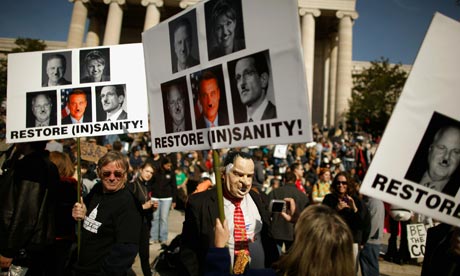
Jon Stewart's Washington rally to restore sanity (or gentility?)


Source : Guardian, comment is free

An American correspondent calls this rally which took place yesterday ahead of the congressional elections encouraging, and has sent me this link to story on the New York Times website. 

And here's a link to the Guardian website covering the same event.

No comment


from New Scientist graduate careers
supplement, 23 Oct 2010

Saturday, October 30, 2010

Want to see trucks like this?


A final decision on introducing mega trucks has not yet been made on a European level even though they were rejected last year by the European Transport Commissioner, Antonio Tajani.  This comes from the Environmental Transport Association (ETA). See their website which includes a video.

These ‘mega trucks’ would be massively longer and heavier than what is currently permitted. 60-tons as against 40 tons,  25 metres long as against 18.25 metres.

40 tons,  18.25 metres is the current maximum permitted for a lorry in Britain.  (And in Ireland too I presume.)

In comparison, a Boeing 737-300 carrying its maximum 127 passengers weighs 57.6 tons at take-off, making it lighter than a mega-truck, says the ETA, which is part of a pan-European coalition of organisations against the widespread introduction of these trucks. 

A small group of thoughtful people - the only thing that ever changed the world


Read Osborne’s comprehensive spending review and imagined myself back in my role as a trade union convenor. I just couldn't do that any more.  Then I saw an article in the Guardian saying the majority of the population support the cuts. Made me feel ill. Then I read this article in the London Independent by Johann Hari and felt a lot better: Protest works. Just look at the proof.

Thanks to Phil for this.

It finishes “Never doubt that a small group of thoughtful people could change the world. Indeed, it's the only thing that ever has.” (This is by Margaret Mead.  I once knew who she was but I've forgotten. See 42 other quotes here.)

Monday, October 25, 2010

You wouldn't see this over here! CNN anchor belittles Republican candidate


On 19th October, Tea Party supporter Christine O'Donnell, who is the Republican candidate for Senate in Delaware, made a fool of herself in front of an audience of law students by questioning where in the Constitution the separation of church and state appeared. Commentators have called her a national phenomenon and suggested she may even knock Sarah Palin off her perch at the top of the Tea Party.

Watch the video. Lasts 4:45 minutes 

(By the way, the Republican party establishment was deeply unhappy with O'Donnell winning the primary and getting to be the Republican candidate for the seat, but that’s another story.)

What's on my mind right now, is the difference between American TV and what I'm used to.  The first time I played this I thought it was a Democrat campaign video. Only when I played it a second time, did I appreciate that it was actually part of CNN’s news output.

The video is introduced by Anderson Cooper, a high-profile CNN anchor. A Paxman figure I guess?  It starts with a clip from a debate hosted by a law school, between O'Donnell and Democrat opponent Chris Coons. They are sparring over the teaching evolution in schools. First O’Donnell displays her ignorance of the First Amendment, to guffaws from the audience. Then we get Cooper’s derogatory comments and a series of quickfire clips of O'Donnell digging her grave by spouting about the Constitution. Terrific stuff.

O'Donnell is shown parading a "graduate fellowship from the Claremont Institute in constitutional government".  Cooper the CNN man demolishes this with : "By the way, the graduate fellowship she talks about from the Claremont Institute? The Claremont Institute is a conservative think tank, it's not a university, and the fellowship lasted a grand total of seven days ... A lot of people, including myself, get confused about constitutional amendments," Cooper says. "But not a lot of people are running for senate based on their deep analysis and study of the constitution."

The thing is, I can't imagine the BBC or RTÉ screening something like this. It would be called partisan.  I've never really watched much CNN, and I had a mental image of it as being firmly rooted in the right of politics, a sort of Fox News lite.  Clearly I got that all wrong! 

... and climate change a scientific fact ...

And another thing you wouldn't get on the BBC or RTÉ.  Here's an 11-minute piece from a radio programme called All Things Considered on NPR (National Public Radio) describing how a Republican victory in the upcoming congressional elections may mean defeat for Obama’s climate change policy. 

The presenter starts as follows: “The more carbon that gets released into the atmosphere, the higher the average temperature rises. That's a scientific fact. Human activities, such as driving, flying, building and even turning on the lights, are the biggest contributor to the release of carbon. That too, is a fact. And yet the majority of Republicans running for House and Senate seats this year disagree.”

Would you get a BBC or RTÉ presenter stating climate change facts this baldly?  Especially when it's explicitly a party political issue, as it is in this story. Wouldn't it be “most scientists says” or something along those lines?