Friday, May 7, 2010

UK general election - not staying up


Am I staying up all night for the UK general election.  Indeed not. Why would I want to depress myself. 1997 was fun with all the exploding blue towers and Portillo and everything and for one night with the wine flowing we could all pretend to believe socialism had arrived.  
I've already heard talk of an 8% swing to the Tories. That's quite enough for now.

Thursday, May 6, 2010

Stephen Hawking says don’t phone ET


The Arecibo radio telescope broadcast
a message to ET, causing a level 8 hazard
Around the end of April Stephen Hawking presented a TV programme on the Discovery Channel. I didn’t see it but it was called Stephen Hawking's Universe: Fear The Aliens, and from reports I've seen it seems he argued that it’s dangerous to send signals into space because if aliens pick them up they are likely to come and get us.

This question of should we or shouldn't we send signals into space is controversial within the SETI community (search for extra-terrestrial intelligence). The astronomer and former BBC science correspondent David Whitehouse said: “The civilisation that blurts out its existence might be like some early hominid descending from the trees and calling ‘here kitty’ to a sabre-toothed tiger.”

Back to Stephen Hawking’s programme, I saw a critique of it along the following lines : Stephen Hawking is a physicist not a SETI expert, so his views should be given no special weight.   This statement must bring a smile to the lips.  What special expertise, pray tell, does a SETI expert possess when it comes to figuring out if we are under threat from hostile aliens?

Ha! they reply.  We have the San Marino Scale – bet you didn’t know that, eh?

Well, no I didn’t know that, so lets look it up.  Here it is : http://avsport.org/IAA/smiscale.htm

This scale is used to gauge the risk to humanity of broadcasting messages into space. It was adopted by the International Academy of Astronautics in 2007.  The index runs from 1 for an insignificant potential hazard to 10 for an extraordinary hazard. The number is based on intensity of the signal (on a logarithmic scale no less), its duration and information content.  For example, in 1974 the Arecibo radio telescope broadcast a message which included depictions of a man and woman, and the DNA double helix, all encoded in binary.  On the San Marino Scale this would score an 8, meaning that the potential hazard is far reaching.  9 on the San Marino Scale is an outstanding hazard, and 10 is as bad as it gets : an extraordinary hazard.

Am I wrong to poke fun at this stuff?

I'm working on a lecture to give to Cork Astronomy Club sometime within the next year or so called “Just because we can does that mean we should?” and I'm going to include this question,  as light relief mainly.  The main focus will be on colonising Mars, (on which I have a separate post if you're interested), and on crewed as opposed to robotic space exploration.

Tuesday, May 4, 2010

My favourite podcasts


Following a worldwide search, I can confidently assert that the BBC’s In Our Time is the best podcast in English.  Its remit in the history if ideas - science, philosophy, history, religion.  What gives In Our Time its edge is that it’s broadcast live (9am Thursdays) without editing.  There’s a newsletter and a listeners debate page, sometimes very illuminating.
You can access a substantial archive of past episodes, but you can't download, you can only “listen again” online. Downloading must be done within 7 days of the episode being broadcast. This rule applies to all the BBC’s output so far as I know, but doesn’t seem to apply to other broadcasters.
I often make notes of In Our Time episodes, including extracts from listeners’ comments and the newsletter. Available on request.
My best 3 - The Translation Movement, The History of Optics, The Nicene Creed
Other BBC favourites are The Forum (World Service), Start the Week, and Woman’s Hour, also two programmes dedicated to religion: Sunday, and Beyond Belief.
Next a few words about science podcasts. There’s a strong field, and I like that all of them touch on the philosophy of science, including science and religion issues. Top of my list is The Guardian’s Science Weekly, with the Nature podcast next.
The SETI institute’s Are We Alone needs a mention. You may wonder if this is a restricted zone for ET enthusiasts. Not so!  It's good science, often lacking any obvious connection with the Mekon. If the presenter Seth Shostak ever tires of physics he could make a living in comedy.
Also worth a look : Science and the City (New York Academy of Sciences), and the CBC’s Quirks and Quarks
That’s all I want to say about science.
Next, RTÉ.  Here is the list of podcasts.   My No 1 is Off The Shelf
There's a separate page for past series of which my best 3 are: Icons of Irish Science, Judging Dev, and Our War (Ireland and the First World War)
I also need to mention:- 
Words at Large (books), and Ideas (politics and philosophy) are top class.  I've already mentioned the CBC science programme Quirks and Quarks,
In 2008 or thereabouts the CBC produced a 24-part series called "How to Think About Science"  Top class. My favourite Best of Ideas episode: Living on Oxford Time, 21/7/08.  It includes Roger Penrose and his notion that time may not exist, it's all bound up with consciousness.
Top here is The Diane Rehm Show (daily, politics, current affairs), and Fresh Air (extended interviews on almost anything. I sample the site from time to time rather than subscribing to the podcast)
NPR Shuffle is a daily sampler from various mainly current affairs broadcasts. Also try It’s All Politics (weekly, takes a narrow view of “politics”, but informed and entertaining) and The Talk of the Nation Opinion Page (daily interview and phone-in with the writer of a controversial op-ed). NPR also has a science programme called Radiolab which I haven’t heard but it has won an award.
1. Background Briefing. Episodes worth mention :
2008-03-30  The three trillion dollar war - Joseph Stilglitz on the Iraq war
2008-04-06  The climate engineers - the politics and ethics of global climate control is even more interesting than the science.  Transcripts available.
2. Late Night Live – daily - politics, history, philosophy, current affairs, sometimes excellent, sometimes annoying.
3. The Ark is no longer broadcast but the archive is still available on the website. History of religion, taken in a broad sense - for example one episode was devoted to the claim that an Arab astronomer anticipated Copernicus by 200 years. This little programme used to pack a lot into 20-minute episodes. Transcripts available.
4. The Philosophers Zone and All in the Mind.

Love your home!


My late mother was brought up in Luleå in the north of Sweden. I've only once visited Luleå in winter, and that was for my grandfather’s funeral which was around 3rd January, some years ago. On the morning of the funeral the temperature was –40C. My uncle Sture scandalised his sisters by standing around not wearing a hat; but Sture is a physicist and knew that the stillness of the air caused his head not to feel the full force of the cold.

Afterwards my uncles and aunts were walking along the street, with me following close behind listening.  Now it happens that with the exception of my aunt Kerstin they have long ago all migrated to regions of Sweden much further south; and this was the tenor of their conversation: “In winter 40 degrees of frost and no sunlight, and in summer sun all night and no sleep. Who can possibly live in this inhuman climate?”  Wrong, wrong, wrong I thought to myself, this is wrong. Whatever the climate home is home and you should love it. I said so, but my words cut no ice with them.

The truth is I love the light nights of summer and can't see how anyone could possibly disagree. Once I played a game of Pontoon with my cousins round our grandmother's kitchen table, we sat down at about 11 pm and got up from our game at about 2 am, by which time the sun was streaming in. At no point during the night had anyone thought to get up and switch on the kitchen light.

For a photo see Midnight in Luleå

Thursday, November 12, 2009

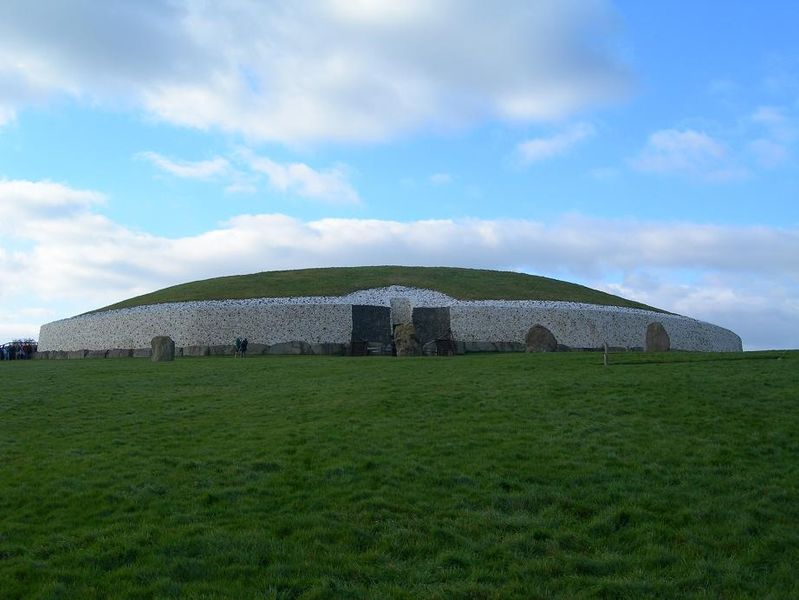
New Grange restored all wrong?


To a lecture about New Grange, by Dr Liam Irwin of Mary Immaculate College, Limerick. It's a neolithic monument not far from Dublin, similar to the pyramids in scale, and a bit older (3200 BCE).


The lecture provoked the question, should archaeologists refrain from restoring ancient monuments? Perhaps they should just build a replica somewhere else instead.
The colour picture shows New Grange restored. The black and white picture shows how the entrance to New Grange looked in 1905. It turns out the restoration is controversial. The high wall should probably be a low sloping retaining wall. But Liam says there's little appetite to change it again. Knossos has the same problem apparently. Prof M J O’Kelly was responsible for the New Grange restoration. Not clear when the work was done, 1970’s?

It’s a tomb. There are 4 types of megalithic tomb in Ireland of which this one is a passage tomb. A chap called I think O’Callaghan stood up and dissented. Said it wasn’t a tomb at all. Perhaps the bones had been brought in by wolves in the modern period, he suggested. I suspect he is not to be taken seriously.

The building materials were brought by sea. Would have taken more than a generation to build. The architect wouldn't have lived to see it completed.

Their houses were flimsy, can only have lasted a couple of generations, but the tombs were permanent and must have diverted huge resources from agriculture and subsistence. Why did they do it? Religion? Belief in afterlife? Fear? Duty? Forced labour?

Gold Roman coins have been found on the site. How to interpret these? Left by Roman tourists, or by pilgrims? Are they evidence of strong connections between Ireland and Roman Britain?

Local buses run from Dublin. Must go there sometime. Maybe Cork Astronomy Club will organise another trip there someday. I missed the last one.

This was a lecture was given to Fermoy Field Club. Dr Irwin told us that Prof O’Kelly was his teacher.


Sunday, October 4, 2009

Against preserving the human species


An imagined Mars colony
(Don Dixon Space Art)
There may be good reasons for colonising Mars. But preserving the human species isn't one of them. Nevertheless it’s a motive that’s often cited when colonising Mars is discussed.

J Richard Gott (professor of astrophysical sciences at Princeton University) wrote in New Scientist 12th Sept 2009 (p 35) that a self-supporting Mars colony would make the world a better place, by making the world not the only place for us, thus improving the long-term survival prospects of our species.

I say, firstly, if we spoil this planet, how can we claim to deserve to survive as a species? One of the first lessons we teach a child, is that you clean up one mess before you make another.

Secondly, it's not self-evident that the survival of the human species is a worthwhile goal. The right to survive must be earnt, not assumed. If we can create a just society amongst existing humans, then we shall have earnt that right. Until then, not.

I'm not arguing against space exploration, nor even against colonising Mars. But lets get the reasons right. I say that the scientific enterprise is justified by one criterion only: that it contributes to human happiness. A Mars colony would contribute to science, it would be a human achieving without parallel, it might conceivably bring economic benefits. All those are worthwhile aims.

But the following are not worthwhile aims : providing an escape route for a privileged elite; and ensuring the survival of a species that has proved itself unworthy.

One of the most prominent scientists who think preserving the human race is a reason for colonising space is Stephen Hawking. He says : "Life on Earth is at an ever-increasing risk of being wiped out by a disaster such as sudden global warming, nuclear war, a genetically engineered virus or other dangers". [1]

Now whilst Hawking is right in his premise, he's wrong in his conclusion. The extinction of the human species is not the worst consequence that could flow from the disasters he enumerates.

Firstly, it’s really human civilisation that stands in danger of being wiped out; a number of humans would almost certainly survive any of those catastrophes to perpetuate the species. Even supposing that is what he really means, the key point is that those catastrophes would be the occasion of much suffering, and this would fall disproportionately on the poor and disadvantaged of this world. The very people least responsible for any man-made catastrophes. And the least likely to be emigrating to Mars.

Avoiding that suffering is the only goal which is worthwhile. And it's a goal that preserving human civilisation on Mars contributes nothing to.

[1] New Scientist 5 May 2007 (issue 2602). Another similar link here. And he's still at it in June 2017.

Tuesday, September 15, 2009

Jesus, the ancient Jews and monotheism


Skip this one unless you like theology.  Recently I've corresponded with a Dominican Friar called John who lectures in philosophy and theology at San Antonio University in the USA.  I raised some theological questions with him, including whether Jesus claimed to be the Son of God. This particular question interests me because I have a God-fearing cousin who says Jesus did so claim. I disputed this with him, on the grounds that the only gospel where these claims appear is John, and John is not to be relied upon.  I quoted the views of the Jesus Seminar on this point; but he dismissed them as heretics. Our debate was sadly not a fruitful one ...   

Anyway back to John the Dominican.  On the question of Jesus' use of titles and his knowledge of his divinity, he says this:-
“I doubt that Jesus ever referred to himself as explicitly divine, although I do think that he may have seen himself as the prophetic embodiment of the "son of man".  It is so obscure that it is not clear that the apostles would have picked it out for him if he had not used it about himself.  But what exactly he meant by using this title is simply unknown. Jesus' intuition about his divine mission and mandate certainly did not become fully clear to him until the end of his career - and even he did not expect the resurrection (although he clearly expected some kind of divine vindication). This is a whole other discussion, but I think that it is quite interesting and hardly settled.”
On the reliability of John’s gospel, he has this to say:
“I do not think that John is reliable as a historical document in the modern sense - it is certainly not intended that way.  It is clearly an explicit theological reflection on the life, death and resurrection of Jesus written by someone who was very close to someone who had been there. I think that the author is trying not only to clarify Jesus' identity (both human and divine), but also to help explain what Jesus' identity says about the God that Jews have always believed in.  So Jesus' consciousness acts as a point of meditation and reflection on the plan of God.  That said, the author may well have believed that Jesus has explicit rational consciousness of his identity and mission from the beginning; it is possible, but I don't think that it is probable.”
Ancient Hebrews did not refer to their deity as God

I asked John the Dominican about the development of monotheism, and the question of when the Jews came to believe in one God; and I sought his comment on the words used in the original Greek and Hebrew of the Bible, which are commonly rendered into English as “God”, and what if anything we lose by this translation. He startled me by offering this:
“I am pretty sure that the ancient Hebrews did not mean to refer to their deity as God - God is a term that emerges out of Greek philosophy, and only becomes the general term for the divine powers or forces in early years of the Roman empire.  Monotheism is a concept that was created long after the Hebrew texts were written and only applied to them subsequently. Like any outsiders trying to understand the language system of another, sometimes it is best to just leave certain words or colloquialisms as they are and over time, if we use them frequently enough, we will get the sense of what they really meant. This is why we should not ever fully trust translations - they are always tentative and in need of revision.”
Later he elaborated:-
“I think that the Hebrew people believed that YWHW was their God and the one ‘true’ God - greater than any 'puny' gods of the pagans.  I think that this means that they did not deny the existence of other ‘principalities and powers’ in the world, but denied their power to ‘save’ - they had no ultimate power over human destiny. For the Hebrews their God was the Lord - he had power over all. Jesus would have probably used the term Lord (addonai) to refer to God. He seems to reject reliance or belief in gods other than YHWH as superstition, but does seem to acknowledge other ‘spiritual’ or invisible forces or powers in the world.  But these are not God, and the Lord has power over all of these forces.  What I am saying is that the Jews did not know that they were monotheists - unlike Islam which explicitly claimed to believe in ‘one’ God.  The Hebrews seem mainly to be interested in their God and his power.  The Greek system will categorize them as monotheists, but this is too narrow to explain the rich notion of the Hebrew people's relationship with their God.” 
That’s what I got from John the Dominican.  Karen Armstrong in her History of God draws attention to Psalm 81 (82).  
“ God presides in the great assembly. He judges among the gods. ‘How long will you judge unjustly, and show partiality to the wicked?’ “ (World English Bible)
The Psalms, it turns out, are amongst the oldest books in the Old Testament and we have in this passage the clear view that the Jewish god is one amongst many.  Incidentally, most translations I've seen don’t even give God the presiding role in the divine assembly - he upbraids the other gods from the floor of the meeting, so to speak. 
Armstrong provides an alternative translation by John Bowker – “Yahweh takes his stand in the Council of El to deliver judgement among the gods.” So El is the presiding god here, not Yahweh.   
In the New International Version they put “gods” in quotes. The typographical equivalent of holding your nose I suppose.