Thursday, May 31, 2012

The first ever Transit of Venus - is this picture right?


"The Founder of English Astronomy", a painting by Eyre Crowe, 1891
I hope someone can tell me exactly what is going on in this 1891 painting, where the artist Eyre Crowe imagines Jeremiah Horrocks at the moment he witnessed the 1639 Transit of Venus.  What an evocative name. The goddess of love, and the brief and transitory nature of existence. The next one is in 6 days time on 5th or 6th June (depending on where you are [1]). In Ireland it's at dawn on Wednesday June 6th, and only the last few minutes will be seen, just as the Sun rises. And the next after that will be December 11, 2117 (a Saturday). [2]

In the painting Horrocks is projecting the image of the Sun, with Venus a small dark spot crossing it, on to a piece of card, on which he marks Venus’s trajectory.  

The 2004 transit (Wikipedia)
The event depicted is taking place late in the afternoon of 4 December 1639. Does the horizontal alignment of the telescope imply that the Sun is just about to set? Or am I trying to over-interpret Eyre’s painting? Perhaps he didn't know much about astronomy? I've seen it said that Horrocks actually used a camera obscura for his observation [3].

If the painting is right, then has Horrocks set up some arrangement of mirrors not shown?  How, I wonder, did he keep the telescope focussed on the piece of card throughout the transit, as the Sun and Venus declined in the sky?  And what is the contraption on the middle of the room?  

Horrocks witnessed the transit for about half an hour from 3.15 till sunset which might have been about 3.45 I suppose.  His prediction of when the transit would occur was accurate to (I think) a few minutes, but distrusting his calculations, he had been checking on the Sun continually, whenever free of clouds, for the previous 24 hours. Then just when the transit began, he was called away on urgent business (unspecified, but maybe as a clergyman he had to conduct a church service) so missed the beginning of it.

All this is in June’s edition of History Today which I saw in the public library in Cork but sadly don't have to hand as I write this. This link shows the first few paragraphs only.

Horrocks was the only person to predict the 1639 Transit, and he and his friend William Crabtree were the only two people to observe and record it. Horrocks was just 21 at the time, and died two years later. What a loss to science.  In several books I've looked at, his name doesn't even appear in the index.

Measuring the solar system

Venus transits are big events in the history of science.  In 1761 and 1769, astronomers undertook extraordinary expeditions to far-flung locations in the first global scientific collaboration.  I can recommend a Nature podcast on this. [4]

They were hoping to use their observations to calculate the size of the solar system. You can use a Transit of Venus to do this by comparing observations from widely different latitudes on Earth, and using the principle of parallax, trigonometry, and Kepler’s laws of planetary motion, which tell you the relative (though not absolute) distances of each planet from the Sun.

The June 2012 transit will help scientists to refine techniques to be used in the search for exoplanets, some of which are detected when they transit their stars.

[1] Worldwide map issued by NASA showing regions where the 2012 Transit is visible from, and when.

[2] The recurrence pattern is gaps of:  8 years, 121 years, 8 years, 105 years.

[3] John North, Fontana History of Astronomy and Cosmology (1994), p 349.

[4] Chasing Venus : Nature Podcast Extra (16 minutes).  Nature is one of the foremost scientific journals. Subscribe to their podcast and hear scientists talking to scientists.  As a taster try the episode of 26 January 2012, available on this page: hunting for 2,500 year old shipwrecks off the coast of Crete, insights into Alzheimer's from reprogrammed cells, and a research tool called 'primitive facebook' with hunter gatherers in southern Africa.


Why I'm voting No in the Irish austerity referendum


Socialist Party Vote No poster
To be honest it's only a gesture but gestures do matter. We’ve all heard the slogan a No vote is a vote against austerity. In itself that slogan sounds naïve - as the parties supporting a Yes have been quick to point out.

So a No vote is empty without a commitment to an ongoing campaign against austerity, and an expression of solidarity with the people of Greece. I'm afraid I'm too old and washed up to do a lot of campaigning these days but at least I'm supporting to the no household charge campaign. 

Incidentally the word austerity is much misused by politicians of the right, and most us have unwittingly fallen in with them. The original age of austerity was postwar Britain.  But the 1945 Labour government set up the welfare state and the NHS.  Look it up in a dictionary and you'll find austerity means the trait of great self-denial especially refraining from worldly pleasures.  But today austerity is being imposed because men in suits say that it’s necessary to satisfy the invisible gods of the financial markets, and it's used for a package of measures that increase inequality (already on the rise throughout the world for the past 30 years) and impacts mainly on the poor, and the people for whom worldly pleasures are already hard to come by.

The Irish referendum is to change the constitution to allow the government to sign up to the European Fiscal Stability Treaty, which will impose penalties on any government that runs a deficit budget.  It's supported by Fine Gael, Labour (the coalition parties) and Fianna Fáil, and opposed by the United Left Alliance and Sinn Fein. The vote is tomorrow.

A final point, there's no doubt a raft of new cutbacks and tax hikes has already been prepared, but will not be announced until after the referendum. The government got a fright from the backlash against the household charge, and you can be sure it is deliberately suppressing news.

Thursday, May 17, 2012

What scientists say about science


Anthologies of scientific quotations are already countless but here's one more. It was about 8 years ago I became interested in science when I attended an evening class in York on the Big Bang, following which Phil & Lindsay gave me Simon Singh’s book of the same title for Christmas. This was 2004. The book tells the history of astronomy; which turns out to be almost the same thing as the history of science itself. It's peppered with wonderful quotes, and that’s when I discovered that scientists are also philosophers.

In proof of which, I'm now going to treat you to my own collection of quotes by scientists talking about science. First a video clip of Richard Feynman describing the scientific method.  Feynman, who died in 1988, was an American physicist and Nobel laureate, and renowned as a spellbinding lecturer. Before PowerPoint, the lecturer’s skill was to hold their audience’s attention with their back turned writing on a blackboard.  The video was shot at Cornell University in 1964.  


This is what he says:  Now I'm going to discuss how we would look for a new Law.  In general we look for a new Law by the following process.  First we guess it.  No, don't laugh, that is the real truth.  Then we compute the consequences of the guess, to see what, if this law that we guessed is right, what it would imply.  And then we compare those computation results to Nature; or we say compare to experiment or experience.  Compare it directly to observation to see if it works.  If it disagrees with experiment, it's wrong.  In that simple statement is the key to science.  It doesn't make a difference how beautiful your guess is, it doesn't make a difference how smart you are, or what your name is.  If it disagrees with experiment, it's wrong.  That's all there is to it.

I've put together a 16-page compendium of my favourite quotations from scientists, but in case you don’t have time for that right now here are a few choice ones. First, one more on the scientific method, from Henri Poincaré, French mathematician, 1854–1912:

Science is built up of facts, as a house is built of stones; but an accumulation of facts is no more a science than a heap of stones is a house.

The biggest insight I got from Simon Singh’s book was that great scientists are normally very modest about science’s achievements, freely admitting how few of nature’s secrets have been unlocked, and perhaps will ever be unlocked.  Here's Albert Einstein on this theme:

Nature shows us only the tail of the lion.  But I have no doubt that the lion belongs to it even though he cannot reveal himself all at once because of his large size.  We can see him only the way a louse sitting on him would.

and:

Everyone who is seriously interested in the pursuit of science becomes convinced that a spirit is manifest in the laws of the universe - a spirit vastly superior to man, and one in the face of which our modest powers must seem humble.

Next Steven Weinberg, American Nobel laureate in physics, born 1933.

The effort to understand the universe is one of the very few things that lifts human life a little above the level of farce and endows it with some of the grace of tragedy.  On another occasion he said:  The more the universe seems comprehensible, the more it also seems pointless.

Some scientists have expressed surprise that the human mind can in fact understand anything about the universe at all.  Einstein (I'm afraid we can't avoid his name cropping up) expressed it this way, that the most incomprehensible thing about the universe is that it is comprehensible.  Eugene Wigner had a similar thought when he suggested that it is not at all natural that "laws of nature" exist, much less that man is able to discover them. *

Saving the best till last, what is science for?  Robert Wilson when Director of the US National Accelerator Laboratory, was obliged in 1969 to go in front of a congressional committee to seek government funding for the construction of a particle accelerator. 

Robert R. Wilson at the
Fermilab groundbreaking ceremony
(Wikipedia)
It would be 4 miles long and massively expensive, but he knew the only hope of uncovering the fundamental laws of nature, was to persuade governments to stump up costly kit like this.  Facing that committee must have been a critical moment in his career, and cross-examined by Senator John Pastore, Wilson had to answer the question he will have dreaded: would the project give the USA any advantage over the Russians in the Cold War?  

No, said Wilson.  It has no military application.  He continued:

What it has to do with is: Are we good painters, good sculptors, great poets? I mean all the things that we really venerate and honor in our country and are patriotic about.  In that sense, this new knowledge has all to do with honor and country; but it has nothing to do directly with defending our country, except to help make it worth defending.

Wilson got the funding: the accelerator was later known as Fermilab.  More in my compendium, page 10.

Wilson by the way has an interesting history.  A veteran of the Manhattan atomic bomb project, he was one of those scientists for whom the work raised deep questions about science and society.  In 1945, when Nazi Germany surrendered, Wilson attempted to raise the question at the lab of whether they should continue with their work. He deplored the actual use of the bomb at Hiroshima. He sounds to me like a good egg, and some day I'll write more about him, and other physicists who worked on the atomic bomb.  On page 16, I have quotes from a couple of them.

I'm putting this on my blog now as a sort of tribute to my friend Stu who died last week. Several years ago I showed him an early draft of this collection of quotes and we talked far into the small hours about the philosophy of science, politics, religion and probably much besides.   I was looking forward to showing him my final list, but the day never came. 

* In his 1960 paper The Unreasonable Effectiveness of Mathematics in the Natural Sciences, cited in the pdf file though I didn't have room for this particular quote

Saturday, May 12, 2012

Sign here to save the Rainforest


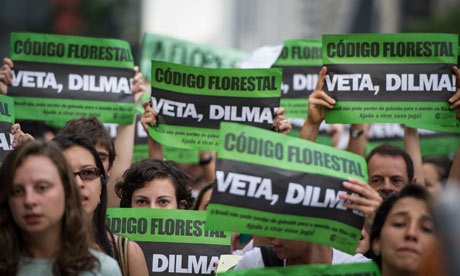
If you like online petitions (which I don't really) here's one that may be worth a look.  A bill has passed the Brazilian parliament relaxing the law on illegal logging. The petition calls on Brazil’s President Dilma Rousseff to save Brazil's precious forests by exercising her veto.

Brazilian protesters demand that president Dilma Rousseff veto a forest code approved
last month by the congress.    Photo: Yasuyoshi Chiba/AFP/Getty Images
Last month President Dilma Rousseff's party lost a vote on the law, which critics fear will unleash a wave of deforestation, by 274 votes to 184.

The result confirms the Brazilian parliament's bias for the interests of large landowners, according to Deutsche Welle, Germany's international broadcaster. It also reveals a tension within the current administration. The majority of members of the largest coalition partner, the Brazilian Democratic Movement Party (PMBD), voted for the law.  President Rousseff's Workers' Party (PT) voted almost unanimously against it.

Which is where the petition comes in.  It seems the president is both entitled to veto and politically disposed to do so, and therefore international encouragement through actions such as online petitions might just be the deciding factor. I suppose it's worth a shot anyway.

An extra factor is Rousseff's presumed desire to avoid embarrassment when she hosts the UN's Rio +20 Earth summit next month. More than 125 heads of state as well as 45,000 delegates are expected to attend the world's largest environment conference in a generation, pledging to protect forests and develop the "green economy".

The petition also urges the president “to prevent further murders of environmental activists and workers by increasing law enforcement against illegal loggers and ramping up protection for people at risk from violence or death. The world needs Brazil to be an international leader on the environment. Your strong action now will safeguard the planet for future generations.”
 
Logged Brazilian rainforest
I can't remember whether I've come across Avaaz before. It may be a site worth keeping an eye on.

Here's the story in The Guardian

Monday, May 7, 2012

Astronomy symposium venue sparks controversy

A 1610 portrait of Johannes Kepler by an unknown artist, probably in Prague.
Cork Astronomy Club went there to study his laws of planetary motion.
A Cork Astronomy Club symposium on Kepler’s laws, held recently in Prague, has given rise to divergent views.  At issue was the venue for this prestigious occasion in the astronomical calendar.  One club member who does not wish to be named said : “Holding it in Prague was an imaginative idea but the trouble was there were two many bars, and ultimately this negated the symposium’s serious purpose. Next year I think the committee should consider hiring a seminar room at UCC instead.”

Asked to recite Kepler’s three laws of planetary motion, the unnamed member said “Well actually I can only remember two of them and that more or less proves my point.”

A spokesperson for Cork Astronomy Club said: “Kepler did his most important work in Prague and we saw his house and Tycho Brahe’s tomb. But the point about all the bars is a fair one and we'll certainly give it due consideration in planning next year’s event.”

Other members praised the astronomical clock in the Old Town Square. 

Cork astronomers gather at the Prague
astronomical clock
Constructed in 1410 the clock was already nearly 200 years old when Kepler was in the city.  On the hour a figure of death pulls on a bell rope, the apostles pass by a window, and a real live trumpeter plays at the top of the tower, as shown in the video, at the end of which cheering Cork Astronomy Club members can be seen thronging the square hundreds of feet below. 


The clock displays the current zodiac sign and the Moon's phase, and tells the time in Old Bohemian Time, Sidereal Time and the Babylonian hour.

The symposium was held from 26th to 29th April.  Rumour has it that next year’s symposium will be held on an apple farm in Leicestershire and will be devoted to Isaac Newton’s law of gravitation.

After a punishing round of seminars, Cork astronomers relax in a Prague restaurant
Tomb of Danish astronomer Tycho Brahe in St Nicholas cathedral, Prague
 

Tuesday, April 17, 2012

How we colonised the night


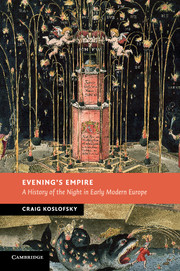
Craig Koslofsky’s book
At last! A history of night-time. Something I've long been waiting for.
It's Evening's Empire: A History of the Night in Early Modern Europe, by Craig Koslofsky, published last June.

I've often wondered how and when we adopted the habit of going to bed in the middle of the night and getting up half way through the morning. If you sleep 8 hours, then a rational arrangement of your day would surely be to retire at 8 and rise at 4. 

And it turns out that’s indeed how it was until very recently. In 1710, Richard Steele wrote in The Tatler of a visit to an old friend just come up to town from the country. Calling at 8 in the evening Steele was surprised to find his friend already gone to bed. He returned at 11 the following morning, only to be told that his friend had just sat down to dinner. “In short”, Steele commented, “I found that my old-fashioned friend religiously adhered to the example of his forefathers, and observed the same hours that had been kept in his family ever since the Conquest”.

A theme of Fanny Burney’s novel Evelina published in 1778, is the unsophisticated country girl’s surprise at fashionable London customs, which include, she finds, eating dinner “when the day is almost over”. [1]

I'll just digress here to mention the Fianna Fail politician Mark Killilea, active in the 1980’s, who considered himself as representing the plain people of Ireland, "the people who eat their dinner in the middle of the day" – a remark often quoted, nowadays normally ironically.

But my theme was night, so back to Richard Steele, writing in 1710. During the previous generation or so “nocturnalisation” had occurred: elites across Europe had moved their clocks forward by several hours. No longer a time reserved for sleep, the night was now a time of recreation for the rich and work for those who waited on them. Presumably the elites started this as they could afford the most candles. But even so, just because you can do something, doesn't mean you do it. What was the actual motive? And when did the peasants and workers follow suit?

18th century chandelier - light to rule by
And now here’s a book that tells us these things.

Two reviews: one from Times Literary Supplement and one from History Today.  

Here's a curiosity from the History Today review. It seems that in early rural communities there were two segments of sleep with a waking interval. Huh? Sounds like a siesta. That can't be right. Which was replaced in cities with a single phase of sleep. Then the schedule of the urban day slipped back: and rising, mealtimes and sleep all occurred later.

I must get hold of this book. According to other reviews I've seen it's overly academic but worth the slog.

As a postscript, Jared Diamond or someone has calculated that whereas it now costs us 5 cents for the electrical energy needed to read for an hour at night, in the 18th century an agricultural worker would have to work for two hours to afford an hour’s worth of candle and in the 12th century they would have to work for a day. I've made those figures up because I can't lay my hands on the reference. I thought it was in Jared Diamond’s Guns Germs and Steel but I've failed to locate it there.  I understand poor Saxons used rush lights (rushes dipped in animal fat).  Can't find an image of one of these.

PS Just come across another book that might cover some of the same ground: Brilliant: The Evolution of Artificial Light by Jane Brox “a sweeping history of our transformative relationship to light”. Published 2010, I think. 


[1] “Before our dinner was over yesterday Madame Duval came to tea; though it will lessen your surprise, to hear that it was near five o'clock, for we never dine till the day is almost over.” Evelina, Penguin Classics 1994, Letter XVI. An editor’s note explains that this implies dining at three-thirty or four o’clock, although eve more fashionable people had already pushed the dinner hour to 6 o’clock

Tuesday, April 10, 2012

Why my Swedish great uncle is remembered at Tower Hill


Tower Hill Memorial, London, 17th February 2012
An obliging passerby took this picture of me in February at Tower Hill Memorial. This memorial, a couple of hundred yards from Tower Hill tube station, was erected in 1928, dedicated to merchant seamen who perished in the 1914-18 war. 

I went there to pay my respects to the memory my grandfather’s younger brother, Axel Vilhelm Åkerlund. In fact I could say, to be the first member of my family to be privileged to do this, for this reason. The discovery that Axel’s name is here was made only recently by my cousin Anders. My mother lived 22 years in England, and my grandfather Albert visited London in 1967, but they didn’t know about this memorial.

Axel Åkerlund was born 11 January 1897 in Luleå. This port at the top of the Baltic Sea is where my mother and Anders’s were brought up. Their sister Kerstin lives there still.  The family knew that Axel perished in 1917 on a British ship, but details were sparse until Anders’ recent research, which began in the archives of Luleå's cathedral and in the port's merchant marine office.

It turns out that Axel served on several Swedish merchant ships, a Russian ship and finally a British one: SS La Blanca, which was torpedoed in the English Channel on 23 November 1917. 

More in these pdf files.  Axel’s life and death at sea summarises what's known of his life as a seaman and his final voyage. Evidence for how he joined La Blanca and how the ship came to be sunk are to be found in the Agreement and Account of Crew and in a House of Lords debate in December 1917.

Axel Vilhelm Åkerlund, 1897 to 1917
Studio portrait by a Luleå photographer
Undated but perhaps taken in September 1914
The portrait of Axel has come down through one of Albert’s sisters, Berta (that would be a great aunt to me). Possibly taken when his ship (SS Torne) was loading iron ore in Luleå, with copies given to his three sisters and to Albert.

At Tower Hill Memorial

Bronze plates with the sailors’ names in relief cover the memorial’s pillars.  12 thousand names in all, according to Wikipedia. They are in alphabetical order by name of ship. La Blanca comes at the top of one list on Pillar 10. The ships in this list are:-.

La Blanca, Liverpool – 2 names: Akerlund A. & Stowe J. J.
Laconia, Liverpool – 6 names
Lodoga, Leith – 25 names (about)
Lady Ann, Sunderland - 11 names
Lady Helen, Sunderland – 6 names
Lady Ninian, Cardiff – 1 name
Lady Salisbury, London – 3 names
Laertes, Liverpool – 14 names
Lake Michigan, Liverpool – 1 name
Lampada, London – 5 names
Landonia, London – 15 names

Just around the corner of pillar 10 you come to Lusitania.

Being at the very top, La Blanca is hard to see from the ground, but I was helped by a photo that Anders had supplied.  As I stared up at the top of the pillar, avoiding being blinded by the sun which was right behind it,  and my eyes got accustomed to the light, I was at length able to make out my grandfather’s brother’s name - Akerlund A.

As a final detail, the U-boat commander was Heinrich Jeß and he lived a long life.

I'll close with the digression that my cousin’s husband Tom did research for his father who was on an American merchant ship that was sunk by a German torpedo during the Second World War.  He learnt that crew members from the American ship and German U-boat met up at several reunions in Germany in their old age.