Thursday, December 8, 2011

Bosses pay too high? Then move to Cuba!


A report has suggested that workers representatives should sit on company remuneration committees. But the idea is barking mad and if that’s what you think you should move to Cuba. So said Heather McGregor of executive recruitment firm Taylor Bennett on the BBC.

Deborah Hargreaves
chair of the High Pay Commission
McGregor was on the Today Programme interviewed by John Humphrys on 22nd November, the day the report was released. It’s good knockabout stuff. McGregor says there is no such thing as too much, or too little for that matter, and that the concept of fairness is for 7-year olds. While the High Pay Commission’s Deborah Hargreaves reveals that in the past 30 years we have seen the ratio between company directors and average pay stretch from a multiple of around 13 to over 100.

The background is a year long inquiry into boardroom pay which has found that excessive deals for the UK's top bosses is having a corrosive effect on the economy, for companies as well as society as a whole.

The High Pay Commission was set up by the mildly leftwing think tank Compass. Their report argues that, left unchecked, income inequality will be back at Victorian levels before long. One of the drivers of this is the runaway train of boardroom pay. Despite the financial crisis, executive pay has continued to grow at levels far in excess of inflation.

It's an argument very much in line with The Spirit Level , a must-read book that produces a wealth of evidence that inequality (not merely absolute poverty) causes shorter, unhealthier and unhappier lives, whilst functioning as a driver of consumption and depleting the planet's resources.

Links

Here's a Guardian podcast where Deborah Hargreaves discusses her report with Guardian city editor Jill Treanor.

High Pay Commission

Heather McGregor's company

Tuesday, December 6, 2011

Christina Rossetti - Remember

.

Remember me when I am gone away,
         Gone far away into the silent land;
         When you can no more hold me by the hand,
Nor I half turn to go yet turning stay.
Remember me when no more day by day
         You tell me of our future that you plann'd:
         Only remember me; you understand
It will be late to counsel then or pray.
Yet if you should forget me for a while
         And afterwards remember, do not grieve:
         For if the darkness and corruption leave
         A vestige of the thoughts that once I had,
Better by far you should forget and smile
         Than that you should remember and be sad.

By Christina Rossetti 1850, when age 19, first publication date 1862

Here's Eleanor Bron reading it. Brilliant.


Christina Rossetti - Remember by poetictouch

Christina Rossetti was the subject of BBC Radio 4’s In Our Time on 1st December. Massive respect to Melvyn Bragg for devising the In Our Time format, but is it time he went? In this episode he's slightly annoying, chuckling at in-jokes that none of us understand.

Download the episode at this page; and for the contributors, blurb and further links go here.

Eleanor Bron

Sunday, December 4, 2011

I muse on Frankenstein and his monster


€1 in Mitchelstown on 28th Nov

Whiling away a spare half hour before my bus to Cork last week, l bought a battered copy of Mary Shelley’s Frankenstein in a charity shop. I decided to familiarise myself with this iconic work.

Here's what happens. The young Swiss Victor Frankenstein growing up in Geneva develops a passion for natural philosophy and chemistry and enrols as a student at the university. There he becomes consumed by the desire to discover the secret of life and after several years of research, attains the knowledge he seeks.

For months he feverishly and clandestinely fashions a creature out of old body parts and strange chemicals. One climactic night, he brings his creation to life. But the monstrosity he has made horrifies him. He flees the scene.  Sickened by his disgusting deed he falls dangerously ill. 

On recovery he returns to Geneva, to his family, and he hopes, to his old life. But the monster dogs his steps, and over the course of the book commits four murders. The first of these is Victor Frankenstein’s little brother. The second is when the monster cleverly contrives a miscarriage of justice so that the kind, gentle Justine, a sort of adopted cousin, is tried for the murder, condemned, and executed,

Only Victor knows of the monster’s existence, which he dare not divulge.

Overcome by grief and remorse, he flees to the Alps. Here the monster (sometimes called a dæmon, sometimes a fiend) tracks him down, and here we would expect the monster to kill him, end of book. But no, the monster whilst admitting to the murders, begs for understanding.

It emerges that the monster has previously attempted to befriend human kind but has been rebuffed due his hideous appearance, and so travels at night and hides in dark places, seeking revenge on Frankenstein. Lonely, shunned, and forlorn, he says that he struck out at Victor’s little brother in a desperate attempt to injure Victor, his cruel creator. The monster begs Victor to create a mate for him, a female monster equally grotesque, to serve as his sole companion.

Creating another monster

Appalled at the prospect of creating a second monster Victor at first refuses. But the monster is eloquent and persuasive, and eventually Victor is convinced.

After many delays (reminiscent of Hamlet, perhaps) Victor secludes himself on a desolate island in Orkney and reluctantly works at his ghastly task. One night, consumed by doubts about the morality of his actions, Victor perceives the monster glaring in at him through a window with a horrid grin. Alive for the first time to the awful consequences of his work, Victor destroys his new creation.

Whereupon the enraged monster vows revenge, and swears that he will be with Victor on his wedding night.  After more adventures, and another murder (of Victor’s friend Henry) Victor returns home to Geneva, where he marries his cousin and childhood sweetheart Elizabeth. Whom, true to his word, the monster murders on their wedding night.

Like Moby Dick

Vowing to devote the rest of his life to finding the monster and exacting his revenge, Victor tracks him ever northward into the arctic ice. His obsessive pursuit puts one in mind of Captain Ahab pursuing the great white whale, a parallel Melville surely had very much in mind.

In a dogsled chase, Victor almost catches up with the monster, but the sea beneath them swells and the ice breaks, leaving an unbridgeable gap between them. At this critical moment, Victor Frankenstein is saved by the crew of an arctic exploration vessel, but after some days expires of exhaustion. Not however before he has told the ship's captain Walton his entire story.

Later Walton is startled to find the monster weeping over Victor’s body. To Walton the monster confides his immense solitude, suffering, hatred, and remorse. He asserts that now his creator is dead, he too can end his suffering. The monster then departs for the northernmost ice to die.

I've put an edited version of the book’s last four pages in this pdf file.

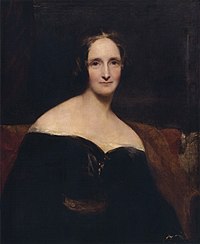
Mary Shelley (née Mary Wollstonecraft Godwin)
1797–1851
Nested narratives

The novel’s structure is the nested narrative, like the Arabian Nights. The arctic explorer Walton’s letters to his sister back in England envelop the entire tale. Victor’s story fits inside Walton’s letters. The monster’s story fits inside Victor’s. And there's more nesting that I won't go into here.

Who is most monstrous?

Eight feet tall and hideously ugly, the monster is rejected by society. His monstrosity resides not only in his grotesque appearance but also from the unnatural manner of his creation.  One commentary I've seen suggests that there are a number of monstrous entities in the novel, of which the monster is only the most literal.

There's the dangerous knowledge that Victor employs to create the monster. And then there's Victor himself - is he a kind of monster. Ordinary on the outside, his ambition, secrecy, and selfishness alienate him from human society, and at last he's consumed by obsessive hatred of his creation.

Finally (it says here), many critics have described the novel itself as monstrous, a stitched-together combination of different voices, texts, and tenses (see nesting above.)

A classic

Mary Shelley was only 18 when she wrote it, and in some places it shows.  But what an achievement. As a metaphor for responsibility in science it’s unrivalled, although doubtless often used carelessly by people who, like me until last week, haven’t read the book. If you are so minded, you can also read a Marxist metaphor into it: Frankenstein the capitalist system, the monster the working class that capitalism summons into existence.  These metaphors are not Mary Shelley's own of course. But they are there to be read, and they are why the book is a classic.

The book’s subtitle is A Modern Prometheus, in reference to the ancient Greek myth that the god Prometheus was assigned the task of creating mankind.

I googled some images to spice this post up a bit but none were satisfactory. I wonder if any of the film versions do it justice. I've not seen any, but I speculate that the answer is no. I suspect it's a book that should remain as a book. This Wikipedia link is to Frankenstein in popular culture.

Wednesday, November 30, 2011

Solidarity with all on strike in the UK today


A picket at a York hospital this morning (York Press)


Public service workers are not asking for more – they just want the pension benefits they signed up for to stand.


The 19th century black anti-slavery campaigner Frederick Douglass said:-


"Find out just what the people will submit to and you have found out the exact amount of injustice and wrong which will be imposed upon them."

Friday, November 25, 2011

Lowest common denominator ban declared


Tahrir Square, 24th Nov. An injured protester wakes up.
Photograph: Tara Todras-Whitehill/AP
Any decent revolution comes in two stages roughly eight months apart, and now that Egypt is in the throes of stage 2, I'm looking at what was written earlier in the year. And I find this in The Guardian of 12th August, under the heading "The Arab Spring's Bottom Line", by Khaled Diab.

He asks why the Arab spring concentrated on political reforms, without addressing economic injustice. The strapline to his article is “You can have all the democracy in the world, but without addressing economic injustice, reforms will be hollow”.

In Egypt and Tunisia trade unions and workers were a vital driving force behind the protests, holding regular strikes and sit-ins, Diab writes. Even the 6 April youth movement, which called for the first protest of the Egyptian revolution on 25 January, was originally set up to express solidarity with textile workers. So why have demands for social justice been sidelined?

One reason, he suggests, is that in order to topple the old order, the Tunisian and Egyptian popular uprisings needed to appeal to all strata of society – young and old, rich and poor, socialist and conservative. To do this they focused on the lowest common denominator: regime change, the creation of a level political playing field and the protection of human rights.

But incompatible class interests meant that on economic issues such as pay and workers rights, there could be no consensus about how to proceed; so the once-united opposition splintered into political factions.

You can read the article here.

At this juncture I must come clean and confess I've been toying with you. This post isn’t actually about politics, it’s a rant in defence of mathematics, and against the persistent abuse of a particular mathematical term, the "lowest common denominator".

9/11 sensationalism

But first, another example. It’s a reader's letter in the London Independent on 6th September, about the glut of media commemoration of the tenth anniversary of the 9/11 attacks.

The letter is from one Paul Harper who notes with considerable disappointment that The Independent has joined the rest of the media in commemorating the anniversary by what he calls “mindless wallowing”. A time for dignified reflection on the causes and effects of 9/11 has been squandered in favour of “sensationalist ratings-grabbing specials. It is lowest common denominator bottom-feeding journalism feeding off crocodile tears of fake emotion. … The media should be ashamed of itself.”

Now I ask: what do Khaled Diab and Paul Harper mean with this expression "lowest common denominator"?

In the piece about the Arab Spring, it appears to mean something like “the only issue shared by the disparate opposition groups and classes”. (I'll return to this example at the end).

In the letter about the 9/11 commemorations, it appears to mean something like “the lowest of the low”; little more than a piece of vulgar abuse, in fact.

An elegant mathematical procedure

I wonder if they teach finding the lowest common denominator in school maths these days. It’s a device you need when adding or subtracting fractions. Suppose you want to do the following sum:-

4/15 + 5/9

Outside of a classroom it’s actually quite unlikely that you would want to do this, you would express the amounts as decimals instead. But just as a mental exercise, say we do wish to add 4/15 and 5/9, how do we do it? We express both fractions with a common denominator; preferably the lowest common denominator.

This will neatly lead you to the answer, which is 37/45.

In this answer, 45 is the lowest common denominator. It’s an elegant procedure, and it's all in this pdf file in case you want to see how it works.

My point at the moment is this.

How, exactly, is this piece of maths connected to the phrase "lowest common denominator" as used by journalists, politicians, business pundits and letters to the editor? Do these people understand the above procedure?

I suspect they do not.

Moreover, suppose we skip the maths, and just for the time being take my word for it that 45 actually is the lowest common denominator of 4/15 and 5/9. What do we notice about this number 45?

That it's larger than any number we started with. So the lowest common denominator isn't even a low number. It’s a high number. Hah!

Moreover the lowest common denominator is also the best common denominator. Other common denominators can be used, but none is as neat as the lowest common denominator.

Yet those who employ the phrase lazily convey the impression that the lowest common denominator is a riffraff number, a base, degraded species of entity.

Anathema

Consequently I declare "lowest common denominator" the third most annoying expression in the English language, I anathematise it and ban it altogether.

For an epilogue, let me just return to my first example, from The Guardian. Whilst in most instances I've come across, "lowest common denominator" is used lazily, often (as in the readers letter about 9/11) as a stand-in for vulgar abuse, such may not be the case here.

In the piece about the Arab Spring, we've noted that "lowest common denominator" appears to mean something like “the only issue shared by the disparate opposition groups and classes”. I thinks it’s fair to deduce therefore that the writer, Khaled Diab, does perhaps have in mind the phrase's actual mathematical meaning. If he's genuinely keen on a mathematical metaphor, then I would suggest the apt one to use is highest common factor. (As in 15 is the highest common factor of 30 and 45).

Thus he could have written “To do this they focused on their highest common factor: regime change, the creation of a level political playing field and the protection of human rights.” I don’t necessarily recommend this. But it works a whole lot better than lowest common denominator.

I could multiply examples but it would become tedious. Woody Allen is fond of using “lowest common denominator” about Hollywood, and I've found an example in the writing of Tony Cliff, late guru of the SWP. See this pdf file if interested.

Tuesday, November 22, 2011

An Irish solution to an Irish problem


Ajai Chopra, an embarrassed axeman
I must be slow on the uptake as I've only just grasped that whenever this cliché of Irish journalism is used, it is with ironic intent.

Back in April (how did I miss this one?) IMF axeman Ajai Chopra, discomforted himself by using the phrase when addressing a press conference to spin the bailout as good for Ireland.

Here's how the Irish Independent made sport with the innocent Mr Chopra on Saturday April 16th under the headline “Chopra's cock-up leaves him open to having the Michael extracted”.

Maybe Ajai Chopra had read or heard the phrase somewhere, and thought it had an elegant, simple ring to it. Moreover, it sounded sort of complimentary, and the IMF bigwig is a very polite pooh bah anyway.

And it's a tough task trying to convince the beleaguered citizenry of Ireland that the bailout is a Good Thing and doesn't represent the overthrow of democracy, and sure not to worry as we'll get our sovereignty back in a few years.

And so Ajai carefully explained it to the rows of media crammed into the Troika's press conference.

"This programme is a lifeline for Ireland," he said in his slightly plummy accent. And then he paused before delivering his new soundbite.

"It represents an Irish solution to Irish problems."

He looked a bit perplexed as titters and sniggers and chuckles rose from the locals massed in front of him.

Read the whole article

What Mr Chopra didn’t know, and nor did I but I do now, and so I guess does he, is that this term is associated with condoms.

And with any official response to a controversial issue that is timid, half-baked, expedient, an unsatisfactory compromise that sidesteps the fundamental issue.

Charlie Haughey - unembarrassed
For this state of linguistic affairs we have Charlie Haughey to thank. In 1979 when health minister, he proclaimed his family planning Bill as an “Irish solution to an Irish problem”.

The Irish problem was that it was illegal to import contraceptives into Ireland but legal to use them.

Illegal to import, due to a 1935 law which had been written to conform to Catholic teaching.

Legal to use, due to campaigning by the Irish Women’s Liberation Movement (IWLM), their 1971 “Contraceptive Train”, and a 1973 landmark legal case.

The Irish solution was to introduce an Act which laid down that contraceptives would only be available from pharmacies on the presentation of a valid doctor’s prescription. It did not say that the person receiving the contraceptive had to be married; only that “the person is seeking the contraceptive, bona fide, for family planning purposes”.

For more about the Irish Womens Liberation Movement and the Contraceptive Train, here's a personal account from Mary Maher, a journalist with The Irish Times, and a founder member of the IWLM. The link includes a report from the Irish Times archives on the contraceptive train.

This pdf file contains some historical background to Charlie Haughey’s Irish solution remark.

I've also posted about Garret Fitzgerald's input into these matters.

By the way, the Irish Independent article concludes:

On reflection, perhaps Ajai's use of the phrase "an Irish solution to an Irish problem" was particularly apt. Sure the country is screwed anyway.

Thursday, November 17, 2011

Of Swedes and turnips


A swede
Here’s a tasty dish I enjoyed while staying with my cousin in Stockholm last week. Root vegetable gratin. Various root veg including potatoes, carrots, swede, turnip, also celery, onions, leeks. Slice thin and bake with cream and a vegetable stock cube in a shallow dish.

The conversation at table turned to the English word swede, and whether it’s connected in any way with Sweden. Such has occasionally been suggested to me in a spirit of fun, but I had always supposed that the similarity between the name of my mother’s native land and a big turnip was mere coincidence.

Not so, it seems. My Shorter Oxford Dictionary tells me that Swede has the following three meanings:

(1) a native of Sweden (first use 1614)
(2) a Swedish ship (rare, first use 1799) and
(3) a large variety of turnip with yellow flesh introduced from Sweden in 1781-2 (first use 1812, earlier known as Swedish turnip).

So “carrots, swede, turnip” is incorrect. It ought to be “carrots, Swede, turnip”.  However since I write “rugby ball” and not “Rugby ball” I'll stick to swede for what I eat and Swede for what I half am.

Harvesting swedes
If the date of introduction, 1781-2, is right that would fit in with the 18th century agricultural improvement drive in Britain. But Wikipedia suggests an earlier date.

The swede originated as a cross between the cabbage and the turnip, something that would I imagine be readily apparent to anyone that’s actually grown them, which I haven’t. The Swedish for swede is kålrot (cabbage root).

Wikipedia says that in North America the common term for the plant is “rutabaga”, derived from the old Swedish word “rotabagge”, root bag.

(Subsequent note 19th Nov. I cooked the dish last night but not a complete success. I thought crème fraisch might be a good idea but it wasn't. More liquid needed, and a slow oven.)